

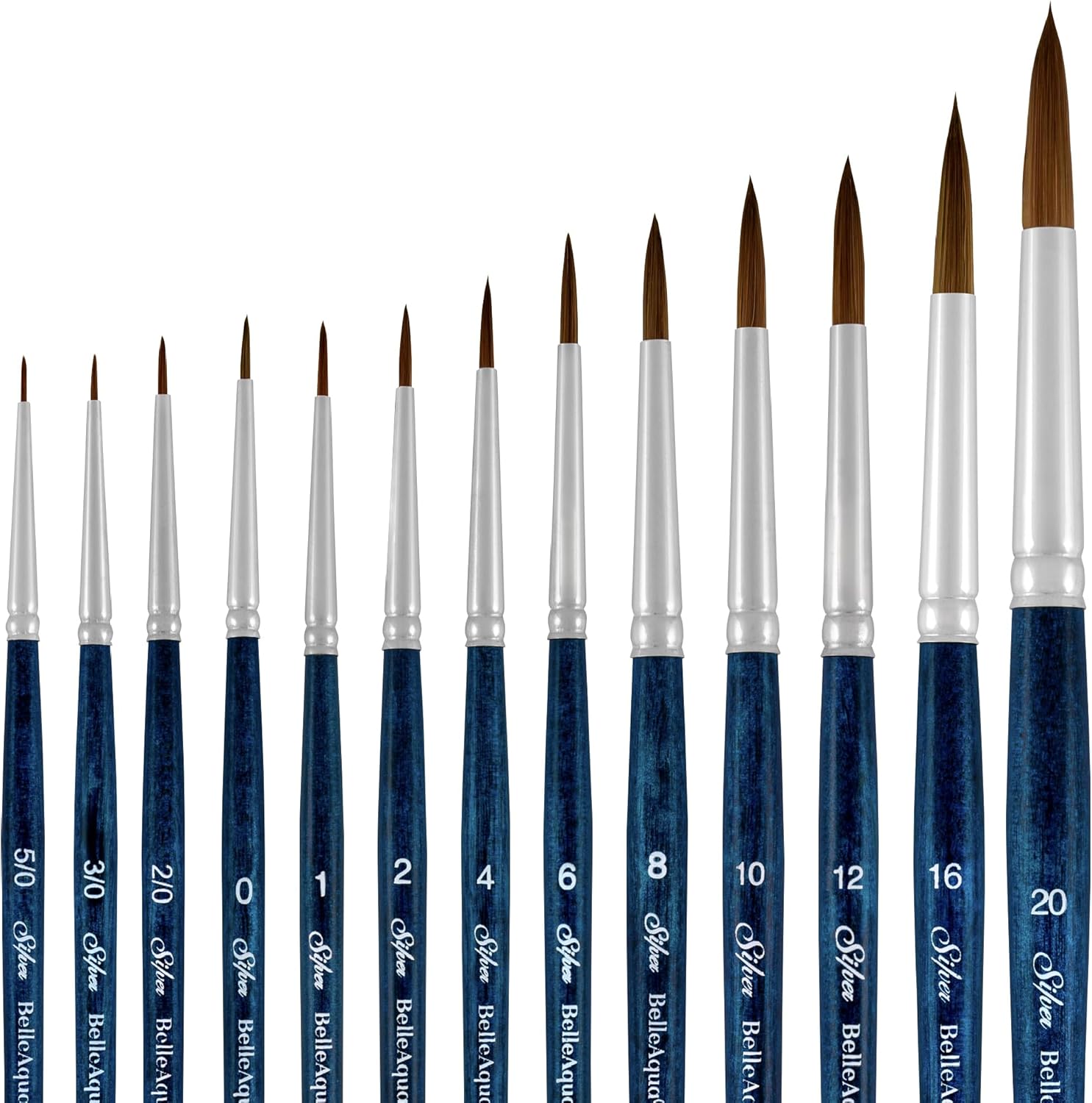
- Complete 13-Piece Professional Round Watercolor Brush Collection: Includes thirteen round brush sizes ranging from ultra-fine 5/0 to large size 20, supporting detailed illustrations, expressive brushwork, and broad watercolor washes.
- Premium Synthetic Red Sable Fibers With Excellent Spring: Features soft yet resilient synthetic filaments designed to maintain fine points, respond to brush pressure, and provide controlled watercolor application.
- High Water and Pigment Retention for Smooth Painting: Designed to carry generous amounts of diluted watercolor pigment, reducing frequent palette reloading during washes, blending, and larger painting passages.
- Versatile Round Brush Shapes for Detailed and Broad Strokes: Supports delicate botanical details, fine lines, floral illustrations, controlled color lifting, and larger expressive strokes using different brush sizes.
- - Short Lacquered Handles With Corrosion-Resistant Metal Ferrules: Combines comfortable tabletop painting control with durable construction, making the brushes suitable for professional watercolor, gouache, and mixed-media techniques.

The BelleAqua Wet and Wild Set Offers the Kind of Brush Control Professional Watercolor Artists Actually Need
The Silver Brush Limited BelleAqua Wet and Wild Watercolor Brush Set is a professional 13-piece collection designed for artists who need reliable brush control, generous pigment retention, and different round brush sizes for detailed and expressive painting. The BA-2750S set includes sizes 5/0, 3/0, 2/0, 0, 1, 2, 4, 6, 8, 10, 12, 16, and 20. For anyone researching the best watercolor brushes for professionals, this range provides considerable flexibility without requiring several unrelated brush collections.
Every brush uses soft synthetic filaments designed to imitate the handling characteristics of natural red sable. Silver Brush Limited emphasizes water absorption, spring, and the ability to maintain a fine point during painting. The professional synthetic watercolor brushes with responsive spring are particularly useful when an artist needs to alternate between delicate details and broader watercolor applications.
The brushes also feature short aqua blue lacquered handles and corrosion-resistant metal ferrules. Short handles are especially practical for watercolor painting at a desk, where artists frequently work close to the paper. The collection is intended primarily for watercolor and gouache, although the manufacturer also identifies liquid acrylics, inks, and dyes as compatible media.
What makes this set interesting is the selection of thirteen round brush sizes. A professional watercolorist might use a large round for an atmospheric landscape wash, a medium round for foliage, and a very small round for architectural details. Having these options within one consistent brush series can make switching between painting techniques more predictable.
The Synthetic Sable Fibers and Thirteen Brush Sizes Make a Real Difference During Painting
The most important feature of the BelleAqua Wet and Wild set is its synthetic red sable imitation. Natural sable brushes are valued for their water retention, flexibility, and ability to form precise points. The soft synthetic sable watercolor brush fibers are designed to reproduce many of these characteristics while avoiding natural animal hair.
Consider a professional watercolor artist painting a botanical illustration. The first stage may require a transparent wash across several flower petals, followed by thin lines representing veins and delicate edges. A brush that holds sufficient water while maintaining a controlled point makes this transition easier.
The BelleAqua fibers are designed to retain substantial amounts of diluted pigment. This matters because repeatedly returning to the palette can interrupt a continuous wash and introduce unwanted differences in pigment concentration. The high-capacity watercolor brushes for smooth washes can help maintain more consistent color delivery across the painting surface.
For example, someone painting a large sky gradient needs enough diluted pigment to move steadily across the paper. If the brush runs dry halfway through a stroke, the resulting wash may develop an uneven edge. A larger BelleAqua round can carry more liquid, although the actual coverage still depends on paper absorbency, brush loading, and painting speed.
The size 20 round is particularly relevant for larger watercolor passages. Its larger brush head can be used for broad washes, expressive marks, and covering substantial areas of paper. The large round watercolor brushes for landscape painting are useful when an artist wants to work quickly before a wet wash begins drying.
However, larger brushes require controlled water loading. Too much liquid can create puddles that dry unevenly, producing backruns or unwanted blooms. Professionals often remove excess water against the palette edge before applying a wash.
The medium-sized rounds, including sizes 6, 8, 10, and 12, offer a different balance between coverage and precision. These sizes are useful for painting leaves, flower petals, tree branches, and architectural forms. The versatile round watercolor brushes for detailed illustrations can produce different stroke widths depending on pressure and the amount of the brush touching the paper.
Imagine painting a tree in a landscape. A medium round can establish the main foliage shapes with broader strokes, then use its pointed tip to add smaller branches. This reduces the need to change brushes repeatedly during one section of the painting.
The smallest brushes in the collection are equally important. Sizes 5/0, 3/0, 2/0, and 0 are intended for very fine marks and controlled detail work. The ultra-fine watercolor detail brushes for professional artwork are especially useful for botanical illustration, miniature painting, and precise finishing work.
For example, a botanical artist painting a rose may need to add extremely thin lines around overlapping petals. A large brush can make these marks difficult to control, particularly when the painting is nearly complete. A small round allows the artist to work within a restricted area without disturbing surrounding details.
However, extremely small brushes hold less water and pigment than larger rounds. Attempting to paint a broad wash with a size 5/0 brush would require constant reloading and could produce uneven coverage. Choosing the appropriate brush size is therefore as important as choosing the brush quality.
Another significant characteristic is the spring of the synthetic fibers. Spring describes how effectively the brush returns toward its original shape after pressure is released. The responsive watercolor brush tips for precise strokes can help artists control changes in line thickness.
Consider someone painting long grasses in a landscape. They may begin each stroke with slightly more pressure, then gradually lift the brush to create a tapered finish. A responsive round brush helps produce this variation without requiring excessive hand movement.
Brush responsiveness is also important when painting calligraphic marks. A professional watercolorist may use the pointed tip for thin lines and the fuller brush body for broader marks. The BelleAqua round design supports these different movements within the limits of each brush size.
The synthetic filaments are also intended to maintain their shape when wet. This is useful because watercolor brushes are repeatedly saturated, rinsed, and reloaded throughout a painting session. The shape-retaining synthetic brushes for repeated watercolor painting are designed to provide consistent control under normal working conditions.
However, even high-quality brushes can lose their shape when handled incorrectly. Pressing the tip aggressively against the bottom of a water container can bend or damage the filaments. Gentle rinsing and reshaping after painting help preserve the original point.
Another practical feature is the softness of the BelleAqua fibers. Silver Brush Limited describes the series as soft enough to apply color without unnecessarily disturbing earlier layers, while retaining enough firmness for controlled color lifting. The soft watercolor brushes for transparent glazing techniques are particularly relevant to artists who build paintings through successive washes.
For example, a portrait artist may begin with a pale skin-tone wash and allow it to dry completely. A second transparent layer can then be applied to establish shadows and warmer color variations. A soft brush can help distribute the new wash without excessive abrasion, although pigment staining and paper sizing also affect whether earlier layers remain undisturbed.
Color lifting is another useful technique. When pigment remains removable, a damp brush can sometimes lift color from the paper to create highlights or soften an edge. The controlled watercolor lifting brushes for subtle corrections can be useful for adjusting reflections, cloud shapes, and botanical details.
Imagine someone painting a lake and realizing that a reflection has become too dark. A clean, slightly damp brush may help lift some pigment before the area is completely dry. The result depends on the pigment's staining properties and the paper surface, so repeated aggressive scrubbing should be avoided.
The short handles provide additional control during close-up painting. Watercolor artists frequently work on horizontal or slightly inclined surfaces, making long easel-style handles unnecessary for many techniques. The short-handle professional watercolor brushes for tabletop painting are particularly useful when working on small or medium-sized paper.
For example, someone painting detailed architectural illustrations may hold the brush relatively close to the ferrule. This can provide greater control over short movements and fine lines. A shorter handle can also be more convenient when working in a compact studio.
The aqua blue lacquered finish helps protect the wooden handles from ordinary moisture exposure. The corrosion-resistant ferrules are designed to secure the synthetic fibers while tolerating repeated rinsing. These construction details matter because watercolor brushes are frequently exposed to water during normal use.
However, corrosion resistance does not mean brushes should remain submerged in water. Leaving a brush standing in a rinse container can deform the tip and allow moisture to affect the handle or ferrule attachment. The proper cleaning routine for professional watercolor brushes is essential for maintaining their condition.
After painting, the manufacturer recommends rinsing watercolor and gouache brushes until the water runs clear. Artists should gently reshape the bristles and allow the brushes to dry horizontally. This reduces the likelihood of moisture collecting inside the ferrule.
Another advantage is compatibility with different water-based painting media. Although watercolor is the primary application, the manufacturer also recommends the brushes for gouache, liquid acrylics, inks, and dyes. The versatile synthetic brushes for watercolor and gouache may appeal to professionals who regularly combine several painting techniques.
For example, an illustrator might begin with transparent watercolor washes and then add opaque gouache highlights. Using brushes from the same collection can make the transition more convenient. However, acrylic paint should be cleaned immediately because dried acrylic can permanently damage brush fibers.
The thirteen-piece selection also makes the set suitable for professional artists working across different subject matters. Landscapes, botanical illustrations, portraits, and detailed architectural paintings require different brush sizes and stroke characteristics. Having a broad range of round brushes reduces the need to purchase individual rounds separately.
There are some limitations worth considering. The collection consists entirely of round brushes, so artists who frequently use flat washes, angular strokes, or specialized textures may still need additional brush shapes. A dedicated flat wash brush, for example, can be more efficient when covering large rectangular areas.
The set may also be more extensive than necessary for artists who regularly use only three or four brush sizes. Professionals with established brush preferences may find some sizes less frequently used. Nevertheless, the collection provides considerable flexibility for artists who want a comprehensive range of professional round watercolor brushes.
Why We Believe the BelleAqua Wet and Wild Deserves Our Number One Ranking
We placed the Silver Brush Limited BelleAqua Wet and Wild 13-Piece Set at number one among our seven selections because it combines an extensive range of round brush sizes with synthetic sable-style fibers and professional watercolor construction. Its sizes extend from the ultra-fine 5/0 to the large size 20, allowing artists to handle delicate details and broad washes within one collection. This versatility is a major reason it stands out.
The first advantage is the complete thirteen-piece professional watercolor brush selection. Artists can choose a brush according to the size and complexity of the painting rather than attempting every technique with one or two general-purpose brushes. This becomes particularly useful when working on detailed compositions.
The synthetic red sable imitation is another important reason for its ranking. The fibers are designed to provide water retention, flexibility, and responsive spring without using natural sable hair. These characteristics are especially relevant to professional watercolor techniques involving controlled washes and precise brushwork.
The collection also offers a broad range of painting applications. Larger rounds are useful for landscapes and washes, medium rounds provide versatility for ordinary painting, and smaller brushes support detailed illustration. The professional watercolor brush versatility for multiple painting techniques makes the set suitable for different artistic styles.
We also appreciate the manufacturer's emphasis on pigment retention. A brush capable of carrying sufficient diluted paint can reduce unnecessary reloading during continuous washes. This is particularly useful when working on larger watercolor paper, where timing and moisture control influence the final result.
The short lacquered handles and corrosion-resistant ferrules provide additional practical advantages. They are designed for tabletop painting and repeated exposure to watercolor materials. Proper cleaning and drying remain necessary, but the construction is appropriate for regular studio use.
There are disadvantages to consider. The set does not include flat, fan, dagger, or other specialty brush shapes, which limits its usefulness as a completely comprehensive watercolor toolkit. Artists who rely heavily on these techniques will still need additional brushes.
The thirteen-piece quantity may also be unnecessary for professionals who prefer a smaller collection of frequently used brushes. Purchasing individual BelleAqua rounds could be more economical for artists with very specific requirements. The value of the complete set depends on how many sizes the artist expects to use.
Another consideration is that synthetic fibers do not behave identically to natural sable. Some artists prefer the particular softness, water release, and handling characteristics of genuine sable brushes. The BelleAqua series provides a synthetic alternative, but individual preferences remain important.
Despite these limitations, the professional synthetic sable watercolor brushes with fine points offer a strong combination of precision and versatility. Their ability to support both broad strokes and detailed work makes them relevant to artists who regularly switch between different watercolor techniques.
The manufacturer's stated compatibility with gouache, inks, dyes, and liquid acrylics also contributes to the set's flexibility. Professional illustrators who work across multiple water-based media may appreciate this additional functionality. Appropriate cleaning is essential when changing between paint types.
Our first-place ranking reflects the breadth of the brush selection, the manufacturer's documented construction, and the range of techniques supported by the BelleAqua series. It is an editorial assessment of the product's specifications and intended applications rather than a claim of independently measured superiority over every competing brush set.
Overall, we believe the Silver Brush Limited BelleAqua Wet and Wild BA-2750S deserves its number one ranking among the best watercolor brushes for professionals. Its thirteen round brush sizes, soft synthetic red sable fibers, responsive spring, generous pigment retention, short lacquered handles, and versatile painting applications make it a compelling choice for serious watercolor artists. For professionals who want a coordinated collection capable of handling everything from delicate botanical details to broad landscape washes, this set offers an excellent combination of control, flexibility, and practical painting performance.

- Seven Professional Round Brushes for Versatile Watercolor Painting: Includes sizes 0, 2, 4, 6, 8, 10, and 12, providing useful options for fine details, botanical illustrations, controlled washes, and expressive brushwork.
- Premium Natural Squirrel and Synthetic Fiber Blend: Combines the water-holding capacity of natural squirrel hair with the responsive spring and pointed control provided by synthetic filaments.
- Generous Pigment Retention for Smooth Watercolor Washes: Features soft, full-bodied brush heads designed to carry diluted watercolor paint and reduce frequent palette reloading during longer strokes.
- Fine Point Retention for Detailed Professional Artwork: Designed to maintain precise pointed tips for delicate lines, flower petals, architectural details, and controlled watercolor glazing.
- - Short Black Lacquered Handles for Comfortable Painting Control: Provides a practical handle design for close-up tabletop watercolor painting, supported by silver-colored ferrules and coordinated professional construction.
The Black Velvet Must-Have Rounds Set Has the Water Control Professional Artists Look For
The Silver Brush Limited Black Velvet Must-Have Rounds Watercolor Brush Set is a seven-piece collection designed for artists who need excellent pigment retention, responsive brush tips, and precise control over different watercolor techniques. The WC-3207S set includes seven round brushes in sizes 0, 2, 4, 6, 8, 10, and 12. For anyone researching the best watercolor brushes for professionals, this collection offers a practical selection of brush sizes with a distinctive combination of natural squirrel hair and synthetic fibers.
The most important feature is the bristle construction. Silver Brush Limited combines natural squirrel hair, which is known for holding generous amounts of water, with black synthetic filaments that provide additional spring and point retention. The professional squirrel hair and synthetic watercolor brush blend is particularly useful when artists need both smooth color application and precise brush control.
The brushes feature short black lacquered handles with silver-colored metal ferrules. This construction is well suited to watercolor artists who paint at a desk or on a slightly inclined drawing board. The shorter handles allow the artist to work close to the paper, particularly when creating detailed botanical illustrations, portraits, and architectural paintings.
Unlike large brush collections containing several specialized shapes, this set focuses entirely on pointed rounds. That makes it particularly useful for artists who rely on round brushes for most of their painting techniques. However, professionals who regularly use flat washes or specialized brush shapes may still need additional tools.
The Squirrel Hair Blend Makes a Noticeable Difference During Watercolor Painting
The natural squirrel hair and synthetic fiber combination is the defining characteristic of the Black Velvet series. Squirrel hair is valued for its softness and ability to absorb water, while synthetic fibers provide additional resilience. The high-capacity watercolor brushes for professional painting techniques are designed to carry diluted pigment while maintaining a useful pointed shape.
Consider a watercolor artist painting a landscape with a large transparent sky wash. The artist needs enough diluted pigment to cover a substantial area before the paper begins drying unevenly. A brush with generous water retention can reduce interruptions caused by repeatedly returning to the palette.
This is particularly important when working with wet-on-wet watercolor techniques. If a brush releases too little liquid, the wash may develop dry edges before the artist finishes the passage. The excellent water retention for smooth watercolor washes can help maintain a more consistent flow of pigment across the paper.
However, high water retention also requires careful control. A brush carrying too much liquid can create puddles, backruns, or uneven pigment deposits. Professional watercolorists often adjust the brush load by touching the bristles against the palette edge before applying paint.
The size 12 round is particularly useful for broader watercolor applications. Its fuller brush head can carry more diluted pigment than the smaller rounds, making it suitable for landscapes, large flower petals, and expressive painting. The large round watercolor brush for controlled color washes provides a useful balance between coverage and pointed detail.
Imagine someone painting a mountain landscape on 300gsm cold-pressed watercolor paper. They begin with a pale blue sky wash and gradually introduce warmer colors near the horizon. Using a larger round allows them to apply broad strokes while adjusting pigment concentration throughout the wash.
The medium brushes, particularly sizes 6, 8, and 10, provide additional versatility. These sizes are useful for painting foliage, flower petals, architectural shapes, and smaller landscape elements. The versatile round watercolor brushes for detailed illustrations can create different stroke widths depending on the amount of pressure applied.
For example, a botanical artist painting a leaf may use the fuller body of a size 8 brush to establish the main green shape. The pointed tip can then help define smaller edges and variations. This reduces the need to switch brushes repeatedly during one painting section.
The smallest brushes, including sizes 0 and 2, are particularly useful for precise details. They can be used for fine lines, small dots, delicate stems, and finishing work. The fine pointed watercolor brushes for botanical painting provide greater control when working within restricted areas.
Consider someone painting a detailed flower illustration. After completing the transparent washes, they need to add thin veins and subtle outlines around overlapping petals. A small pointed round can help create these marks without disturbing large surrounding areas.
However, smaller brushes hold less pigment than larger rounds. Attempting to paint an entire background with a size 0 brush would require frequent reloading and could create uneven coverage. Choosing the correct brush size remains essential for efficient watercolor painting.
Another important characteristic is the spring provided by the synthetic fibers. Spring describes how effectively the bristles return toward their original shape after pressure is released. The responsive watercolor brush tips for precise line control are useful when artists need to vary stroke thickness.
For example, someone painting tall grasses may begin each stroke with slightly more pressure and gradually lift the brush to create a tapered finish. A responsive brush can help maintain control throughout this movement. This is particularly useful for botanical details and expressive landscape painting.
The Black Velvet brushes are also designed to maintain fine points when wet. This is important because watercolor brushes are repeatedly saturated, rinsed, and reloaded during painting. The precision pointed watercolor brushes for professional detail work can support consistent line quality when handled properly.
However, even premium brushes can lose their shape through incorrect handling. Pressing the tip against the bottom of a water container can bend or damage the fibers. Gentle rinsing and reshaping after each painting session help maintain the brush point.
The softness of the squirrel hair blend is another practical advantage. Silver Brush Limited describes the Black Velvet series as soft enough for applying transparent layers without unnecessarily disturbing earlier washes. The soft watercolor brushes for transparent glazing techniques are particularly useful when building depth through multiple layers of pigment.
Consider a portrait artist painting subtle skin tones. They may begin with a pale wash, allow it to dry, and then apply additional transparent layers to develop shadows. A soft brush can distribute the new pigment with less mechanical disturbance to the underlying layer.
However, successful glazing depends on more than brush softness. Pigment staining properties, paper sizing, drying time, and brush pressure all influence whether an earlier layer remains intact. Artists should avoid repeatedly brushing the same area while applying a glaze.
The controlled watercolor glazing for professional portrait painting benefits from a brush that carries enough liquid to distribute pigment smoothly. The Black Velvet series is designed to provide this balance. Its squirrel hair contributes softness, while the synthetic fibers provide additional control.
Color lifting is another technique supported by the brush construction. Silver Brush Limited describes the series as firm enough to lift color with gentle brushing. The watercolor lifting brushes for subtle painting corrections can be useful when adjusting highlights or softening edges.
For example, someone painting reflections on a lake may discover that a section has become too dark. A clean, slightly damp brush can sometimes lift pigment to create a lighter area. The result depends on the staining characteristics of the paint and the durability of the paper surface.
Repeated aggressive scrubbing should be avoided, particularly on soft watercolor paper. Excessive friction can damage the sizing and lift paper fibers. Professional watercolorists generally approach lifting gradually, checking the result between applications.
The seven-brush selection is also useful for artists working across different subject matters. A landscape painter may rely on sizes 8, 10, and 12 for broader forms, while a botanical illustrator may use sizes 0, 2, and 4 more frequently. The seven essential round watercolor brushes for professional artists provide flexibility without including numerous rarely used specialty shapes.
The short handles are another practical feature. Watercolor painting is commonly performed on horizontal or slightly inclined surfaces, where artists work relatively close to the paper. The short-handle watercolor brushes for controlled tabletop painting are particularly useful for precise movements.
Consider someone painting a detailed architectural illustration. They may hold the brush closer to the ferrule to control small windows, rooflines, and decorative features. A short handle can make these movements convenient, particularly when working on smaller watercolor sheets.
The black lacquered finish also gives the brushes a consistent appearance. More importantly, the lacquer helps protect the wooden handles from ordinary moisture exposure during painting. The silver-colored ferrules secure the bristle bundles to the handles.
However, watercolor brushes should not be left standing in water for extended periods. Prolonged soaking can deform the bristles and allow moisture to affect the handle or ferrule attachment. The proper cleaning and storage of professional watercolor brushes is important for preserving their condition.
After painting, the brushes should be rinsed gently until visible pigment has been removed. The bristles can then be reshaped with clean fingers and allowed to dry horizontally. Storing brushes upright after they have dried helps protect the pointed tips.
Another useful characteristic is compatibility with different water-based painting media. Silver Brush Limited recommends the Black Velvet series primarily for watercolor, but also identifies gouache, inks, and dyes as suitable applications. The versatile watercolor and gouache brushes for professional illustration can therefore support several painting methods.
For example, an illustrator may begin with transparent watercolor washes and later introduce opaque gouache highlights. Using brushes from the same collection can make this transition convenient. However, thick paint should be cleaned thoroughly to prevent pigment buildup near the ferrule.
The manufacturer also lists liquid acrylics among compatible media. Artists should exercise additional care because acrylic paint can dry permanently within the bristles. Immediate cleaning is important when using acrylic-based materials.
One limitation of the Black Velvet set is that it contains only round brushes. Professional watercolorists who frequently paint large rectangular washes may prefer a flat or oval wash brush for those applications. The round watercolor brush collection for detailed painting techniques is versatile, but it does not replace every specialized brush shape.
Another consideration is the natural squirrel hair content. Artists who prefer exclusively synthetic or animal-free brushes may find this construction unsuitable. The natural hair contributes to the brush's water retention, but it also distinguishes the set from fully synthetic alternatives.
The seven-brush quantity may also be more than necessary for artists who regularly use only two or three favorite sizes. Purchasing individual Black Velvet brushes could be more practical for someone with very specific requirements. Nevertheless, the set offers a useful range for professionals who want coordinated round brushes.
Why We Ranked the Black Velvet Must-Have Rounds Set Second Instead of First
We placed the Silver Brush Limited Black Velvet Must-Have Rounds Set at number two among our seven selections because it offers excellent watercolor-specific construction, generous pigment retention, and a practical range of seven round brush sizes. Its squirrel hair and synthetic fiber blend provides a combination of softness and responsiveness that is particularly valuable for professional painting. However, our first-ranked selection offers a broader range of brush sizes.
Our first-ranked Silver Brush Limited BelleAqua Wet and Wild BA-2750S includes thirteen round brushes ranging from size 5/0 to size 20. This provides additional options for extremely fine details and larger watercolor applications. The broader professional watercolor brush size selection contributed to its first-place position.
By comparison, the Black Velvet WC-3207S includes seven round brushes in sizes 0, 2, 4, 6, 8, 10, and 12. These sizes cover many common watercolor techniques, but the collection does not include the smallest detail brushes or largest rounds found in the BelleAqua set. Artists who regularly work on very large paintings may need additional brushes.
Another difference is the bristle material. BelleAqua uses synthetic fibers designed to imitate natural sable, while Black Velvet combines genuine squirrel hair with synthetic filaments. The natural squirrel hair and synthetic watercolor brush construction may appeal to professionals who prioritize softness and generous water retention.
The Black Velvet series also offers excellent control for transparent glazing. Its soft fibers are designed to apply color without unnecessarily disturbing previous layers. This can be particularly useful for portrait painting, botanical illustration, and layered landscape techniques.
The seven round sizes provide a practical working range. Larger brushes can handle washes and broader forms, while smaller brushes support fine lines and detailed finishing work. The professional pointed round brushes for watercolor painting make the collection suitable for several artistic styles.
One of the strongest reasons to consider Black Velvet is its pigment-carrying capacity. Natural squirrel hair can hold substantial amounts of diluted paint, reducing the need for frequent reloading. This is especially useful when painting continuous washes or working with large areas of transparent color.
The synthetic fibers provide additional spring and point retention. This combination allows the brushes to support both soft washes and controlled line work. The balanced watercolor brush flexibility and precise pointing is an important characteristic for professional artists.
However, the collection's exclusive focus on round brushes is a limitation. Artists who frequently use flat washes, angular marks, or specialized textures will still need additional brush shapes. A more varied set may be preferable for those painting styles.
The natural squirrel hair content is another consideration. While it contributes to water retention and softness, it may not suit artists who prefer animal-free painting materials. Fully synthetic alternatives can provide a more appropriate choice for those preferences.
Another disadvantage is the smaller range of included sizes compared with our first-ranked BelleAqua collection. The Black Velvet set covers many essential applications but offers fewer options at the extremes of brush size. This contributed to its second-place ranking.
However, these limitations do not indicate inferior brush quality. The Black Velvet series is specifically designed for watercolor artists and provides characteristics that some professionals may prefer over synthetic-only brushes. Its softness, pigment retention, and controlled pointing remain significant advantages.
In fact, artists who prioritize natural hair handling may reasonably prefer Black Velvet over BelleAqua. The premium squirrel blend watercolor brushes for professionals provide a distinctive painting experience that differs from fully synthetic alternatives. Personal brush preference plays an important role in professional watercolor work.
We also appreciate the coordinated seven-piece selection. Rather than including several unrelated brush shapes, the set provides a consistent family of round brushes with different sizes. This can make switching between detail work and broader painting more predictable.
The short black lacquered handles also contribute to its practical design. They are suitable for close-up tabletop painting and provide a consistent grip across the collection. The silver-colored ferrules complete the professional construction.
Its second-place ranking reflects the smaller brush-size range and more specialized natural hair construction compared with our first-ranked selection. It is not a claim that Black Velvet has been demonstrated to produce inferior watercolor results. For many professional artists, its particular combination of softness and spring may be exactly what they prefer.
Overall, we believe the Silver Brush Limited Black Velvet Must-Have Rounds WC-3207S deserves its number two ranking among the best watercolor brushes for professionals. Its seven essential round sizes, natural squirrel and synthetic fiber blend, excellent pigment retention, precise pointed tips, and short lacquered handles make it a strong choice for serious watercolor painting. For professionals who value soft brush handling, controlled glazing, and dependable detail work, this collection remains an excellent option worth considering.

- Complete 16-Piece Professional Brush Collection With Multiple Shapes: Includes round, bright, filbert, angle, liner, wash, mop, and specialty brushes for detailed illustration, watercolor washes, botanical painting, and expressive landscape techniques.
- Responsive Golden Taklon Synthetic Fibers for Controlled Painting: Features durable brown-tipped synthetic filaments designed to provide spring, consistent pigment delivery, and controlled brush movements during detailed watercolor applications.
- Specialized Large Wash and Pointed Oval Brushes: Includes a 3-inch large wash brush, 1-inch square wash brush, and 3/4-inch pointed oval for broad color application and expressive strokes.
- Precision Detail Brushes for Botanical and Architectural Artwork: Provides size 0 liner and round brushes alongside angled and filbert shapes for fine lines, delicate petals, foliage, and controlled edge work.
- - Durable Short Handles With Reinforced Metal Ferrules: Uses balanced matte teal handles and nickel-plated double-crimped brass ferrules for comfortable tabletop painting and repeated professional studio use.
The Crystal Must-Have Set Gives Professional Watercolor Artists More Than Just Round Brushes
The Silver Brush Limited Crystal Must-Have 16-Piece Brush Set is designed for artists who need different brush shapes for watercolor painting, detailed illustration, and broader color applications. The CR-6868S collection includes sixteen brushes, ranging from fine pointed rounds to a large 3-inch wash brush. For anyone researching the best watercolor brushes for professionals, its biggest advantage is the variety of techniques supported by one coordinated collection.
The brushes use durable golden synthetic filaments with distinctive brown tips. Silver Brush Limited designed these fibers to provide responsive spring, controlled pigment release, and good color retention during painting. The professional synthetic watercolor brushes with responsive spring are particularly useful for artists who need consistent handling across different brush shapes.
The collection includes round brushes in sizes 0, 4, 6, and 10, bright brushes in sizes 1 and 4, and filbert brushes in sizes 0 and 4. It also contains 1/4-inch and 1/2-inch angle brushes, a size 0 liner, a 1-inch square wash, a 3/4-inch pointed oval, a 3-inch large wash, a 3/8-inch natural mop, and a 1/4-inch filbert grass comb.
That is a substantial selection for a watercolor studio. Instead of expecting one round brush to handle every technique, artists can choose a brush specifically suited to broad washes, narrow lines, curved petals, or textured foliage. The short handles also make the collection convenient for tabletop painting and detailed work on watercolor paper.
The Different Brush Shapes Are Where This Collection Becomes Particularly Useful
The four round brushes provide the foundation of the Crystal Must-Have collection. Round brushes are among the most versatile watercolor tools because their pointed tips support fine lines while their fuller bodies can apply broader strokes. The professional round watercolor brushes for detailed painting are useful for botanical illustrations, landscapes, and controlled color applications.
Consider a professional botanical artist painting a flower arrangement. They may begin with a size 10 round to establish the larger petal shapes before switching to a size 4 for smaller details. A size 0 round can then help define thin stems and delicate edges.
The size 6 round is particularly useful for everyday watercolor painting. It provides a practical middle ground between broad color application and fine detail work. Artists who regularly paint small landscapes or floral illustrations may find themselves returning to this size frequently.
The responsive synthetic watercolor brush tips for precision are designed to return toward their original shape after pressure is released. This characteristic is commonly described as brush spring. It matters when producing tapered strokes, narrow branches, and controlled changes in line thickness.
For example, someone painting tall grasses can begin a stroke with moderate pressure and gradually lift the brush to create a thinner finish. A brush with suitable spring helps maintain control during that movement. Excessive pressure, however, can flatten the bristles and make the resulting marks less predictable.
The bright brushes provide a different painting experience. Unlike pointed rounds, bright brushes have relatively short, flat bristles with squared ends. The flat bright watercolor brushes for geometric shapes are useful when creating controlled rectangular marks, architectural details, and defined edges.
Imagine an artist painting a watercolor illustration of a city street. Windows, doorframes, and building edges often require straight marks that are difficult to produce consistently with a pointed round. A bright brush can simplify these shapes by using its flat edge.
The set includes bright brushes in sizes 1 and 4. These smaller flat brushes are particularly useful for controlled marks rather than covering large backgrounds. They can also help apply short, concentrated strokes when developing shadows or geometric forms.
The filbert brushes introduce another useful shape. Their rounded edges allow artists to create softer, curved marks without the sharp corners associated with traditional flat brushes. The soft filbert watercolor brushes for natural shapes are particularly useful for flower petals, leaves, and rounded landscape details.
Consider someone painting a collection of roses. A filbert brush can establish curved petal shapes with relatively few movements. Changing the brush angle and pressure allows the artist to vary the appearance of each mark.
The set includes filbert sizes 0 and 4. These are useful for smaller organic forms, particularly when the painting requires controlled curves. Larger background areas may still require a wash brush or broader round.
The two angle brushes are another important feature. Their slanted bristle edges make them useful for painting diagonal lines, sharp corners, and controlled shapes. The angled watercolor brushes for precise architectural details can help artists work around edges that are difficult to reach with ordinary rounds.
For example, someone painting a building facade may need to define rooflines and angled shadows. A 1/4-inch angle brush provides a relatively narrow working edge, while the 1/2-inch version can handle broader shapes. The brush angle helps determine how much paint reaches the paper.
Angle brushes are also useful for botanical painting. A single controlled stroke can establish a pointed leaf or petal shape. However, the result depends on pigment loading and brush pressure, so practicing the movement before applying it to finished artwork is worthwhile.
The size 0 liner brush serves a more specialized purpose. Its narrow shape is intended for fine lines and elongated marks. The fine liner watercolor brush for delicate details is useful for branches, grasses, hair, and small architectural features.
Imagine painting the rigging of a sailboat in a coastal watercolor. A liner brush can help create thin, continuous marks without requiring several short strokes. The artist still needs to control water loading because excess pigment can produce uneven lines.
The large wash brushes are among the most significant additions to this collection. Silver Brush includes a 1-inch square wash brush and a 3-inch large wash brush. The large professional watercolor brushes for broad washes are particularly useful when covering substantial areas of watercolor paper.
Consider an artist painting a landscape on A3 watercolor paper. They need to apply a pale blue sky wash across the upper portion of the composition before the surface begins drying. A 3-inch wash brush can cover a larger area with fewer strokes than a small round brush.
This matters because watercolor washes can develop visible boundaries when adjacent sections dry at different rates. Working efficiently helps maintain a continuous wet edge. A properly loaded large wash brush can make this process more manageable.
However, a large brush can also introduce too much water. Excess liquid may create puddles, backruns, or uneven pigment deposits. The controlled watercolor wash application for professional landscapes requires adjusting the brush load before applying paint.
The 1-inch square wash brush is useful for smaller backgrounds and rectangular passages. It can distribute pigment across a relatively broad area while maintaining a defined edge. Its clear acrylic handle also differs from the matte teal handles used on most of the collection.
Silver Brush identifies a beveled feature on its square wash handle that can assist with certain scraping techniques and separating sheets from watercolor blocks. This provides an additional function beyond ordinary painting. Artists should use such techniques carefully to avoid damaging delicate watercolor paper.
The 3/4-inch pointed oval brush provides another option for expressive painting. Its shape supports broad, sweeping marks while retaining a more tapered profile than a conventional flat brush. The pointed oval watercolor brush for expressive strokes is useful for foliage, petals, and larger organic forms.
For example, someone painting a large tropical leaf may want to establish the main shape with a single broad movement. The pointed oval can help create a tapered end while depositing a generous amount of pigment. This can reduce the need to repeatedly correct the shape with smaller brushes.
The 3/8-inch natural mop brush is particularly useful for softening edges and applying gentle washes. Mop brushes generally have fuller heads that can carry substantial amounts of diluted pigment. The soft watercolor mop brush for delicate blending can help artists work with atmospheric transitions and subtle color variations.
Consider someone painting distant mountains. Hard edges may make the mountains appear too prominent, especially when they are intended to sit behind the main subject. A clean, damp mop brush can help soften selected edges while the paint remains workable.
However, softening requires careful timing. If the paint has dried completely, additional brushing may lift pigment or disturb the paper surface. The artist should consider the pigment's staining characteristics and the moisture remaining in the sheet.
The filbert grass comb brush is another distinctive inclusion. Its separated filament arrangement is designed to create multiple fine marks and textured effects. The specialty watercolor grass comb brush for landscapes can help produce grasses, hair-like textures, and other irregular details.
For example, someone painting a meadow may need to create numerous fine grass marks. Producing every blade individually with a liner brush can take considerable time. A grass comb brush allows several marks to be applied within one movement.
However, repeated identical strokes can make natural textures appear mechanical. Varying the brush angle, pigment concentration, and stroke direction produces more convincing results. The specialty brush is most effective when used selectively rather than across an entire painting.
The synthetic filament construction is another important characteristic. Silver Brush describes the Crystal series as having generous color retention and responsive spring. The durable golden synthetic watercolor brush fibers are designed to support repeated painting with watercolor and other compatible media.
Unlike natural squirrel hair brushes, synthetic filaments generally provide a more resilient response under pressure. This can be useful for techniques requiring firmer marks or repeated changes in stroke direction. However, synthetic and natural hair brushes have different handling characteristics, and personal preference remains important.
The Crystal brushes are also designed to resist excessive puddling and dripping during normal painting. This does not mean that the brushes automatically regulate every wash. Water loading, brush angle, and painting technique still determine how much liquid reaches the paper.
For example, someone applying a transparent glaze over an earlier watercolor layer needs enough pigment for consistent coverage without flooding the surface. The controlled pigment release for transparent watercolor glazing can help maintain a more even application. Allowing the previous layer to dry completely remains essential.
Another advantage is compatibility with several painting media. The manufacturer recommends Crystal brushes for watercolor, gouache, acrylic, inks, dyes, and other water-based applications. This makes the collection relevant to professional illustrators who regularly combine different techniques.
Consider someone producing a mixed-media botanical illustration. They may begin with transparent watercolor washes and later introduce opaque gouache details. Using brushes from the same collection can make the transition more convenient, provided the brushes are cleaned appropriately.
Acrylic paint requires particular attention because it can dry permanently within the bristles. Brushes should be cleaned promptly after acrylic painting rather than left with paint near the ferrule. The proper cleaning routine for professional synthetic watercolor brushes helps preserve their working shape.
Silver Brush recommends cleaning watercolor and gouache brushes with warm water until the rinse water runs clear. Brushes should then be laid flat to dry. Leaving them standing in water can deform the bristles and allow moisture to affect the handle or ferrule attachment.
The short matte teal handles are designed for comfortable tabletop painting. This is particularly relevant to watercolor artists who work close to the paper rather than standing at an easel. The short-handle watercolor brushes for detailed studio painting support controlled movements during illustration and smaller compositions.
The nickel-plated double-crimped brass ferrules provide another construction detail. They secure the filament bundles to the handles and are intended for repeated studio use. Nevertheless, proper cleaning and storage remain necessary to maintain brush condition.
There are limitations worth considering. A sixteen-piece collection may include several brush shapes that an individual artist rarely uses. Professionals who rely almost entirely on pointed rounds may find a smaller specialized collection more economical.
The set also includes different brush types with distinct handling characteristics. Learning to use every shape effectively requires practice. Artists should not expect a specialty brush to automatically produce convincing foliage, smooth washes, or precise architectural details without appropriate technique.
Why We Ranked the Crystal Must-Have Set Third Instead of Higher
We placed the Silver Brush Limited Crystal Must-Have CR-6868S at number three among our seven selections because it offers exceptional variety across sixteen different brushes. Its synthetic filaments, specialized shapes, and professional construction make it useful for many watercolor techniques. However, our two higher-ranked selections provide a more concentrated approach to watercolor brush performance.
Our first-ranked BelleAqua Wet and Wild BA-2750S includes thirteen round brushes ranging from extremely fine detail sizes to a large size 20. That collection emphasizes synthetic sable-style handling, water retention, and pointed brush control. The specialized professional round watercolor brush selection may appeal more directly to artists who primarily paint with rounds.
Our second-ranked Black Velvet Must-Have Rounds WC-3207S includes seven round brushes made from natural squirrel hair and synthetic fibers. That combination emphasizes softness, pigment retention, and responsive pointing. Artists who prefer traditional watercolor brush handling may find this construction particularly attractive.
By comparison, the Crystal Must-Have set focuses on versatility across different brush shapes. It includes rounds, brights, filberts, angles, liners, wash brushes, a mop, and a specialty grass comb. The sixteen-piece professional watercolor brush variety collection provides a broader selection of techniques than either of the higher-ranked round-focused sets.
This variety is the product's strongest advantage. A professional illustrator can use the same collection for botanical details, broad backgrounds, architectural shapes, and textured landscapes. Having several specialized brushes available can reduce the need to purchase additional tools separately.
The 3-inch large wash brush is particularly valuable for artists who paint larger compositions. It allows broad color application across substantial areas of paper. The 1-inch square wash and 3/4-inch pointed oval provide additional options for backgrounds and expressive shapes.
The smaller brushes also contribute to the collection's versatility. Round sizes 0, 4, 6, and 10 support ordinary painting and detail work, while the liner provides a more specialized option for narrow marks. The precision watercolor detail brushes for professional illustrations are useful when completing botanical or architectural artwork.
The synthetic filament construction is another positive feature. Silver Brush designed the Crystal series to provide spring, color retention, and controlled pigment release. These characteristics are important for artists who work with both transparent watercolor and more opaque water-based media.
However, there are disadvantages to consider. The collection's sixteen brushes may be unnecessary for professionals who consistently use only a few preferred shapes. A smaller set of premium rounds may provide better value for those artists.
The synthetic fibers also offer a different painting experience from the natural squirrel blend used in Black Velvet. Artists who prioritize exceptionally soft natural hair handling may prefer the second-ranked collection. This is a matter of brush behavior and personal technique rather than evidence of inferior construction.
Another limitation is that specialized brush shapes require familiarity. A grass comb or pointed oval can be useful, but its advantages depend on knowing how to control pigment loading, pressure, and movement. Beginners and professionals unfamiliar with these shapes may need practice before obtaining consistent results.
Nevertheless, the versatile synthetic watercolor brushes for professional mixed-media painting provide substantial flexibility. The collection supports watercolor, gouache, acrylic, inks, and other compatible painting media. This makes it particularly useful for illustrators who work across different techniques.
The short handles and reinforced ferrules also contribute to its practical design. They are appropriate for close-up painting and regular studio use. Proper cleaning and drying will help maintain the brushes over time.
Its third-place ranking reflects a preference for the specialized watercolor handling of BelleAqua and Black Velvet rather than a demonstrated weakness in the Crystal collection. Artists who need multiple brush shapes may reasonably prefer Crystal over either higher-ranked set. The best choice ultimately depends on the techniques used most frequently.
We particularly appreciate that Silver Brush includes both traditional and specialized brush shapes in one collection. The large wash brush, pointed oval, mop, and grass comb provide options that ordinary round-only sets do not offer. These additions can be useful when developing more varied watercolor compositions.
Overall, we believe the Silver Brush Limited Crystal Must-Have 16-Piece Set CR-6868S deserves its number three ranking among the best watercolor brushes for professionals. Its sixteen assorted brush shapes, responsive golden synthetic filaments, generous color retention, reinforced ferrules, and balanced short handles make it a strong choice for artists who value versatility. For professional watercolorists and illustrators who want one coordinated collection capable of handling detailed painting, broad washes, and expressive textures, the Crystal Must-Have set remains an excellent option worth considering.

- Three Professional Round Brushes for Versatile Watercolor Techniques: Includes pointed round sizes 2, 6, and 10, providing practical options for detailed illustration, medium brushwork, and broader watercolor applications.
- Premium White Toray Synthetic Fibers With Responsive Spring: Uses carefully selected synthetic filaments designed to retain fine points, respond to pressure changes, and provide controlled watercolor application.
- Compact Travel Construction With Protective Metal Caps: Features portable brush handles that protect the bristles during transportation and support professional watercolor painting away from the studio.
- Excellent Water Retention for Smooth Transparent Watercolor Washes: Soft synthetic fibers are designed to carry diluted pigment while allowing controlled release during blending, glazing, and continuous brushstrokes.
- - Handcrafted Spanish Brush Design for Professional Artists: Combines Escoda's established brushmaking methods with versatile pointed round shapes suitable for landscape painting, botanical illustration, and urban sketching.
The Escoda Perla Travel Set Is a Strong Choice for Professionals Who Paint Outside the Studio
The Escoda Perla White Toray Travel Brush Set is a three-piece collection designed for watercolor artists who want professional brush control without carrying a large painting kit. The set includes pointed round brushes in sizes 2, 6, and 10, providing a practical selection for fine details, medium-sized shapes, and broader washes. For anyone researching the best watercolor brushes for professionals, its combination of synthetic fibers and compact travel construction makes it particularly interesting.
The brushes belong to Escoda's Perla series, which uses White Toray synthetic filaments designed to provide softness, water retention, and responsive spring. These characteristics are important because professional watercolor painting requires a brush that can hold diluted pigment while maintaining enough control for precise strokes. The professional White Toray synthetic watercolor brushes are particularly useful for artists who work with transparent washes and detailed illustrations.
Another important feature is the travel construction. Each brush has a protective metal cap that can be removed and attached to the opposite end when painting, creating a longer working handle. This design protects the delicate brush tips during transportation while allowing the artist to work with a more comfortable handle length.
The set is manufactured in Spain, where Escoda has an established history of producing professional artist brushes. Its three-brush selection is deliberately compact rather than comprehensive. That makes it particularly suitable for urban sketching, outdoor landscape painting, travel journals, and artists who already own larger studio brushes.
The White Toray Fibers and Three Brush Sizes Work Well for Detailed Watercolor Painting
The most important characteristic of the Escoda Perla series is its White Toray synthetic fiber construction. Escoda uses selected synthetic filaments designed to imitate some of the handling characteristics associated with natural watercolor brush hair. The soft synthetic watercolor brushes with precise points provide a combination of flexibility and controlled movement.
Consider a professional watercolor artist painting a small landscape while traveling. They may begin with a transparent sky wash, then introduce distant mountains and smaller architectural details. A brush that maintains its point while carrying sufficient pigment can make these transitions more manageable.
The size 10 round is the largest brush included in this particular set. It is useful for medium-sized watercolor washes, broader landscape shapes, and expressive brushstrokes. The large pointed round watercolor brush for landscapes can distribute diluted pigment across a reasonable area while retaining a pointed tip for more controlled movements.
For example, someone painting a coastal scene in an A5 watercolor sketchbook may use the size 10 brush to establish the sky and sea. Its fuller brush head can carry more water than the smaller brushes, reducing the need to reload constantly. However, larger paintings may require an additional wash brush for efficient coverage.
Water retention is particularly important when painting transparent watercolor washes. If a brush runs out of pigment before completing a passage, the artist may produce an unwanted hard edge or inconsistent color transition. The water-holding synthetic watercolor brushes for smooth washes are designed to support more continuous painting.
However, water retention alone does not guarantee an even wash. Paper absorbency, pigment concentration, brush loading, and painting speed all influence the result. Professional watercolorists still need to control the amount of liquid held within the bristles.
The size 6 round provides a useful middle ground between broader painting and detailed work. It can handle flower petals, tree foliage, architectural shapes, and smaller landscape elements. The versatile medium round watercolor brush for illustrations is particularly useful when an artist wants to avoid switching brushes repeatedly.
Imagine painting a botanical illustration of a flowering branch. A size 6 brush can establish the larger leaf shapes using the fuller body of the bristles. The pointed tip can then help define smaller edges and variations within the same composition.
The size 2 round is designed for more precise painting. It is useful for fine lines, delicate stems, small architectural features, and finishing details. The fine pointed watercolor brush for botanical details gives artists greater control when working in restricted areas.
For example, someone painting an urban street scene may need to add window frames, narrow rooflines, and small figures. A size 2 brush can help produce these details without depositing excessive pigment. The smaller head is particularly useful when the surrounding washes have already dried.
However, small brushes hold less water and pigment than larger rounds. Attempting to paint a broad background with a size 2 brush would require frequent reloading and could produce uneven coverage. Selecting the correct brush size remains essential for efficient watercolor painting.
Another important characteristic is the spring of the White Toray fibers. Spring describes how effectively a brush returns toward its original shape after pressure is released. The responsive synthetic brush tips for controlled watercolor strokes are useful for creating tapered lines and varying stroke thickness.
Consider someone painting grasses along the edge of a river. They may begin each stroke with slightly more pressure and gradually lift the brush to create a narrow finish. A responsive pointed round can help maintain control throughout this movement.
The Perla series is also designed to maintain a precise point during painting. This is particularly useful for artists who alternate between broad strokes and detailed marks. The precision watercolor brush points for professional artwork can reduce the need to switch to a smaller brush for every fine detail.
For example, a size 10 round with a well-formed point may be capable of producing surprisingly narrow lines when lightly loaded. This can be useful when painting branches or small landscape features. However, the actual result depends on the condition of the brush and the artist's technique.
The softness of the synthetic fibers also makes the brushes relevant to transparent watercolor glazing. Glazing involves applying a thin layer of pigment over a previously dried wash. The soft watercolor brushes for transparent glazing techniques can help distribute color without excessive friction against the paper.
Imagine painting a landscape with several layers of atmospheric color. The first wash establishes the sky, while later glazes introduce distant hills and shadows. A soft brush helps apply these additional layers with controlled pressure.
However, successful glazing requires the earlier layer to dry completely. Repeated brushing over damp pigment can disturb the underlying wash and produce unwanted marks. Brush softness helps, but proper timing remains essential.
The travel handle construction is another major advantage. Unlike ordinary short-handle brushes, these models use removable protective caps that also function as handle extensions. The compact professional watercolor travel brushes with protective caps are designed to make transportation safer and painting more convenient.
For example, an urban sketcher may carry a small watercolor palette, an A5 sketchbook, and three brushes inside a compact bag. The protective caps help prevent the brush tips from being crushed against other supplies. This is particularly important because damaged points can make detailed painting difficult.
When painting begins, the cap can be fitted onto the opposite end of the brush. This creates a longer handle that may feel more comfortable during ordinary brushwork. The artist can then remove the extension and cover the bristles again after cleaning and drying.
The portable watercolor brush design for outdoor sketching is especially useful for artists who paint while traveling. Instead of carrying a large brush case, they can keep three essential round brushes together. This makes the set suitable for landscape studies, travel journals, and quick watercolor illustrations.
However, protective caps should not be used to store brushes while the bristles remain excessively wet. Trapped moisture can encourage deterioration of the brush assembly over time. Allowing the brushes to dry appropriately before extended storage is important.
Another advantage is the fully synthetic construction. Artists who prefer avoiding natural animal hair can use the Perla series without relying on genuine sable or squirrel brushes. The animal-free synthetic watercolor brushes for professional painting provide an alternative while maintaining a focus on water retention and responsive handling.
Escoda also uses specialized manufacturing techniques intended to improve the resilience of its brush fibers. The company emphasizes consistent point formation and brush spring across its professional ranges. These characteristics can be useful for artists who paint frequently and expect predictable brush behavior.
Proper maintenance remains important. After watercolor painting, the brushes should be rinsed gently with clean water until visible pigment has been removed. The bristles should then be reshaped and allowed to dry without resting against a hard surface.
The proper cleaning routine for synthetic watercolor brushes helps preserve the pointed tips and prevent pigment accumulation near the ferrule. Leaving brushes standing in water can deform the bristles and expose the handle assembly to unnecessary moisture. Gentle cleaning is preferable to aggressive scrubbing.
There are limitations worth considering. The collection contains only three round brushes, so artists who regularly use flat washes, angular marks, or specialty textures will need additional tools. The size 10 round may also be insufficient for covering very large watercolor sheets efficiently.
The compact travel construction is another consideration. Although convenient for outdoor painting, some artists prefer the balance and feel of conventional studio handles. The best choice depends on whether portability or a larger permanent studio setup is more important.
Why We Ranked the Escoda Perla Travel Brush Set Fourth Instead of Higher
We placed the Escoda Perla White Toray Travel Brush Set at number four among our seven selections because it provides professional watercolor handling in a particularly portable format. Its synthetic fibers, pointed round shapes, and protective travel construction make it useful for serious artists. However, the three-brush selection is less comprehensive than the larger collections ranked above it.
Our first-ranked Silver Brush Limited BelleAqua Wet and Wild set includes thirteen round brushes covering a much broader range of sizes. This provides additional options for extremely fine details and large watercolor washes. The broader professional watercolor brush size selection contributed to BelleAqua's higher position.
Our second-ranked Black Velvet Must-Have Rounds set includes seven brushes made from natural squirrel hair and synthetic fibers. That collection emphasizes softness, water retention, and pointed control. Artists who prefer natural hair handling may find Black Velvet particularly appealing.
Our third-ranked Crystal Must-Have set includes sixteen brushes with several different shapes. It offers rounds, filberts, angles, liners, wash brushes, and specialty options. The greater variety of professional watercolor brush shapes makes it suitable for a wider range of studio techniques.
By comparison, the Escoda Perla set focuses on three pointed rounds in sizes 2, 6, and 10. This selection covers many common watercolor applications but does not provide the same breadth as the larger collections. Its strongest advantage is portability rather than the number of included brushes.
The White Toray synthetic fibers are a significant reason to consider the set. They are designed to provide softness, spring, and controlled pigment delivery. The professional synthetic watercolor brushes with excellent point retention are particularly useful for artists who prioritize precision.
The protective travel caps also distinguish this collection from ordinary studio brushes. They help protect the bristles during transportation and extend the handle during painting. This makes the set especially relevant to plein air watercolor artists and urban sketchers.
There are disadvantages to consider. Three round brushes may not provide enough variety for professionals who regularly paint large backgrounds or use specialized brush shapes. An additional flat wash brush or larger round may still be necessary.
The travel design may also be less appealing to artists who rarely paint outside their studios. Conventional short-handle brushes can provide similar painting functions without requiring removable protective caps. For those artists, a larger studio-oriented collection may offer better value.
However, these limitations do not indicate inferior brush quality. Escoda's Perla series is designed for professional watercolor painting, and its White Toray fibers provide useful handling characteristics. The high-quality synthetic watercolor travel brushes for professionals remain particularly appealing when portability matters.
In fact, artists who regularly travel may reasonably prefer this set over larger collections. Carrying three carefully selected brushes can be more convenient than transporting thirteen or sixteen separate tools. The protective caps also help reduce the risk of damage during movement.
Our fourth-place ranking therefore reflects the smaller brush selection and specialized travel format rather than a demonstrated weakness in painting performance. The Escoda Perla set provides a focused collection for artists who already understand which brush sizes they use most frequently.
We particularly appreciate the balance between compact construction and professional brush handling. The size 2 supports fine details, the size 6 provides everyday versatility, and the size 10 handles broader painting passages. Together, they offer a practical working range for small and medium-sized watercolor compositions.
Overall, we believe the Escoda Perla White Toray 3-Piece Travel Brush Set deserves its number four ranking among the best watercolor brushes for professionals. Its three pointed round sizes, soft synthetic fibers, responsive spring, protective travel handles, and Spanish brushmaking construction make it a compelling choice for portable watercolor painting. For professional artists who regularly paint outdoors, travel with sketchbooks, or prefer a compact selection of dependable brushes, this set remains an excellent option worth considering.

- Watercolor Brush Design for Detailed Professional Painting: Suitable watercolor brushes can support precise illustrations, controlled brushstrokes, delicate botanical details, and carefully applied transparent washes.
- Potential Versatility for Different Watercolor Painting Techniques: Appropriate brush shapes can help artists transition between broad color application, smaller details, blending, and layered watercolor compositions.
- Controlled Water and Pigment Application for Smooth Washes: Well-constructed watercolor brushes can distribute diluted pigments consistently, helping reduce unnecessary reloading and uneven color transitions.
- Useful Brush Control for Botanical and Landscape Illustrations: Responsive bristles can help create tapered leaves, delicate stems, textured foliage, and precise architectural details.
- - Practical Addition to an Existing Professional Painting Collection: A compatible watercolor brush selection can complement specialized studio tools and support different painting subjects and techniques.
The Pinturale Arts Round Series Makes Sense for Artists Who Prefer a Focused Brush Collection
The Pinturale Arts Round Series Professional Watercolor Brush Set is an eight-piece collection designed for artists who want reliable brush control, consistent water absorption, and a practical selection of round brushes. The AA-0122 model includes eight different brush sizes, ranging from 2/0 to 12, with soft synthetic nylon bristles and a protective velvet travel pouch. For anyone researching the best watercolor brushes for professionals, this set offers an interesting balance between everyday studio painting and portable watercolor work.
The most important feature is its collection of eight round brushes. Round brushes are widely used in professional watercolor painting because their pointed heads can produce fine lines, broader strokes, and controlled changes in line thickness. The professional round watercolor brushes for versatile painting are particularly useful for artists who work on landscapes, botanical illustrations, portraits, and detailed watercolor studies.
Pinturale Arts describes the synthetic bristles as having high water absorption and controlled pigment release. These characteristics matter because watercolor painting requires careful management of moisture, especially when applying transparent washes. A brush that carries enough diluted pigment can help reduce interruptions during longer strokes.
The collection also includes a velvet pouch for carrying and protecting the brushes. This is useful for artists who regularly move between their home studio, workshops, and outdoor painting locations. Unlike larger brush collections with numerous specialty shapes, the Round Series concentrates on a smaller group of frequently used brush types.
The Eight Round Brushes Provide Useful Control for Washes, Details, and Everyday Watercolor Techniques
The eight-brush selection is the main reason this collection deserves consideration. Pinturale Arts provides sizes ranging from 2/0 to 12, covering fine detail work and larger watercolor applications. The eight professional watercolor brushes for detailed illustrations allow artists to choose a brush according to the scale of the painting.
Consider a professional botanical artist painting a collection of flowers. The initial stage may involve applying transparent washes to establish the main petal shapes. Smaller brushes can then be used for fine veins, narrow stems, and controlled finishing details.
The smallest brush sizes are particularly useful for delicate work. A 2/0 round can help produce narrow lines when properly loaded and maintained. The fine pointed watercolor brushes for botanical painting are useful when working around small shapes without disturbing surrounding areas.
For example, someone painting a detailed orchid may need to add fine lines along the petals after the initial washes have dried. A small round brush allows the artist to control the placement of each mark. Using a larger brush for these details can make the work unnecessarily difficult.
However, small brushes hold less water and pigment than larger rounds. Attempting to cover a broad background with a detail brush requires frequent reloading and can create uneven color transitions. Selecting the appropriate brush size remains important.
The medium-sized brushes provide more versatility for everyday painting. They can be used for leaves, flower petals, landscape features, and smaller architectural forms. The versatile synthetic round brushes for watercolor illustrations allow artists to create different stroke widths by changing brush pressure.
Imagine painting a tree in a landscape. A medium round brush can establish the main foliage shapes using the fuller body of the bristles. Its pointed tip can then be used to add smaller branches and irregular edges.
This reduces the need to change brushes repeatedly during one painting section. However, the quality of the result still depends on pigment concentration, brush loading, and the artist's control. A versatile brush does not eliminate the need for proper technique.
The size 12 round is particularly useful for broader watercolor applications. Its larger head can carry more diluted pigment than the smaller brushes, making it suitable for washes and expressive marks. The large round watercolor brush for smooth landscape washes is relevant when painting skies, water, and broad areas of foliage.
Consider someone painting an A4 landscape on 300gsm cold-pressed watercolor paper. They begin with a pale blue wash across the sky and gradually introduce warmer colors near the horizon. A larger round brush can help maintain a continuous application without returning to the palette after every short stroke.
Water retention is especially important during this process. If a brush runs dry before completing a passage, the wash may develop an unwanted hard edge. The high water absorption watercolor brushes for continuous painting are intended to help maintain more consistent pigment delivery.
However, carrying too much water can create different problems. Excess liquid may collect in certain areas and produce backruns or uneven drying marks. Professional watercolorists usually adjust the brush load against the palette before applying paint.
The synthetic nylon construction is another important characteristic. Pinturale Arts uses soft synthetic fibers intended to provide controlled movement and water absorption. The soft synthetic watercolor brush fibers for professional artists offer an alternative to natural sable or squirrel hair.
Synthetic bristles can be particularly useful when artists want predictable brush response. They generally provide a degree of resilience that helps the brush return toward its original shape after pressure is released. This characteristic is commonly described as spring.
For example, someone painting long grasses may begin each stroke with moderate pressure and gradually lift the brush to create a tapered finish. A responsive round brush can help maintain control during this movement. The responsive watercolor brush tips for precise line work are useful for landscape details and botanical illustrations.
Brush spring also matters when painting curved shapes. A brush that bends excessively without recovering can make controlled marks more difficult. Conversely, a brush that feels too stiff may not provide the softness required for delicate watercolor washes.
The Pinturale Arts Round Series aims to balance these characteristics through its synthetic bristle construction. However, exact spring and water-retention performance have not been independently measured against competing professional brushes. Individual handling preferences remain important.
Another useful application is transparent watercolor glazing. Glazing involves applying a thin layer of diluted pigment over an earlier wash that has dried completely. The soft watercolor brushes for controlled transparent glazing can help distribute color without excessive friction against the paper.
Consider a portrait artist developing subtle skin tones. They may begin with a pale wash and gradually add transparent layers to establish shadows and warmer color variations. A soft round brush can help control where the additional pigment is placed.
However, glazing requires careful timing. Applying another layer before the previous wash has dried can disturb the pigment and create unwanted marks. Repeated brushing over the same area may also damage the paper surface.
The controlled watercolor glazing technique for professional portraits depends on brush softness, pigment staining characteristics, and paper sizing. The brush should carry enough liquid to distribute color evenly without flooding the surface. This balance becomes easier to judge through repeated practice.
The Round Series is also suitable for wet-on-wet watercolor techniques. This involves applying pigment to a surface that is already damp, allowing colors to spread and blend. The watercolor brushes for smooth wet-on-wet blending should provide enough moisture for continuous application while allowing the artist to control the amount of paint released.
For example, someone painting a cloudy sky may dampen the paper before introducing diluted blue and gray pigments. A larger round brush can distribute color across the surface while the paper remains wet. Smaller brushes can then introduce selected details once the wash begins settling.
The main challenge is controlling the relationship between brush moisture and paper moisture. A brush containing substantially more water than the paper can create backruns. A brush that is too dry may produce harder edges than intended.
Another technique supported by round brushes is wet-on-dry painting. This involves applying pigment directly to dry watercolor paper, producing more defined edges. The precision round watercolor brushes for wet-on-dry painting are particularly useful for architectural illustrations, botanical details, and controlled shapes.
Consider an artist painting a small village scene. Rooflines, windows, and narrow shadows often require more defined boundaries than atmospheric background washes. A smaller round brush can help create these details after the surrounding paint has dried.
The pointed round shape also supports changes in stroke thickness. Light pressure allows the tip to create relatively narrow marks, while greater pressure brings more of the bristles into contact with the paper. This makes round brushes useful for both expressive painting and controlled illustration.
However, excessive pressure can damage the brush point over time. Pressing the bristles aggressively against rough paper may cause them to spread or lose their original shape. The proper brush pressure for professional watercolor painting should remain controlled throughout the stroke.
The manufacturer describes the brushes as handmade using selected materials. This includes soft synthetic bristles and wooden handles. The handcrafted watercolor brushes for regular studio use are intended to provide reliable construction for repeated painting sessions.
Handmade construction can be appealing, but it does not automatically establish superior performance. Brush quality also depends on filament selection, point formation, ferrule attachment, and manufacturing consistency. These factors influence how the brush behaves after repeated use.
The velvet carrying pouch is another practical advantage. Professional watercolor artists often transport brushes between studios, workshops, and outdoor painting locations. The portable watercolor brush set with protective velvet pouch provides a convenient way to keep the collection together.
Consider someone attending a weekend watercolor workshop. They may need to carry a compact palette, watercolor paper, water containers, and several brushes. Keeping the brushes inside one pouch reduces the likelihood of leaving individual tools behind.
The pouch can also help protect the brush handles from ordinary contact with other supplies. However, the bristles should be cleaned and dried before prolonged storage. Enclosing damp brushes can trap moisture and contribute to deterioration.
For outdoor watercolor painting, portability is particularly useful. An artist working in a park or along a coastline may not want to carry a large studio brush collection. The compact professional watercolor brushes for plein air painting provide several useful round sizes in a relatively manageable package.
For example, an urban sketcher might use a larger round for the initial building washes and a smaller brush for windows, signs, and architectural details. The same collection can support several stages of a painting. This makes the set useful for portable watercolor sketchbooks.
There are limitations to the round-only design. Artists who frequently paint large rectangular backgrounds may prefer a flat wash brush. Those who create specialized textures may also benefit from fan, dagger, or comb brushes.
The round watercolor brush collection for everyday painting techniques provides versatility, but it does not replace every professional brush shape. A dedicated wash brush can cover broad areas more efficiently. Similarly, a liner brush may be preferable for exceptionally long, continuous fine lines.
Another consideration is the difference between synthetic and natural hair brushes. Natural squirrel brushes are often valued for their softness and substantial water retention. Synthetic brushes can provide a different balance of spring, control, and durability.
Neither material is automatically better for every professional watercolor technique. Artists who prefer very soft natural hair handling may find synthetic brushes firmer than expected. Those who prioritize controlled spring may appreciate the response of synthetic filaments.
Proper maintenance is also important. After painting, brushes should be rinsed gently until visible pigment has been removed. The correct cleaning routine for synthetic watercolor brushes helps prevent pigment buildup near the ferrule and preserve the pointed bristles.
Brushes should not be left standing in water for extended periods. Prolonged soaking can deform the tips and allow moisture to affect the handle assembly. After cleaning, the bristles should be reshaped and allowed to dry appropriately.
Another common mistake is using excessive force when removing pigment. Pressing the brush repeatedly against the bottom of a water container can damage the filaments. Gentle rinsing is generally more appropriate for watercolor brushes.
For artists who work with gouache, additional cleaning may be necessary because opaque pigments can accumulate within the bristle bundle. The Round Series is primarily marketed for watercolor painting, so compatibility with other media should be checked before regular use. Acrylic paint, in particular, should never be allowed to dry inside the bristles.
The eight-brush quantity is a practical middle ground. It provides more options than a small three-brush travel collection without requiring the storage space of a sixteen-piece set. The eight-piece professional watercolor brush collection for artists may therefore appeal to painters who want a focused group of commonly used rounds.
However, professionals who already own several high-quality round brushes may not need every size included. Purchasing individual replacement brushes could be more economical for artists with very specific preferences. The value of the complete set depends on how frequently its different sizes will be used.
Why We Ranked the Pinturale Arts Round Series Fifth Instead of Higher
We placed the Pinturale Arts Round Series Professional Watercolor Brush Set at number five among our seven selections because it offers a useful combination of eight round brush sizes, synthetic bristles, and portable storage. Its focus on water absorption and controlled pigment delivery makes it relevant to serious watercolor painting. However, the higher-ranked collections provide either broader brush selections or more specialized professional constructions.
Our first-ranked Silver Brush Limited BelleAqua Wet and Wild collection includes thirteen round brushes ranging from size 5/0 to size 20. That provides a wider range of detail and wash applications. The broader professional watercolor brush size selection contributed to BelleAqua's higher position.
Our second-ranked Black Velvet Must-Have Rounds set includes seven brushes made from natural squirrel hair and synthetic fibers. This construction emphasizes softness, water retention, and controlled pointing. Artists who prefer natural hair characteristics may find that collection particularly appealing.
Our third-ranked Crystal Must-Have set includes sixteen brushes with several different shapes. It provides rounds, filberts, angles, liners, wash brushes, and specialty options. The greater variety of professional watercolor painting brush shapes makes it suitable for a wider range of techniques.
Our fourth-ranked Escoda Perla White Toray Travel Set includes three pointed round brushes in sizes 2, 6, and 10. Although smaller, that collection emphasizes compact travel construction and Escoda's established professional brushmaking approach. It may appeal more directly to artists who prioritize portability and a carefully selected group of brushes.
By comparison, Pinturale Arts offers eight round brushes spanning sizes 2/0 through 12. This provides a useful range for detailed illustrations, ordinary watercolor painting, and medium-sized washes. The versatile eight-piece round watercolor brush selection remains one of the product's strongest advantages.
The synthetic nylon bristles are another positive feature. They are designed to provide water absorption and controlled pigment flow, which are important for transparent watercolor techniques. The manufacturer also emphasizes handmade construction and resistance to unwanted bristle shedding.
However, these performance claims have not been independently verified through controlled comparisons with the higher-ranked brush sets. Professional artists may want to assess point retention, spring, and water release before relying on the brushes for demanding commissioned work. The absence of comparable independent testing is one reason for a more cautious ranking.
Another limitation is the exclusive use of round brushes. Although rounds are highly versatile, professionals who regularly use flat washes or specialty textures may need additional tools. A larger mixed-shape collection could provide greater flexibility.
The size 12 maximum is another consideration. It can handle many ordinary watercolor applications, but very large paintings may require a bigger round or dedicated wash brush. The large watercolor wash brush requirements for professional landscapes depend on paper dimensions and the amount of water used.
The velvet travel pouch is a useful addition. It allows artists to organize and transport the brushes without carrying a large case. This makes the collection particularly relevant to workshops, travel painting, and portable watercolor studies.
We also appreciate that the set includes smaller detail brushes. Professional watercolorists frequently need to switch between broad color application and precise finishing work. Having several sizes available reduces the need to purchase separate brushes for every stage of a painting.
The controlled synthetic watercolor brush performance for detailed artwork may be particularly useful for botanical artists, illustrators, and landscape painters. These disciplines frequently require tapered lines, transparent washes, and careful pigment placement. A coordinated round brush collection can support all three.
Nevertheless, professionals who prefer natural squirrel or sable hair may find the synthetic handling characteristics less suitable for their personal techniques. This is not necessarily a defect. Brush material preferences vary according to the artist's approach and desired response.
Its fifth-place ranking therefore reflects the narrower range of brush shapes and the more limited independent performance evidence compared with some established specialist collections. It does not mean that the Pinturale Arts brushes have been demonstrated to produce inferior paintings. The set still offers practical specifications for serious watercolor use.
For artists who mainly use round brushes, this collection may be more appealing than its ranking suggests. Eight sizes provide flexibility without introducing numerous specialty tools that may remain unused. The included travel pouch also supports convenient storage and transportation.
Overall, we believe the Pinturale Arts Round Series AA-0122 deserves its number five position among the best watercolor brushes for professionals. Its eight round brush sizes, soft synthetic nylon filaments, advertised water absorption, handmade construction, and protective velvet pouch provide a useful combination of painting control and portability. For watercolor artists who prefer a focused collection of synthetic round brushes for detailed illustrations, everyday studio work, and travel painting, it remains a positive option worth considering.

- Three Essential Professional Brushes for Watercolor Painting: Includes size 6 and 12 pointed rounds alongside a 1-inch square wash brush for detailed illustrations, medium strokes, and broad backgrounds.
- Premium Squirrel Hair and Synthetic Fiber Blend: Combines soft natural squirrel hair with responsive black synthetic filaments for generous water retention, precise pointing, and controlled brush movement.
- High Pigment Carrying Capacity for Smooth Washes: Designed to hold substantial diluted watercolor paint, helping artists maintain continuous strokes and reduce frequent palette reloading.
- Specialized Square Wash Brush for Large Backgrounds: Includes a 1-inch flat wash brush that supports even color application across skies, landscapes, and broad watercolor painting areas.
- - Short Black Lacquered Handles for Professional Control: Features compact handles suitable for tabletop painting, detailed brushwork, transparent glazing, and regular studio use.
The Black Velvet Basic Set Focuses on Three Brushes That Professional Watercolor Artists Actually Use
The Silver Brush Limited Black Velvet Basic Watercolor Brush Set is a three-piece collection designed for artists who want professional brush handling without purchasing a large assortment of painting tools. The WC-3201S set includes two pointed round brushes in sizes 6 and 12, together with a 1-inch square wash brush. For anyone researching the best watercolor brushes for professionals, this combination provides useful options for detailed painting, medium-sized shapes, and broader transparent washes.
The defining characteristic of the Black Velvet series is its combination of natural squirrel hair and black synthetic fibers. Squirrel hair contributes softness and water retention, while the synthetic filaments provide additional spring and control. The professional squirrel hair and synthetic watercolor brushes are particularly relevant to artists who need generous pigment capacity without sacrificing precise brush movements.
All three brushes feature short black lacquered handles intended for tabletop painting. This is practical for watercolorists who work on horizontal or slightly inclined drawing boards, particularly when creating botanical illustrations, portraits, and landscapes. The collection is also suitable for artists who prefer keeping a smaller number of frequently used brushes within reach.
What makes this set interesting is the inclusion of a square wash brush alongside two pointed rounds. Many compact watercolor brush sets focus entirely on round brushes, leaving artists to purchase a separate flat brush for larger backgrounds. The Black Velvet Basic collection addresses both types of painting within three carefully selected brush shapes.
The Squirrel Hair Blend and Square Wash Brush Make a Noticeable Difference During Painting
The most important feature of the Black Velvet Basic set is its mixed-fiber construction. Silver Brush Limited combines natural squirrel hair with synthetic filaments to achieve a balance between water retention and responsive spring. The soft watercolor brushes with excellent pigment retention are designed to carry substantial amounts of diluted paint while maintaining useful control.
Consider a professional watercolor artist painting a landscape with a large transparent sky. The artist needs enough diluted pigment to cover the working area before the paper begins drying unevenly. A brush with generous water retention can reduce interruptions caused by returning to the palette repeatedly.
This matters particularly during wet-on-wet watercolor painting. When a brush runs out of pigment halfway through a wash, the resulting color transition may become uneven. The high-capacity watercolor brushes for continuous transparent washes can help maintain more consistent paint delivery across the surface.
However, high water retention also requires careful handling. A brush carrying excessive liquid can create puddles, backruns, or unwanted blooms. Professional watercolorists usually adjust the brush load against the palette before applying pigment to the paper.
The size 12 round is the larger of the two pointed round brushes. It is useful for medium-sized washes, foliage, flower petals, and expressive landscape marks. The large pointed round watercolor brush for professional landscapes provides enough body for broader strokes while retaining a fine point for controlled details.
Imagine someone painting a mountain landscape on 300gsm cold-pressed watercolor paper. They begin by applying a pale blue wash to the sky before introducing distant mountain shapes. The size 12 round can help distribute diluted pigment while allowing the artist to vary the stroke width through pressure.
The size 6 round offers a different balance between precision and coverage. It is particularly useful for smaller shapes, botanical details, and controlled brushwork. The versatile medium round watercolor brush for illustrations can handle many ordinary painting tasks without requiring constant brush changes.
For example, a botanical artist painting a leaf may use the fuller body of the size 6 brush to establish the main green shape. The pointed tip can then help define the leaf edges and smaller details. This makes the brush useful for compositions requiring both broad and narrow marks.
Another important characteristic is the spring provided by the synthetic fibers. Spring describes how effectively the brush returns toward its original shape after pressure is released. The responsive watercolor brush tips for precise line control can help artists create tapered strokes and controlled variations in thickness.
Consider someone painting grasses along a riverbank. They may begin each stroke with moderate pressure and gradually lift the brush to create a narrow finish. A responsive pointed round helps maintain control throughout the movement.
Brush spring is also important when painting curved botanical forms. A brush that bends excessively without recovering can make controlled marks more difficult. The Black Velvet blend is intended to combine softness with enough resilience for precise brushwork.
The square wash brush is another major advantage of this collection. Its 1-inch width provides a relatively broad, flat working surface for applying diluted watercolor pigment. The professional square wash brush for smooth backgrounds is particularly useful when painting skies, water, and large areas of transparent color.
For example, someone painting a coastal landscape may need to apply a pale blue wash across the upper portion of an A4 sheet. A 1-inch square wash brush can cover more surface area per stroke than a small pointed round. This helps the artist work efficiently while maintaining a continuous wet edge.
Maintaining a wet edge is important because watercolor washes can develop visible boundaries when adjacent sections dry at different rates. A flat wash brush can help distribute pigment across broader areas with fewer interruptions. However, the final result still depends on paper absorbency, water loading, and painting speed.
The controlled flat watercolor brush for even color application is also useful when painting rectangular shapes. Architectural backgrounds, window reflections, and geometric compositions often benefit from straight brush edges. The square wash can provide more consistent coverage than attempting every shape with a pointed round.
Imagine painting a modern building with large glass windows. The artist may need to apply several rectangular washes while preserving defined boundaries. A flat brush can simplify these shapes by using its straight edge.
The square wash brush is also useful for applying clean water before a wet-on-wet technique. Dampening the paper evenly can help create smooth pigment transitions. The wide watercolor wash brush for wet-on-wet preparation allows artists to cover a reasonable area without repeatedly changing direction.
However, excessive water can cause problems before pigment is even introduced. If the paper becomes unevenly saturated, colors may spread unpredictably. The artist should inspect the surface sheen and remove unnecessary puddles before painting.
The Black Velvet brushes are also designed for transparent glazing. Glazing involves applying a thin layer of pigment over a previously dried watercolor wash. The soft squirrel blend watercolor brushes for glazing can help distribute new color without excessive friction against the earlier layer.
Consider a portrait artist developing subtle skin tones. They may begin with a pale wash and gradually add transparent layers to establish shadows and warmer color variations. A soft brush can help control these transitions while reducing unnecessary disturbance to the paper surface.
However, successful glazing requires the previous wash to dry completely. Applying additional pigment too early can disturb the underlying color and create unwanted marks. Brush softness helps, but correct timing remains essential.
The controlled watercolor glazing technique for professional portraits also depends on pigment staining properties. Some watercolor pigments lift more easily than others. Artists should avoid repeatedly brushing the same area when applying transparent layers.
Color lifting is another technique supported by the Black Velvet series. Silver Brush Limited describes the brushes as soft enough for layering but sufficiently responsive for controlled lifting. The watercolor lifting brushes for subtle painting corrections can be useful when adjusting highlights or softening selected edges.
For example, someone painting reflections on a lake may discover that one section has become too dark. A clean, slightly damp brush can sometimes lift pigment to create a lighter passage. The result depends on the pigment's staining characteristics and the paper surface.
Repeated aggressive scrubbing should be avoided, particularly on soft cotton watercolor paper. Excessive friction can damage the paper sizing and lift fibers. Professional watercolorists generally approach lifting gradually and inspect the surface between attempts.
The two round brushes also provide useful options for detailed landscape painting. The size 12 can establish broader tree shapes, while the size 6 can add smaller branches and foliage. The precision pointed watercolor brushes for landscape details allow artists to work at different scales within one composition.
For example, someone painting a forest scene may begin with broad green shapes before adding individual branches and darker shadows. Switching between the two rounds provides greater control over these stages. The square wash can then be used for larger background passages.
This combination makes the three-piece set practical for artists who prefer a simple working arrangement. Instead of selecting from a large collection of brushes, they can concentrate on a few familiar tools. The essential professional watercolor brush set for everyday painting supports several common techniques without excessive complexity.
The short handles are another useful feature. Watercolor artists frequently work close to the paper, particularly when painting small illustrations or detailed compositions. The short-handle watercolor brushes for controlled tabletop painting provide a comfortable format for these situations.
Consider someone painting a detailed architectural illustration. They may hold the size 6 round relatively close to the ferrule to control small windows and rooflines. A short handle can make these movements more convenient than a long easel-style handle.
The black lacquered finish also provides a consistent appearance across the collection. More importantly, the lacquer helps protect the wooden handles from ordinary moisture exposure during painting. The metal ferrules secure the bristle bundles to the handles.
However, watercolor brushes should not remain submerged in water for extended periods. Prolonged soaking can deform the bristles and allow moisture to affect the handle or ferrule attachment. The proper cleaning and storage of professional watercolor brushes is important for preserving their condition.
After painting, the brushes should be rinsed gently until visible pigment has been removed. The bristles can then be reshaped with clean fingers and allowed to dry horizontally. Once dry, the brushes can be stored upright or inside a suitable protective case.
The manufacturer also identifies gouache, inks, dyes, and liquid acrylics as compatible painting media. This gives the set additional versatility beyond transparent watercolor. The versatile watercolor and gouache brushes for professional illustration may appeal to artists who regularly combine different water-based techniques.
For example, an illustrator may begin with transparent watercolor washes and later introduce opaque gouache highlights. The same brush collection can support both stages, provided the brushes are cleaned appropriately. This is particularly convenient for small studio projects.
Liquid acrylics require additional care because dried acrylic can permanently damage brush fibers. Brushes should be cleaned immediately after use rather than left with paint near the ferrule. The Black Velvet series is primarily intended for watercolor-style handling, so heavy acrylic applications may not be its strongest use.
There are limitations worth considering. The collection contains only three brushes, which may be insufficient for professionals who regularly work with extremely fine details or specialized textures. A size 6 round may not replace a dedicated size 0 detail brush.
The square wash brush is useful for backgrounds, but it does not replace every specialty brush shape. Artists who frequently paint delicate grasses, intricate architectural lines, or unusual textures may need liners, riggers, or other specialized brushes.
The natural squirrel hair content is another consideration. Artists who prefer exclusively synthetic or animal-free painting materials may find this construction unsuitable. The natural hair contributes to water retention and softness, but it also distinguishes the set from fully synthetic alternatives.
Why We Ranked the Black Velvet Basic Set Sixth Instead of Higher
We placed the Silver Brush Limited Black Velvet Basic Watercolor Brush Set at number six among our seven selections because it offers excellent watercolor-specific construction but includes only three brushes. Its squirrel hair and synthetic fiber blend provides useful softness, pigment retention, and control. However, the limited selection makes it less comprehensive than the larger professional collections ranked above it.
Our first-ranked Silver Brush Limited BelleAqua Wet and Wild set includes thirteen round brushes ranging from extremely fine detail sizes to a large size 20. That provides substantially more flexibility for artists working across different painting scales. The broader professional watercolor brush size selection contributed to BelleAqua's higher position.
Our second-ranked Black Velvet Must-Have Rounds set includes seven pointed round brushes in sizes 0, 2, 4, 6, 8, 10, and 12. It uses the same general squirrel hair and synthetic fiber construction. The larger selection provides additional options for fine details and medium-sized painting tasks.
By comparison, the Black Velvet Basic set includes only sizes 6 and 12 in round brushes. Artists who regularly paint extremely small details may need to purchase additional sizes. However, the inclusion of a 1-inch square wash provides a useful capability that the seven-piece round-only set does not offer.
Our third-ranked Crystal Must-Have collection includes sixteen brushes with several different shapes. It provides rounds, filberts, angles, liners, wash brushes, and specialty tools. The greater variety of professional watercolor brush shapes makes it suitable for a wider range of studio techniques.
Our fourth-ranked Escoda Perla White Toray Travel Set includes three pointed round brushes in sizes 2, 6, and 10. Although similarly compact, that collection emphasizes portability and protective travel construction. It may be more suitable for professional artists who frequently paint outdoors.
Our fifth-ranked Pinturale Arts Round Series includes eight round brushes spanning sizes 2/0 through 12. That provides a broader selection of round sizes than the Black Velvet Basic collection. However, Pinturale Arts uses synthetic nylon rather than the natural squirrel and synthetic blend found in Black Velvet.
The premium squirrel blend watercolor brush construction remains one of the strongest reasons to consider this sixth-ranked set. The natural hair contributes softness and water retention, while the synthetic fibers provide additional spring. These characteristics are particularly useful for transparent washes and controlled brushwork.
The 1-inch square wash brush is another significant advantage. It provides a practical option for larger backgrounds and continuous color applications. Artists who regularly paint landscapes may appreciate having a dedicated flat wash brush alongside their pointed rounds.
The two round brushes also cover many everyday painting tasks. Size 12 is useful for broader shapes, while size 6 provides greater control for smaller details. The versatile professional watercolor brush combination for everyday painting supports several common techniques within a compact collection.
However, there are disadvantages to consider. Three brushes may not provide enough variety for artists who work across many different subjects and painting styles. Professionals may still need additional detail brushes, larger wash brushes, or specialty shapes.
The natural squirrel hair construction may also be unsuitable for artists who prefer animal-free materials. Fully synthetic alternatives can provide a more appropriate option for those preferences. This is a material consideration rather than evidence of inferior painting performance.
Another limitation is that the set may not offer the same convenience as a larger coordinated collection. Artists who frequently switch between multiple brush sizes may need to purchase additional Black Velvet brushes individually. This can increase the overall cost of building a complete professional watercolor toolkit.
Nevertheless, the professional watercolor brush performance for transparent washes remains a compelling feature. Black Velvet brushes are designed to carry substantial amounts of pigment while maintaining controlled pointing. These characteristics are important for serious watercolor painting.
The short lacquered handles also contribute to practical studio use. They provide a familiar working format for artists who paint at a desk or drawing board. Proper cleaning and drying can help preserve the brushes over time.
Its sixth-place ranking therefore reflects the limited number of included brushes rather than a demonstrated weakness in construction or painting performance. Artists who already own specialized brushes may find that this three-piece collection provides exactly the additional tools they need.
In fact, someone who primarily paints landscapes may prefer this set over a larger collection containing numerous detail brushes. The square wash can handle backgrounds, while the two rounds support foliage, architecture, and smaller forms. The focused watercolor brush selection for professional landscape artists can be practical when a compact working setup is preferred.
We also appreciate that the set combines two different brush shapes rather than offering three nearly identical rounds. This provides a useful distinction between broad wash application and pointed detail work. The natural squirrel and synthetic fiber blend further supports controlled watercolor handling.
Overall, we believe the Silver Brush Limited Black Velvet Basic WC-3201S deserves its number six ranking among the best watercolor brushes for professionals. Although its three-piece selection is less comprehensive than our higher-ranked collections, the combination of size 6 and 12 pointed rounds, a 1-inch square wash, premium squirrel and synthetic fibers, generous pigment retention, and short lacquered handles makes it a strong option for serious watercolor artists. For professionals who want a compact collection of dependable brushes for transparent washes, detailed illustrations, and everyday studio painting, the Black Velvet Basic set remains an excellent choice worth considering.

- Professional Synthetic Fibers for Controlled Watercolor Painting: Suitable synthetic bristles can provide responsive spring and precise pigment application for detailed watercolor illustrations and everyday painting techniques.
- Potential Fine Point Control for Detailed Artwork: Properly constructed watercolor brushes can support delicate botanical lines, architectural details, tapered strokes, and controlled finishing work.
- Water and Pigment Handling for Transparent Watercolor Washes: Quality synthetic watercolor fibers can carry diluted pigments and distribute color smoothly when the brush is correctly loaded.
- Versatile Applications Across Professional Watercolor Techniques: Appropriate brush shapes can support transparent glazing, wet-on-wet painting, wet-on-dry details, and expressive watercolor compositions.
- - Established Professional Brushmaking Brand With Synthetic Options: Escoda produces several professional synthetic brush ranges, offering artists alternatives to natural sable and squirrel hair.
Escoda's Synthetic Watercolor Brushes Are Worth Considering for Artists Who Prioritize Control
The Escoda Professional Synthetic Watercolor Brush product listed under ASIN B0DL78NXCG takes seventh place in our comparison of the best watercolor brushes for professionals. Escoda is an established Spanish brush manufacturer known for producing specialized watercolor brushes using different synthetic filament technologies. Although the exact series and brush configuration of this Amazon listing could not be confirmed, the brand's professional synthetic ranges provide useful context for understanding what artists should expect from this category.
One of the most important characteristics of a professional watercolor brush is how it responds when loaded with water and pigment. A suitable brush should carry enough diluted paint for controlled strokes while retaining the flexibility required for detailed work. The professional synthetic watercolor brushes for precise painting are particularly relevant to artists who work with transparent washes, botanical illustrations, and layered watercolor compositions.
Escoda manufactures several synthetic watercolor brush series, including Perla, Versàtil, Prado, and Último. These ranges use different synthetic fibers to produce distinct levels of softness, spring, and water retention. However, the exact series represented by ASIN B0DL78NXCG remains unverified, so it would be incorrect to attribute one particular filament formulation to this product.
For professional watercolorists, the choice of synthetic brush should depend on the intended technique rather than the manufacturer's reputation alone. An artist painting large atmospheric landscapes may prioritize water capacity, while someone producing botanical illustrations may need sharper point retention. Understanding these differences helps determine whether a brush is appropriate for regular professional use.
Water Retention, Spring, and Point Control Matter More Than the Number of Brushes
The first characteristic to consider is water retention. Watercolor painting depends on controlling the relationship between pigment concentration, brush moisture, and paper absorbency. The high-quality synthetic watercolor brushes for smooth washes should carry enough liquid to support continuous painting without requiring constant reloading.
Consider a professional landscape artist painting a transparent sky wash on 300gsm cold-pressed watercolor paper. They need to apply diluted blue pigment across a relatively broad area before the surface begins drying unevenly. A brush with adequate water capacity can help maintain a continuous wet edge.
However, carrying more water is not always beneficial. Excess moisture can create puddles, backruns, and unwanted blooms when the liquid redistributes across the paper. Professional artists usually adjust the brush load against the palette before beginning a wash.
The controlled pigment delivery for professional watercolor washes becomes especially important when working with transparent colors. A brush that releases too much liquid may produce an uneven concentration of pigment. A brush that releases too little may require repeated strokes that disturb the developing wash.
For example, someone painting a coastal landscape may want a gradual transition from a darker blue sky to a pale horizon. Consistent brush loading helps maintain that transition. The artist must also work at an appropriate speed for the paper and surrounding humidity.
Another important characteristic is brush spring. Spring describes how effectively the bristles return toward their original shape after pressure is released. The responsive synthetic watercolor brush tips for detailed artwork can help artists create tapered strokes and controlled variations in line thickness.
Consider someone painting grasses along the edge of a river. They begin each stroke with moderate pressure and gradually lift the brush to produce a narrow finish. A responsive pointed brush can help maintain control throughout this movement.
Brush spring also affects botanical painting. Leaves and flower petals often require curved strokes with changing widths. A brush that recovers predictably after pressure changes can make these marks easier to repeat.
However, excessive stiffness can make soft watercolor blending more difficult. The balance between brush softness and spring is therefore important when selecting a professional watercolor brush. Different painting techniques benefit from different handling characteristics.
Escoda's Perla series, for example, uses White Toray synthetic fibers and emphasizes fine point control. Its Versàtil range uses synthetic fibers designed to imitate some of the handling characteristics of Kolinsky sable. These are examples of Escoda's brush technologies, not confirmed specifications of the particular Amazon listing being reviewed.
The precision pointed watercolor brushes for botanical illustrations are especially useful when painting small details. A well-formed point allows artists to place pigment within restricted areas without unnecessarily disturbing surrounding washes.
Imagine a botanical artist painting a detailed orchid. The first stage involves transparent washes across the petals, followed by fine veins and narrow edges. A brush with reliable point retention helps complete these details without constantly changing tools.
However, a brush point can deteriorate through incorrect handling. Pressing the bristles aggressively against rough paper or the bottom of a rinse container may deform the fibers. Gentle pressure and proper cleaning help preserve the original shape.
Another practical consideration is brush size. Small brushes are useful for detailed lines and miniature work, while larger brushes carry more water and cover broader areas. The correct watercolor brush size for professional painting depends on paper dimensions and the type of marks required.
For example, a small pointed round may be appropriate for painting individual flower stamens. A larger round or wash brush is generally more efficient for covering an A3 watercolor sheet. Attempting both tasks with one small brush can make the painting process unnecessarily difficult.
The exact brush sizes included with ASIN B0DL78NXCG could not be confirmed. Buyers should therefore inspect the product listing before assuming that it contains a comprehensive range. A brush set with several sizes may offer more versatility, but only when those sizes are relevant to the artist's work.
Transparent glazing is another important watercolor technique. Glazing involves applying a thin layer of pigment over a previously dried wash to develop depth and color variation. The soft synthetic watercolor brushes for transparent glazing can help distribute new pigment without excessive friction against the earlier layer.
Consider a portrait artist developing subtle skin tones. They begin with a pale wash, allow it to dry, and then introduce additional transparent layers to establish shadows. A soft brush can help apply the new color while minimizing unnecessary disturbance to the paper.
However, successful glazing depends on several factors beyond brush quality. Pigment staining properties, paper sizing, drying time, and water loading all influence the result. Repeatedly brushing the same area can lift the earlier wash or damage the paper surface.
The controlled watercolor glazing technique for professional portraits requires careful timing. The previous layer should generally be completely dry before another transparent wash is applied. Artists should also avoid using more water than necessary.
Wet-on-wet painting requires a different approach. The paper is dampened before pigment is applied, allowing colors to spread and blend across the surface. The professional watercolor brushes for wet-on-wet blending should provide enough moisture for continuous application while allowing the artist to control the amount of pigment released.
For example, someone painting a cloudy sky may dampen the paper before introducing diluted blue and gray pigments. A larger brush can distribute the colors across the surface while the paper remains wet. The resulting transitions depend on the moisture balance between brush and paper.
If the brush contains substantially more water than the paper, unwanted backruns may develop. If the brush is too dry, the pigment may produce harder edges than intended. Professional watercolor painting requires adjusting these conditions throughout the process.
Wet-on-dry painting places greater emphasis on precision. Pigment is applied directly to dry paper, producing more defined edges and controlled shapes. The precision synthetic watercolor brushes for wet-on-dry techniques are useful for architectural illustrations, botanical details, and finishing work.
Consider someone painting a detailed street scene. Windows, rooflines, and small architectural features often require clearly defined boundaries. A pointed brush with suitable spring can help produce these marks after the background washes have dried.
The quality of the brush point matters particularly in this situation. A poorly formed point may deposit pigment outside the intended area. Artists should inspect the brush when wet because its working shape can differ from its appearance when dry.
Another technique worth considering is watercolor lifting. This involves removing or lightening pigment from the paper using a clean, damp brush or another suitable tool. The controlled watercolor lifting technique for subtle corrections can be useful when adjusting highlights or softening selected edges.
For example, an artist painting reflections on a lake may discover that one section has become too dark. A slightly damp brush can sometimes lift pigment before the area dries completely. The result depends on the pigment's staining characteristics and the durability of the paper surface.
Excessive scrubbing should be avoided, particularly on soft cotton watercolor paper. Repeated friction can damage the sizing and lift paper fibers. A brush suitable for lifting should provide enough control without requiring aggressive pressure.
Another consideration is synthetic versus natural hair. Natural sable and squirrel brushes are traditionally valued for softness, water retention, and particular handling characteristics. Synthetic watercolor brushes provide an alternative that may offer greater resilience and more consistent spring.
The animal-free synthetic watercolor brush options for artists may appeal to professionals who prefer avoiding natural animal hair. However, synthetic fibers are not identical across manufacturers or product series. Some are designed for softness, while others emphasize firmness or point retention.
Escoda's professional ranges illustrate these differences. The company uses several synthetic filament formulations rather than relying on one universal material. Artists should therefore identify the exact series before comparing one Escoda brush with another.
Brush construction also matters. The ferrule secures the bristles to the handle, while the handle provides the balance and grip used during painting. The durable professional watercolor brush construction for studio use should tolerate regular cleaning and normal painting pressure.
However, even well-constructed brushes can deteriorate through poor maintenance. Leaving brushes standing in water can deform the tips and allow moisture to affect the handle assembly. Cleaning and drying them correctly is important for maintaining their working condition.
After watercolor painting, brushes should be rinsed gently until visible pigment has been removed. The bristles can then be reshaped and allowed to dry without resting against a hard surface. The proper cleaning routine for synthetic watercolor brushes helps prevent pigment buildup near the ferrule.
For example, someone completing a long watercolor session may leave several brushes in a rinse container while preparing another wash. If the brushes remain pressed against the bottom, their tips may become bent. Rinsing and laying them horizontally to dry is a better routine.
Storage is another practical consideration. Brush tips should be protected from unnecessary pressure during transportation. A suitable brush case can help prevent the bristles from being crushed against other painting supplies.
For artists who paint outdoors, portability can be particularly important. The professional watercolor brushes for plein air painting should be convenient to carry alongside a sketchbook, compact palette, and water container. However, the exact handle configuration and travel accessories for this Amazon listing have not been verified.
Another consideration is compatibility with different painting media. Some Escoda synthetic ranges are suitable for watercolor, gouache, and other water-based paints. The intended media for this exact product should be confirmed before using it regularly with acrylic or more demanding materials.
Acrylic paint requires particular care because dried acrylic can permanently damage brush fibers. Brushes should be cleaned immediately after use rather than left with paint near the ferrule. The correct maintenance of professional synthetic painting brushes becomes especially important when switching between media.
There are limitations worth considering with this particular Amazon listing. The exact brush count, included sizes, synthetic fiber formulation, and handle specifications remain unverified. These missing details make it difficult to assess the product's value against professional sets with fully documented configurations.
For artists who already own several high-quality watercolor brushes, purchasing another set without confirming its contents may lead to unnecessary duplication. Checking the brush shapes and sizes before ordering can help determine whether the product fills a genuine gap in the existing collection.
Why We Ranked This Escoda Professional Synthetic Watercolor Brush Product Seventh
We placed the Escoda Professional Synthetic Watercolor Brush product identified by ASIN B0DL78NXCG at number seven among our seven selections because its exact configuration could not be independently verified. Escoda is an established professional brush manufacturer, but the available information does not establish which series, sizes, or brush shapes are included. This makes a direct specification-based comparison with the higher-ranked collections difficult.
Our first-ranked Silver Brush Limited BelleAqua Wet and Wild collection includes thirteen round brushes ranging from size 5/0 to size 20. That provides a documented selection for extremely fine details and broader watercolor applications. The complete professional watercolor brush size range contributed to its higher position.
Our second-ranked Black Velvet Must-Have Rounds collection includes seven pointed round brushes made from natural squirrel hair and synthetic fibers. This construction emphasizes softness, pigment retention, and controlled pointing. Artists who prefer natural hair handling may find that collection particularly attractive.
Our third-ranked Crystal Must-Have collection includes sixteen brushes with several different shapes. It provides rounds, filberts, angles, liners, wash brushes, and specialty tools. The greater variety of professional watercolor brush shapes makes it suitable for a broad range of studio techniques.
Our fourth-ranked Escoda Perla White Toray Travel Set includes three pointed round brushes in sizes 2, 6, and 10. Its documented travel construction and White Toray synthetic fibers make it easier to assess for portable watercolor painting. The exact relationship between that set and this seventh-ranked listing could not be established.
Our fifth-ranked Pinturale Arts Round Series includes eight round brushes spanning sizes 2/0 through 12. It uses synthetic nylon bristles and includes a protective carrying pouch. Its documented configuration provides a clearer basis for evaluating the number of brushes and intended applications.
Our sixth-ranked Black Velvet Basic set includes size 6 and 12 pointed rounds together with a 1-inch square wash brush. This provides a compact combination of detail and wash tools. Its squirrel hair and synthetic fiber construction is also clearly identified.
By comparison, the exact specifications of this Escoda listing remain uncertain. We cannot establish whether it contains more brushes, a broader selection of shapes, or a particular synthetic filament technology. The importance of verified professional watercolor brush specifications is therefore central to its seventh-place position.
However, the ranking should not be interpreted as evidence that Escoda brushes perform poorly. The manufacturer produces several professional watercolor ranges with different handling characteristics. A specific Escoda brush may be highly suitable for an artist's technique even when the associated online listing lacks sufficient information.
One potential advantage is access to Escoda's synthetic brush technologies. The company's established ranges include fibers designed for point retention, softness, and controlled water release. The professional synthetic watercolor brush handling characteristics can be particularly useful for detailed illustration and transparent painting.
Another advantage is the availability of different Escoda brush shapes across its wider catalogue. Artists can choose pointed rounds, flat brushes, mops, and specialized designs according to their preferred techniques. However, these catalogue options should not be assumed to be included with this particular Amazon product.
There are disadvantages to consider. Without a verified brush count or size selection, buyers cannot determine whether the product offers sufficient versatility for their needs. The absence of confirmed fiber specifications also prevents a meaningful comparison of water retention and spring.
Another limitation is uncertainty about portability. Some Escoda brushes use conventional studio handles, while others feature travel designs. The correct watercolor brush handle configuration for professional use depends on whether the artist primarily paints in a studio or outdoors.
Professionals should also consider the painting techniques they use most frequently. An artist working on large atmospheric landscapes may need a substantial wash brush, while a botanical illustrator may prioritize fine pointed rounds. The best brush selection should reflect these requirements.
The seventh-place ranking therefore reflects incomplete product verification rather than a demonstrated weakness in Escoda's manufacturing quality. Confirming the exact model, brush sizes, and fiber composition could change its position in a specification-based comparison.
For artists who already appreciate Escoda's synthetic brush handling, this product may still be worth investigating. The manufacturer's established experience with professional brushmaking provides a reason to examine the listing more closely. Buyers should confirm the exact configuration before purchasing.
Overall, we believe the Escoda Professional Synthetic Watercolor Brush product B0DL78NXCG remains a reasonable seventh-place candidate among the best watercolor brushes for professionals, subject to confirmation of its specifications. Its potential appeal lies in Escoda's professional synthetic brush technology and the versatility such brushes can provide for detailed painting, transparent washes, and controlled watercolor techniques. For artists who verify the exact series and select a configuration suited to their work, Escoda remains a strong brand worth considering for professional watercolor painting.