

Quick Buying Guide: The best spiral notebooks for students should survive a full term while making notes easy to organize and review. Choose page size and ruling for the subject, then compare paper weight if you use gel pens, markers, or both sides of each sheet. Durable covers and snag-resistant coils matter in crowded backpacks, while perforated pages help with assignments. Check divider quality, pocket capacity, page count, and whether the notebook lies flat on small desks. Color-coding several subjects can simplify daily packing.

- Large bulk pack includes 180 spiral notebooks
- College ruled pages provide organized writing space
- Each notebook contains 100 lined writing pages
- Soft cover design keeps notebooks lightweight and portable
- Ideal for classrooms, offices, and back-to-school supplies


- Thick paper helps reduce ink bleed through pages
- Durable kraft cover protects notebooks during daily use
- Wirebound spiral binding folds flat for comfortable writing
- A5 size fits backpacks and school bags easily
- Suitable for note taking, journaling, sketching, and planning

- Five-subject layout keeps multiple classes well organized
- Thick no-bleed paper supports various pen types
- College ruled pages maximize writing space efficiently
- Durable spiral binding folds flat for comfortable note taking
- Sturdy cover protects notes throughout the school year

- Large bulk pack supplies multiple students simultaneously
- College ruled pages provide organized writing space
- Soft cover construction keeps notebooks lightweight and portable
- Spiral binding allows notebooks to lay flat comfortably
- Suitable for school, office, journaling, and note taking

- Bulk notebook set supports classrooms and student groups
- College ruled pages provide structured note-taking space
- Soft cover construction keeps notebooks lightweight every day
- Spiral binding folds back for comfortable writing anywhere
- Compact A5 size fits backpacks and school bags easily
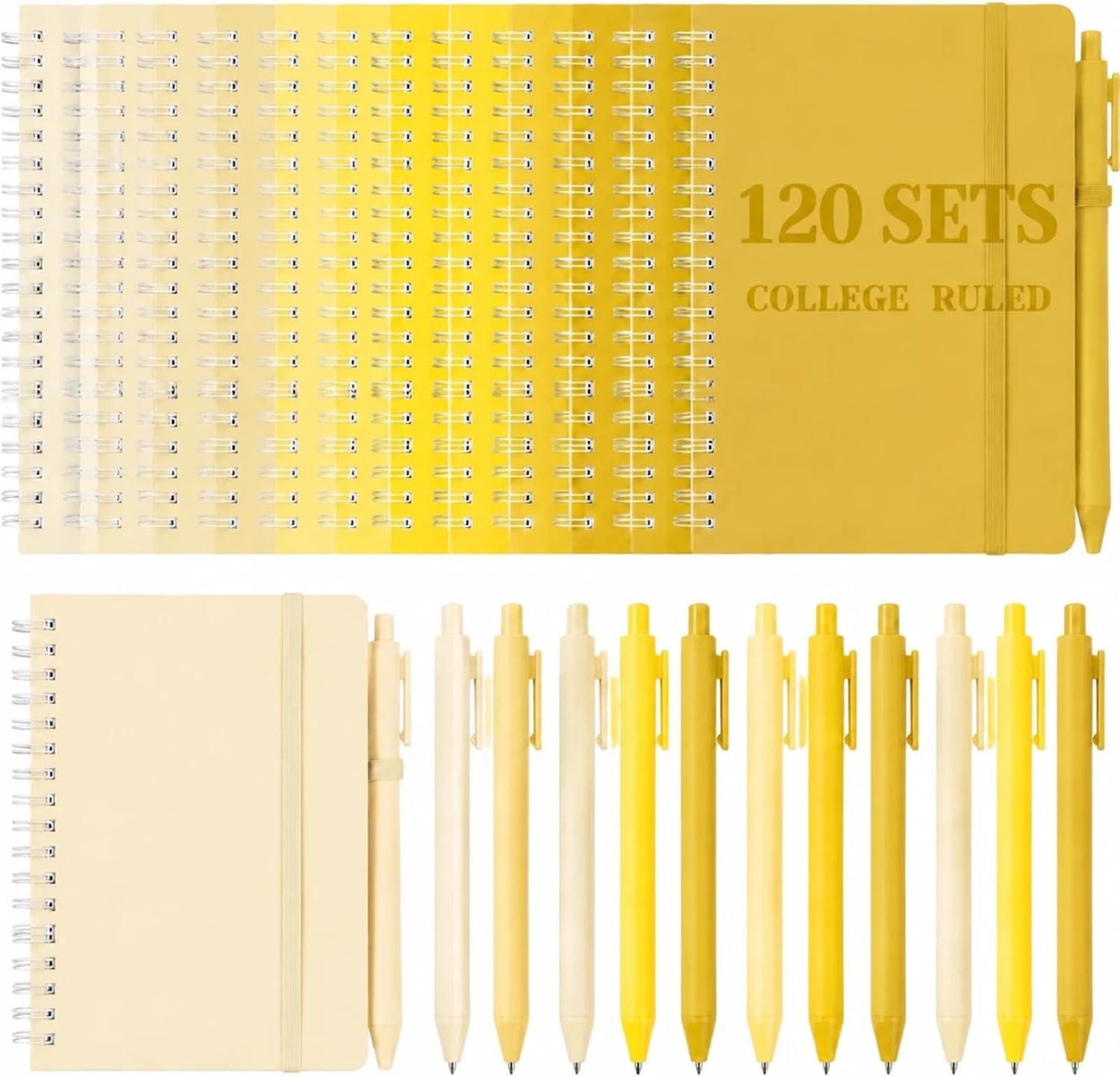
- Assorted colorful covers simplify subject organization visually
- College ruled pages provide neat structured writing space
- Spiral binding folds flat for comfortable classroom note taking
- Bulk notebook pack supports schools and educational programs
- Lightweight design makes daily transportation more convenient

- Motivational cover designs encourage positive daily learning habits
- Spiral binding folds flat for comfortable note taking
- Compact notebooks fit easily inside backpacks and school bags
- Bulk set suitable for classrooms, events, and appreciation gifts
- Includes matching ballpoint pens for complete writing sets
Choose the Notebook Around the Class, Not the Cover
A useful student notebook begins with the work it must hold. A seminar dominated by reading notes may need generous ruled pages and room for marginal questions. Mathematics, physics, accounting, and design courses often benefit from a grid that keeps equations and diagrams aligned. Laboratory classes may call for a dedicated book that stays separate from lecture notes. Start by listing each course, the type of marks you make, how often handouts are added, and whether the notebook must travel every day.
Size changes both writing comfort and portability. Letter-size and similarly large books provide space for full-page outlines, calculations, and pasted worksheets, but they occupy more desk and bag space. A5 books are easier to carry and can be comfortable for reading notes or compact handwriting, though a crowded lecture may fill them quickly. Compare a conventional spiral with a premium notebook for structured notes before assuming one format fits every subject.
Estimate page demand from the course schedule. If a class meets three times a week and you normally use two pages per meeting, a fifteen-week term can consume about ninety pages before review sheets and assignments. That rough calculation is more useful than buying by cover color alone. Leave a buffer so the final weeks do not end up in a second book with no index.
- Match ruling to the dominant work: ruled for prose, grid for calculations, blank for sketches, or dot grid for mixed layouts.
- Choose a page size that fits both the desk surface and the bag you actually carry.
- Reserve separate books for courses with important lab, field, or project records.

Evaluate Paper With the Pens and Pencils You Use
Paper weight is only one part of writing performance. Surface sizing, fiber, opacity, and coating affect how a pen feels and how clearly the reverse side remains usable. A smooth dense sheet can keep fine lines crisp, while a softer absorbent sheet may spread wet ink. Heavy paper can still feather if its surface is porous, and a lighter sheet may perform well with pencil or a dry ballpoint. Treat manufacturer weight figures as a comparison point, not a guarantee.
Test a small area with your normal tools. Write a sentence, draw a filled box, highlight one line after the ink dries, and inspect the back under ordinary light. Distinguish show-through, where the mark is visible from the reverse, from bleed-through, where ink penetrates the sheet. Show-through may be acceptable for single-sided notes; bleed-through can make the next page difficult to use. Students who color-code heavily can compare assorted gel pen sets, felt-tip pens for note taking, and highlighters intended for thin paper, while remembering that every combination still needs testing.
Pencil users should look for enough tooth to control graphite without creating a rough writing drag. Erase a sample several times and check whether the surface pills or the ruling lifts. For calculation-heavy classes, a graph-paper notebook can reduce time spent drawing guides. The correct choice is the sheet that remains readable with your usual pressure and tools, not necessarily the thickest paper on the shelf.

Compare Spiral Formats, Page Layouts, and Subject Counts
Single-wire spirals can fold back fully and are common in affordable school notebooks. Twin-wire bindings often turn smoothly and can look tidy, but bent loops may catch if the book is crushed in a bag. Subject notebooks add dividers and reduce the number of separate books a student carries, yet one damaged or lost volume can affect several courses at once. Boundaries between subjects can also become awkward when one class uses pages faster than another.
| Format | Useful when | Trade-off to check | Simple test |
|---|---|---|---|
| One-subject spiral | You want a separate record for each class | More books and covers in the bag | Confirm the page count covers the term |
| Multi-subject spiral | You carry several classes on the same day | Fixed divider space may not match each course | Assign sections from the syllabus workload |
| Grid or dot grid | You mix diagrams, calculations, and text | Guides may be too dark or too faint | Photograph and scan a sample page |
| Perforated pages | You submit or share pages | Sheets can loosen if the perforation is weak | Tear one page slowly along the full edge |
Ruling width should suit handwriting size. Narrow ruling increases the number of lines but can crowd larger scripts and annotations. Wide ruling gives each line breathing room but uses pages faster. Dot grids offer flexible structure for timelines, charts, and planning; see how dot-grid bullet journals handle mixed layouts. If your semester includes internships or project meetings, a separate notebook for work notes can keep professional records apart from class material.
Check whether front and back pages rotate without scraping the coil, and whether the book lies stable when folded. A left-handed writer may prefer the coil at the top or a smaller wire profile. No binding removes every compromise, so test it in the same writing position used in lectures.
Inspect the Coil, Cover, Pockets, and Perforations
A spiral notebook spends much of its life under mechanical stress. It is pulled from a bag, stacked under a laptop, opened on small desks, and handled by the coil. Inspect the ends of a single spiral: they should be turned or crimped so they do not snag fabric. On twin wire, look for evenly closed loops without gaps that let pages escape. Rotate several pages from front to back and listen for catching around punched holes.
Cover stiffness matters when writing without a full desk. A flexible cover saves weight but offers little support on a lap. A rigid cover protects page corners and gives a firmer surface, though it adds bulk. The best compromise depends on where notes are taken. If the notebook shares a bag with a computer and charger, compare the dimensions against a laptop backpack with organized compartments rather than relying on a generic size label.
Pockets are useful for a temporary handout, but they should not become permanent storage for every loose page. Overfilled pockets distort covers and push against the coil. Perforation should release a page cleanly without sacrificing the punched strip that stays bound. Hold the book flat and pull slowly toward the perforation; tearing outward at an angle can damage the sheet even when the cut is sound.
Also check the first and last pages, where damage often starts. Reinforced pockets, a slightly oversized cover, or a durable divider may protect them. At home, a desktop shelf for organized course materials can keep active notebooks upright without burying them under heavier books.

Set Up Each Notebook Before the First Lecture
A few minutes of setup makes a plain notebook easier to search for months. Write the course name, term, instructor, and a non-sensitive return contact inside the cover. Number pages if the notebook does not, then reserve the first two pages for an index. Add each major topic and its starting page as the course progresses. This lightweight system works even when lectures do not follow the syllabus perfectly.
Date every new set of notes and repeat the topic at the top of continuation pages. Leave a narrow cue column for questions, definitions, or references and a short summary space at the bottom. The layout resembles Cornell-style note organization without requiring a printed template. Use removable tabs for units rather than permanent labels until the class structure is clear. A time-management planner should hold deadlines and appointments; the class notebook should hold learning material. Keeping those roles distinct reduces duplication.
Color can identify subjects quickly, but use it consistently. Assign a cover or tab color to each course and repeat that color in digital folders. Avoid a complicated legend that takes longer to maintain than it saves. For fast lectures, use a pen suited to quick writing and leave blanks rather than stopping to make every heading decorative. Clarify the blanks during review while the lecture context is fresh.
Store the syllabus and grading rubric in a pocket only if they remain flat. Photograph or scan documents that are difficult to replace. Do not write passwords, student account numbers, or sensitive personal data on an exposed cover. A notebook should be easy to return without revealing information that should stay private.
Build a Note-Taking Routine That Supports Review
Notebook quality cannot compensate for notes that are never revisited. During class, capture the structure of the explanation rather than attempting a transcript. Mark definitions, examples, exceptions, and questions in visibly different ways. When the instructor emphasizes a connection, draw it. When a step is unclear, leave enough space to repair the explanation later instead of squeezing an answer into the margin.
Within a day, spend a short review pass adding headings, answering marked questions, and writing a two- or three-sentence summary. This is also the time to transfer deadlines to a planner. A planner-friendly pen may need to dry quickly in small boxes, while a notebook pen can prioritize longer writing comfort. Use different tools when the surfaces and jobs differ.
For equations, diagrams, or vocabulary, create retrieval prompts rather than rereading passively. Cover one column and answer from memory, redraw a process on scrap paper, or explain the idea aloud. A mechanical pencil for school use is practical for calculations that will be revised, while ink helps create a stable final summary. If wooden pencils are required, an electric classroom pencil sharpener belongs in a shared study area rather than inside the notebook workflow.
Keep corrections readable. Cross out a small mistake once instead of erasing through thin paper or covering a paragraph with ink. If a full page becomes obsolete, note where the replacement begins. The goal is a traceable record that helps revision, not a display piece that discourages active thinking.
Combine Paper and Digital Notes Without Losing the Source
Paper is quick, flexible, and free from notifications, while digital systems make searching, backup, and sharing easier. A hybrid routine works when each item has one clear home. Use the spiral notebook as the original lecture record, then capture only high-value pages: summaries, worked examples, diagrams, and review sheets. Do not create an unsearchable photo archive of every page without names or dates.
Before scanning, flatten the page, use even light, and keep the camera parallel to the paper. Include the page number in the filename and organize files by course and unit. Check that pencil marks and pale ruling remain legible before discarding any paper. If digital handwriting is central to the program, compare purpose-built electronic notebooks for digital note taking with ordinary paper plus a scanning app. Consider export formats, battery dependence, account requirements, and whether files remain accessible after a subscription ends.
For quantitative courses, a scientific calculator for student mathematics and science may sit beside the notebook, but the written record should still show inputs, assumptions, and units. A result with no method is difficult to check later. For group work, share a clean summary rather than an entire notebook containing unrelated class or personal notes.
Back up scans in at least two places when they are important, and test the restore process before exams. Preserve the physical book until grades, appeals, and project deadlines have passed. The strongest hybrid system reduces the risk of loss without doubling every minute of work.

Use a Final Student Notebook Checklist
Make the final choice with the same tools, bag, and desk conditions the notebook will face. A short in-store or at-home test reveals more than a long feature list. Open the book in the middle, fold it back, write near the coil, turn several pages, and place it in the intended compartment. If the book will be used on a small lecture tablet, confirm that the cover does not slide and that enough page remains supported.
- Confirm the title count and product ranks match the actual selection you are comparing.
- Choose ruling and page size for the course work, not only for appearance.
- Estimate whether the usable page count covers the semester with a reasonable buffer.
- Test pen, pencil, eraser, and highlighter for feathering, show-through, bleed-through, and surface damage.
- Check coil ends, punched holes, page turning, cover stiffness, pockets, and divider placement.
- Test perforations only if removable pages are important to the class.
- Measure the notebook against the bag compartment and the smallest desk you use.
- Label, number, index, and date pages before the material becomes difficult to search.
- Plan a simple weekly review and a backup method for essential pages.
- Compare total cost per usable page rather than price per notebook alone.
Writing comfort can also depend on the surface under the book. A desk mat chosen for writing may cushion a single sheet, but a thick spiral notebook usually needs a level, stable base so the cover does not rock. Remove clutter from beneath the book before judging paper feel.
Finally, buy enough consistency to stay organized without overstocking an untested model. Start with one notebook or a small pack, use it for real notes, and record what worked: line spacing, page durability, coil comfort, and remaining pages. That evidence will make the next purchase faster and more accurate than relying on a cover design or a broad claim about what every student needs.
Calculate Value From Usable Pages and Daily Friction
Price per notebook can be misleading when packs contain different sheet counts, page sizes, or paper that you can use on only one side. Compare the cost per usable writing page after your pen test. Add any predictable extras, such as replacement dividers, protective folders, or a separate book required because one subject section is too small. A low purchase price is not economical if the coil bends early or the reverse of every sheet remains blank because ink shows through too strongly.
Daily friction also has value even though it is not printed on a receipt. A book that barely fits the bag, catches on fabric, slides on a lecture desk, or forces the hand against a large coil may interrupt every class. Conversely, a modest notebook that opens reliably, has clear ruling, and is easy to identify may support better habits than a more elaborate model. Note these small problems during the first two weeks, while an exchange or a change in system may still be practical.
When comparing packs, verify that every notebook has the same specifications. Assorted covers do not always mean identical ruling, page count, or interior dividers, and marketplace listings can combine multiple variations on one page. Read the exact selected size and quantity rather than borrowing details from a neighboring option. If a class requires archival records, carbonless copies, waterproof field paper, or a prescribed laboratory format, follow the instructor or department requirement instead of substituting a general student spiral.
Plan for the End of the Term
Decide in advance what happens when the course ends. Keep notebooks that document methods, portfolio development, laboratory work, or prerequisites for later classes. For routine notes, scan the index and essential summaries, then recycle or dispose of the paper according to local rules. Remove pages containing names, grades, contact details, or other sensitive information before recycling. Label retained books with the course and term on the spine or top edge so they can be found without opening every cover.
A simple closing review improves the next purchase. Record how many pages remained, which tools bled or smeared, whether dividers were useful, and whether the chosen size was carried consistently. This turns one semester of experience into a practical specification for the next, reducing waste and making it easier to buy only what the upcoming schedule requires.
FAQ: Spiral Notebooks for Students
What size spiral notebook is practical for students?
Letter-size and similarly large notebooks provide room for detailed outlines, calculations, and handouts, while A5 notebooks are easier to carry. Match the size to the course work, bag compartment, and smallest desk you regularly use.
Is college-ruled or wide-ruled paper better?
College ruling fits more lines and often suits compact handwriting. Wide ruling gives larger writing and annotations more space. Test a sample with your normal handwriting rather than choosing only by age or grade level.
How many pages should a notebook have for one semester?
Estimate pages from class meetings and your normal notes per meeting, then add room for review sheets and assignments. A course meeting three times weekly can use a notebook quickly, so page demand is more reliable than a generic target.
Does heavier notebook paper always prevent ink bleed?
No. Weight, surface treatment, fiber, ink, tip size, and writing pressure all affect performance. Test your own pen and highlighter, then inspect the reverse for show-through and bleed-through before committing to a full pack.
Are multi-subject spiral notebooks better than separate notebooks?
Multi-subject books reduce the number of items carried, but fixed sections may not match each course and one lost book affects several subjects. Separate notebooks make archiving and replacement simpler but add more covers and bulk.
What should left-handed students check in a spiral notebook?
Check whether the coil interferes near the writing hand, whether the book folds back securely, and whether writing close to the inner margin remains comfortable. A top-bound format or smaller coil can help some writers, but hand position varies.
How can students keep spiral notebook pages organized?
Label the course, number pages, reserve space for an index, date every entry, and add removable unit tabs. Transfer deadlines to a planner and scan only essential summaries or worked examples with clear course and page names.