


- Compact 1U rackmount design conserves valuable space inside network cabinets and server racks.
- Lithium-ion battery technology provides backup power with potentially longer service life than conventional lead-acid batteries.
- Rated 500VA and 400W output supports appropriately sized networking and communication equipment.
- Integrated LCD display provides convenient access to operating information and UPS status.
- - Cloud-oriented management capability is designed to support remote UPS monitoring and power infrastructure oversight.

A Compact 1U Rackmount UPS That Makes Remote Power Management Much Easier
The Eaton Tripp Lite BC500RT1ULNC is a 500VA, 400W lithium-ion uninterruptible power supply designed for network equipment, small server racks, communication systems, and other essential electronics. It combines a compact 1U rackmount chassis with cloud-based monitoring, six battery-backed outlets, and a front-panel LCD. For buyers comparing the best UPS battery backup rack mount options, this model provides a particularly useful balance of compact construction, battery technology, and remote management.
The unit measures approximately 17.2 inches wide, 8.27 inches deep, and 1.73 inches high. It weighs approximately 5.73 pounds, making it considerably lighter than many traditional rackmount UPS systems. The compact one-unit rackmount chassis design is particularly useful in network cabinets where every available rack unit matters.
One of its strongest features is the lithium-ion battery system. Eaton states that its batteries are designed to last five years or longer, potentially reducing the frequency of replacements compared with conventional lead-acid UPS batteries. That matters in installations where equipment is difficult to access or where maintenance visits create additional expenses.
The BC500RT1ULNC is rated for 120V electrical systems and uses a NEMA 5-15P input plug. It provides six NEMA 5-15R outlets, all offering battery backup and surge protection. The six battery-backed and surge-protected outlets make it practical for small collections of networking and communication equipment.
However, the 400W output limit should be considered carefully. This UPS is intended for appropriately sized electrical loads rather than large servers or power-hungry workstation systems. Buyers should calculate their connected equipment's total power consumption before deciding whether this capacity is sufficient.
The Lithium Battery and Cloud Monitoring Are Where This UPS Becomes Particularly Useful
One of the most important advantages of the Eaton BC500RT1ULNC is its lithium-ion battery technology. Conventional UPS systems often use sealed lead-acid batteries that require periodic replacement. The longer-life lithium-ion battery technology can reduce maintenance requirements in environments where the UPS operates continuously.
Consider a small business operating a network cabinet with a router, firewall, and network switch. If the equipment is installed in a locked communications room, replacing a UPS battery can require scheduling maintenance and temporarily accessing the cabinet. A longer-lasting battery may reduce how frequently that work is necessary.
The lithium-ion construction also contributes to the unit's relatively low weight. At approximately 5.73 pounds, the UPS is manageable during installation compared with many heavier battery backup systems. This can be useful when mounting equipment in a wall-mounted rack or compact network enclosure.
The 1U rackmount design is another significant advantage. A standard rack unit measures approximately 1.75 inches high, and the BC500RT1ULNC fits within that general space allocation. The space-saving rackmount and tower installation options provide flexibility for different equipment arrangements.
For example, a small office may have a network cabinet with limited room beneath its switches and patch panels. Installing a 1U UPS can preserve additional space for future equipment. The unit can also be used in a tower configuration when a traditional rack is unavailable.
However, buyers should measure the available installation depth and consider cable clearance. The chassis is approximately 8.27 inches deep, but the complete installation requires additional room for connected power cables and ventilation. Ignoring that space can make installation difficult in shallow cabinets.
The UPS provides a maximum output of 400 watts and an apparent power rating of 500VA. These measurements describe different aspects of electrical capacity and should not be treated as interchangeable. The rated 500VA and 400W power capacity must both be respected when calculating the connected load.
For example, imagine a network installation containing a 25W router, a 45W firewall, a 60W switch, and a 20W modem. The combined nominal consumption would be approximately 150 watts. That is below the UPS's 400W maximum, although startup demands, connected power adapters, and future equipment should also be considered.
A common mistake is selecting a UPS based entirely on the number of outlets. Six available outlets do not mean that six high-power devices can be connected without exceeding the electrical rating. Users should calculate the actual load rather than relying on outlet count alone.
Runtime is another important consideration. Eaton publishes an estimated backup duration of approximately 14 minutes at half load and three minutes at full load. The documented backup runtime at different loads helps buyers understand what to expect during a power interruption.
At a 400W load, three minutes may be enough for certain equipment to complete an orderly shutdown, but it is not intended for extended operation. At approximately 200W, the published 14-minute runtime provides more time to respond. Actual duration depends on battery condition, temperature, load characteristics, and operating circumstances.
Consider a small retail store using a network switch and payment terminal. During a brief power interruption, the UPS may allow connected equipment to remain operational long enough for electricity to return. During a longer outage, the available runtime can provide an opportunity to protect data and shut down systems safely.
However, buyers should not assume that every connected computer will shut down automatically. That depends on the available communication interfaces, software, and configuration. Planning a reliable shutdown procedure before an outage is essential when protecting equipment that stores important information.
The Eaton BC500RT1ULNC uses standby UPS topology. Under normal conditions, connected equipment receives utility power, and the UPS switches to battery operation when necessary. The manufacturer's documentation identifies a typical transfer time of approximately four milliseconds, with a maximum below ten milliseconds.
This is appropriate for many ordinary networking and computing applications, but it differs from an online double-conversion UPS. An online model continuously conditions power through its conversion system, while a standby UPS relies on transfer during interruptions. Understanding the difference between standby and online UPS systems is important when selecting protection for sensitive equipment.
Another technical consideration is the output waveform. Eaton specifies a sine-wave output during normal utility operation and a simulated sine wave while running on battery. Buyers using equipment that requires a pure sine-wave battery output should confirm compatibility before purchasing.
The six outlets provide both surge protection and battery backup. Eaton also specifies 190 joules of surge suppression and filtering for electrical interference. The combination of battery backup and surge protection helps address several common electrical problems affecting network equipment.
For example, a short voltage disturbance may interrupt a router or network switch even when the rest of the building appears unaffected. A suitable UPS can reduce the risk of these interruptions causing immediate equipment shutdowns. However, the level of protection depends on the disturbance and the UPS operating characteristics.
One of the most distinctive features is the cloud-based remote monitoring system. Eaton uses its Brightlayer platform to provide access through a web browser or mobile application. The integrated cloud-based remote UPS monitoring allows administrators to check operating information without standing directly in front of the equipment.
This is particularly useful for businesses with equipment installed at several locations. A technician responsible for multiple retail stores may need to check whether a UPS has reported a battery issue or power interruption. Remote monitoring can make that information accessible without requiring an immediate site visit.
The system supports notifications and remote management functions. Administrators can receive alerts, review operating conditions, and manage supported outlet banks. This provides more flexibility than a basic UPS that only offers local audible alarms.
For example, imagine a network device becoming unresponsive at an unattended office. Where the device is connected to an appropriate switched outlet bank, an authorized administrator may be able to cycle power remotely. The remotely controllable outlet bank functionality can reduce the need for someone to visit the location simply to restart equipment.
However, remote power control should be configured carefully. Restarting a device without understanding its function can interrupt network services or affect connected users. Administrators should identify critical equipment and document which outlets are safe to control remotely.
The UPS also supports NFC-assisted configuration. Eaton describes a setup process that allows users to configure network settings through a compatible mobile device. This can simplify initial deployment compared with equipment that requires extensive manual configuration.
Security remains important when using cloud-connected infrastructure. Eaton supports account protection with two-factor authentication. The additional security provided by two-factor authentication can help protect remote management access when correctly configured.
The front-panel LCD provides another way to monitor the UPS. This is useful during installation, troubleshooting, or routine inspections when an administrator is physically present. It also provides an alternative to relying exclusively on remote monitoring.
For example, a technician installing the UPS in a network rack may want to confirm its operating condition before connecting critical equipment. The local display and status indicators can help with that process. The front-panel LCD and local status indicators provide convenient access to essential operating information.
The unit also includes audible alarms for conditions such as power failure, low battery, overload, and other operating events. These alerts can help staff identify problems when they are near the installation. However, alarm behavior should be reviewed during setup to avoid unnecessary disturbance in occupied offices.
Battery maintenance is another important consideration. Eaton describes a user-replaceable internal battery and a self-test capability. The user-replaceable battery and self-test functionality can help simplify preventative maintenance over the UPS's operating life.
Users should still follow the manufacturer's replacement procedures and safety instructions. Lithium-ion batteries require appropriate handling, and incompatible replacements should not be installed. Routine inspections should also include checking the ventilation openings and surrounding equipment.
Temperature can affect battery performance and service life. Eaton specifies an operating temperature range of approximately 32 to 104 degrees Fahrenheit, equivalent to 0 to 40 degrees Celsius. Keeping the UPS within its recommended environmental conditions is important for reliable operation.
Another useful feature is automatic restart when utility power returns. This can help restore connected equipment after a prolonged outage without requiring someone to manually restart the UPS itself. The automatic restart after utility power restoration is particularly valuable in unattended installations.
For example, a small remote network cabinet may lose electricity overnight. Once power returns, the UPS can restart automatically, helping the connected installation recover. The behavior of individual connected devices will still depend on their own power settings and startup requirements.
The BC500RT1ULNC also includes a five-year limited manufacturer warranty. This is a useful consideration for buyers planning a longer-term network infrastructure installation. Warranty coverage should be reviewed carefully, including applicable conditions and exclusions.
Finally, the UPS should be installed with a realistic understanding of its intended purpose. It is designed to provide temporary backup power and protection for appropriately sized equipment, not to operate a complete network indefinitely during a blackout. Correct load planning and realistic runtime expectations are essential for obtaining the most practical benefit from this model.
Why We Believe the Eaton BC500RT1ULNC Deserves First Place
We ranked the Eaton Tripp Lite BC500RT1ULNC first out of seven because it combines a compact 1U design, lithium-ion battery technology, cloud-based monitoring, and useful remote management capabilities. These features address several practical concerns associated with small rackmount installations. The combination of compact construction and remote management is its strongest advantage.
The lithium-ion battery system is an important reason for its ranking. Eaton advertises a service life of five years or longer, potentially reducing replacement frequency and maintenance costs. This is particularly useful for businesses managing equipment across multiple locations.
The compact dimensions are another major advantage. At approximately 17.2 inches wide, 8.27 inches deep, and 1.73 inches high, the UPS occupies relatively little rack space. The shallow one-unit rackmount form factor makes it suitable for network closets and other installations with limited equipment capacity.
The six battery-backed outlets also provide useful flexibility. They can support an appropriately sized combination of routers, switches, communication equipment, and other critical electronics. The 400W output limit remains important, but it is sufficient for many smaller installations.
Cloud monitoring provides another meaningful benefit. Administrators can receive notifications, inspect UPS status, and manage supported outlet banks remotely. The ability to monitor and manage power remotely can reduce unnecessary maintenance visits and improve visibility across distributed installations.
The published runtime figures also make planning easier. Eaton specifies approximately 14 minutes at half load and three minutes at full load. These figures help buyers estimate whether the unit provides enough time for their equipment to remain operational or shut down safely.
However, there are limitations worth acknowledging. The 400W capacity is not intended for large servers or high-power equipment. Buyers with more demanding installations may require a UPS with a higher output rating.
The standby topology is another consideration. Although suitable for many networking applications, it does not provide the continuous power conversion of an online UPS. The limitations of standby power protection should be understood when selecting equipment for particularly sensitive applications.
The simulated sine-wave battery output may also be unsuitable for certain specialized power supplies. Buyers should verify compatibility with their connected equipment before purchasing. This is especially important for devices whose manufacturers explicitly require pure sine-wave backup power.
Another limitation is the relatively short full-load runtime. Three minutes at 400W is intended for brief continuity or controlled shutdown rather than extended operation. Users requiring longer backup duration should consider a lower connected load or a different UPS with greater battery capacity.
The 120V electrical configuration is also important. This model uses North American NEMA connections and should not be assumed compatible with 230V electrical installations. Checking input voltage and outlet compatibility before purchasing is essential.
Despite these limitations, the Eaton BC500RT1ULNC provides a strong combination of features for small network racks and distributed IT environments. Its lithium-ion battery, remote monitoring, LCD display, and compact construction address practical installation and maintenance requirements. It is particularly appealing for organizations that value remote visibility and reduced maintenance.
Ultimately, we believe the Eaton Tripp Lite BC500RT1ULNC deserves first place because it offers reliable short-duration backup with intelligent remote management in a compact 1U rackmount design. Its 500VA/400W capacity, six protected outlets, long-life lithium-ion battery, and five-year limited warranty make it a well-rounded option for appropriately sized network installations. For buyers seeking a compact, cloud-connected rackmount UPS that is practical to install and manage, the Eaton BC500RT1ULNC is an excellent choice.

- Rated 1000VA and 600W output provides backup power for appropriately sized servers, switches, and networking equipment.
- Line-interactive topology with automatic voltage regulation corrects moderate voltage fluctuations without immediately using battery power.
- Pure sine-wave output during battery operation supports compatible sensitive electronics and active PFC power supplies.
- Integrated SmartConnect Ethernet port enables cloud-based monitoring, automatic notifications, and remote UPS visibility.
- - Compact 2U rackmount chassis includes an LCD status display and replaceable lead-acid battery system.
The APC SMC1000-2UC Offers Serious Power Protection Without Complicated Setup
The APC Smart-UPS C SMC1000-2UC is a 1000VA, 600W rackmount uninterruptible power supply designed for small servers, networking equipment, retail systems, and business communication devices. It combines line-interactive power protection, automatic voltage regulation, pure sine-wave output, and cloud-based monitoring through APC SmartConnect. For buyers comparing the best UPS battery backup rack mount options, it offers a useful combination of electrical capacity, monitoring capabilities, and practical installation features.
The UPS occupies 2U of rack space and measures approximately 17 inches wide, 16 inches deep, and 3.4 inches high. Its listed weight is approximately 45.2 pounds, making it substantially heavier than compact lithium-ion UPS systems. The rackmount design with substantial power capacity is particularly suitable for network cabinets that have enough space for a dedicated backup power unit.
One of its strongest features is the 1000VA and 600W output rating. This provides more power capacity than smaller 400W rackmount systems, allowing the APC to support a broader combination of appropriately sized devices. However, buyers still need to calculate their actual electrical load rather than assuming that every connected device can operate at maximum power simultaneously.
The SMC1000-2UC includes six NEMA 5-15R outlets, all providing battery backup and surge protection. These outlets can accommodate compatible routers, switches, entry-level servers, and communication equipment. The six battery-backed and surge-protected outlets provide flexibility for small business network installations.
The UPS is designed for 120V electrical systems and uses a NEMA 5-15P input plug. This makes it appropriate for compatible North American power installations, but it should not be assumed suitable for 230V electrical environments. Buyers should confirm voltage and connector compatibility before purchasing.
The Voltage Regulation and Pure Sine-Wave Output Are Its Biggest Strengths
One of the most important features of the APC SMC1000-2UC is its line-interactive topology. Unlike a basic standby UPS, a line-interactive system can correct certain voltage fluctuations without immediately switching to battery power. The automatic voltage regulation for unstable utility power is particularly useful in buildings where minor voltage variations occur regularly.
For example, a small office may experience occasional voltage drops when large electrical equipment starts operating. A conventional standby UPS may respond to some of these events by switching to battery power. The APC's automatic voltage regulation can correct moderate fluctuations while preserving battery capacity.
This matters because unnecessary battery operation can contribute to additional battery cycling. Reducing those events may help preserve available backup capacity for actual power interruptions. However, automatic voltage regulation operates within defined limits and cannot correct every possible electrical problem.
The manufacturer specifies an adjustable input voltage range that can extend from approximately 85 to 136 volts, depending on configuration. This provides flexibility for installations where incoming utility voltage is not always consistent. The adjustable input voltage operating range allows administrators to configure the UPS according to the electrical environment.
However, settings should not be changed without understanding the connected equipment's requirements. An excessively wide operating range may allow equipment to experience voltage conditions outside its preferred limits. Buyers should follow APC's recommended configuration guidance.
Another major advantage is the pure sine-wave output. APC identifies the SMC1000-2UC as providing sine-wave power during battery operation. The pure sine-wave battery output for sensitive electronics is particularly relevant for modern servers and networking equipment.
Many contemporary computer power supplies use active power factor correction. These power supplies may operate more predictably with a pure sine-wave UPS than with certain simulated sine-wave models. However, compatibility should still be confirmed against the connected equipment's specifications.
Consider a small business running a compact server with an active PFC power supply. During a power interruption, the UPS must provide electricity while the server continues operating. A pure sine-wave output can help maintain compatibility with equipment designed for conventional sinusoidal AC power.
The APC also provides a typical transfer time of approximately six milliseconds, with a maximum of ten milliseconds. This describes how quickly the UPS changes to battery operation when necessary. The rapid transfer to battery backup power is intended to keep compatible connected devices operating through brief interruptions.
However, transfer time should not be confused with uninterrupted online double-conversion operation. A line-interactive UPS still requires a transfer when utility power becomes unavailable. Particularly sensitive equipment may require a different UPS topology.
The SMC1000-2UC uses a sealed lead-acid battery system. APC specifies an expected battery service life of approximately four to six years, depending on operating conditions. The replaceable sealed lead-acid battery system allows the UPS to remain in service when its original battery reaches the end of its useful life.
The compatible replacement battery cartridge is identified as APCRBC124. This is useful because buyers can plan maintenance without replacing the entire UPS. However, replacement batteries should be sourced from appropriate suppliers and installed according to the manufacturer's instructions.
Battery runtime is another important consideration. APC's published technical comparison identifies approximately 14 minutes of backup at half load and five minutes at full load. The documented backup runtime at different power loads helps buyers estimate how much time is available during an outage.
At approximately 300W, the published half-load runtime is around 14 minutes. At the full 600W rating, the published figure is approximately five minutes. Actual runtime will vary with battery age, temperature, equipment behavior, and other operating conditions.
Consider a small network cabinet containing a 35W router, a 70W firewall, a 100W switch, and a 50W storage device. Their combined nominal consumption would be approximately 255W. That is below half of the UPS's maximum wattage, although startup demands and future expansion should also be considered.
A common mistake is selecting a UPS based entirely on its VA rating. The 1000VA specification does not mean that the unit can continuously supply 1000 watts. The difference between volt-amperes and actual watt capacity must be understood when calculating connected loads.
For example, connecting equipment with a combined 750W demand would exceed the APC's 600W output rating. The fact that the UPS is labeled 1000VA does not make that load acceptable. Buyers should calculate both apparent power and real power where the information is available.
Another important consideration is shutdown planning. A UPS provides temporary electricity, but it cannot keep a server running indefinitely. Configuring automatic shutdown before the battery becomes depleted helps reduce the risk of abrupt system interruption.
The SMC1000-2UC supports USB and serial communication for compatible shutdown software. APC identifies PowerChute Serial Shutdown as an available option for supported systems. This allows connected equipment to respond to extended power interruptions when properly configured.
For example, a small business server may store accounting records or customer information. During a prolonged outage, a controlled shutdown can allow software to close files and stop services appropriately. That is preferable to waiting until the UPS battery becomes completely exhausted.
The UPS also includes APC SmartConnect cloud monitoring. Its dedicated Ethernet port allows supported monitoring features to be accessed remotely. The integrated SmartConnect remote power monitoring system is particularly useful for administrators responsible for equipment at multiple locations.
Consider a company operating several small branch offices. Each location may have a network cabinet containing a router, switch, and backup power supply. Remote monitoring can help administrators identify battery warnings or electrical events without visiting every location.
However, SmartConnect functionality depends on the applicable service terms and available subscription features. Buyers should confirm which monitoring and notification capabilities are included with their purchase. Not every cloud management feature is necessarily available without additional service arrangements.
The SMC1000-2UC does not include independently switched outlet groups. This means administrators should not assume they can remotely restart individual devices by cycling selected outlets. Understanding the limitations of remote outlet control is important when planning network management.
The front-panel LCD provides another way to inspect the UPS. It displays operating information and allows users to review relevant status details locally. The multifunction LCD status and control display is useful during installation, routine inspections, and troubleshooting.
For example, a technician installing the UPS may want to confirm that the unit recognizes incoming power and reports an appropriate battery condition. The LCD provides a convenient way to inspect operating status without relying entirely on cloud access. Audible alarms also help identify certain operating events.
The APC provides surge protection and electrical noise filtering. Current Schneider Electric specifications identify a surge energy rating of 680 joules. The integrated surge protection and electrical noise filtering help address common disturbances affecting connected electronics.
However, surge protection should not be interpreted as complete protection against every electrical event. Severe disturbances and direct lightning effects may require additional building-level protection. Buyers should consider the entire electrical installation rather than relying exclusively on the UPS.
Rack installation also requires planning. The UPS measures approximately 16 inches deep and weighs around 45 pounds. The substantial weight and two-unit rackmount dimensions make proper mounting support especially important.
For example, a shallow wall-mounted network cabinet may have enough vertical space but insufficient depth for the UPS and its connected cables. Buyers should measure the cabinet before purchasing. They should also confirm that the mounting hardware and rack structure can safely support the unit.
APC includes rackmount brackets and installation hardware with the product. The UPS should generally be positioned low in the rack to maintain a sensible weight distribution. Heavy equipment installed too high can make certain rack configurations less stable.
Ventilation is another practical consideration. The manufacturer specifies an operating temperature range from 0 to 40 degrees Celsius. Maintaining adequate ventilation and appropriate operating temperatures is important for battery performance and service life.
For example, a network cabinet installed in a poorly ventilated storage room may become unusually warm during summer. Elevated temperatures can accelerate battery deterioration. Keeping the installation within the manufacturer's recommended environmental conditions can help reduce this risk.
The UPS has an expected battery recharge time of approximately three hours under the manufacturer's stated conditions. This matters after an outage because the battery may need time to recover its available capacity. The approximately three-hour battery recharge specification should be considered when planning for repeated power interruptions.
For example, a business may experience several short outages during severe weather. If the battery has not fully recharged between interruptions, the available runtime may be reduced. Users should not assume that the original backup duration will be available immediately after power returns.
Maintenance should include periodic battery checks, ventilation inspection, and review of operating alerts. The UPS should also be tested according to the manufacturer's recommended procedures. Regular inspection can help identify developing problems before an actual outage occurs.
Finally, the SMC1000-2UC is intended for appropriately sized business and networking equipment. It offers meaningful protection against short power interruptions and certain voltage disturbances, but it is not a replacement for a generator or long-duration backup system. Correct equipment sizing and realistic runtime planning remain essential for reliable operation.
Why We Ranked the APC SMC1000-2UC Number Two
We placed the APC Smart-UPS C SMC1000-2UC second out of seven because it offers substantial power capacity, line-interactive voltage regulation, pure sine-wave output, and cloud monitoring. These features make it particularly suitable for small business servers and networking installations. The combination of stronger output capacity and electrical protection is its biggest advantage.
The 1000VA and 600W rating is an important reason for its ranking. It provides more wattage than our first-ranked Eaton Tripp Lite BC500RT1ULNC, which is rated at 500VA and 400W. This additional capacity can be useful when protecting several networking devices or a small server.
The pure sine-wave output is another major strength. It provides a suitable power waveform for many modern computer power supplies and sensitive electronics. The pure sine-wave protection for modern IT equipment helps distinguish the APC from rackmount UPS systems that use simulated sine-wave battery output.
The line-interactive topology also contributes to its appeal. Automatic voltage regulation can correct moderate voltage fluctuations without immediately switching to battery power. This can be particularly useful in buildings where utility voltage is not always consistent.
The six battery-backed outlets provide practical flexibility. They can accommodate a combination of compatible servers, switches, routers, and communication equipment within the UPS's electrical limits. The SmartConnect monitoring system also provides useful visibility into operating conditions.
However, we ranked the Eaton BC500RT1ULNC first because its compact 1U chassis and lithium-ion battery technology offer important advantages for space-constrained installations. The Eaton weighs approximately 5.73 pounds, while the APC is substantially heavier. The difference in physical size and battery technology is a major consideration in this comparison.
The Eaton also advertises a longer-life lithium-ion battery system that may reduce maintenance requirements. The APC uses a sealed lead-acid battery with an expected service life of approximately four to six years. Buyers who prioritize lower weight and potentially less frequent battery maintenance may prefer the Eaton.
The APC occupies 2U of rack space rather than 1U. This may not matter in a full-size server rack, but it can be significant in compact network cabinets. The additional rack space required for installation is one reason it does not take first place.
Another limitation is the absence of switched outlet groups. Although SmartConnect provides cloud-based monitoring, the SMC1000-2UC does not offer the same type of independently controlled outlet functionality available on some other UPS systems. Buyers who need remote power cycling should consider this carefully.
The lead-acid battery system also contributes to the unit's weight. At approximately 45 pounds, the UPS requires more care during installation than lightweight lithium-ion alternatives. Proper rack support and mounting hardware are essential.
However, the APC has clear advantages of its own. Its higher 600W output rating, pure sine-wave battery power, and automatic voltage regulation make it suitable for a broader range of small business equipment. The strong electrical performance and practical management features provide meaningful value.
The published runtime of approximately 14 minutes at half load is another positive feature. It provides time for brief continuity or controlled shutdown during an outage. Actual performance depends on the connected load and battery condition.
The replaceable APCRBC124 battery cartridge also supports long-term maintenance. Buyers can replace the battery when necessary rather than automatically replacing the entire UPS. This makes the APC a practical option for organizations planning to maintain their equipment over several years.
These considerations explain why the APC occupies second place rather than the top ranking. It is larger and heavier than our first-ranked Eaton, but it provides greater power capacity and a more advanced approach to voltage regulation. The balance of reliable backup power and business-oriented features makes it a strong contender.
Ultimately, we believe the APC Smart-UPS C SMC1000-2UC deserves second place because it offers dependable rackmount backup with intelligent power management, while its larger 2U chassis and lead-acid battery make it less compact than our top choice. Its 1000VA/600W capacity, pure sine-wave output, automatic voltage regulation, SmartConnect monitoring, and replaceable battery make it particularly suitable for small servers, networking equipment, and business communication systems. For buyers who prioritize higher output capacity and dependable electrical protection, the APC SMC1000-2UC remains an excellent choice.

- Compact 1U short-depth rackmount chassis saves valuable installation space in network cabinets.
- Long-life lithium-ion battery technology offers an advertised eight to ten years of battery design life.
- Line-interactive power protection delivers 500VA and 400W with sine-wave output for compatible electronics.
- Integrated SmartConnect Ethernet port enables cloud-based UPS monitoring and remote power notifications.
- - Four battery-backed NEMA outlets provide temporary backup power for essential networking equipment.
The APC SCL500RM1UC Is a Compact UPS With Some Serious Advantages
The APC Smart-UPS SCL500RM1UC is designed for small network racks, communication cabinets, and business equipment that needs temporary backup power during electrical interruptions. It combines a 500VA/400W output rating, lithium-ion battery technology, line-interactive power protection, and SmartConnect cloud monitoring. For buyers comparing the best UPS battery backup rack mount options, its strongest advantage is providing these features in a compact 1U chassis.
The unit measures approximately 17.01 inches wide, 9.13 inches deep, and 1.73 inches high. It weighs just 9.22 pounds, making it considerably lighter than many conventional rackmount UPS systems. The compact short-depth rackmount chassis design is particularly useful in network cabinets where installation space is limited.
One of the most important features is its lithium-ion battery system. APC specifies a battery design life of approximately eight to ten years, although actual service life depends on operating conditions. This can reduce the frequency of battery maintenance compared with conventional lead-acid UPS systems.
The SCL500RM1UC also uses line-interactive topology with sine-wave output. This provides a more advanced approach to electrical protection than a basic standby UPS. The combination of line-interactive protection and sine-wave output makes it suitable for many modern networking and computing devices.
However, the 400W output limit should be considered carefully. This UPS is intended for smaller electrical loads rather than large servers or power-hungry workstations. Buyers should calculate their equipment's total power requirements before deciding whether this capacity is sufficient.
The Lithium Battery and SmartConnect Monitoring Make Everyday Management Easier
One of the strongest advantages of the APC SCL500RM1UC is its lithium-ion battery technology. Traditional rackmount UPS systems frequently use sealed lead-acid batteries that require replacement after several years. The long-life lithium-ion battery construction can reduce maintenance requirements in installations where the UPS operates continuously.
Consider a small business operating a network cabinet containing a router, firewall, and switch. If the cabinet is installed in a locked communications room, battery replacement may require scheduling maintenance and temporarily accessing the equipment. A battery designed for a longer service life can reduce how frequently that work is necessary.
APC also identifies a battery replacement prediction feature. This provides an estimated replacement date based on operating conditions and battery information. The predictive battery replacement and maintenance planning can help administrators prepare for servicing before the battery reaches the end of its useful life.
However, an eight to ten-year design life is not a guarantee that every battery will operate for that entire period. High temperatures, repeated discharge cycles, and other environmental conditions can affect longevity. Users should follow the manufacturer's maintenance recommendations rather than relying exclusively on the advertised lifespan.
The compact 1U chassis is another important feature. A standard rack unit measures approximately 1.75 inches high, and the APC fits within that general space allocation. The space-saving one-unit rackmount installation design is useful for cabinets with limited available rack space.
For example, a small retail store may have a wall-mounted network cabinet containing a patch panel, router, and Ethernet switch. A large 2U or 3U UPS could occupy a substantial portion of the available space. The SCL500RM1UC requires only one rack unit, leaving more room for other equipment.
The chassis is also relatively shallow at approximately 9.13 inches deep. This can be useful in network enclosures that cannot accommodate deeper UPS systems. However, buyers should still allow additional clearance for connected cables and ventilation.
One common mistake is measuring only the UPS chassis and ignoring the space required by power plugs. Rear-mounted connectors can increase the total installation depth. Checking rack depth and rear cable clearance is essential before purchasing a short-depth UPS.
The unit weighs approximately 9.22 pounds. This makes it relatively manageable during installation compared with heavier lead-acid rackmount systems. However, it should still be mounted using appropriate support hardware.
APC includes rack mounting support rails and installation instructions. The manufacturer also identifies compatibility with certain two-post mounting arrangements. The included rack mounting rails and hardware help simplify installation in compatible network cabinets.
However, buyers should confirm that their rack supports the intended mounting arrangement. Rack depth, post spacing, and available mounting positions can vary between enclosures. The installation should follow APC's instructions rather than relying on improvised support.
The SCL500RM1UC provides a maximum output of 400 watts and an apparent power rating of 500VA. These values describe different electrical characteristics and should not be treated as interchangeable. The rated 500VA and 400W output capacity must both be respected when selecting connected equipment.
For example, imagine a small network installation containing a 25W router, a 45W firewall, a 60W switch, and a 20W modem. Their combined nominal consumption would be approximately 150 watts. This is below the UPS's maximum output, although startup demands and future equipment should also be considered.
A common mistake is assuming that a 500VA UPS can continuously supply 500 watts. The SCL500RM1UC is specifically rated for 400W of real power. Connecting equipment that exceeds this limit can cause overload warnings or shutdowns.
The APC provides four NEMA 5-15R outlets. These outlets can supply temporary backup power to compatible networking and communication equipment. The four battery-backed outlets for essential electronics are suitable for smaller installations where only a few devices require protection.
For example, a small office may need to protect a router, firewall, network switch, and modem. Four outlets may be sufficient for that arrangement. However, installations with additional devices may require a different UPS or an appropriately designed power distribution arrangement.
The unit uses a NEMA 5-15P input plug and is designed for 120V electrical systems. This is important because the model should not be assumed compatible with 230V installations. Buyers should verify their local electrical supply and connector requirements before purchasing.
The line-interactive topology is another major advantage. It is designed to maintain compatible connected equipment through short power interruptions while managing certain input voltage variations. The line-interactive electrical protection for network equipment provides a useful alternative to basic standby UPS designs.
APC specifies an input voltage operating range of approximately 92 to 139 volts. This allows the UPS to operate across a defined range of utility voltage conditions. However, buyers should not assume that every disturbance can be corrected without battery operation.
For example, a small office may experience occasional voltage fluctuations when nearby electrical equipment starts operating. The UPS can help protect connected networking devices from certain disturbances. The exact response depends on the incoming voltage and the UPS operating conditions.
The SCL500RM1UC also provides sine-wave output. This is particularly relevant for equipment using modern active power factor correction power supplies. The pure sine-wave output for sensitive electronics can provide better compatibility than certain simulated sine-wave UPS designs.
Consider a small server with an active PFC power supply. During an electrical interruption, the UPS needs to provide power while the server remains operational. A sine-wave output is generally preferable when the connected equipment expects a conventional sinusoidal AC waveform.
The manufacturer identifies a typical transfer time of approximately six milliseconds, with a maximum of ten milliseconds. This is the time required to change to battery operation when necessary. The rapid transfer to battery backup power is intended to maintain operation for compatible connected devices.
However, line-interactive UPS systems are not identical to online double-conversion models. They still require a transfer when utility power becomes unavailable. Equipment with particularly demanding power requirements may need a different UPS topology.
Battery runtime is another important consideration. The available product records indicate that backup duration decreases substantially as the connected load approaches the 400W maximum. Buyers should use APC's official runtime chart to estimate performance for their specific equipment.
For example, a router and switch consuming a combined 100W will generally require less battery power than a server drawing 350W. The lower-load arrangement can therefore be expected to operate longer during an outage. Calculating realistic backup runtime from actual power consumption is essential for proper planning.
A UPS should not be selected based only on its maximum wattage. The amount of time equipment needs to remain operational is equally important. Some installations require only enough time for a controlled shutdown, while others need several minutes of continued network access.
The SCL500RM1UC includes APC SmartConnect monitoring through its dedicated Ethernet port. This allows supported operating information to be accessed remotely through the SmartConnect service. The integrated SmartConnect cloud-based UPS monitoring is particularly useful for administrators responsible for multiple locations.
Consider a company operating several small retail stores. Each location may have a network cabinet containing a router, switch, and UPS. Remote monitoring can help administrators identify power events or battery warnings without visiting every store.
SmartConnect can provide notifications and operating information through supported cloud features. However, the available functions depend on the applicable service terms and subscription arrangements. Buyers should confirm which features are included before relying on the platform for ongoing monitoring.
The UPS also supports USB and serial communication. These interfaces can be used with compatible management software, including supported APC PowerChute shutdown tools. The USB and serial communication for controlled shutdown is useful when connected equipment needs to respond automatically to extended outages.
For example, a small business server may store accounting records or important operational data. During a prolonged outage, a properly configured shutdown procedure can allow the system to stop services and close files before battery power is exhausted. This is preferable to an abrupt loss of electricity.
However, automatic shutdown is not guaranteed simply because the UPS is connected to a computer. The appropriate software, communication cable, and shutdown settings must be configured correctly. Users should test the arrangement according to the manufacturer's guidance.
Another practical feature is the UPS's switched outlet group capability. APC describes a single controllable outlet group that can support selected power management functions. The switched outlet group for equipment power control may be useful when administrators need to manage connected devices.
For example, a network appliance may occasionally become unresponsive and require a restart. Where supported by the available management interface and configuration, controlled outlet cycling may help restore operation. However, users should confirm the exact capabilities available through their chosen management method.
Power cycling should also be approached carefully. Restarting a router or switch can interrupt services for connected users. Administrators should identify critical equipment and document which devices can be safely restarted.
The SCL500RM1UC includes front-panel LED status indicators rather than a full graphical LCD. These indicators provide information about operating conditions, battery status, and detected events. The front-panel LED status and warning indicators are useful during installation and routine inspections.
For example, a technician working in a network cabinet may want to confirm that the UPS is operating normally before connecting critical equipment. The status indicators provide a quick local reference. Audible alarms can also help identify certain power or battery conditions.
The UPS includes surge protection and electrical noise filtering. APC specifies a surge energy rating of approximately 680 joules. The integrated surge protection and electrical filtering help address common electrical disturbances affecting connected devices.
However, surge protection should not be treated as complete protection against every possible electrical event. Severe disturbances may require additional building-level protection. Buyers should consider the entire electrical installation rather than relying exclusively on the UPS.
Operating temperature is another important consideration. APC specifies an operating range of approximately 0 to 40 degrees Celsius. Maintaining appropriate temperature and ventilation around the UPS is important for battery longevity and reliable operation.
For example, a network cabinet installed in a poorly ventilated storage room may become unusually warm during summer. Elevated temperatures can affect battery performance and service life. Adequate ventilation and routine environmental checks can help reduce this risk.
The UPS also requires periodic maintenance. Users should inspect the unit for dust accumulation, review operating alerts, and follow APC's recommended battery testing procedures. Regular UPS inspection and preventative maintenance can help identify developing problems before an actual power interruption occurs.
Finally, the SCL500RM1UC is intended for appropriately sized networking and computing equipment. It provides temporary battery backup rather than unlimited emergency electricity. Correct load calculations, realistic runtime expectations, and a suitable shutdown plan remain essential for reliable operation.
Why We Ranked the APC SCL500RM1UC Number Three
We placed the APC Smart-UPS SCL500RM1UC third out of seven because it offers a strong combination of compact construction, lithium-ion battery technology, sine-wave output, and cloud monitoring. These features make it particularly useful for small network cabinets and remote equipment installations. The combination of compact rackmount design and intelligent monitoring is its strongest advantage.
The lithium-ion battery system is an important reason for its ranking. APC specifies an eight to ten-year battery design life, potentially reducing maintenance requirements compared with conventional lead-acid UPS systems. This is particularly valuable in installations where replacing batteries requires scheduled service visits.
The short-depth 1U chassis is another major advantage. At approximately 9.13 inches deep, it can fit into certain compact cabinets that cannot accommodate larger UPS systems. The lightweight and shallow rackmount installation design makes it suitable for space-constrained network environments.
The sine-wave output also contributes to its appeal. It provides a suitable waveform for many modern computing devices and active PFC power supplies. This is an important consideration when protecting sensitive networking and server equipment.
SmartConnect monitoring adds further value. Administrators can review supported operating information and receive notifications without being physically present at the installation. The remote UPS monitoring and maintenance visibility can simplify management across several locations.
However, we ranked the Eaton Tripp Lite BC500RT1ULNC first because it provides a similarly compact 1U lithium-ion design with six battery-backed outlets and a more extensive documented remote management arrangement. The APC SCL500RM1UC provides four outlets instead of six. This may be a limitation for buyers protecting several networking devices.
The Eaton also has a slightly shallower chassis and lower listed weight. Those differences may be useful in particularly compact installations. The difference in outlet capacity and physical dimensions contributes to our preference for the Eaton.
Our second-ranked APC SMC1000-2UC offers a higher 1000VA/600W output rating. This provides more capacity for small servers and networking equipment with greater power requirements. The SCL500RM1UC is limited to 500VA/400W.
However, the SCL500RM1UC has advantages over the larger SMC1000-2UC. Its lithium-ion battery, lower weight, and 1U construction make it easier to accommodate in compact network cabinets. The compact lithium-ion design for smaller installations is a meaningful benefit.
Another limitation is the relatively small number of outlets. Four NEMA 5-15R connections may be sufficient for a router, firewall, switch, and modem, but installations with additional devices may require another arrangement. Buyers should calculate both outlet requirements and total electrical load.
The 400W output limit is also important. Although suitable for many networking applications, it may not provide enough capacity for larger servers or power-intensive equipment. The limited output capacity for demanding server loads prevents it from ranking higher in this comparison.
The front-panel LED indicators are another consideration. They provide useful operating information, but they do not offer the same detailed local interface as a full LCD display. Buyers who prefer reviewing numerical operating data directly from the front panel may find this less convenient.
The SmartConnect platform also requires attention to service terms. Some cloud monitoring functions may depend on subscription arrangements or supported service levels. Buyers should verify the available features before purchasing.
Despite these limitations, the APC SCL500RM1UC remains a strong option for smaller installations. Its lithium-ion battery technology, sine-wave output, line-interactive protection, and compact dimensions address several important requirements for network infrastructure. The balance of reliable backup power and reduced maintenance makes it particularly appealing.
Ultimately, we believe the APC Smart-UPS SCL500RM1UC deserves third place because it provides compact lithium-ion backup with useful cloud monitoring, while its four outlets and 400W capacity make it less versatile than some higher-ranked alternatives. Its short-depth 1U chassis, long-life battery design, sine-wave output, and SmartConnect capability make it well suited to routers, switches, communication equipment, and small network cabinets. For buyers who prioritize compact installation and dependable short-duration power protection, the APC SCL500RM1UC remains an excellent choice.

- High-capacity 2200VA class output supports demanding server and networking installations.
- Line-interactive topology with automatic voltage regulation helps correct utility fluctuations without unnecessary battery use.
- Pure sine-wave battery output supports compatible servers, storage systems, and active PFC power supplies.
- Eight battery-backed outlets include six NEMA 5-15R and two NEMA 5-20R connections.
- - SmartConnect cloud monitoring, LCD controls, and replaceable batteries simplify power management and maintenance.
The APC SMT2200RM2UC Has the Power Capacity for More Demanding Server Racks
The APC Smart-UPS SMT2200RM2UC is a high-capacity rackmount uninterruptible power supply designed for servers, network switches, storage equipment, and business communication systems. It combines line-interactive power protection, automatic voltage regulation, pure sine-wave output, and SmartConnect cloud monitoring in a 2U chassis. For buyers comparing the best UPS battery backup rack mount options, its main advantage is the ability to support substantially larger electrical loads than compact 500VA and 1000VA alternatives.
The SMT2200RM2UC belongs to APC's 2200VA Smart-UPS range, with a published nominal output rating of 1920 watts and a maximum configurable capacity of 1980 watts. This provides considerably more electrical headroom than smaller rackmount UPS systems. The high-capacity rackmount battery backup system is particularly useful for businesses protecting multiple servers and networking devices.
The unit occupies 2U of rack space and measures approximately 17 inches wide, 26.9 inches deep, and 3.4 inches high. Its listed weight is approximately 93.3 pounds, making it substantially heavier than compact lithium-ion alternatives. This is not equipment that should be installed without checking the rack's structural capacity and mounting arrangement.
One of its strongest features is the combination of eight protected outlets and substantial output capacity. The UPS provides six NEMA 5-15R outlets and two NEMA 5-20R outlets, all offering battery backup and surge protection. The eight battery-backed power outlet configuration provides flexibility for installations containing several compatible devices.
The SMT2200RM2UC is designed for 120V electrical systems and uses a NEMA 5-20P input plug. This is an important installation requirement because the plug needs a compatible 20-amp receptacle. Buyers should not assume that it can be connected to an ordinary 15-amp outlet or a 230V electrical supply.
The Voltage Regulation and SmartConnect Features Are Particularly Useful for Business Equipment
One of the most important advantages of the APC SMT2200RM2UC is its line-interactive topology. This design allows the UPS to correct certain incoming voltage fluctuations without immediately switching to battery operation. The automatic voltage regulation for unstable electrical supplies is useful in buildings where voltage levels occasionally rise or fall outside their normal range.
Consider a small business operating several servers in a network cabinet. When large electrical equipment starts elsewhere in the building, the incoming voltage may temporarily decrease. Automatic voltage regulation can help maintain an appropriate output without unnecessarily discharging the UPS battery.
APC specifies a normal input voltage operating range of approximately 82 to 143 volts, with an adjustable range extending from 75 to 154 volts. These figures help administrators understand the conditions under which the UPS can continue operating from utility power. However, the settings should be selected according to the connected equipment's requirements.
A common mistake is assuming that a wider input voltage range is always better. Allowing equipment to operate under excessively low or high voltage conditions may not be appropriate for every installation. Correct voltage configuration for connected equipment is more important than simply choosing the widest available setting.
The UPS also provides pure sine-wave output. This is particularly relevant for modern servers, storage appliances, and power supplies using active power factor correction. The pure sine-wave output during battery operation helps maintain compatibility with equipment designed for conventional sinusoidal AC power.
For example, a rackmount server may contain a power supply that expects a stable AC waveform. During a power interruption, the UPS must provide temporary electricity while the server remains operational. A pure sine-wave UPS can be preferable to certain simulated sine-wave alternatives for this type of equipment.
However, waveform compatibility should still be checked against the connected devices' specifications. Pure sine-wave output does not automatically guarantee compatibility with every electrical load. Equipment with unusual startup requirements or high inrush current may need additional consideration.
The SMT2200RM2UC also has a typical transfer time of approximately six milliseconds, with a maximum of ten milliseconds. This describes how quickly the UPS changes to battery operation when utility power becomes unavailable. The rapid transfer to emergency battery power is intended to keep compatible equipment operating through brief interruptions.
However, line-interactive operation differs from online double-conversion technology. An online UPS continuously converts incoming power and supplies its load through the conversion system. Organizations requiring that type of power conditioning should evaluate an online model rather than assuming all UPS topologies provide identical protection.
The unit's substantial power capacity is particularly useful when several devices need protection. Imagine a small server rack containing two servers consuming 350 watts each, a storage appliance drawing 180 watts, and networking equipment using another 120 watts. The combined nominal demand would be approximately 1000 watts.
That load is below the UPS's published nominal 1920W output rating, leaving room for some additional equipment. However, startup demands, power supply efficiency, and future expansion should also be considered. Calculating the complete electrical load before installation is essential for avoiding overload conditions.
One common mistake is selecting a UPS based entirely on its advertised VA rating. Volt-amperes measure apparent power, while watts describe real power consumption. Buyers should respect both published ratings and verify the actual electrical demand of their equipment.
Another mistake is connecting every available outlet without considering the combined load. Eight protected outlets do not mean that eight high-power servers can operate simultaneously at their maximum consumption. The total electrical demand must remain within the UPS's rated capacity.
Battery runtime is another important consideration. Published reseller specifications identify approximately 15.9 minutes at half load and 5.4 minutes at full load. The available battery runtime under different loading conditions helps administrators estimate how long their equipment can remain operational during an outage.
At approximately half of the nominal 1920W rating, the UPS may provide around 16 minutes of backup under the published test conditions. At full load, the available time is considerably shorter. Actual runtime depends on battery condition, temperature, equipment behavior, and operating circumstances.
Consider a business operating a small virtualization server and network storage appliance. During a short power interruption, the UPS may allow the equipment to continue running until electricity returns. During a longer outage, the available battery time can support an orderly shutdown.
However, the UPS should not be treated as a substitute for a generator or long-duration backup system. Its batteries provide temporary power, not unlimited operation. Planning an orderly shutdown before battery depletion is essential for protecting important business systems.
The SMT2200RM2UC supports serial and USB communication. These interfaces can be used with compatible APC PowerChute software to coordinate shutdown procedures. Administrators should configure and test the appropriate software before relying on it during an actual outage.
For example, a server storing accounting records may need several minutes to stop applications and close active files. A properly configured shutdown procedure can help reduce the risk of abrupt interruption. The UPS provides the temporary power, while the connected system and software must perform the shutdown correctly.
The SmartConnect Ethernet port is another important feature. APC provides cloud-based monitoring capabilities that allow administrators to review supported operating information remotely. The integrated SmartConnect cloud monitoring capability is particularly useful for businesses managing several network locations.
Imagine a company with a main office and three smaller branches. Each location contains networking equipment that needs backup power. Remote monitoring can help the IT administrator identify battery warnings or power events without traveling to every site.
SmartConnect can provide notifications and operating information through supported service features. However, functionality depends on the applicable service terms and subscription arrangements. Buyers should confirm which features are available with their purchase before planning their monitoring procedures.
The UPS also includes a SmartSlot expansion interface. This allows compatible management cards to be installed for additional monitoring and control capabilities. The expandable SmartSlot network management interface is useful for organizations that require more advanced infrastructure management.
For example, a business may eventually want to integrate its UPS into a centralized network monitoring platform. A compatible management card may provide additional communication and administration options. Buyers should verify the exact card compatibility and supported functions before purchasing accessories.
The SMT2200RM2UC also provides a switched outlet group. This can support selected power sequencing, noncritical load management, and equipment restart functions through compatible management interfaces. The controllable outlet group for connected equipment adds flexibility beyond basic battery backup.
Consider a network appliance that becomes unresponsive and requires a restart. Where the equipment is connected to an appropriately configured switched group, an administrator may be able to cycle its power. However, the available control method depends on the installed management features and configuration.
Power cycling should be approached carefully. Restarting a switch or storage device can interrupt important services. Administrators should document which equipment can be restarted safely and avoid placing critical systems in groups that may be switched off unintentionally.
The front-panel LCD provides another useful management option. It allows users to inspect operating information and configure supported settings directly from the UPS. The multifunction LCD display and local controls are particularly convenient during installation and routine maintenance.
For example, a technician installing the UPS may want to check the incoming voltage, battery status, and connected load before placing the system into regular operation. The local display provides access to operating information without requiring a separate computer. Audible alarms also help identify certain operating events.
The unit includes surge protection and electrical noise filtering. APC specifies a surge energy rating of approximately 530 joules. The integrated surge protection and electrical filtering help address common electrical disturbances affecting connected electronics.
However, surge protection should not be interpreted as complete protection against every electrical event. Severe disturbances may require additional building-level protection. The UPS should be considered one component of a broader electrical protection strategy.
The SMT2200RM2UC uses a sealed lead-acid battery system. APC specifies an expected battery service life of approximately three to five years, depending on operating conditions. The user-replaceable sealed lead-acid battery system allows the UPS to remain in service when its original battery reaches the end of its useful life.
The compatible replacement battery cartridge is identified as RBC43. This is useful for businesses planning long-term maintenance because the battery can be replaced without automatically replacing the entire UPS. However, replacement procedures should follow the manufacturer's instructions.
The manufacturer also identifies an approximate three-hour battery recharge time under specified conditions. This matters when power interruptions occur close together. The battery recharge time after electrical interruptions should be considered when evaluating how quickly full backup capacity may become available again.
For example, a building may experience two outages during severe weather. If the second interruption occurs before the battery has fully recharged, the available runtime may be reduced. Administrators should not assume that the original backup duration is immediately restored when utility power returns.
Battery temperature is another important consideration. APC specifies an operating temperature range of 0 to 40 degrees Celsius. Elevated temperatures can accelerate battery deterioration, making ventilation and environmental monitoring important.
For example, a server rack installed in a poorly ventilated storage room may become unusually warm during summer. The heat generated by servers, switches, and the UPS can raise the surrounding temperature. Maintaining appropriate ventilation and operating temperatures helps support reliable battery performance.
Physical installation requires particular attention because of the UPS's weight. At approximately 93.3 pounds, the SMT2200RM2UC is considerably heavier than compact rackmount models. It should be installed using the supplied mounting rails and appropriate rack support.
The unit is also approximately 26.9 inches deep. This makes it unsuitable for some shallow network cabinets, even when sufficient vertical rack space is available. Checking rack depth and structural load capacity is essential before purchasing.
For example, a wall-mounted network cabinet may provide 2U of available height but only 18 inches of usable depth. The SMT2200RM2UC would not fit properly in that enclosure. Buyers should measure the complete installation space, including rear cable clearance.
The UPS should generally be positioned low in the rack. Heavy equipment installed near the top can affect stability, particularly in freestanding cabinets. Users should follow the rack manufacturer's loading recommendations and the APC installation instructions.
The supplied equipment includes rackmount brackets, support rails, a serial communication cable, and a USB cable. These accessories help simplify installation in compatible racks. The included rackmount hardware and communication cables provide useful components for initial setup.
Routine maintenance should include inspecting the battery condition, reviewing operating alerts, checking ventilation openings, and confirming that the UPS remains securely mounted. Administrators should also periodically verify that shutdown procedures work as intended. Regular testing is more useful than discovering a configuration problem during an actual power failure.
Finally, the SMT2200RM2UC is intended for organizations that need substantial short-duration backup capacity. Its combination of higher output power, remote monitoring, and replaceable batteries makes it suitable for demanding small business installations. However, correct electrical planning and proper rack installation remain essential.
Why We Ranked the APC SMT2200RM2UC Number Four
We placed the APC Smart-UPS SMT2200RM2UC fourth out of seven because it provides substantially greater power capacity than our higher-ranked compact models, but its physical size, weight, and battery maintenance requirements make it less convenient for smaller installations. Its 2200VA class rating and eight protected outlets are major advantages. The combination of high output capacity and intelligent power management is its strongest selling point.
The unit is particularly suitable for organizations protecting several servers or a larger collection of networking devices. Its published nominal 1920W output provides considerably more capacity than the 400W and 600W models ranked above it. This additional electrical headroom is valuable when the connected equipment requires more power.
The pure sine-wave output is another important strength. It supports compatibility with many modern server power supplies and sensitive electronics. The pure sine-wave protection for demanding IT equipment is particularly useful in business server racks.
Automatic voltage regulation also contributes to its appeal. The line-interactive design can correct certain utility voltage fluctuations without immediately switching to battery operation. This helps preserve battery capacity for more serious interruptions.
The eight protected outlets provide additional flexibility. Six NEMA 5-15R outlets and two NEMA 5-20R outlets accommodate compatible equipment within the UPS's total electrical rating. The versatile eight-outlet battery backup configuration is useful for installations containing multiple devices.
SmartConnect monitoring and SmartSlot expansion also make the UPS suitable for managed business environments. Administrators can review supported operating information remotely and expand management capabilities with compatible accessories. This is a meaningful advantage for organizations with dedicated IT support.
However, our first-ranked Eaton Tripp Lite BC500RT1ULNC provides a much more compact 1U design with lithium-ion battery technology. It is considerably lighter and requires less rack space. The difference in physical size and battery maintenance contributes to our preference for the Eaton in compact installations.
The Eaton also offers six battery-backed outlets and cloud-oriented management features in a smaller package. Although its 400W output is much lower, that capacity can be sufficient for routers, switches, and communication equipment. Buyers with modest power requirements may not need the additional capacity of the APC SMT2200RM2UC.
Our second-ranked APC SMC1000-2UC also provides line-interactive protection, pure sine-wave output, and SmartConnect monitoring. Its 600W rating is lower, but its physical dimensions and weight are more manageable. The balance between output capacity and installation requirements is an important reason for its higher placement.
The third-ranked APC SCL500RM1UC offers a compact 1U chassis and lithium-ion battery technology. Its advertised battery design life of eight to ten years may reduce maintenance requirements compared with conventional lead-acid systems. The SMT2200RM2UC uses a battery with an expected service life of approximately three to five years.
Another limitation is the substantial weight. At approximately 93.3 pounds, the SMT2200RM2UC requires careful handling and suitable rack support. It is not as convenient to install as lightweight rackmount UPS systems.
The 26.9-inch chassis depth is also a significant consideration. Some network cabinets simply do not provide enough space for a UPS of this size. The considerable rack depth and mounting requirements limit its suitability for compact installations.
The 20-amp input connection is another factor. Buyers need a compatible electrical receptacle and suitable branch circuit. This may require additional planning in locations originally designed for lower-power equipment.
The lead-acid battery system also requires periodic replacement. Although the RBC43 cartridge is user-replaceable, servicing still involves handling a substantial battery assembly. The ongoing battery replacement and maintenance requirements should be considered when estimating long-term ownership costs.
Another consideration is the UPS topology. The line-interactive design provides useful voltage regulation and battery backup, but it does not offer the continuous power conversion of an online double-conversion UPS. Organizations with particularly demanding power quality requirements may prefer a different topology.
These limitations explain why the SMT2200RM2UC occupies fourth place rather than a higher ranking. Nevertheless, its substantial output capacity, eight protected outlets, sine-wave power, and management features make it particularly useful for larger network installations. It offers capabilities that smaller UPS systems cannot provide.
Ultimately, we believe the APC Smart-UPS SMT2200RM2UC deserves fourth place because it provides high-capacity rackmount backup with advanced management features, while its large chassis, considerable weight, and lead-acid battery system make it less practical for compact installations. Its powerful output, automatic voltage regulation, pure sine-wave protection, SmartConnect monitoring, and replaceable battery make it a strong choice for business servers and network infrastructure. For buyers who need substantial electrical capacity and have the rack space to accommodate it, the APC SMT2200RM2UC remains an excellent and dependable option.

- Compact 1U rackmount and tower design fits smaller network cabinets and equipment installations.
- Line-interactive automatic voltage regulation corrects moderate undervoltage without immediately draining the battery.
- Five battery-backed outlets and one surge-only outlet accommodate essential networking and peripheral equipment.
- Hot-swappable, user-replaceable battery supports long-term maintenance without replacing the entire UPS.
- - USB and serial connectivity enable compatible shutdown software, with optional network management card support.
The Tripp Lite SMART500RT1U Is a Practical UPS for Smaller Network Racks
The Eaton Tripp Lite SMART500RT1U SmartPro is a compact 500VA, 300W uninterruptible power supply designed for networking equipment, telecommunications devices, and small business electronics. It combines line-interactive power protection, automatic voltage regulation, replaceable battery technology, and a compact 1U rackmount chassis. For buyers comparing the best UPS battery backup rack mount options, its main advantage is providing essential power protection without requiring a large server cabinet.
The UPS measures approximately 17.32 inches wide, 11.26 inches deep, and 1.73 inches high. It weighs approximately 15.84 pounds, making it relatively manageable compared with larger rackmount backup systems. The compact one-unit rackmount chassis design is particularly useful for small network cabinets with limited available space.
The SMART500RT1U also supports rackmount and tower installation. This provides flexibility for businesses that do not have a traditional equipment rack. A small office can position the unit in a compatible network enclosure or use an approved tower arrangement.
One of its strongest features is automatic voltage regulation. The UPS can correct certain low-voltage conditions without immediately switching to battery operation. The integrated automatic voltage regulation system helps protect connected equipment while preserving battery capacity for actual outages.
However, the 300W output limit is important. This model is intended for relatively small electrical loads rather than large servers or demanding workstation systems. Buyers should calculate their equipment's combined power consumption before purchasing.
The Voltage Regulation and Replaceable Battery Make Everyday Maintenance Easier
One of the most useful features of the SMART500RT1U is its line-interactive topology. Unlike a basic standby UPS, this design includes automatic voltage regulation that can correct certain incoming voltage fluctuations. The line-interactive protection against voltage fluctuations is particularly relevant in buildings where electrical conditions are not always consistent.
Eaton specifies that the UPS can maintain line-power operation during brownouts with incoming voltage as low as approximately 90 volts. Its undervoltage correction system increases the voltage by approximately 14 percent within the specified operating range. This helps connected electronics continue operating without immediately using stored battery energy.
Consider a small retail store with a router, network switch, and payment terminal. When nearby electrical equipment starts operating, the building may experience a temporary voltage reduction. The SMART500RT1U can respond to certain undervoltage conditions while preserving its battery for a more serious interruption.
This matters because unnecessary battery cycling can contribute to wear over time. Keeping the UPS on utility power during manageable voltage fluctuations reduces the need to discharge its battery. However, the voltage regulation system cannot correct every electrical disturbance.
The UPS provides a 500VA apparent power rating and a maximum real power output of 300 watts. These measurements describe different aspects of electrical capacity. The difference between VA and watt capacity is important when selecting equipment for battery backup.
For example, imagine a network installation containing a 25W router, a 40W firewall, a 45W switch, and a 20W modem. Their combined nominal consumption would be approximately 130 watts. That is below the UPS's 300W maximum, although startup demands and future expansion should also be considered.
A common mistake is assuming that a 500VA UPS can continuously supply 500 watts. The SMART500RT1U is specifically rated for 300W of real power. Connecting equipment that exceeds this limit can trigger overload protection or cause the UPS to shut down.
The unit provides six NEMA 5-15R outlets. Five supply battery backup, voltage regulation, and surge protection, while the remaining outlet provides surge protection without battery backup. The five battery-backed and one surge-only outlet arrangement allows users to prioritize which devices need temporary power.
For example, a business may want its router, firewall, and network switch to remain operational during a short outage. A less critical peripheral can be connected to the surge-only outlet instead. This preserves the battery-backed connections for equipment that genuinely needs continuity.
However, users should identify the outlet functions carefully during installation. Connecting a critical router to the surge-only outlet would mean it loses power when utility electricity fails. Correctly assigning critical devices to battery-backed outlets is essential for obtaining the intended protection.
The SMART500RT1U is designed for 120V electrical systems and uses a NEMA 5-15P input connection. Its power cord is approximately 10 feet long. Buyers should confirm electrical compatibility before installation, particularly in locations using different voltage standards.
Battery runtime is another important consideration. Eaton publishes approximately 14 minutes of backup at half load, equivalent to 150W, and approximately three minutes at the full 300W load. The published runtime at different power loads helps buyers estimate how long their equipment can remain operational.
For example, a small network cabinet consuming around 150W may have enough backup time to remain online through a brief interruption. If the outage continues, that time can also provide an opportunity to shut down connected systems safely. Actual runtime depends on battery age, temperature, and equipment consumption.
At the maximum 300W load, the published runtime is considerably shorter. Three minutes may be sufficient for certain controlled shutdown procedures, but it is not intended for extended operation. Buyers needing longer backup duration should consider a larger UPS or reduce the connected load.
One common mistake is selecting a UPS based entirely on its maximum output rating. A device may technically operate within the wattage limit but still receive insufficient backup time for its intended purpose. Calculating realistic battery runtime before installation is just as important as checking electrical capacity.
The SMART500RT1U uses a sealed lead-acid battery system. Eaton identifies the battery as hot-swappable and user-replaceable, allowing maintenance without automatically replacing the entire UPS. The convenient hot-swappable battery replacement design is particularly useful for businesses planning long-term equipment ownership.
However, replacement battery compatibility requires attention. Eaton specifies the RBC12V-1U cartridge for units with series number AG-03AA, sold starting in 2021. Earlier versions require the RBC62-1U cartridge.
This distinction matters because the product model number alone does not identify the correct replacement battery for every production version. Buyers should inspect the series number on the UPS nameplate before ordering a cartridge. Checking the exact series number before battery replacement can prevent purchasing an incompatible component.
Consider a small office that has operated the UPS for several years. When the battery eventually needs replacement, the owner may search for the model number and order the first compatible-looking cartridge. Checking the production series first avoids a potentially expensive mistake.
Battery replacement should follow Eaton's instructions. Although the battery is designed to be user-replaceable, it still contains electrical energy and requires appropriate handling. Users should not open the battery enclosure or substitute an unapproved battery assembly.
The manufacturer also provides an estimated recharge time of less than 12 hours to reach approximately 90 percent capacity under its stated conditions. This is important when outages occur close together. The battery recharge period after an outage should be considered when planning for repeated interruptions.
For example, a business may experience two outages during severe weather. If the second interruption occurs before the battery has recharged sufficiently, the available runtime may be shorter than expected. Users should not assume full backup capacity is restored immediately when utility power returns.
The UPS also supports USB and DB9 serial communication. These interfaces can be used with compatible power management software to monitor operating conditions and coordinate shutdown procedures. The USB and serial communication for controlled shutdown is useful when protecting computers or other supported systems.
For example, a small business computer may store accounting files or customer records. During a prolonged power failure, a properly configured shutdown process can close applications and stop the operating system before the battery becomes exhausted. This reduces the risk of an abrupt interruption.
However, automatic shutdown requires correct software and configuration. Simply connecting a UPS to a computer does not guarantee that every application will close safely. Users should verify the supported software and test their shutdown procedures according to the manufacturer's guidance.
Another interesting feature is the optional network management capability. Eaton identifies the WEBCARDLXE interface as an available accessory for compatible remote monitoring. The optional network management card expansion allows the UPS to support more advanced administration when the appropriate hardware is installed.
Consider a business with a network cabinet located in a separate building. An administrator may want to inspect power conditions without visiting the installation. A compatible network management card can provide additional remote monitoring capabilities.
However, the network management card is optional rather than a standard integrated cloud interface. Buyers should not assume that remote Ethernet monitoring is available immediately after unpacking the base UPS. The accessory and its compatibility should be confirmed before purchasing.
The SMART500RT1U also provides a controllable single-outlet load bank through supported management arrangements. This can be useful for selected equipment power management tasks. The individually controllable outlet for load management adds flexibility beyond ordinary battery backup.
For example, a network appliance may occasionally require a controlled restart. Where the necessary management hardware and configuration are available, the switched outlet may help support that process. However, restarting connected equipment can interrupt services, so administrators should use the function carefully.
The front panel includes five LED indicators for operating conditions such as utility power, battery operation, overload, voltage regulation, and battery status. Audible alarms provide additional warnings during certain events. The front-panel LED indicators and audible alerts help users identify operating problems without specialized diagnostic equipment.
For example, a technician inspecting the network cabinet may notice an overload warning. That information can prompt a review of the connected equipment before an actual outage occurs. Addressing the problem early can help prevent unexpected shutdowns.
However, the SMART500RT1U does not provide the same detailed numerical display as UPS models with an integrated LCD. Users who want to review load percentage or voltage information directly from a screen may prefer another model. The LED system is simpler but still useful for basic monitoring.
The unit also includes surge suppression and electrical noise filtering. Eaton specifies a surge suppression rating of 567 joules. The integrated surge suppression and noise filtering help protect connected electronics against certain electrical disturbances.
However, surge protection should not be treated as complete protection against every possible electrical event. Severe disturbances may require additional building-level protection. A UPS should be considered one part of a broader electrical protection arrangement.
The compact rackmount design is another practical advantage. At approximately 1.73 inches high, the SMART500RT1U occupies only one rack unit. This is useful in network cabinets where space is limited.
For example, a small office may have a wall-mounted cabinet containing a patch panel, router, and switch. Installing a 1U UPS can preserve additional space for future equipment. The space-saving rackmount and tower installation flexibility makes it suitable for several small business environments.
However, buyers should measure the available rack depth before purchasing. The UPS chassis is approximately 11.26 inches deep, but connected power cables require additional clearance. A cabinet that barely accommodates the chassis may still be unsuitable for installation.
The unit weighs approximately 15.84 pounds. Although this is manageable compared with larger server UPS systems, proper mounting support remains important. Users should follow the supplied installation instructions and verify that the rack can support the equipment safely.
The UPS includes mounting hardware, USB and DB9 cables, an emergency power-off cable, and an owner's manual. These accessories help simplify initial installation in compatible environments. The included mounting hardware and communication accessories provide useful components for setup.
Maintenance should include checking battery status, inspecting ventilation openings, and reviewing operating alarms. Dust accumulation can interfere with cooling, while excessive temperatures can shorten battery life. Regular inspection is preferable to discovering a problem during an actual outage.
Finally, the SMART500RT1U is designed for appropriately sized networking and communication equipment. Its compact construction and line-interactive protection make it practical for small installations, but the 300W output limit should always be respected. Correct electrical load planning and routine maintenance remain essential for dependable operation.
Why We Ranked the Tripp Lite SMART500RT1U Number Five
We placed the Eaton Tripp Lite SMART500RT1U fifth out of seven because it provides useful rackmount power protection, automatic voltage regulation, and replaceable batteries, but its output capacity and management features are more limited than those of several higher-ranked alternatives. Its compact 1U construction is a meaningful advantage. The combination of compact installation and essential power protection is its strongest selling point.
The 500VA and 300W rating makes it suitable for smaller networking installations. Routers, modems, communication devices, and modest network switches may fit comfortably within its electrical capacity. However, buyers should calculate the actual connected load rather than relying on the equipment category alone.
The automatic voltage regulation system is another positive feature. It can correct certain low-voltage conditions without immediately switching to battery power. The practical voltage regulation for small network equipment provides a useful advantage over basic standby UPS systems.
The five battery-backed outlets also provide flexibility. They allow users to prioritize essential devices while reserving the surge-only outlet for equipment that does not require backup power. This arrangement can work well in compact network cabinets.
The replaceable battery system is another reason the SMART500RT1U remains competitive. Owners can replace the appropriate battery cartridge when necessary instead of automatically purchasing a new UPS. The user-replaceable battery system for long-term maintenance supports continued use over several years.
However, our first-ranked Eaton Tripp Lite BC500RT1ULNC provides a lithium-ion battery system, a compact 1U design, and a higher 400W output rating. It also includes integrated cloud-oriented management features. These advantages make it more appealing for buyers who prioritize modern battery technology and remote monitoring.
Our second-ranked APC SMC1000-2UC offers a 1000VA and 600W capacity, providing twice the real power output of the SMART500RT1U. It also features pure sine-wave battery output and SmartConnect monitoring. The difference in power capacity and waveform quality contributes to the APC's higher ranking.
The third-ranked APC SCL500RM1UC also provides a 400W output rating and lithium-ion battery technology. Its short-depth 1U chassis and integrated cloud monitoring make it particularly attractive for smaller network installations. The SMART500RT1U relies on conventional lead-acid battery technology and optional network management hardware.
Our fourth-ranked APC SMT2200RM2UC offers substantially more power capacity for larger server installations. Its 2200VA class output and eight protected outlets make it suitable for demanding electrical loads. However, the SMART500RT1U is much smaller and easier to accommodate in compact cabinets.
Another limitation is the simulated sine-wave output during battery operation. Although suitable for many conventional networking devices, it may not be appropriate for every sensitive power supply. The limitations of simulated sine-wave battery output should be considered when selecting equipment.
Buyers using active PFC power supplies or specialized electronics should verify compatibility before purchasing. Some equipment manufacturers recommend pure sine-wave UPS systems. Choosing the correct waveform can prevent unexpected problems during battery operation.
The 300W maximum output is another limitation. It may be sufficient for a router and switch, but larger servers or several demanding devices can exceed that rating. The relatively limited capacity for demanding electrical loads prevents the SMART500RT1U from ranking higher.
Battery runtime also decreases significantly at higher loads. Eaton publishes approximately three minutes at full capacity, which may be sufficient for certain shutdown procedures but not extended operation. Buyers requiring longer backup duration should consider their actual runtime needs carefully.
The absence of integrated cloud monitoring is another consideration. Remote network management requires compatible optional hardware rather than being available through a built-in SmartConnect-style interface. This can add complexity and expense for businesses managing several locations.
The front-panel LED indicators are useful but less detailed than an LCD display. Users who prefer immediate numerical information about load, battery condition, and input voltage may find the simpler interface limiting. The basic local monitoring and optional remote management are appropriate for straightforward installations but less comprehensive than some alternatives.
Despite these limitations, the SMART500RT1U remains a practical rackmount UPS. Its compact dimensions, automatic voltage regulation, five battery-backed outlets, and replaceable battery provide meaningful advantages for small network installations. It is particularly relevant for businesses that do not need high output capacity or extensive cloud management.
Ultimately, we believe the Eaton Tripp Lite SMART500RT1U deserves fifth place because it offers dependable compact backup with practical voltage regulation, while its 300W capacity, lead-acid battery, and simulated sine-wave output make it less versatile than our higher-ranked options. Its 1U rackmount design, flexible installation, user-replaceable battery, and communication interfaces provide useful everyday functionality. For buyers protecting a small collection of networking or telecommunications equipment, the SMART500RT1U remains a solid and worthwhile choice.

- Rated 1500VA and 900W output supports appropriately sized servers, network switches, and communication equipment.
- Expandable battery runtime allows compatible external battery packs to extend backup duration during outages.
- Automatic voltage regulation corrects moderate utility fluctuations without unnecessarily switching to battery operation.
- Eight battery-backed outlets provide convenient power connections for multiple essential networking devices.
- - Front-panel LCD display and USB communication provide useful operating information and shutdown management options.
The Tripp Lite SMART1500LCDXL Offers Useful Power Capacity With One Important Extra
The Eaton Tripp Lite SMART1500LCDXL SmartPro is a 1500VA, 900W uninterruptible power supply designed for network equipment, desktop computers, communication systems, and small business electronics. It combines line-interactive power protection, automatic voltage regulation, an LCD status display, and support for an external battery pack. For buyers comparing the best UPS battery backup rack mount options, its most interesting advantage is the ability to extend backup runtime without replacing the entire UPS.
The unit measures approximately 17.33 inches wide, 10.68 inches deep, and 3.49 inches high. It weighs approximately 29.27 pounds and occupies 2U of rack space. The relatively shallow rackmount and tower chassis makes it suitable for network cabinets and other installations where a full-depth server UPS would be difficult to accommodate.
The SMART1500LCDXL provides 1500VA of apparent power and a maximum real power output of 900 watts. This gives it considerably more capacity than basic 300W or 400W UPS systems. However, buyers still need to calculate the electrical demand of their connected equipment before deciding whether the unit is suitable.
One of its strongest features is the expandable battery system. Eaton identifies the BP24V15RT2U external battery pack as a compatible accessory, allowing users to increase backup duration when additional runtime is necessary. The expandable battery runtime with external battery support is particularly useful for businesses that need more than a few minutes of temporary electricity.
The UPS also includes eight NEMA 5-15R outlets, all providing battery backup and surge protection. This allows several compatible devices to share the same power protection system. However, the total connected load must remain within the UPS's 900W maximum rating.
The Expandable Runtime and LCD Display Are Useful, but Proper Load Planning Matters
One of the most important advantages of the SMART1500LCDXL is its support for an external battery pack. Many compact UPS systems provide only the runtime available from their internal batteries. The ability to extend backup duration with an additional battery gives this model more flexibility for installations where power interruptions may last longer.
Eaton identifies the BP24V15RT2U as the compatible external battery pack, with support for one additional pack. This accessory is sold separately and must be installed according to the manufacturer's instructions. Buyers should not assume that any external UPS battery will work with the SMART1500LCDXL.
Consider a small office operating a router, firewall, network switch, and storage appliance. The equipment may need to remain operational during short utility interruptions, particularly when staff are processing transactions or accessing network files. Adding the compatible battery pack can provide additional time before the system must shut down.
The manufacturer publishes approximately 12 minutes of backup at half load, equivalent to 450 watts, using the internal battery system. At the full 900W rating, the published runtime is approximately 4.18 minutes. The documented runtime at different electrical loads helps buyers understand how quickly available backup time decreases as consumption increases.
For example, a network installation consuming around 450W may have approximately 12 minutes of backup under the manufacturer's test conditions. That may be sufficient for a brief outage or a controlled shutdown. However, a system operating near 900W will have considerably less time available.
Eaton's runtime chart also provides estimates for the optional external battery configuration. With one compatible BP24V15RT2U pack, the chart identifies approximately 36 minutes at 500W and 15 minutes at 900W. The extended backup time with the optional battery pack can be useful when a business needs additional operating time.
However, published runtime figures are estimates rather than guarantees. Actual duration depends on battery age, temperature, load characteristics, and operating conditions. Buyers should use the manufacturer's runtime chart as a planning reference and allow a reasonable margin.
One common mistake is assuming that a 1500VA UPS can continuously supply 1500 watts. Volt-amperes measure apparent power, while watts describe real electrical consumption. The difference between VA and watt output ratings must be understood when calculating connected equipment loads.
For example, imagine a network installation containing a 250W server, a 120W storage appliance, an 80W switch, and a 40W firewall. Their combined nominal demand would be approximately 490 watts. That is below the UPS's 900W maximum, although startup requirements and future expansion should also be considered.
Connecting equipment with a combined 1000W demand would exceed the UPS's rated real power output. The presence of eight outlets does not make that load acceptable. Users should calculate the total demand rather than relying on the number of available connections.
The eight NEMA 5-15R outlets are useful for installations with several smaller devices. They allow compatible routers, switches, computers, and communication equipment to receive temporary backup power from the same UPS. The eight battery-backed and surge-protected outlet configuration provides more flexibility than models with only four or five protected connections.
For example, a small retail store may need to protect a router, modem, payment system, security recorder, and network switch. Having eight outlets can simplify the physical connection arrangement. However, the equipment should still be prioritized according to its importance during an outage.
Another important feature is the line-interactive topology. The SMART1500LCDXL uses automatic voltage regulation to correct certain incoming voltage fluctuations without immediately switching to battery power. The automatic voltage regulation for unstable utility power can help preserve battery capacity during manageable electrical disturbances.
Eaton specifies that the UPS can correct undervoltage conditions down to approximately 75 volts and overvoltage conditions up to approximately 147 volts within its defined operating behavior. This provides a useful range for responding to certain brownouts and voltage increases. However, not every disturbance can be corrected without battery operation.
Consider an office where the incoming voltage occasionally drops when large electrical equipment starts operating. A basic standby UPS may switch to battery during some of these events. The SMART1500LCDXL can correct certain fluctuations while continuing to use utility power.
This matters because unnecessary battery cycling can contribute to wear over time. Reducing those events helps preserve stored energy for actual interruptions. The ability to regulate voltage without battery discharge is particularly useful in buildings with inconsistent electrical conditions.
However, the voltage regulation system should not be confused with online double-conversion technology. A line-interactive UPS still relies on a transfer to battery operation when utility power becomes unavailable. Organizations with particularly demanding power quality requirements may need a different UPS topology.
The manufacturer specifies an approximate transfer time of four milliseconds from utility power to battery operation. This is intended to maintain operation for compatible connected electronics during short interruptions. However, equipment compatibility should still be confirmed before installation.
The SMART1500LCDXL provides a sine-wave output during normal utility operation and a PWM simulated sine-wave output while running on battery. The simulated sine-wave output during battery operation is an important consideration for certain sensitive power supplies.
Many ordinary networking devices can operate with this type of UPS output. However, some active PFC power supplies and specialized electronics may require pure sine-wave backup power. Buyers should verify compatibility with their equipment rather than assuming that every UPS waveform is interchangeable.
For example, a small server may use a power supply whose manufacturer recommends a pure sine-wave UPS. Connecting that server to a simulated sine-wave model could create compatibility concerns during battery operation. Checking the power supply documentation before purchasing can prevent this problem.
The front-panel LCD is another important feature. Eaton describes a rotatable display that shows operating information such as input voltage, output voltage, load percentage, battery charge, and estimated runtime. The rotatable LCD display with detailed operating information is particularly useful during installation and routine inspections.
For example, a technician installing the UPS in a network cabinet may want to confirm the connected load before placing the equipment into regular operation. The LCD can provide information without requiring a separate computer. This makes it easier to identify whether the UPS is approaching its rated capacity.
The display also supports several configuration functions. These include alarm settings, self-testing, brightness adjustment, and external battery configuration. The accessible front-panel configuration and diagnostic controls help simplify routine management.
The rotatable display is useful because the UPS can be installed in either rackmount or tower orientation. Users can adjust the display arrangement to improve readability. This is a small detail, but it can make local inspections more convenient.
The SMART1500LCDXL also supports USB and DB9 serial communication. These interfaces can be used with compatible power management software to monitor operating conditions and coordinate shutdown procedures. The USB and serial communication for automatic shutdown is useful when protecting computers and other supported systems.
For example, a small business computer may store accounting records or customer information. During a prolonged outage, compatible software can initiate an orderly shutdown before the battery becomes exhausted. This helps reduce the risk of an abrupt interruption.
However, automatic shutdown requires correct configuration. Simply connecting the UPS to a computer does not guarantee that every application will close safely. Users should install the appropriate software and test the shutdown procedure according to the manufacturer's instructions.
Eaton identifies PowerAlert software as an available management option for the UPS's built-in communication interfaces. This supports local monitoring and selected shutdown functions. However, the SMART1500LCDXL does not provide integrated network management card support.
That distinction matters for businesses managing equipment across several locations. A UPS with built-in cloud monitoring may provide remote status information without requiring a directly connected computer. The absence of integrated cloud-based network monitoring is one limitation of the SMART1500LCDXL.
The UPS also includes an emergency power-off interface. This allows compatible external safety arrangements to shut down connected equipment under specified conditions. The feature should be installed only according to the manufacturer's instructions and applicable electrical requirements.
Another practical feature is the replaceable internal battery. Eaton identifies the RBC1500 as the compatible replacement cartridge. The hot-swappable user-replaceable internal battery design allows maintenance without automatically replacing the entire UPS.
However, battery replacement still requires appropriate care. The UPS contains electrical energy, and replacement procedures should follow the manufacturer's instructions. Users should avoid installing incompatible batteries or modifying the internal wiring.
The battery system uses sealed lead-acid technology. This is common in conventional UPS equipment, but it generally requires periodic replacement over the product's operating life. Buyers should consider battery maintenance when estimating long-term ownership costs.
The manufacturer specifies a recharge time of less than approximately 4.5 hours to move from 10 percent to 90 percent battery capacity under its stated conditions. The battery recharge period after an outage is important when power interruptions occur close together.
For example, a business may experience two outages during severe weather. If the second interruption occurs before the battery has recharged sufficiently, the available runtime may be reduced. Users should not assume that the original backup duration is immediately restored when utility power returns.
The UPS also provides surge protection and electrical noise filtering. Eaton specifies a surge suppression rating of 1038 joules. The integrated surge suppression and electrical noise filtering help address certain disturbances affecting connected electronics.
However, surge protection should not be interpreted as complete protection against every electrical event. Severe disturbances may require additional building-level protection. The UPS should be considered one component of a broader electrical protection arrangement.
The SMART1500LCDXL is designed for 120V electrical systems and uses a NEMA 5-15P right-angle input plug. The power cord is approximately six feet long. Buyers should verify electrical compatibility before installation, particularly in regions using 230V power.
The right-angle plug can be useful where wall clearance is limited. However, the outlet must still be accessible and properly rated for the connected equipment. Checking input voltage and receptacle compatibility before installation is essential for safe operation.
The compact chassis provides another practical advantage. At approximately 10.68 inches deep, it can fit into certain network cabinets that cannot accommodate larger server UPS systems. However, buyers should allow additional room for power cables and ventilation.
For example, a small office may have a wall-mounted cabinet containing a patch panel, router, and switch. A shallow 2U UPS may be easier to accommodate than a much deeper server backup system. The shallow rackmount chassis for compact network cabinets is particularly useful in these environments.
However, the UPS still occupies 2U of rack space. A standard rack unit measures approximately 1.75 inches high, so the installation requires roughly 3.5 inches of vertical space. Buyers should confirm that their rack has sufficient room before purchasing.
The unit weighs approximately 29.27 pounds. This is manageable compared with larger high-capacity UPS systems, but it still requires proper mounting support. Users should follow the supplied installation instructions and verify the rack's structural capacity.
The manufacturer includes mounting hardware, USB and DB9 cables, a telephone cable, and an owner's manual. These accessories provide useful components for initial setup. The included mounting hardware and communication cables can simplify installation in compatible environments.
Operating temperature is another important consideration. Eaton specifies a range of approximately 0 to 40 degrees Celsius. Maintaining appropriate ventilation can help preserve battery performance and reduce the risk of overheating.
For example, a network cabinet installed in a poorly ventilated storage room may become unusually warm during summer. Heat generated by connected equipment can increase the surrounding temperature. Maintaining suitable ventilation and operating temperatures is important for reliable UPS operation.
Routine maintenance should include inspecting the battery condition, reviewing LCD warnings, checking ventilation openings, and testing shutdown procedures. Dust accumulation and excessive heat can affect long-term performance. Regular inspection is preferable to discovering a problem during an actual power failure.
Finally, the SMART1500LCDXL is intended to provide temporary backup power for appropriately sized equipment. Its expandable runtime offers additional flexibility, but it is not a replacement for a generator or unlimited emergency power source. Correct load planning and realistic runtime expectations remain essential for dependable operation.
Why We Ranked the Tripp Lite SMART1500LCDXL Number Six
We placed the Eaton Tripp Lite SMART1500LCDXL sixth out of seven because it offers useful power capacity, expandable runtime, and practical local monitoring, but its conventional battery technology and limited remote management features make it less versatile than several higher-ranked alternatives. Its 1500VA/900W output is a meaningful advantage. The combination of expandable runtime and substantial power capacity is its strongest selling point.
The optional external battery pack is an important reason the SMART1500LCDXL remains competitive. It allows buyers to increase backup duration when the standard internal battery is insufficient. This is particularly useful for installations where equipment needs to remain operational beyond a brief outage.
The 900W output rating also provides more capacity than several compact rackmount models. It can support an appropriately sized combination of networking devices, communication equipment, and computers. The higher output capacity for multiple connected devices makes it useful for small business installations.
The eight battery-backed outlets are another positive feature. They provide convenient connections for several essential devices without requiring multiple separate UPS systems. However, the total connected load must remain within the manufacturer's electrical limits.
The rotatable LCD display also contributes to its appeal. It provides access to operating information such as load percentage, input voltage, battery condition, and estimated runtime. The detailed LCD monitoring and local configuration options make everyday inspections more convenient.
However, our first-ranked Eaton Tripp Lite BC500RT1ULNC offers a compact 1U chassis, lithium-ion battery technology, and integrated cloud-oriented management. These features make it particularly appealing for space-constrained installations where remote visibility matters. The SMART1500LCDXL requires more rack space and uses conventional lead-acid batteries.
Our second-ranked APC SMC1000-2UC also provides line-interactive protection, pure sine-wave output, and SmartConnect monitoring. Although its 600W rating is lower, its electrical waveform and remote management features may be preferable for certain server installations. The difference in battery output waveform and remote monitoring contributes to the APC's higher ranking.
The third-ranked APC SCL500RM1UC offers lithium-ion battery technology in a compact 1U chassis. Its advertised battery design life of eight to ten years may reduce maintenance requirements. The SMART1500LCDXL offers more output capacity but uses a conventional sealed lead-acid battery.
Our fourth-ranked APC SMT2200RM2UC provides substantially greater electrical capacity for demanding server installations. Its 2200VA class output, pure sine-wave battery power, and SmartConnect capability make it suitable for larger network environments. However, the SMART1500LCDXL is considerably smaller and lighter.
The fifth-ranked Tripp Lite SMART500RT1U also offers line-interactive protection and a compact rackmount design. Its 300W capacity is much lower, but it occupies only 1U of rack space. The difference in installation size and electrical capacity is important when comparing these two models.
Another limitation of the SMART1500LCDXL is its simulated sine-wave output during battery operation. Although suitable for many conventional electronics, it may not be appropriate for every sensitive power supply. Buyers should verify compatibility before connecting equipment that requires pure sine-wave backup power.
The lack of integrated cloud monitoring is another consideration. USB and serial communication provide useful local management options, but they do not offer the same built-in remote visibility as certain SmartConnect models. The limited remote monitoring and network management capabilities prevent it from ranking higher.
The sealed lead-acid battery system also requires periodic replacement. Although the internal battery is user-replaceable, maintenance still involves purchasing and installing a compatible cartridge. Buyers should consider this when estimating long-term ownership costs.
The 2U chassis is another limitation for compact installations. Although relatively shallow, it occupies twice the vertical rack space of a 1U UPS. This may matter in small network cabinets with limited available mounting positions.
The optional external battery pack also adds cost and requires additional installation space. Buyers should consider the complete system rather than evaluating only the base UPS. The additional expense and space required for extended runtime may affect the overall value.
Despite these limitations, the SMART1500LCDXL remains a practical option for small business power protection. Its 900W capacity, eight protected outlets, automatic voltage regulation, and expandable runtime provide meaningful advantages. It is particularly useful when longer backup duration is more important than compact size or integrated cloud monitoring.
Ultimately, we believe the Eaton Tripp Lite SMART1500LCDXL deserves sixth place because it offers flexible rackmount backup with expandable battery runtime, while its lead-acid battery system, simulated sine-wave output, and limited remote management features make it less versatile than our higher-ranked alternatives. Its 1500VA/900W capacity, rotatable LCD, eight battery-backed outlets, and optional external battery pack provide practical functionality for networking equipment and small business systems. For buyers who prioritize additional runtime and straightforward local management, the SMART1500LCDXL remains a capable and worthwhile choice.
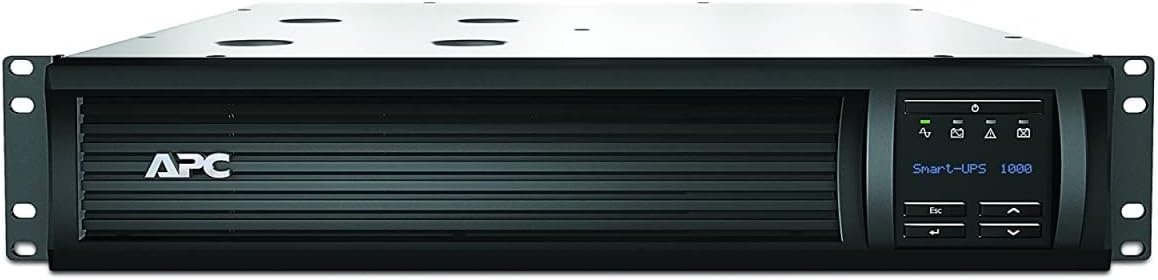
- Rated 1500VA and 1000W output supports appropriately sized servers, network switches, and storage equipment.
- Line-interactive power protection with automatic voltage regulation corrects moderate electrical fluctuations without unnecessary battery use.
- Pure sine-wave battery output supports compatible sensitive electronics and active PFC power supplies.
- Eight battery-backed NEMA 5-15R outlets provide convenient connections for multiple essential networking devices.
- - SmartConnect cloud monitoring, multifunction LCD controls, and replaceable batteries support ongoing management and maintenance.
The APC SMT1500RM2UC Has the Power Capacity Most Small Server Racks Actually Need
The APC Smart-UPS SMT1500RM2UC is a line-interactive rackmount uninterruptible power supply designed for servers, network switches, storage devices, and business communication equipment. It combines a 1440VA/1000W output rating, pure sine-wave battery power, automatic voltage regulation, and SmartConnect monitoring. For buyers comparing the best UPS battery backup rack mount options, it offers a practical combination of electrical protection and management features, although its size and battery technology create some disadvantages.
The UPS occupies 2U of rack space and is designed for 120V electrical installations. It provides six NEMA 5-15R outlets and uses a standard NEMA 5-15P input connection. The combination of substantial output capacity and six protected outlets makes it suitable for a small collection of business-critical devices.
Its rated 1000W output is particularly useful for installations that have outgrown smaller 300W or 400W UPS systems. A router, firewall, switch, and modest server may fit within this power budget, depending on their actual consumption. The important detail is calculating the load before connecting equipment.
The SMT1500RM2UC also provides a multifunction LCD, USB and serial communication, and a SmartSlot expansion interface. These features are relevant to businesses that want more than basic battery backup. The integrated monitoring and configurable power protection features help administrators inspect operating conditions and plan maintenance.
However, this is not a compact lithium-ion UPS. It uses a replaceable lead-acid battery system and requires enough rack space for a relatively heavy 2U chassis. Buyers should consider those installation requirements alongside its electrical capabilities.
The Pure Sine-Wave Output and Voltage Regulation Are Its Strongest Technical Features
One of the most useful features of the APC SMT1500RM2UC is its line-interactive topology. This allows the UPS to correct certain incoming voltage fluctuations without immediately switching to battery operation. The automatic voltage regulation for unstable utility power can help maintain a suitable electrical supply during moderate brownouts and overvoltage conditions.
Consider a small office where a network cabinet shares a building with equipment that occasionally causes voltage fluctuations. A brief reduction in incoming voltage may not require a complete switch to battery power. The APC can regulate certain disturbances while preserving stored energy for a more significant interruption.
This matters because battery capacity is limited. Repeatedly discharging a battery for manageable voltage fluctuations can increase cycling and reduce the energy available for actual outages. However, automatic voltage regulation does not eliminate every possible electrical problem.
The UPS also provides pure sine-wave output during battery operation. This is particularly relevant for servers and computers using active power factor correction power supplies. The pure sine-wave battery output for sensitive electronics offers a compatibility advantage over certain simulated sine-wave UPS models.
For example, a small server may use a power supply that expects a conventional sinusoidal AC waveform. When utility electricity fails, the UPS needs to provide temporary power without creating an unexpected compatibility problem. A pure sine-wave output is a sensible choice for that application.
However, waveform compatibility is only one part of the selection process. Startup current, continuous power consumption, and the equipment manufacturer's requirements also matter. Buyers should confirm the electrical specifications of their connected devices before installation.
The SMT1500RM2UC is rated for 1440VA of apparent power and 1000W of real power. These figures are related but not interchangeable. Understanding the difference between VA and watts is essential when sizing a rackmount battery backup.
For example, imagine a server consuming 300W, a storage appliance using 120W, and networking equipment drawing another 100W. Their combined nominal demand would be 520W. That is below the UPS's 1000W maximum, although additional headroom should be allowed for startup demands and future expansion.
A common mistake is selecting a UPS based only on its advertised VA class. The SMT1500RM2UC belongs to the 1500VA product category, but its documented apparent power rating is 1440VA. Users should calculate both real and apparent power requirements rather than relying on the category name.
The six NEMA 5-15R outlets provide connections for compatible equipment requiring battery backup and surge protection. This is enough for many small network cabinets. The six battery-backed outlets for essential equipment can accommodate devices such as routers, switches, firewalls, and entry-level servers.
However, six available outlets do not mean that six demanding servers can operate simultaneously. The total connected load must remain within the UPS's electrical ratings. Equipment should also be prioritized according to its importance during an outage.
For example, a business may want to protect its firewall, main network switch, and storage appliance. A noncritical monitor or peripheral may not require the same backup priority. Connecting only essential devices can reduce power consumption and improve available runtime.
Runtime planning is another important consideration. Backup duration decreases as the connected load increases, and it also changes with battery age and temperature. Calculating realistic battery runtime at the intended load is more useful than relying on a single maximum-runtime claim.
Consider a small business server that requires several minutes to stop applications and shut down properly. The UPS must provide enough time for that process to complete. A system operating close to the maximum 1000W rating will generally have less available backup time than one drawing only 300W.
Buyers should consult APC's official runtime information for their planned load. They should also allow a safety margin rather than assuming the published estimate will remain unchanged throughout the battery's service life. A UPS is intended to provide temporary continuity, not unlimited emergency electricity.
The SMT1500RM2UC supports communication through USB and serial connections. These interfaces can work with compatible APC PowerChute software to coordinate an orderly shutdown. The supported communication interfaces for automatic shutdown are particularly valuable when protecting servers and storage systems.
For example, a business may operate a file server containing documents that employees access throughout the day. During an extended outage, a controlled shutdown can help applications close and the operating system stop properly. This is preferable to allowing the battery to become completely exhausted while the server is still running.
However, automatic shutdown requires correct configuration. Connecting a communication cable does not guarantee that every operating system or application will respond appropriately. Administrators should install supported software and test the shutdown procedure before relying on it.
Another important feature is APC SmartConnect. The UPS includes an Ethernet connection intended for supported cloud-based monitoring. The built-in SmartConnect remote UPS monitoring capability allows administrators to review certain operating conditions without being physically present.
Imagine a company with three small offices, each containing a network cabinet. An administrator may need to identify which location has experienced a power interruption or reported a battery warning. SmartConnect can provide remote visibility that reduces the need for routine visits simply to inspect UPS status.
However, SmartConnect features depend on the applicable service terms and subscription arrangements. Buyers should confirm which notifications, monitoring functions, and management options are available with their purchase. Remote monitoring should not be confused with unrestricted remote control of every connected outlet.
The UPS also includes a SmartSlot expansion interface. This supports compatible management accessories for organizations requiring additional monitoring capabilities. The expandable SmartSlot interface for network management can be useful when integrating UPS equipment into an established IT monitoring environment.
For example, an administrator may want UPS events reported through a centralized network management platform. A compatible management card may provide additional communication options. The exact accessory and supported functions should be confirmed before purchasing.
The SMT1500RM2UC also supports a switched outlet group. This can be useful for selected equipment restart and power sequencing functions when the appropriate management method is available. The configurable outlet group for equipment power control provides more flexibility than a UPS with only permanently grouped outputs.
However, power cycling must be planned carefully. Restarting a network switch or storage appliance can interrupt connected services. Administrators should document which equipment may be safely restarted and which devices must remain powered whenever possible.
The multifunction LCD provides another useful management option. It allows technicians to inspect UPS operating information and review supported configuration settings directly from the front panel. The front-panel LCD with accessible operating information is convenient during installation and maintenance.
For example, a technician may want to inspect the connected load after adding a new network switch. The LCD can provide immediate information without requiring a separate monitoring computer. This helps identify situations where the UPS is approaching its capacity.
The sealed lead-acid battery system is another important consideration. Unlike lithium-ion alternatives, lead-acid batteries require periodic replacement as their capacity deteriorates. The replaceable lead-acid battery for continued service allows owners to maintain the UPS without automatically replacing the complete unit.
APC identifies the APCRBC159 as the replacement battery cartridge for this model. Buyers should confirm compatibility before ordering and follow the manufacturer's installation instructions. Battery replacement involves electrical and handling risks, so unsuitable substitutes should be avoided.
Battery condition also depends on the operating environment. Elevated temperatures can accelerate deterioration, particularly when a UPS operates continuously in a poorly ventilated cabinet. Maintaining appropriate ventilation and battery operating temperatures is important for reliable long-term performance.
For example, a network cabinet installed in a storage room may become unusually warm during summer. Servers, switches, and power equipment all contribute to the surrounding heat. Proper airflow and periodic temperature checks can help reduce unnecessary battery stress.
The 2U rackmount construction also requires planning. Two rack units occupy approximately 3.5 inches of vertical mounting space. Buyers should confirm the available cabinet depth, rail compatibility, and weight capacity before installation.
A common mistake is measuring only the available rack height. A UPS may fit vertically but still be too deep for the cabinet once rear power cables are connected. Checking rack depth and rear cable clearance can prevent an inconvenient installation problem.
The unit should be mounted using appropriate rails and hardware. Heavy rack equipment is generally best positioned low in the cabinet to support a stable weight distribution. Users should follow the rack manufacturer's loading recommendations rather than relying on improvised supports.
Another practical consideration is the electrical connection. The SMT1500RM2UC uses a 120V NEMA 5-15P input plug. This makes it suitable for compatible North American installations but not automatically appropriate for 230V electrical systems.
Buyers should verify their electrical supply before purchasing. A similarly named international APC model may have different voltage and outlet configurations. Confirming the exact regional UPS model and voltage prevents mistakes that can be expensive to correct.
Routine maintenance should include reviewing UPS alarms, inspecting ventilation openings, monitoring battery condition, and checking the connected load. Administrators should also periodically test their shutdown procedures according to APC's recommendations. Regular inspections can identify problems before an actual power failure occurs.
Finally, the SMT1500RM2UC is intended for businesses that need reliable short-duration backup power for appropriately sized equipment. Its line-interactive topology, pure sine-wave output, and monitoring features provide useful protection. Correct load calculations and maintenance remain essential for dependable operation.
Why We Ranked the APC SMT1500RM2UC Number Seven
We placed the APC Smart-UPS SMT1500RM2UC seventh out of seven because it offers substantial power capacity and useful management features, but its lead-acid battery system and 2U construction are less attractive for our preferred compact rackmount installations. This ranking does not mean it lacks electrical capability. The combination of pure sine-wave power and voltage regulation remains a significant advantage.
The 1000W output rating is one of its strongest features. It provides more capacity than the smaller 300W, 400W, and 600W models in our comparison. This makes it particularly relevant for installations containing several network devices or a modest server.
The pure sine-wave battery output is another positive feature. It supports compatibility with many modern computing power supplies and sensitive electronics. The reliable waveform for compatible server power supplies makes it a useful option for business IT environments.
SmartConnect monitoring also contributes to its appeal. Administrators can review supported UPS information remotely and receive notifications through available cloud features. This can help businesses manage equipment across multiple locations.
However, our first-ranked Eaton Tripp Lite BC500RT1ULNC uses lithium-ion battery technology in a compact 1U chassis. It is designed for smaller loads but offers a more space-efficient installation. The difference in battery technology and rack space contributes to our preference for the Eaton.
Our second-ranked APC SMC1000-2UC also offers line-interactive protection and pure sine-wave output. Its lower 600W capacity is sufficient for many small network installations, while its configuration may be more appropriate for buyers who do not need a full 1000W. Selecting the correct capacity is often more useful than purchasing a larger UPS without a clear requirement.
The third-ranked APC SCL500RM1UC provides a short-depth 1U chassis and lithium-ion battery technology. Its smaller physical footprint can be particularly useful in compact wall-mounted network cabinets. The SMT1500RM2UC requires more installation space and uses a heavier conventional battery system.
Our fourth-ranked APC SMT2200RM2UC provides substantially greater output capacity for demanding server installations. Buyers who already require a larger UPS may prefer that additional electrical headroom. The difference in available output power and expansion needs affects the relative value of these models.
The fifth-ranked Tripp Lite SMART500RT1U occupies only 1U of rack space and provides straightforward protection for smaller networking loads. The sixth-ranked SMART1500LCDXL offers a 900W output and support for an optional external battery pack. That expandable runtime is useful when additional backup duration is more important than cloud monitoring.
Another limitation of the SMT1500RM2UC is its conventional lead-acid battery. Although replaceable, the battery requires periodic maintenance and eventual replacement. The ongoing battery maintenance and replacement requirements can increase long-term ownership effort compared with certain lithium-ion alternatives.
The 2U chassis is another consideration. It occupies twice the vertical rack space of a 1U UPS, which may be significant in compact cabinets. Buyers should also account for its depth and mounting requirements.
The UPS does not provide online double-conversion protection. Its line-interactive topology is suitable for many ordinary server and networking applications, but some sensitive installations may require continuous power conversion. The limitations of line-interactive UPS topology should be considered when evaluating demanding electrical environments.
SmartConnect subscription arrangements are another factor. Some remote management features may require an appropriate service plan. Buyers should confirm the available functionality before making cloud monitoring a central part of their purchasing decision.
These considerations explain why the SMT1500RM2UC occupies seventh place in our comparison. Nevertheless, its 1000W output, six protected outlets, pure sine-wave battery power, automatic voltage regulation, and management interfaces provide substantial practical value. It remains capable of protecting appropriately sized business equipment.
Ultimately, we believe the APC Smart-UPS SMT1500RM2UC deserves seventh place because it offers substantial rackmount power protection with useful management features, while its larger chassis and lead-acid battery system make it less convenient than several compact alternatives. Its strong electrical capacity, pure sine-wave output, SmartConnect monitoring, and replaceable battery make it particularly suitable for small servers and network infrastructure. For buyers who have sufficient rack space and need dependable 1000W-class backup protection, the APC SMT1500RM2UC remains a capable and worthwhile choice.