


- 160W total output handles several high-power devices while traveling.
- Five charging ports reduce the need for multiple adapters.
- Smart display provides real-time charging information at a glance.
- GaN technology delivers substantial power from a compact charger.
- Up to 140W single-port charging supports compatible high-power laptops.

This is the kind of charger that can replace several travel adapters
The UGREEN Nexode Pro 160W takes our number one position in the best multi port USB charger for travel comparison because it puts serious charging capacity into one relatively compact unit. With five ports, up to 160W total output, high-power USB-C charging, GaN technology, and a built-in smart display, it is designed for travelers carrying considerably more than a phone.
That is increasingly normal for business travel. A laptop, smartphone, tablet, smartwatch, earbuds, and power bank can easily end up in the same carry-on, and bringing a separate wall adapter for every device wastes space and occupies several outlets at the hotel.
The five-port layout changes that setup. One charger can handle several devices from a single wall outlet, which is useful in airport lounges, hotel rooms, conference centers, and older accommodation where conveniently positioned power sockets can be limited.
The 160W total power budget is the important number here. This is not simply a multi-port phone charger with several low-power connections added to the front, but a charger intended to accommodate higher-power USB-C hardware as part of the same setup.
The 140W USB-C output is what makes laptop travel easier
The highest-power USB-C connection can deliver up to 140W to a compatible device and cable. That is enough to cover demanding USB-C laptops that would be poorly served by the 20W or 30W adapters commonly packed for phones and tablets.
This matters for business travelers because the laptop is often the device that determines whether one charger can genuinely replace the rest. Charging a phone is easy, but a high-performance notebook may require considerably more USB Power Delivery capacity.
With the Nexode Pro, a compatible laptop can receive high-power charging while the remaining ports handle smaller electronics. That makes the charger useful as a complete desk power hub when you arrive at a hotel rather than merely being an emergency travel accessory.
There is an important detail with multi-port chargers, though. The 160W figure represents the total available charging capacity, and power is distributed differently depending on which ports are being used and how many devices are connected.
If one laptop is drawing substantial power while several phones, tablets, or accessories are charging, the charger has to allocate its available wattage between those devices. You should not expect every port to simultaneously provide its individual maximum rating.
This is normal behavior for multi-port USB-C chargers. The practical mistake is looking at the maximum rating printed beside each port, adding those numbers together, and assuming all of them remain available at once.
For travel, the better approach is to connect the highest-power laptop to the primary USB-C port. Lower-power devices such as a phone, earbuds, smartwatch, or power bank can then use the remaining connections.
Cable choice matters as well. High-wattage charging requires a suitable USB-C cable, and a cable that works perfectly for a phone may not support the full charging rate available to a laptop.
For charging above 100W, use an appropriately rated USB-C cable with the required electronic marking and Power Delivery support. Otherwise the charger and laptop may negotiate a lower power level even though both devices themselves support something faster.
The five-port arrangement is particularly useful when two people are traveling together. One person can charge a laptop and phone while another connects a tablet and smartphone, leaving another port available for smaller accessories.
That can also reduce arguments over hotel outlets. Instead of plugging several bulky adapters into a wall strip, the group can centralize most USB charging around one compact unit.
Why we believe the Nexode Pro 160W deserves number one
The smart display is one of the features that separates this model from simpler GaN chargers. It gives users visible charging information rather than leaving them to guess whether a connected device is receiving the expected power.
That is useful when troubleshooting a travel setup. If a laptop appears to be charging unusually slowly, the display can help reveal whether the charger is supplying a lower power level because of the cable, device negotiation, or the way power is currently distributed across several ports.
This makes the screen more than decoration. Real-time charging information helps diagnose problems that would otherwise require unplugging devices and swapping cables until something changes.
GaN technology is another important part of the design. Gallium nitride power electronics allow modern chargers to handle substantial power while reducing the bulk that would normally come with a conventional high-output multi-device power supply.
Size matters when traveling. A charger may spend more time inside a backpack or carry-on than attached to a wall, so reducing the number and size of separate power bricks can make packing noticeably easier.
The compact design also helps in airport lounges. Wall outlets are often positioned behind seats, underneath counters, or in other inconvenient places where a large collection of adapters becomes awkward quickly.
Heat is still normal with high-output charging. A compact 160W charger converting AC power while several devices are drawing substantial current will become warm, particularly during fast charging.
Do not cover it with clothing, paperwork, bedding, or other objects while it is operating. Clear airflow is sensible during high-power charging, especially when several devices are connected for an extended period.
Travelers also need to understand the difference between plug compatibility and voltage compatibility. A travel plug adapter changes the physical connection to the wall, while the charger itself must support the electrical input voltage available in the destination country.
Before international travel, check the input specification printed on the charger and confirm it supports the destination's mains voltage and frequency. If the electrical input is compatible, you may only need the appropriate physical plug adapter rather than a voltage converter.
This distinction matters because plugging an incompatible appliance into a simple travel adapter does not magically convert voltage. Fortunately, modern USB chargers are often designed around broad international input ranges, but the actual specification should always be checked before departure.
Device charging protocols matter too. USB Power Delivery negotiates power between the charger and connected hardware, meaning the charger does not simply force 140W into every device attached to the high-power port.
A smartphone that only accepts a much lower charging level will request what it supports. That is why one high-power USB-C charger can serve different devices without every connected product receiving the same wattage.
The main compromise is that this is more charger than a minimalist traveler may need. Someone carrying only a phone and earbuds could use a much smaller two-port adapter and save additional luggage space.
It also depends on intelligent power sharing, so users with several demanding laptops cannot assume every computer will receive maximum power simultaneously. Port selection and the total 160W budget still need to be considered.
But those limitations are reasonable because this charger is designed for a different kind of traveler. It makes the most sense for people carrying a laptop plus several USB devices, business travelers sharing charging space, or anyone trying to consolidate a bag full of separate power bricks.
That is why we believe the UGREEN Nexode Pro 160W deserves the number one ranking out of seven. Five charging ports, up to 160W total power, high-output USB-C charging, GaN construction, and a useful smart display address the main problems that appear when several devices need power away from home.
For business trips in particular, it can simplify the whole charging setup. Pack appropriate high-wattage cables and the correct international plug adapter when required, and one compact charger can take care of the laptop, phone, tablet, accessories, and other everyday electronics from a single wall connection.

- 140W maximum charging supports compatible high-power USB-C laptops.
- Four charging ports power several travel devices simultaneously.
- Built-in digital display shows useful real-time charging information.
- GaN technology keeps high-power charging hardware relatively compact.
- Foldable plug design makes storage easier inside travel bags.
The 140W output makes this a real laptop charger, not just a phone hub
The MINIX Neo P4 takes the number two position in our best multi port USB charger for travel comparison because it combines high-power USB-C charging, four device connections, GaN technology, and a built-in display in a package designed to replace several individual adapters. For a business traveler carrying a laptop, phone, tablet, and accessories, that combination makes immediate sense.
The headline specification is the 140W maximum output available for compatible USB-C hardware. That level of USB Power Delivery means the charger can handle demanding laptops rather than forcing travelers to carry a separate high-wattage notebook power brick.
This matters because laptops are usually the difficult device in a travel charging setup. Phones, earbuds, watches, and many tablets can run from modest chargers, but high-power laptops need considerably more USB-C capacity if you want them to charge properly while they are being used.
Imagine arriving at a hotel after a full day of meetings. The laptop is nearly empty, the phone is below 20 percent, the tablet was used on the flight, and the earbuds need charging before the next morning.
A four-port charger lets those devices share one wall connection. Instead of spreading separate power bricks around the room, the charging setup stays in one place and leaves more outlets available for other equipment.
Four ports are enough for most business travel bags
The four-port arrangement is a useful middle ground. It gives you enough connections for the equipment most people actually travel with without making the charger unnecessarily large.
A typical setup might use the primary high-power USB-C connection for a MacBook or another USB-C laptop. The remaining connections can then handle a smartphone, tablet, power bank, wireless earbuds, or another smaller accessory depending on the trip.
Power distribution still needs to be understood correctly. Maximum port ratings are not all available simultaneously when several devices are connected because the charger's total available power has to be divided between them.
This is normal for multi-port GaN chargers. Connecting another device can cause the charger to renegotiate power and redistribute its output based on what each connected product requests.
You may notice a laptop briefly change its charging state when another device is plugged in. That does not automatically indicate a fault, because USB Power Delivery can renegotiate the available charging profile as the load changes.
The practical approach is simple. Connect the most demanding laptop to the port designed for the highest output, then use the other connections for lower-power devices.
Cables matter just as much as ports. A high-power USB-C charger cannot deliver its full potential through a cable that is only designed for lower-wattage charging.
For very high USB-C power levels, use a properly rated e-marked USB-C cable. If the laptop, charger, and cable do not all support the required Power Delivery profile, charging will fall back to a lower negotiated rate.
The built-in display is particularly useful here. Instead of simply seeing a tiny charging icon on the laptop and wondering what is happening, the charger provides visible information about the active charging process.
This can help when comparing cables. If one cable consistently results in lower charging power than another with the same laptop and port, the display gives you another clue about where the limitation may be.
It is also useful at airports. You can connect a nearly depleted laptop during a layover and get a clearer idea of how the charging setup is behaving without opening system menus on every connected device.
Why the Neo P4 comes very close to our number one pick
GaN technology is another reason the MINIX makes sense for travel. Gallium nitride power components allow manufacturers to build high-output chargers that are considerably more compact than older high-wattage power supplies.
That matters when every item needs to fit inside a laptop bag or carry-on. One compact charger can replace several power bricks, reducing cable clutter and the amount of charging hardware packed for a trip.
The foldable plug improves portability further. When the charger is packed, the AC pins can fold into the body rather than sticking outward where they can catch on cables, scratch another device, or take up unnecessary space.
That sounds like a minor design detail until the charger lives inside a tightly packed technology pouch. Fixed prongs are awkward around power banks, adapters, cables, and other small electronics.
International travel needs a little more thought. A foldable North American plug will not physically fit every wall socket around the world, so the correct destination plug adapter may still be required.
A plug adapter and a voltage converter are not the same thing. The adapter only changes the physical shape of the connection, while electrical voltage compatibility depends on the charger's supported input range.
Always check the input rating printed on the actual charger before connecting it abroad. If the charger supports the destination's mains voltage and frequency, a physical travel adapter may be all you need.
Heat should also be expected during high-power charging. Converting substantial AC power into USB-C output inside a compact enclosure naturally produces heat, particularly when a laptop and several other devices are charging together.
Warm operation is not automatically a problem, but airflow matters. Do not bury the charger underneath clothing, bedding, paperwork, or a travel bag while it is delivering high power.
Give the charger some open space around its body. This is especially important when charging overnight at a hotel where people sometimes place power adapters behind pillows or underneath luggage to keep cables out of sight.
Another common mistake is buying a high-wattage charger and expecting every device to charge at 140W. USB Power Delivery is negotiated between the charger and the connected device, so a phone that accepts 27W will not suddenly receive the full output intended for a laptop.
This is actually an advantage. Devices request the charging profiles they support, allowing one powerful charger to serve very different electronics without treating them all as identical loads.
So why does the MINIX Neo P4 finish number two instead of taking our top position? The UGREEN Nexode Pro 160W ranked above it provides a larger 160W total power budget and five charging ports, giving it more capacity when several devices need power at once.
That additional port also matters for heavier travel setups. A laptop, phone, tablet, earbuds, and power bank can all occupy their own connection on the UGREEN, while the four-port MINIX requires slightly more planning when the bag contains five or six rechargeable devices.
The difference is not huge, though. The MINIX still provides high-power 140W charging, four useful ports, a smart display, GaN construction, and a foldable design that is particularly well suited to travel.
In fact, some travelers may prefer the simpler four-port arrangement if it results in less bulk. Someone carrying one laptop and three smaller devices may have no practical need for a fifth connection or a 160W total power ceiling.
That is why we believe the Neo P4 deserves the number two position out of seven. It has enough power for demanding USB-C laptops, enough ports for a realistic business travel setup, and the display gives users useful visibility into what their charger is actually doing.
Pack it with appropriately rated USB-C cables and the correct international plug adapter when necessary, and the MINIX can replace a surprising amount of charging hardware. For business trips, airport layovers, hotel desks, and everyday carry, it is a strong alternative to traveling with several separate wall chargers.
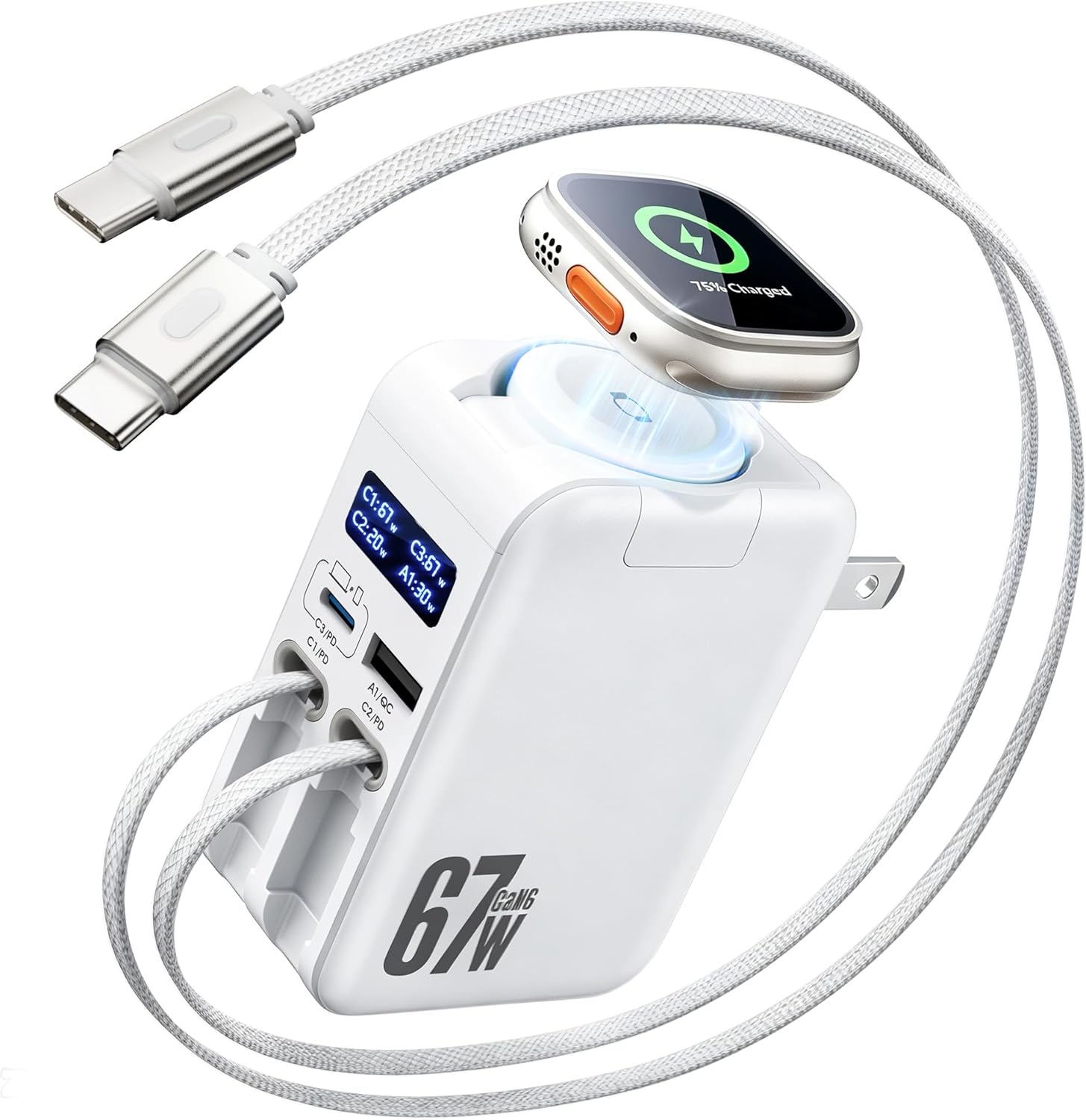
- Retractable USB-C cable reduces loose cable clutter while traveling.
- Multiple charging connections handle several everyday devices from one adapter.
- Compact all-in-one design takes up less room inside luggage.
- USB-C fast charging supports compatible phones, tablets, and electronics.
- Integrated cable makes quick airport and hotel charging more convenient.
The built-in retractable cable solves a real travel problem
The LISEN retractable charger takes the number three position in our best multi port USB charger for travel comparison because it approaches travel charging differently from the high-wattage desktop-style chargers above it. Instead of focusing only on maximum power, it combines multiple charging connections with an integrated retractable USB-C cable, making the whole setup easier to pack and quicker to use.
The retractable cable is the feature that immediately makes sense when traveling. Loose USB-C cables tend to become tangled around laptop chargers, headphones, power banks, adapters, and whatever else has been pushed into the same technology pouch.
With the cable already built into the charger, there is one less separate accessory to remember. You can pull out the cable when needed, connect a compatible device, then retract it back into the charger when charging is finished.
That is particularly convenient during short airport stops. If you only have twenty minutes before boarding, taking one charger from the bag and immediately connecting the phone is much easier than unpacking an adapter and searching for the correct cable separately.
The all-in-one design works well when luggage space matters
Travel chargers have to balance power, ports, weight, and physical size. A charger with enormous output is useful for a workstation, but somebody traveling with a phone, tablet, earbuds, and smaller USB-C electronics may care more about reducing the number of individual accessories in the bag.
This is where the LISEN design becomes interesting. Multiple charging connections allow several devices to share one wall adapter, while the integrated cable removes at least one loose cable from the setup.
Imagine arriving at a hotel after a long flight. Your phone needs charging immediately, the earbuds are nearly empty, and another USB-powered device needs to be ready before the next morning.
Instead of spreading several chargers around the room, one multi-device charger simplifies the setup. It is also useful when the hotel provides only one convenient outlet beside the bed or desk.
The retractable mechanism helps with cable management at the hotel too. You can extend only the amount of cable required rather than leaving a long charging lead hanging across the desk.
That can make a surprisingly big difference on small hotel tables. Laptops, passports, phones, coffee, paperwork, and charging equipment all compete for the same limited surface area.
The built-in cable should still be treated carefully. Retractable cables contain a mechanical winding system, so repeatedly pulling the cable aggressively to its maximum extension or letting it snap back at high speed can create unnecessary wear.
Extend it smoothly and allow it to retract under control. Gentle handling can help the mechanism last longer, especially if the charger is being used every day during frequent business trips.
USB-C fast charging is another useful part of the package. Compatible smartphones, tablets, power banks, and other devices can negotiate faster charging than they would receive from an old low-power USB adapter.
The actual charging speed still depends on the connected device. A charger cannot force a phone to accept more power than its charging system supports, and different devices may negotiate different USB-C power profiles.
This is normal USB charging behavior. The device and charger communicate, determine an appropriate charging level, and then deliver power within the supported limits.
Why this practical travel charger finishes third
Multi-device charging needs a little planning. When several products are connected simultaneously, the charger's available output may be divided between them rather than every connection delivering its maximum individual charging rate.
This means a phone may charge differently when it is the only device connected compared with when several other electronics are drawing power at the same time. Total charger output has to be shared across the active connections.
For overnight hotel charging, that is usually not a major issue. A phone, earbuds, smartwatch, and smaller accessories have several hours to recharge while you sleep, so absolute maximum speed on every connection is less important.
During a short airport layover, port priority matters more. Connect the device that needs power most urgently first, particularly if you only have fifteen or twenty minutes before boarding.
Business travelers should also think about which devices genuinely need high wattage. A laptop can require far more power than a phone or pair of earbuds, so check the charging requirements of the computer before assuming one compact multi-port charger can replace its original adapter.
This is where our first and second ranked products maintain an advantage. The UGREEN Nexode Pro provides up to 160W total output with a high-power USB-C connection, while the MINIX option is built around similarly demanding laptop charging requirements.
The LISEN is more about convenience and integration. The retractable cable is its main travel advantage, rather than competing purely on the largest possible wattage number.
That can actually make it more appropriate for some travelers. If the trip revolves around a smartphone, tablet, earbuds, power bank, and other compact electronics rather than a power-hungry laptop, carrying a smaller all-in-one charging solution may be preferable.
International travel requires another check before departure. The physical plug on a North American charger will not fit every socket type used around the world, so a suitable plug adapter may still be required.
A plug adapter does not convert electrical voltage. Always check the input voltage specification printed on the actual charger and make sure it is compatible with the mains electricity used at the destination.
If the charger supports the destination voltage, a physical plug adapter may be enough. If it does not, simply changing the plug shape does not make the electrical input safe.
Heat is another normal consideration. Charging several devices simultaneously creates more load than charging a single phone, and compact power electronics can become warm during operation.
Do not bury the charger underneath clothing, bedding, or luggage while it is connected. Keep some open space around the charger, particularly when several devices are drawing power for hours.
The same rule applies on airplanes and in airport lounges. If an outlet is tucked beside a seat, make sure the charger is not being crushed between luggage or covered by a jacket while operating.
One common travel mistake is relying completely on the integrated cable. Built-in cables are convenient, but carrying one short backup USB-C cable is still sensible if charging is critical to the trip.
A separate cable adds very little weight and provides redundancy. If the retractable mechanism is ever damaged, the remaining charging ports can still keep compatible devices powered.
So why does this LISEN charger receive our number three ranking out of seven? Its multi-device design, retractable USB-C cable, compact construction, and fast-charging support address some of the most annoying parts of traveling with several electronics.
It finishes behind the UGREEN and MINIX because those chargers provide stronger high-wattage laptop charging and larger overall power budgets. Travelers carrying demanding notebooks will appreciate that additional power.
But the LISEN has an advantage of its own. It reduces cable clutter and makes quick charging unusually convenient, which matters when moving repeatedly between airports, hotels, conference centers, trains, and temporary workspaces.
For travelers who value portability and an integrated charging setup more than maximum laptop wattage, this is a very practical option. That balance of multiple connections, fast charging, and a retractable cable is why we believe it deserves the number three position.

- Universal plug system supports travel across many international destinations.
- Multiple USB ports charge several personal devices simultaneously.
- USB-C charging supports compatible phones, tablets, and travel electronics.
- All-in-one design reduces separate adapters inside your luggage.
- Built-in safety features provide added protection during international charging.
The universal plug system solves a problem the faster chargers cannot
The VYLEE universal travel adapter takes the number four position in our best multi port USB charger for travel comparison because it solves a different problem from a conventional high-wattage GaN charger. Instead of concentrating entirely on maximum USB-C output, it combines multi-device USB charging with an international plug system designed for use across different countries.
That becomes useful the moment a trip crosses between regions with different wall sockets. A powerful charger is not much help if its plug physically cannot connect to the outlet beside your hotel bed.
The VYLEE puts several common international plug configurations into one compact travel accessory. One adapter can cover multiple destinations, reducing the need to pack a separate plug adapter every time the itinerary changes.
This is particularly useful on multi-country business trips. Someone traveling from Canada to the United Kingdom, then into continental Europe and later another region may encounter several socket standards during the same journey.
Multiple USB ports make hotel charging much less complicated
The multi-port design is the other reason this product belongs in the comparison. Instead of using the adapter only as a bridge between one North American plug and a foreign socket, the integrated USB connections allow several compatible devices to charge directly from the unit.
A typical hotel setup might include a smartphone, smartwatch, wireless earbuds, tablet, and power bank. Without a multi-port charger, each device either needs its own adapter or has to wait for another device to finish.
Putting several USB connections into the travel adapter reduces that clutter. One wall socket can charge several devices, which matters in hotel rooms where the conveniently positioned outlets are often already occupied by lamps or other equipment.
This becomes even more useful beside the bed. Rather than running several adapters from outlets around the room, the phone, watch, and earbuds can remain together where they are easy to collect the following morning.
USB-C support also makes the adapter more relevant to modern electronics. Newer phones, tablets, power banks, headphones, and many other devices increasingly use USB-C instead of relying entirely on older USB-A connections.
The actual charging rate still depends on the individual port and connected device. A USB-C connector does not automatically mean every port provides the same high-power charging level as a dedicated 100W or 140W laptop charger.
This distinction matters for travelers carrying powerful notebooks. Port shape and charging wattage are separate things, so always check the power requirement of the laptop before deciding to leave its normal charger at home.
Smaller electronics are much easier. Phones, earbuds, watches, and many tablets require considerably less power, making a multi-port travel adapter particularly convenient for overnight charging.
Power sharing needs to be considered as well. When several devices are connected simultaneously, the adapter has to distribute its available USB charging capacity across those active ports.
A phone may therefore charge more quickly when connected alone than when several devices are drawing power at the same time. That is normal behavior for multi-device charging hardware rather than necessarily indicating a fault.
Why the VYLEE finishes fourth despite being better suited to international trips
The biggest thing to understand is that a travel adapter is not automatically a voltage converter. This is probably the most important practical point with any universal adapter.
The plug system changes the physical connection between your device and the foreign wall socket. It does not necessarily transform 220V or 240V electricity into the 110V or 120V supply expected by a voltage-specific appliance.
Before connecting equipment internationally, check the voltage rating on the device. Electronics marked for a broad input range such as 100V to 240V are generally designed for international mains voltages, assuming the frequency and other requirements are also compatible.
Many modern laptop chargers, phone chargers, and USB power supplies use broad voltage input ranges. Hair dryers, curling irons, electric shavers, and other high-power appliances require more careful checking because some models are designed for only one voltage range.
Plugging a 120V-only appliance into a 230V outlet through a simple travel adapter can damage the appliance and create a safety risk. The fact that the plug physically fits does not make the electrical supply compatible.
The integrated USB charging section is different because the adapter's electronics handle the conversion required for its USB outputs within the product's specified input range. Even then, users should follow the manufacturer's electrical limits rather than assuming every appliance can be connected.
Another issue is total load. Universal adapters have maximum electrical ratings, and those limits matter when using the AC outlet with higher-power equipment.
Do not connect several high-wattage appliances through additional splitters and assume the travel adapter can handle everything. Stay within the adapter's rated electrical limits and use it for the kinds of electronics the manufacturer specifies.
The physical connection should also be checked after inserting the adapter into a foreign socket. Different outlets can vary in wear and grip, especially in older hotels, airports, and temporary accommodation.
If the adapter feels loose or begins pulling away from the wall under the weight of attached equipment, reduce the load and reposition it. Heavy cables hanging from a travel adapter can put unnecessary mechanical stress on the socket.
Heat is another normal consideration when several USB devices are charging. Keep the adapter exposed to air rather than burying it underneath bedding, clothing, or luggage.
This is especially important overnight. Travelers sometimes place charging equipment behind a pillow or suitcase to keep the desk tidy, but power adapters need reasonable ventilation while operating.
So why does the VYLEE finish number four rather than joining our top three? The products above it provide stronger dedicated charging performance for travelers who need substantial USB-C power.
The UGREEN Nexode Pro at number one offers up to 160W total output and five ports, while the MINIX at number two provides high-power laptop charging in a compact GaN package. Our number three retractable charger also provides a particularly convenient integrated-cable design.
The VYLEE is less specialized around maximum charging speed. Its advantage is international compatibility, giving it a broader physical plug solution for travelers moving between countries.
For someone traveling only within Canada or the United States, that advantage may not matter much. A smaller high-output GaN charger could provide more power without carrying an international plug mechanism that rarely gets used.
For international business travel, the calculation changes. The universal plug system becomes genuinely useful because one adapter can remain in the travel bag for different destinations instead of changing adapters for every region.
That is why we believe the VYLEE deserves the number four position out of seven. It does not match the highest-ranked products for raw USB-C charging power, but multiple USB connections, USB-C support, international plug compatibility, and an all-in-one design make it a very practical travel accessory.
If your trips regularly cross borders, its versatility may matter more than the ranking suggests. Check device voltage compatibility, stay within the rated electrical limits, and the VYLEE can simplify charging across airports, hotels, conference venues, and international business trips without filling the luggage with separate plug adapters.

- 100W USB-C output supports fast charging for compatible laptops.
- Four charging ports handle several travel devices simultaneously.
- GaN technology delivers substantial power from a compact body.
- Foldable plug design makes packing inside travel bags easier.
- USB-C Power Delivery supports laptops, tablets, phones, and accessories.
One hundred watts is still plenty for a lot of travel laptops
The UGREEN Nexode 100W takes the number five position in our best multi port USB charger for travel comparison because it offers a sensible balance between laptop charging power and portability. With up to 100W USB-C output, four charging ports, GaN technology, and a foldable wall plug, it can replace several separate chargers without becoming another large power brick inside your carry-on.
The 100W output is the specification that makes this much more than a phone charger. Many USB-C laptops can operate and recharge from a 100W Power Delivery source, so business travelers may be able to leave the original laptop adapter at home.
That can remove a surprising amount of bulk from a bag. One charger can cover the laptop and smaller devices instead of packing a notebook brick, phone adapter, tablet charger, and another adapter for accessories.
Whether 100W is enough depends on the laptop. Thin business notebooks and many MacBook configurations are relatively easy to cover, while more demanding workstation-class laptops may require higher power or may charge more slowly when heavily loaded.
Four ports make much more sense once you reach the hotel
The four-port design is useful because business travelers rarely carry only a laptop. A normal technology bag can include a smartphone, tablet, power bank, earbuds, smartwatch, portable hotspot, or another USB-powered accessory.
At a hotel, those devices all tend to need power at the same time. The Nexode allows several of them to share one wall outlet rather than spreading separate charging adapters around the room.
This is especially useful when the only convenient socket is beside the desk. Connect the laptop, phone, and other electronics there and keep the charging setup in one location rather than trying to remember which outlet each device was left beside.
Multi-port charging does require some understanding of power distribution. The maximum output printed for an individual USB-C port does not mean every connection can deliver that maximum simultaneously.
When multiple devices are connected, the charger's available power is distributed between the active ports according to the supported charging profiles. Plugging in another device can therefore change the amount of power available to the laptop.
This is normal behavior. USB Power Delivery negotiates the charging requirements of connected devices and adjusts output accordingly rather than simply forcing the same wattage through every connection.
For the best travel setup, connect the laptop to the highest-power USB-C port. Phones, earbuds, and other lower-power electronics can use the remaining connections because they generally need far less charging power.
Cable quality matters too. A charger capable of 100W cannot provide that full output if the USB-C cable between the charger and laptop is only rated for substantially lower power.
Use an appropriately rated USB-C cable when charging a high-power notebook. This is one of the most common reasons people buy a powerful charger and then wonder why the computer reports slower charging.
The same principle applies to charging protocols. A device only draws a power level that it supports, so connecting a smartphone to a high-power USB-C port does not mean the charger automatically sends 100W into the phone.
The charger and device communicate first. An appropriate charging profile is selected, which is why one USB-C charger can safely serve very different electronics when the required protocols are supported.
Why the Nexode 100W settles into fifth place
GaN technology is a major reason the Nexode works as a travel charger. Gallium nitride power components allow substantial charging capacity to fit inside a smaller enclosure than many older high-wattage silicon-based power adapters.
That difference matters inside a carry-on. A charger may spend more time packed than plugged in, so reducing its physical volume is almost as useful as increasing its charging speed.
The foldable wall plug helps further. When the charger goes back into the bag, the prongs fold away rather than sticking out between cables, power banks, and other equipment.
Fixed prongs can scratch nearby devices or catch on fabric inside a tightly packed technology pouch. Foldable prongs make travel storage cleaner and reduce the awkward shape of the charger when it is not being used.
International travelers still need to consider socket compatibility. A North American plug will not physically fit many outlets in Europe, the United Kingdom, Australia, and other destinations without the correct travel plug adapter.
A plug adapter is different from a voltage converter. The plug adapter only changes the physical interface, so the charger itself must be electrically compatible with the voltage supplied at the destination.
Check the input specification printed on the charger before international use. If the power supply supports the local mains voltage and frequency, the correct physical plug adapter may be all that is required.
This is worth checking before leaving rather than after arriving at the hotel. Never assume plug compatibility means voltage compatibility, particularly when other electrical appliances are being packed alongside the USB charger.
Heat is another normal part of high-power charging. A compact charger converting substantial power while several devices are connected can become warm, especially when the laptop is drawing close to the charger's upper output range.
Keep the charger exposed rather than covering it with clothes, bedding, or paperwork. Hotel desks can become cluttered quickly, but power electronics should have reasonable airflow during sustained charging.
So why does this UGREEN rank number five out of seven when it is clearly capable? The biggest reason is that the products above it provide either more total charging power or more travel-specific functionality.
Our number one UGREEN Nexode Pro offers 160W total output and five ports. That gives it more room for a demanding laptop plus several other devices, particularly when multiple products need fast charging at the same time.
The MINIX above it also pushes into higher-power charging territory, while the retractable model reduces cable clutter and the universal travel adapter adds direct support for different international wall socket formats.
This 100W Nexode is simpler. It does not have the same power reserve as the 160W model, and four ports provide slightly less flexibility for someone carrying a very large collection of electronics.
But that simplicity can also be useful. A traveler carrying one laptop, one phone, earbuds, and a power bank may have no need for 160W or five simultaneous connections.
In that situation, the smaller 100W charger can cover the devices that actually matter without adding unnecessary size or complexity. It still provides enough power for many USB-C laptops and enough connections for a realistic travel setup.
That is why we believe the UGREEN Nexode 100W deserves the number five position out of seven. It does not lead the group in maximum output or international versatility, but the combination of 100W laptop charging, four ports, GaN construction, and a foldable plug makes it a very practical travel charger.
For business trips where packing light matters and your laptop does not require more than 100W, this may actually be the sensible middle option. Bring properly rated USB-C cables and the correct plug adapter when traveling internationally, and it can replace several individual chargers with one compact unit.

- Multiple USB ports charge several travel devices from one station.
- 100W USB-C charging supports compatible laptops and larger electronics.
- Multiple AC outlets accommodate chargers and other travel equipment.
- Extension cord provides flexible placement around hotel desks and rooms.
- Compact charging station reduces reliance on several separate wall adapters.
This works better when the hotel outlet is nowhere near your desk
The TESSAN charging station takes the number six position in our best multi port USB charger for travel comparison because it solves a slightly different problem from a compact wall charger. Instead of putting every connection directly against the wall socket, it combines multiple USB charging ports and AC outlets with an extension cord, letting the actual charging hub sit where your devices are.
That becomes useful in hotel rooms because power outlets are not always positioned logically. The available socket may be behind a bedside table, underneath the desk, or several feet away from where the laptop and phone actually need to sit.
An extension cord lets you move the charging connections closer to the working area. The outlet does not dictate where your devices sit, which is useful when setting up a temporary office in a hotel room.
This also helps in airport lounges and shared workspaces. Instead of leaving an expensive phone or laptop on the floor beside a wall outlet, the charging station can potentially bring power closer to the table.
The mix of USB and AC connections is useful for a full travel setup
The multi-device layout is the main reason this product belongs in the comparison. A business traveler may need to power a laptop, smartphone, tablet, smartwatch, earbuds, power bank, and equipment that still uses a conventional AC adapter.
A charging station handles that mixed setup better than a USB-only charger. USB devices can connect directly while the AC outlets remain available for equipment that still requires its original power brick.
This can reduce outlet competition when two people share a hotel room. Several devices can use one central charging station rather than repeatedly unplugging one charger to make room for another.
The high-power USB-C connection is particularly important. Up to 100W charging gives the station enough capacity to support many compatible USB-C laptops rather than limiting it to phones and smaller electronics.
That matters because laptop charging is usually the hardest part of consolidating travel power. A phone may only require a fraction of the available output, while a modern notebook can demand substantially more power when its battery is low and the computer is being actively used.
Not every laptop needs 100W. Many thin business notebooks use lower-power USB-C charging, while workstation-class computers and some larger performance laptops may require more than this station can provide.
Check the computer's charging specification before leaving the original adapter at home. A USB-C connector does not guarantee enough wattage for every laptop that happens to use the same physical port.
Power distribution also matters when several USB devices are connected simultaneously. The maximum rating of the primary USB-C port may apply under specific connection conditions rather than remaining available unchanged while every other USB port is occupied.
This is normal for multi-port chargers. The internal power supply has a total capacity, and that power has to be distributed among the devices currently requesting it.
For a business trip, connect the laptop to the highest-power USB-C connection. Phones, earbuds, watches, and other lower-power accessories can then use the remaining USB outputs.
Cables are another part of the equation. If the charger supports high-power USB-C output but the cable does not, the laptop may negotiate a slower charging rate.
Use a properly rated USB-C charging cable when approaching the higher end of the charger's output. This avoids blaming the charging station for a limitation actually caused by the cable between the station and computer.
Why this versatile charging station lands at number six
The extension-cord design is useful at the destination, but it creates a tradeoff while traveling. A compact GaN wall charger can disappear into a small electronics pouch, while a charging station with a cable naturally takes up more room.
That is one of the main reasons this model finishes below our more compact choices. If the priority is minimum luggage volume, the UGREEN and MINIX wall chargers higher in our ranking are easier to pack.
The TESSAN makes more sense for somebody who values a complete temporary workstation. Arrive at the hotel, place the station on the desk, and connect the laptop, phone, accessories, and conventional AC equipment in one location.
This can be especially useful for longer business trips. A central charging hub keeps the hotel desk organized when the room effectively becomes your office for several days.
The AC outlets need to be used correctly, though. A charging station has a maximum electrical load, and connecting several high-wattage appliances can exceed what the unit is designed to handle.
Do not assume that having several outlets means every socket can simultaneously run a high-power appliance. Check the station's rated maximum load before connecting equipment such as heaters, kettles, hair dryers, or other high-consumption devices.
International travel requires even more attention. A physical plug adapter and a voltage converter perform different jobs, and a charging station should never be assumed to convert foreign mains voltage unless the manufacturer specifically states that function.
If the station is being taken overseas, check its input voltage specification and the electrical requirements of anything connected to its AC outlets. Voltage compatibility must be confirmed before use, particularly with devices designed for only one mains voltage.
Many modern USB chargers and laptop power supplies accept broad international input ranges, but traditional appliances may not. The fact that an international adapter makes the plug physically fit does not mean the appliance can safely handle the local voltage.
Heat management matters too. A charging station powering a laptop and several smaller devices can become warm during sustained use.
Keep the station on a hard, open surface. Do not place it underneath bedding, clothing, paperwork, or luggage where heat can accumulate and ventilation may be restricted.
The extension cord should also remain accessible rather than being pinched behind heavy furniture. Damaged power cables are not something to ignore, especially with equipment carrying mains electricity.
One advantage of the larger format is stability. A desktop charging station does not have the same tendency as a heavy wall charger to pull downward on a loose or worn hotel outlet.
This can be useful in older accommodation. The wall plug handles the cable while the heavier charging hardware remains on the desk instead of hanging directly from the socket.
So why does the TESSAN receive our number six ranking out of seven? The main issue is portability rather than capability.
Our higher-ranked UGREEN and MINIX options pack substantial USB-C power into smaller wall-mounted designs. The retractable charger reduces loose cable clutter, while the universal travel adapter adds more direct international socket flexibility.
The TESSAN requires more luggage space because it behaves more like a portable charging station than a tiny travel adapter. For somebody trying to travel with only a small backpack, that difference matters.
But the larger design also gives it a clear advantage for hotel workstations. Multiple USB connections, AC outlets, high-power USB-C charging, and an extension cord provide more flexibility once you reach the destination.
That is why we believe it deserves the number six position. It is not the smallest choice in this comparison, but for longer trips, shared hotel rooms, temporary offices, and travelers carrying a mixture of USB and AC-powered equipment, the TESSAN charging station can be more practical than a tiny wall charger.

- 100W USB-C charging supports compatible laptops and portable electronics.
- Four charging ports power several devices from one adapter.
- Built-in digital display provides useful real-time charging information.
- GaN technology combines substantial charging power with compact dimensions.
- Foldable plug design makes the charger easier to pack.
The display makes this 100W charger more useful than it first looks
The MINIX Neo P3 takes the number seven position in our best multi port USB charger for travel comparison, but there is still quite a lot to like here. It combines up to 100W USB-C charging, four charging ports, GaN technology, a digital display, and a compact wall-charger format intended to replace several separate adapters.
The 100W output is enough to make this a genuine laptop charging option rather than something designed only for phones. Many USB-C business laptops can charge from a 100W Power Delivery source, although the exact requirement depends on the computer.
That distinction matters when packing. If your laptop works properly from 100W USB-C Power Delivery, one charger can replace several power bricks that would otherwise occupy valuable space inside a carry-on.
The built-in display is useful because it provides visible charging information. Instead of relying entirely on a small battery icon on the connected device, you can get a clearer indication of what is happening at the charger itself.
Four ports cover a realistic business travel setup
Four charging connections are enough for a lot of travelers. A laptop, smartphone, tablet, and pair of wireless earbuds can all be part of the same charging setup without carrying four separate wall adapters.
That becomes useful after checking into a hotel. Devices that have been used throughout a flight and workday usually need power at roughly the same time, while the room may only provide one conveniently positioned outlet beside the desk.
A multi-port charger centralizes everything. Your main electronics can charge from one outlet, which also makes it easier to remember them when packing the following morning.
The high-power USB-C connection should normally be reserved for the laptop. Phones, earbuds, power banks, and other smaller electronics generally require much less power and can use the remaining connections.
There is an important detail with the 100W specification. Maximum single-port output does not mean that every connection can simultaneously deliver its individual maximum rating.
The charger has to distribute its available power when several devices are connected. Adding another device can therefore change the charging rate available to the laptop or another high-power product.
This is expected behavior with multi-port USB chargers. USB Power Delivery negotiates charging requirements dynamically, so power allocation changes with connected devices rather than remaining fixed under every configuration.
For overnight charging, this usually matters less. Phones, tablets, earbuds, and power banks may have several hours to reach full charge, so maximum speed on every port is not always necessary.
It becomes more important during a short airport stop. If the laptop battery is nearly empty and you only have thirty minutes before boarding, connecting fewer secondary devices can leave more charging capacity available where it matters most.
The display becomes useful in exactly this situation. You can observe charging behavior while connecting devices and get a better understanding of how the power distribution changes.
Cables can also limit charging performance. A USB-C charger capable of delivering substantial power still needs a cable designed to carry that level of power safely.
Use a correctly rated USB-C cable with high-power laptops. An older or lower-rated cable may cause the devices to negotiate a lower charging level even when the charger itself is capable of more.
Why a capable MINIX charger still finishes seventh
GaN technology is one of the Neo P3's main advantages for travel. Gallium nitride power electronics allow substantial output to fit inside a smaller charger than older designs with similar charging capacity.
That reduction in size matters because chargers spend much of a trip inside luggage. A smaller adapter leaves more room for the laptop, power bank, travel documents, headphones, and everything else competing for space.
The foldable wall plug improves packing too. Fixed AC prongs create an awkward shape and can catch on cables or scratch nearby equipment inside a tightly packed electronics pouch.
Folding the prongs into the body makes the charger easier to store safely. It is a small feature, but it is exactly the kind of detail that becomes noticeable after repeated travel.
The display also helps with troubleshooting. If a laptop appears to charge slowly, the visible charging information can help determine whether the issue changes after disconnecting another device or switching cables.
That does not replace proper diagnostics, but it gives the user more information than a charger with no display at all. For people interested in how their devices are charging, it is genuinely useful.
International travel still requires some planning. A North American plug will not physically fit many outlets used in Europe, the United Kingdom, Australia, and other regions without an appropriate travel adapter.
A physical plug adapter does not automatically convert voltage. Before traveling internationally, check the input voltage and frequency specifications printed on the charger and make sure they are compatible with the destination's electrical supply.
If the charger supports the local mains electricity, the correct physical plug adapter may be enough. Never confuse plug adaptation with voltage conversion, particularly when traveling with other electrical appliances.
Heat is another normal consideration. Delivering high USB-C power from a compact GaN enclosure creates heat, especially when several connected devices are charging at the same time.
Keep the charger uncovered while operating. Do not bury it underneath clothing, bedding, paperwork, or luggage where heat can accumulate during an extended charging session.
So why does the MINIX Neo P3 finish number seven out of seven? The issue is mainly comparison rather than a major flaw with the charger itself.
Our higher-ranked options provide more total power, additional ports, integrated retractable cables, universal international plug systems, or extension-cord charging stations. Those features give each of them a more distinctive advantage for particular types of travel.
The UGREEN Nexode Pro at number one, for example, reaches 160W total output and provides five charging ports. That offers considerably more headroom when a high-power laptop and several other devices need to charge simultaneously.
The higher-ranked MINIX model also pushes into stronger laptop-charging territory. Meanwhile, the VYLEE universal adapter addresses international socket compatibility more directly, and the retractable charger reduces the number of loose cables in the bag.
The Neo P3 is therefore a more conventional option. Its 100W output remains genuinely useful, but it does not provide as much power reserve or as many specialized travel features as the products placed above it.
That can actually make it appropriate for a simpler setup. Someone carrying one USB-C laptop, a phone, earbuds, and one additional device may not need 160W, five ports, a universal adapter mechanism, or a larger charging station.
For that traveler, four ports and up to 100W can be enough. The smart display adds useful charging visibility, while the GaN construction and foldable plug keep the package suitable for a backpack or carry-on.
That is why we believe the MINIX Neo P3 deserves the number seven position out of seven. It loses points because the other chargers provide stronger or more specialized travel features, not because the basic charging package is weak.
If your laptop works comfortably with a 100W USB-C supply and four ports cover the devices you normally carry, the Neo P3 remains a practical travel charger. Pack it with properly rated cables and the correct international plug adapter when necessary, and it can still replace several individual chargers with one compact unit.