


- Supports two monitors from 17 to 40 inches each.
- Handles displays weighing up to 25 pounds per arm.
- Vertical stacking option saves valuable horizontal desk space.
- Wide range of motion allows flexible dual-screen positioning.
- Silver desk-mounted design creates a clean professional workstation.

This stand gives two large monitors much more room to work properly
The ErgoUnion Dual Monitor Stand takes the number one position in our best monitor stand for 2 monitors comparison because it handles a genuinely useful range of display sizes without forcing both screens into one fixed arrangement. It supports two monitors from 17 to 40 inches, with a stated capacity of up to 25 pounds for each screen.
Those numbers matter. A pair of 32-inch monitors is a completely different mounting job from two lightweight 22-inch office displays, so having room for larger screens gives this stand considerably more flexibility.
The vertical configuration is one of its strongest features. Two monitors can be stacked vertically, which reduces the amount of horizontal desk width required compared with placing two large displays side by side.
That can solve a very real problem on smaller desks. Two wide monitors positioned horizontally may extend beyond the desk edges, interfere with speakers, or force the user to turn their head farther than they would like during normal work.
Stacking them creates another option. The primary display can stay at a comfortable central viewing position while the secondary screen sits above it for reference material, communication apps, monitoring software, timelines, or other information that does not need constant attention.
The 40-inch support is impressive, but check weight and VESA fit separately
The stand supports displays between 17 and 40 inches, but screen size alone should never determine monitor-mount compatibility. The weight of each display matters just as much.
ErgoUnion rates each arm for up to 25 pounds. Each monitor needs its own weight check, because the two-screen capacity does not mean that one arm can carry the combined allowance of both arms.
Look for the monitor's weight without its original desktop stand. Retail specifications sometimes provide shipping weight, weight with stand, and panel-only weight, and those figures can be very different.
The panel weight is the useful number when evaluating a VESA monitor mount. The original monitor base will be removed and does not contribute to the load hanging from the ErgoUnion arm.
This becomes particularly important with larger displays. Two 40-inch monitors can have dramatically different weights depending on panel construction, chassis materials, curvature, internal power hardware, and other components.
Do not choose the mount by inches alone. A compatible monitor needs to satisfy the supported screen size, individual arm weight limit, and VESA mounting requirements.
Check the VESA pattern on the rear of both displays before ordering. Some monitors use recessed mounting points or require spacers between the screen and mounting plate.
Others need an adapter because the original stand attaches through a proprietary mounting system. Verify this before dismantling the existing workstation.
Correct screw length matters too. Do not use a longer screw simply because it fits the thread, since hardware extending too deeply into the monitor can potentially interfere with internal components.
Use the correct VESA mounting hardware specified for the displays. With two monitors suspended above a desk, secure mounting is more important than making an improvised screw combination fit.
The wide range of motion is where this ErgoUnion becomes much more useful than a simple fixed dual-monitor pole. Each screen can be positioned according to its role rather than being forced into one symmetrical arrangement.
For example, a video editor might keep the main editing display directly ahead and position the second monitor above it for playback, media management, or system information. A financial user could keep active spreadsheets on the primary screen and reference data on the upper display.
Programming is another good example. Independent positioning improves dual-screen flexibility, because the main monitor can remain dedicated to code while documentation, terminal windows, or communication tools stay visible on the second display.
The monitors do not necessarily need to remain stacked. Depending on screen dimensions and available articulation, the stand can be adjusted to suit different dual-screen layouts.
That flexibility matters if the workstation changes over time. Someone might begin with two 24-inch displays and later upgrade one screen without immediately replacing the complete mounting system.
Why we believe this ErgoUnion deserves the number one ranking
A dual-monitor mount should do more than simply hold two screens. The monitors need to be positioned so the workstation remains comfortable during several hours of actual use.
If one screen is used significantly more than the other, keep the primary display directly in front of the normal seated position. The main monitor should not require constant turning simply because a symmetrical two-screen layout looks tidy.
The secondary monitor can then be positioned beside or above it according to how frequently it is viewed. A screen checked occasionally can tolerate a less central position than one containing the user's primary working application.
Vertical stacking needs careful height adjustment. The upper monitor should not be positioned so high that the user repeatedly tilts their head sharply upward to read it.
This is a common mistake when people first build stacked-monitor setups. They concentrate on fitting one screen above another and forget that the upper display still needs to remain reasonably viewable.
Screen placement should follow actual working habits. If the upper display is only used for occasional reference, a higher position may be acceptable, but frequent viewing deserves a more comfortable angle.
The wide adjustment range can help with this. Tilt the upper display toward the user rather than leaving it completely vertical if that produces a more natural viewing angle.
The lower monitor can also be adjusted so the two displays sit closer together. Reducing the physical gap makes it easier for the eyes to transition between screens.
Desk space is another major advantage. Two factory monitor stands can occupy a surprisingly large percentage of the usable surface, particularly when both displays use wide V-shaped feet.
A desk-mounted dual arm removes those bases. Removing two stands frees substantial desk space for a keyboard, notebook, speakers, audio interface, drawing tablet, docking station, or other equipment.
This can make a shallow desk much easier to use. Factory stands often determine the monitor depth, while an adjustable arm provides more control over how far forward or backward each display sits.
Desk construction still needs to be checked carefully. A dual-monitor stand concentrates the weight of two displays around one mounting location rather than distributing that load across two separate factory bases.
This becomes more important as screen size increases. Two monitors approaching the 25-pound-per-arm limit create a substantial combined load at the desk connection.
The desktop must support the combined setup, including the monitors, arms, and leverage created when the screens are extended away from the mounting point.
Inspect the desk material and thickness before installation. A solid office desk and a thin hollow-core desktop should not automatically be treated as equally suitable mounting surfaces.
Check underneath the desk too. Frames, drawers, cable trays, and reinforcement beams can interfere with the mounting location even when the top surface looks completely clear.
Choose the mounting position before assembling both screens. Moving a fully installed dual-monitor system is considerably more awkward once two displays and all their cables are attached.
Plan the final monitor layout before mounting. Think about wall clearance, screen width, arm movement, desk depth, and where the keyboard will sit.
Wall clearance can become important with two articulated arms. Some arm positions require rearward movement when the monitors are pushed farther away from the user.
If the desk is pressed completely against a wall, part of the available adjustment range may disappear. Leave enough room behind the mounting point for the arm system to move properly.
Cable management becomes more important with two monitors as well. Instead of one power cable and one display connection, the workstation may have four or more cables moving around the stand.
Route them along the arms where the design allows, but leave enough slack for every adjustment. Both monitors need independent cable movement, particularly if one screen is raised, tilted, or repositioned more frequently than the other.
Test the complete movement range before finishing the cable arrangement. Move both displays through the positions you expect to use and check that HDMI, DisplayPort, USB, and power cables never become tight.
A cable that is pulled every time the monitor moves can place unnecessary stress on the connector. Adding a little controlled slack is better than creating an extremely neat cable run that restricts articulation.
Installation is easier with a second person when larger monitors are involved. A 40-inch display may remain below the 25-pound weight limit but still be physically awkward to hold while attaching it to the mounting system.
Large screens are easier to mount with help. One person can support the display while the other confirms that the VESA connection is properly seated and secured.
Install one monitor at a time rather than trying to balance the complete two-screen system immediately. After the first display is secured, verify the arm position before attaching the second.
Once both monitors are mounted, check that every adjustment point holds correctly. The screens should remain where they are positioned rather than gradually tilting or dropping.
Recheck the mounting hardware after the setup has been used for several days according to the manufacturer's guidance. This is especially sensible when both displays are large or repositioned frequently.
Dual monitors create more total mechanical load than a single display, so desk stability and secure mounting deserve proper attention.
The silver finish is another small advantage. Most monitor arms are black, so the lighter aluminum-style appearance can fit nicely with silver laptops, light-colored desks, and modern office equipment.
Appearance is secondary to load capacity and adjustment, but a dual arm remains visible behind the monitors. A clean finish can make the complete workstation look more deliberate once the original stands have been removed.
The biggest potential drawback is that not everyone needs support for screens up to 40 inches. Someone using two lightweight 22-inch office monitors could choose a smaller dual-monitor stand and still have more than enough capacity.
But the additional headroom gives the ErgoUnion room for future upgrades. The broad size range supports changing setups, which can be valuable if the monitors are replaced before the stand itself.
The 25-pound-per-arm limit also gives it useful capacity for larger displays without forcing every user into an extremely bulky commercial mounting system. It strikes a sensible balance between screen support and workstation flexibility.
That is why we believe the ErgoUnion Dual Monitor Stand deserves the number one ranking out of seven. Support for two 17 to 40-inch monitors, up to 25 pounds per arm, combined with vertical stacking and a wide range of motion gives it the versatility we want from a serious two-monitor mounting system.
The vertical arrangement is particularly useful because it solves a problem that many ordinary dual arms do not handle elegantly. Two large screens can be organized without consuming enormous horizontal space across the desk.
Check the stand-free weight and VESA pattern of both monitors, make sure the desk can support the combined load, plan the screen positions before installation, and leave enough cable slack for the complete movement range. Set up properly, this ErgoUnion creates a flexible two-monitor workstation with more usable desk space and far greater positioning freedom than two conventional monitor stands.

- Dual adjustable arms provide independent positioning for both monitors.
- Gas spring mechanism supports smooth height and distance adjustments.
- Full-motion design allows flexible tilt, swivel, and screen rotation.
- Desk-mounted configuration removes two bulky original monitor stands.
- Integrated cable management helps organize a complete dual-screen workstation.
This is the more conventional ErgoUnion setup, and that works very well for two screens
The ErgoUnion Adjustable Dual Monitor Stand takes the number two position in our best monitor stand for 2 monitors comparison because it gives each display its own adjustable arm instead of forcing both screens into a rigid position. That independent movement is the feature that matters most once two monitors are being used for different tasks.
A typical dual-screen workstation is rarely perfectly symmetrical in actual use. One monitor usually becomes the primary display while the second handles email, reference documents, communication apps, browser windows, timelines, or other supporting information.
Independent arms let the two screens reflect that workflow. Each monitor can be positioned separately, so the secondary display does not have to sit at exactly the same height, depth, or angle as the primary screen.
This also makes the stand more adaptable when the two monitors are not identical. Plenty of real workstations combine an older display with a newer one, and matching their physical positions can be difficult when the factory stands have different heights.
Independent adjustment is where a dual arm starts becoming genuinely useful
With two original monitor stands, screen positioning is limited by whatever adjustment each manufacturer included. One display might have excellent height adjustment while the other barely tilts.
A dual monitor arm creates a common mounting system. Both screens gain a much wider adjustment range, making it easier to align their upper edges, lower edges, centers, or whatever arrangement works best for the user.
This matters more than it sounds. If one screen sits several centimeters higher than the other, repeatedly moving your eyes and head between them can make the setup feel awkward during long sessions.
The displays do not necessarily need perfect alignment, though. If one is clearly the primary monitor, keep that screen directly ahead and position the second around it.
A programmer, for example, might keep code centered on the main screen and documentation on the second. The secondary monitor can be angled slightly inward so information remains easy to view without turning the entire upper body.
The primary screen should remain comfortably centered when most of the working day is spent looking at it. Do not move both monitors equally far to the sides simply because a perfectly symmetrical desk looks attractive.
Someone working with spreadsheets may use both monitors more evenly. In that case, bringing the inner edges close together and positioning the combined display area more centrally can make more sense.
Creative work presents another situation. A video editor may keep the timeline and editing controls on one monitor while using the second for full-size preview, media bins, or additional tools.
The adjustable arms allow the viewing angles to change around those tasks. Independent movement suits mixed-screen workflows better than a fixed bar where both monitors remain locked into one relationship.
Height adjustment is only one part of the benefit. Depth matters too, particularly if one monitor is larger than the other.
A smaller display may need to sit slightly closer so text remains comfortable to read, while a larger screen can sit farther back. Independent arms allow that difference without moving the entire desk setup.
Tilt is useful when the screens sit at different heights. The higher monitor can be angled toward the user's normal seated position instead of remaining vertically upright.
Tilt adjustment can improve viewing alignment, particularly when a secondary monitor is positioned slightly above or farther away from the main display.
Swivel helps create the familiar inward-facing dual-monitor arrangement. Each screen can be angled toward the user rather than forming one completely flat horizontal line.
The amount of angle depends on monitor size and viewing distance. Larger screens generally need less aggressive inward rotation because they already occupy more of the user's field of view.
Rotation adds another option for compatible monitors. One display can remain landscape while the second is rotated vertically for coding, long documents, chat applications, web pages, or reference material.
A portrait secondary monitor can be very practical, especially when the main display remains dedicated to conventional widescreen applications.
Why this ErgoUnion earns second place instead of taking the top spot
Compatibility should be checked before any monitor stands are removed. Start with the weight of each display without its original base.
Do not use the packaged shipping weight. That figure may include the monitor stand, power adapter, accessories, cables, protective materials, and retail box.
Each arm needs its own weight check. A dual monitor stand does not mean unused capacity from one arm can automatically be transferred to an overloaded second arm.
If one display is significantly heavier, verify that it remains inside the individual arm limit. This becomes particularly important with large curved or gaming monitors.
VESA compatibility needs to be checked separately. Look at the mounting pattern on the back of both monitors and confirm that each display works with the supplied mounting plates.
Some monitors have recessed mounting areas. Others require spacers or a manufacturer-specific VESA adapter after the original stand is removed.
Screen size does not guarantee VESA compatibility, so check the actual monitor specifications rather than assuming two similarly sized displays use the same mounting pattern.
Use the correct screws as well. Hardware that is too short may not provide sufficient engagement, while excessively long screws can extend farther into the monitor housing than intended.
Once the displays are installed, the arm tension needs to match each monitor. If this model uses independently adjustable gas spring mechanisms, each side should be balanced for the display attached to that particular arm.
If one monitor slowly drops, increase the appropriate tension according to the manufacturer's instructions. If the screen rises after being released, the arm may be applying too much counterbalance force.
Correct arm tension keeps monitors stationary while still allowing them to move when intentionally repositioned. Make small adjustments and test after each change.
Desk construction becomes particularly important with a dual monitor mount. Two screens concentrate their combined weight around one desk mounting location rather than distributing the load across two separate factory bases.
The arms also create leverage when the monitors are extended forward. The farther the screens move from the mounting point, the more mechanical load is transferred to that area of the desk.
A strong mount still requires a strong desktop. Inspect the desk material, thickness, edge condition, and underside before installation.
Solid wood, engineered wood, hollow-core furniture, thin particleboard, and glass should not automatically be treated as equally suitable. Follow the manufacturer's mounting requirements rather than judging the desk only by appearance.
Look underneath before choosing the mounting position. Drawers, steel frames, cable trays, and reinforcement beams can prevent the clamp or other mounting hardware from sitting where you expected.
Plan the monitor arrangement first. Once two screens and several cables are installed, moving the entire stand to another part of the desk becomes considerably more inconvenient.
Measure available desk and wall clearance first. Articulating arms can move backward as the monitors are pushed away from the user, so a desk positioned directly against a wall may restrict part of the adjustment range.
Cable management is another area where dual monitors become more complicated. Two displays can easily introduce two power cables, two video cables, USB connections, and possibly additional webcam or hub wiring.
Route the cables along the arms where possible, but do not pull them tight. Each display needs enough cable slack to move independently through its intended adjustment range.
Test both monitors at maximum useful extension before finishing the cable arrangement. Cables should never limit arm movement or pull against HDMI, DisplayPort, USB, or power connectors.
The reclaimed desk space is one of the biggest everyday benefits. Two factory stands can occupy a large percentage of the available surface, especially when modern monitors use wide V-shaped feet.
Removing those stands opens the area underneath both displays. A keyboard can move farther back, speakers can be repositioned, and notebooks or other equipment gain more room.
Two suspended monitors create useful desk space, which can make a modest home-office desk feel considerably less crowded.
Cleaning becomes easier as well. Instead of wiping around four large monitor feet and several cables, much of the desktop underneath the screens remains open.
The dual-arm arrangement can also help with laptop docking setups. A laptop can remain closed or positioned separately while both external monitors occupy the primary working area.
For someone who connects and disconnects a work laptop daily, that creates a more permanent desktop environment. The monitors stay positioned while only the computer itself moves.
Installation is easier with another person when larger displays are involved. Even a monitor that falls comfortably inside the arm's weight capacity can be physically awkward to hold while the VESA connection is being secured.
Mount one screen at a time and verify that the first arm is stable before attaching the second display. This keeps the installation process more controlled.
Once everything is assembled, move both screens through their complete intended range. Check that they do not collide with one another, hit the wall, or pull cables tight.
Monitor collision is easy to overlook with articulating arms. Two displays that sit perfectly side by side may touch when one is pulled forward and rotated inward.
Why does this ErgoUnion rank second instead of first? Our number one ErgoUnion model supports two monitors from 17 to 40 inches and up to 25 pounds each while also offering a particularly useful vertical stacking arrangement.
The first-ranked model offers greater layout flexibility for users who want large screens positioned one above another rather than only working within a conventional side-by-side arrangement.
Vertical stacking can save substantial horizontal width and creates a useful configuration for monitoring, coding, editing, trading, and other workflows where one screen acts as a secondary reference display.
This second-ranked ErgoUnion is more conventional. Its strength is flexible independent dual-arm positioning for users who primarily want two monitors arranged beside one another.
For many people, that may actually be the preferred layout. A conventional side-by-side workstation keeps both displays closer to the same eye level and can be more comfortable when both screens receive similar amounts of attention.
Second place still represents a strong overall package. The independent adjustment, desk-space savings, full-motion positioning, and cleaner cable arrangement address the main problems created by using two separate factory stands.
The important thing is matching the mount to the actual monitors. Verify the stand-free weight, VESA pattern, screen dimensions, desk construction, and available movement space before buying.
That is why we believe the ErgoUnion Adjustable Dual Monitor Stand deserves the number two ranking out of seven. It gives two monitors the independent positioning they need while reclaiming desk space and creating a much more adaptable workstation than conventional monitor bases.
Set the primary display directly around your normal working position, angle the secondary screen according to how often it is used, balance both arms correctly, and leave enough cable slack for full movement. Installed carefully, this ErgoUnion provides an excellent dual-monitor setup for office work, coding, creative applications, financial workflows, study, and general home computing.

- Supports dual 17 to 49-inch ultrawide monitors.
- Handles up to 44 pounds on each arm.
- Gas spring arms provide smooth independent screen positioning.
- Supports vertical stacking plus flexible side-by-side monitor layouts.
- Full-motion adjustment includes tilt, swivel, and 360-degree rotation.
This is the heavy-duty option once two ordinary monitors are no longer enough
The ARES WING GDT1004P-2BK takes the number three position in our best monitor stand for 2 monitors comparison because its specifications move well beyond a typical office dual-monitor arm. It supports displays from 17 to 49 inches and is designed to hold up to 44 pounds on each arm, which gives it room for some genuinely substantial ultrawide setups.
That 44-pound individual arm capacity is important. Two large curved monitors place very different demands on a mount compared with a pair of lightweight 24-inch office displays, particularly when those screens are extended forward instead of sitting directly above the desk clamp.
The stand is also designed with ultrawide and curved monitors in mind, including screens with aggressive curvature. Large-screen compatibility is the main attraction here, especially for users building a workstation around displays that would be too heavy or wide for many ordinary dual arms.
The gas spring arms allow the screens to move independently. You can adjust height and depth rather than accepting whatever position the original monitor stands happen to provide.
The 44-pound capacity matters, but the adjustment range is what you use every day
ARES WING gives the arms up to 27.9 inches of height adjustment and up to 22.4 inches of extension. That extension is useful because viewing distance can change dramatically depending on whether the workstation uses conventional 27-inch displays or very large ultrawides.
The movement range includes +50 degrees to -20 degrees of tilt, plus or minus 90 degrees of swivel, and 360-degree screen rotation. Each display gets substantial positioning freedom, which is useful when the two monitors perform different jobs.
A video editor might keep one large screen directly ahead for the timeline and use the second above or beside it for preview and media panels. A programmer could keep the main workspace centered while positioning documentation, terminals, or communication software on the second display.
Vertical stacking is particularly interesting with large monitors. Two ultrawides positioned side by side can consume an enormous amount of horizontal desk width, and the user may end up turning their head significantly to view the far edges.
Stacking the screens creates another option. The primary monitor can remain centered at a comfortable height while the second display sits above it for information that needs to remain visible but is not viewed continuously.
Vertical stacking saves horizontal desk width, which can be useful when speakers, a desktop computer, studio equipment, or other hardware already occupies the sides of the workstation.
Do not automatically place the upper screen as high as the arms allow. If you constantly need to tilt your head upward to read it, the arrangement may look impressive but feel uncomfortable during a long working session.
Position the most frequently viewed monitor first. Then place the secondary screen around that primary viewing position rather than treating both displays as equally important if your actual workflow does not work that way.
Side-by-side positioning is still available when that makes more sense. Two monitors used equally for spreadsheets, research, design, or financial applications may work better with their inner edges close together and both screens angled slightly toward the user.
The layout should follow the actual workflow, not a predetermined idea that every two-monitor desk needs to look perfectly symmetrical.
Gas spring adjustment helps when the screen positions change regularly. Once each arm has been balanced for its monitor, the display can be moved without repeatedly loosening and retightening basic mechanical joints.
The internal gas springs are stated to have undergone more than 20,000 fatigue tests. That is relevant for a mount intended to hold heavy displays, especially when the arms are repositioned frequently rather than installed once and never touched again.
Proper tension adjustment is still required. If a monitor slowly sinks after you release it, the arm tension needs to be checked according to the manufacturer's instructions.
Each arm must be balanced independently because two monitors can have completely different weights. Do not assume that identical tension settings are appropriate simply because both displays have the same diagonal screen size.
A 34-inch monitor with a lightweight housing may weigh much less than another 34-inch display with a thicker chassis and more substantial internal hardware. Use the actual monitor weight without the factory stand.
The same rule applies to the 44-pound capacity. It is a limit for each arm, not permission to redistribute unused capacity from one side to the other.
VESA compatibility needs to be checked separately. The mount supports 75 x 75 mm and 100 x 100 mm VESA patterns, so monitors without compatible mounting holes may require an appropriate VESA adapter.
Screen size alone does not confirm compatibility. A 49-inch display can fit the advertised size range but still require an adapter if its rear mounting arrangement does not match the supplied VESA interface.
Check the monitor manufacturer's documentation before removing the original stand. Some displays use recessed mounting areas and may require spacers or specific screw lengths.
Do not improvise with longer screws simply because the threads fit. Correct VESA hardware needs to secure the mounting plate without extending farther into the monitor housing than intended.
Why the ARES WING earns third place instead of moving into our top two
The steel and aluminum construction makes sense given the weight capacity. Supporting two monitors that can each approach 44 pounds requires a much more substantial structure than a lightweight dual-monitor office mount.
That strength also means the desk needs proper consideration. Two heavy monitors create substantial combined loading, and the mounting point has to handle both their static weight and the leverage created when the arms extend forward.
This is one of the most common mistakes with heavy-duty monitor arms. People verify that the monitors fall within the arm specifications but forget that the desk itself becomes part of the structural system.
Inspect the desktop material and thickness before installation. Thin hollow-core furniture should not automatically be treated the same as a substantial solid or properly engineered desktop.
The ARES WING provides C-clamp and grommet mounting options. Which method makes sense depends on the desk construction, available mounting location, and the manufacturer's stated installation requirements.
Check underneath the desk before mounting. Steel frames, cable trays, drawers, and reinforcement bars can block the exact location where the mounting hardware needs to sit.
The arms can extend as far as 22.4 inches, so wall clearance matters too. A desk pushed directly against a wall may prevent some arm positions from being used.
Plan the screen arrangement before tightening everything permanently. It is much easier to move the base before two large monitors and several cables have been attached.
The quick-release VESA system helps during installation. Attach the appropriate mounting hardware to each monitor first, then secure the screens to the arms according to the supplied procedure.
Large ultrawides are easier to install with help. Even if a display weighs less than the 44-pound limit, its physical width can make it awkward for one person to control while attaching it to the arm.
With a 40-inch or 49-inch curved monitor, having another person support the opposite side is sensible. Install one screen, verify the mounting connection, then move to the second.
Cable management becomes another practical consideration with two displays. The setup may include two power cables, two DisplayPort or HDMI cables, USB connections, and possibly additional hub or peripheral wiring.
ARES WING includes cable management so those connections can follow the arms rather than hanging loosely behind the desk. Leave enough slack around every moving joint.
Cables must move freely with both arms. A perfectly neat cable run is not useful if pulling one monitor forward places tension on its DisplayPort connector.
Test the highest, lowest, nearest, and farthest positions you expect to use before finishing the cable arrangement. Also rotate and swivel the displays to make sure the cables remain relaxed throughout the usable movement range.
Removing two factory monitor stands can reclaim a substantial amount of desktop space. This is particularly noticeable with gaming and ultrawide displays that use broad V-shaped bases.
The open area beneath the monitors can then accommodate speakers, a keyboard, audio equipment, a laptop dock, notebooks, or other workstation hardware. Cleaning the desk also becomes easier when large monitor feet are no longer sitting across it.
Desk-space recovery is a real everyday benefit, not simply an aesthetic improvement. On a shallow desktop, removing the factory stands can provide considerably more freedom when positioning the keyboard and mouse.
The heavy-duty specification does introduce a tradeoff. Someone using two lightweight 24-inch office monitors simply does not need 44 pounds of capacity per arm or support for screens up to 49 inches.
For that user, a smaller dual arm may be cheaper, lighter, and easier to install. The ARES WING makes more sense when there is a real need for substantial load capacity or large-screen compatibility.
This is part of why it finishes third. Our first-ranked ErgoUnion provides a particularly strong balance for two-monitor use with support for 17 to 40-inch screens, up to 25 pounds per display, and a very practical vertical configuration.
Our second ErgoUnion model focuses on flexible independent positioning for a more conventional dual-screen workstation. Those models fit a broader range of everyday two-monitor desks without requiring such heavy-duty hardware.
The ARES WING is more specialized. Its advantage appears with bigger heavier monitors, where that 44-pound-per-arm rating and 49-inch support become genuinely meaningful rather than unnecessary capacity.
For someone running two substantial ultrawides, that specialization may actually make it the more appropriate product despite its third-place ranking. A higher-ranked arm is never the better choice if the intended monitor exceeds its supported weight.
That is why we believe the ARES WING GDT1004P-2BK deserves the number three ranking out of seven. Its combination of 17 to 49-inch monitor support, 44-pound capacity per arm, gas spring adjustment, 27.9-inch maximum height, 22.4-inch extension, vertical stacking, and extensive full-motion adjustment makes it one of the strongest heavy-duty options in this comparison.
It misses the top two mainly because its heavy-duty specification is more than many ordinary dual-monitor workstations require. But for a desk built around large curved or ultrawide displays, the ARES WING offers serious dual-screen capability with enough adjustment freedom to build either a stacked or side-by-side workstation around the way you actually work.

- Vertical dual-monitor layout saves considerable horizontal desk space.
- Designed to accommodate compatible ultrawide and larger monitor screens.
- Independent monitor positioning helps create more comfortable viewing angles.
- Full-motion adjustment supports flexible tilt, swivel, and screen rotation.
- Desk-mounted construction removes two bulky original monitor bases.
The vertical layout is the main reason this PEGZONE deserves attention
The PEGZONE Vertical Dual Monitor Stand takes the number four position in our best monitor stand for 2 monitors comparison because it is designed around a layout that solves a very specific desk problem. Instead of requiring two monitors to spread horizontally across the workspace, it allows compatible displays to be positioned in a vertical stacked arrangement.
That becomes particularly useful with ultrawide screens. Put two large monitors side by side and the total width can become difficult to manage, especially on a smaller desk or in a workstation where speakers and other equipment already occupy the sides.
Stacking one monitor above another changes that completely. Vertical mounting preserves horizontal desk space while still giving the user two independent screens for applications, reference material, communication tools, monitoring software, and other workloads.
The lower monitor can remain the primary working display while the upper screen handles information that needs to stay visible but does not require constant attention. For the right workflow, that arrangement makes more sense than repeatedly turning your head toward a second display positioned far to the side.
Two ultrawides need more planning than two ordinary office monitors
Large-screen compatibility sounds straightforward, but monitor size is only the first thing to check. Weight and VESA mounting compatibility matter just as much when choosing a dual monitor stand.
Always find the weight of each monitor without its original desktop stand. Each display needs an individual compatibility check, because one monitor may be considerably heavier than another even when both have the same diagonal measurement.
Do not use the shipping weight listed for the complete retail package. That number can include the monitor stand, cables, power supply, accessories, packaging, and protective materials.
The important number is the weight that will actually hang from the PEGZONE mounting system. Compare that figure with the supported load for each monitor position rather than assuming that unused capacity from one side can compensate for another display.
VESA compatibility needs to be checked separately. Look at the mounting holes on the back of each screen and compare them with the patterns supported by the monitor stand.
Screen size does not confirm VESA compatibility. Some ultrawide and gaming monitors use recessed mounting areas, special adapters, or unusual rear housings that affect how a standard mounting plate can be attached.
If the monitor requires spacers, use the correct ones. Do not substitute random hardware or excessively long screws simply because the thread fits.
Once compatibility is confirmed, decide which screen should become the primary monitor. This is important with a vertical arrangement because the two positions should not automatically be treated as equally important.
The display used most frequently should normally occupy the more comfortable viewing position. For many users, that means the lower screen remains close to normal eye level while the upper display is reserved for secondary applications.
Primary screen placement should come first, then the second monitor can be positioned around it. This produces a more useful workstation than simply stacking both displays as high as the mounting system allows.
A video editor might keep the timeline and main interface on the lower screen while using the upper monitor for preview, media organization, or other reference panels. That reduces the need to constantly rearrange windows on one display.
A programmer could keep the development environment below and documentation, terminals, system monitoring, or communication tools above. The second screen remains visible without consuming a huge amount of horizontal space.
Financial and productivity work can benefit too. A spreadsheet can remain on the main display while dashboards, reports, email, or reference information occupy the second monitor.
Vertical stacking works well for secondary information, particularly when that information needs to remain visible without being the user's main point of focus.
Do not position the upper monitor so high that frequent viewing requires a large upward head movement. A stacked setup still needs to be comfortable rather than simply fitting two displays into the available physical space.
Tilt can help here. Angling the upper display toward the seated user can create a more direct viewing position than leaving both monitors completely vertical.
The distance between the two screens matters too. A large physical gap forces the eyes to travel farther whenever attention moves from one display to the other.
Keeping screen edges reasonably close improves continuity, provided the monitors do not interfere with one another when they are tilted or repositioned.
If the PEGZONE allows independent swivel and rotation, those adjustments create additional layout options. The screens do not necessarily have to remain in a perfectly straight vertical column.
A secondary display can be rotated into portrait orientation when that suits the content better. Long documents, coding, web pages, chat applications, and monitoring panels can work particularly well vertically.
Why the PEGZONE finishes fourth rather than moving into our top three
The desk itself becomes part of the mounting system once two large monitors are attached to one base. This is especially important with ultrawide displays because the combined load can be substantial.
Two factory monitor stands normally distribute their weight across two separate areas of the desk. A dual monitor mount concentrates that load around one mounting location.
The desktop must handle the combined load, plus the additional leverage created when the monitors extend away from the mounting point.
Inspect the desk material before installation. A solid wood or substantial engineered desktop behaves differently from a thin hollow-core panel or damaged particleboard.
Desk thickness matters too. Follow PEGZONE's stated mounting requirements rather than assuming that a clamp will be safe simply because it physically fits around the desktop.
Check underneath the mounting location before assembling the stand. Drawers, cable trays, steel frames, and reinforcement beams can prevent the mounting hardware from sitting where you intended.
Choose the mounting position before adding monitors. Relocating the complete system becomes much more awkward once two large displays and all their cables are attached.
Wall clearance is another consideration. Monitor arms often need some rearward movement when screens are pushed farther away from the user.
If the desk sits completely against a wall, part of the available adjustment range may become unusable. Test the intended layout before tightening everything permanently.
Installing large monitors is easier with another person. An ultrawide screen can be awkward to control even when its weight falls comfortably inside the mount's supported range.
Use help when mounting large displays, particularly for the upper monitor in a stacked configuration. One person can support the screen while the other verifies that the VESA plate is properly engaged and secured.
Install the lower monitor first and establish its position. Then add the upper display and adjust the spacing between them.
This also makes it easier to judge whether the vertical arrangement is becoming too tall. You can position the primary screen correctly before deciding exactly where the secondary monitor belongs.
Cable management becomes more complicated with two displays. There may be two power cables, two HDMI or DisplayPort connections, USB cables, and other wiring running between the monitors and computer.
Leave enough cable slack for adjustment. A neat cable route should never prevent the monitor from moving or place tension on its ports.
Test the screens at the maximum positions you realistically expect to use. Tilt, swivel, raise, lower, and rotate them while checking the cables at every point.
If a DisplayPort cable becomes tight when the upper monitor tilts downward, add more slack. Repeated pulling against a connector can create unnecessary stress over time.
Removing the two original monitor bases creates another major advantage. Large factory stands can occupy a considerable amount of desk depth and may push the keyboard closer to the front edge.
Suspending both displays opens the desk surface, leaving more room for speakers, a keyboard, laptop, docking station, notebook, audio equipment, or other accessories.
This is particularly useful with ultrawides because their original stands often have broad feet designed to stabilize the large screen. Those feet can extend surprisingly far across the desk.
Cleaning becomes easier as well. With fewer stand legs sitting underneath the displays, the surface can be wiped without working around several large obstacles.
The PEGZONE ranks fourth mainly because the three products above it provide stronger overall propositions for demanding dual-screen installations. Our number one ErgoUnion offers support for two 17 to 40-inch monitors at up to 25 pounds each while providing a highly practical vertical layout.
The second-ranked ErgoUnion gives users strong independent adjustment for a more conventional dual-monitor arrangement. Our third-ranked ARES WING moves into heavy-duty territory with support for monitors up to 49 inches and a substantial 44-pound-per-arm capacity.
The PEGZONE faces very strong competition above it, particularly for users who need clearly defined heavy-monitor specifications or a broader range of established mounting options.
That does not make this a poor choice. Its vertical and ultrawide-oriented design addresses exactly the kind of setup that many basic dual monitor stands struggle to accommodate elegantly.
For somebody with two compatible larger displays and limited horizontal desk width, the stacked configuration may be more useful than a conventional side-by-side arm. It can keep both screens centered around the user's working position rather than spreading the workstation across an extremely wide area.
There is also value in having layout flexibility. A dual stand should adapt to the workflow, rather than forcing every user into the same symmetrical monitor arrangement.
Before buying, check the exact monitor weights, VESA patterns, desk construction, available vertical clearance, and wall clearance. Large stacked displays can reach surprisingly high, so shelving above the desk should be measured as well.
Also consider how often the upper monitor will actually be viewed. If both screens require constant attention, a side-by-side arrangement may feel more natural than looking upward repeatedly.
If the second screen is primarily used for reference, communication, dashboards, previews, or monitoring, vertical stacking becomes much more compelling. The primary screen remains central while secondary information stays available immediately above it.
That is why we believe the PEGZONE Vertical Dual Monitor Stand deserves the number four ranking out of seven. Its ultrawide-focused design, vertical stacking capability, independent positioning, full-motion adjustment, and desk-space savings make it a strong option for more ambitious dual-screen workstations.
It falls just outside our top three because those products offer particularly strong combinations of load capacity, screen-size support, and adjustment flexibility. Still, for a user specifically trying to mount two large screens without consuming enormous horizontal desk width, the PEGZONE offers a practical vertical solution that can create a cleaner and much more flexible workstation.

- Vertical stacking design saves valuable horizontal workspace on desks.
- Dual adjustable mounts allow separate positioning for both monitors.
- Full-motion adjustment supports tilt, swivel, and screen rotation.
- Desk-mounted configuration removes bulky original monitor stand bases.
- Integrated cable management helps organize a cleaner dual-screen setup.
The vertical arrangement is useful when desk width is the real limitation
The MOUNTUP Vertical Dual Monitor Stand takes the number five position in our best monitor stand for 2 monitors comparison because it solves a common problem with dual-screen desks without making the setup unnecessarily complicated. Instead of requiring two displays to stretch across the desk from left to right, the stand can position them vertically, with one monitor above the other.
That arrangement is particularly useful on narrower desks. Two 27-inch monitors placed side by side already create a fairly wide viewing area, and larger displays can quickly start interfering with speakers, desktop computers, shelves, or other equipment.
Stacking the displays changes the amount of horizontal space required. Vertical mounting keeps both screens centered around the main working area while leaving more room at the sides of the desk.
For some workflows, this is much more practical than a traditional dual-monitor arrangement. The main screen can remain directly ahead while the second display holds information that needs to stay visible without requiring constant attention.
The best setup starts by deciding which monitor you actually look at most
A stacked monitor stand should not be installed by simply putting one display as low as possible and the other as high as possible. Start with the primary monitor and build the rest of the arrangement around it.
The screen used for most work should remain in the most comfortable position. Primary monitor placement matters more than symmetry, particularly if the second display is mostly used for email, chat, dashboards, reference documents, or monitoring applications.
Imagine a programmer using the lower screen for the development environment. The upper display can hold documentation, terminal windows, system information, or communication tools.
The user can glance upward when necessary without giving those secondary applications valuable space on the primary display. This is one of the situations where vertical stacking starts making practical sense rather than simply looking different.
Video editing provides another example. The main editing interface can remain on the lower screen while the second monitor displays playback, media folders, scopes, or other supporting panels.
Secondary applications work well on the upper display because they remain visible without forcing the user to turn significantly toward one side.
Financial and office users can apply the same idea. A spreadsheet or primary business application can stay below while reports, browser research, email, or dashboards remain available above.
The upper monitor should still be positioned carefully. If it sits too high, repeated viewing can require more upward head movement than is comfortable during a full working day.
Tilt the upper screen toward the seated position if the stand provides that adjustment. This can make the display easier to view than leaving it completely upright.
Do not mount the upper screen unnecessarily high. The goal is fitting two useful monitors into the workstation, not using every centimeter of available vertical adjustment.
Keep the gap between the displays reasonably small too. A large physical separation means the eyes have farther to travel every time attention moves between screens.
Leave enough clearance so the monitors do not contact each other during tilt or rotation. This becomes especially important if the two screens are different sizes.
Full-motion adjustment gives the MOUNTUP more flexibility than a fixed dual-monitor pole. Tilt, swivel, and rotation allow each display to be positioned according to its actual role.
Independent adjustment helps mixed monitor setups, where one screen may be larger, thicker, or positioned differently from the other.
A portrait-oriented secondary display can be particularly useful. Long documents, programming, chat applications, web pages, and reference material often benefit from extra vertical space.
The other monitor can remain landscape for normal widescreen applications. That combination can provide more practical workspace than simply placing two identical landscape screens next to one another.
Before planning any of this, check VESA compatibility. Both monitors need mounting patterns supported by the stand.
Check both monitors separately before installation, because two displays of the same diagonal size do not necessarily use identical mounting arrangements.
Some monitors have recessed VESA holes. Others require spacers or an adapter after the factory stand is removed.
Use the hardware recommended for the actual monitor. Do not install unnecessarily long screws simply because they thread into the rear mounting holes.
Monitor weight is equally important. Look for the weight of each screen without its original stand and compare it with the supported load for the individual monitor mount.
Use the stand-free monitor weight, not the packaged shipping weight that includes the base, cables, accessories, power supply, and packaging.
Do not assume unused capacity from one monitor position can compensate for an overweight second display. Each mounting point needs to remain within its own supported range.
Why the MOUNTUP finishes fifth in this seven-product comparison
One of the biggest advantages of removing two factory monitor bases is the desk space you get back. Large stands often have feet extending toward the keyboard and into areas that could otherwise hold useful equipment.
A desk-mounted dual system moves most of that supporting structure toward one mounting point. Removing two bases creates usable desk space for speakers, a keyboard, docking station, notebook, audio equipment, or other accessories.
This can make a particularly noticeable difference on shallow desks. Factory stands may force the monitors toward the user because their bases occupy too much depth.
A monitor mount gives you more control over that distance. You can position the screens according to viewing comfort rather than according to where the original stand happens to fit.
The desk itself needs to be strong enough, though. Two monitors concentrate their combined weight around a much smaller mounting area than two separate factory bases.
The desk becomes part of the mounting system, so desktop material, thickness, and condition need to be checked before installation.
A solid office desktop should not automatically be treated the same as thin particleboard, hollow-core furniture, or glass. Follow the mounting requirements supplied with the MOUNTUP stand.
Check underneath the desk before deciding where the mount will go. Drawers, reinforcement bars, frames, and cable trays can interfere with the mounting hardware.
This is much easier to discover before two monitors have been attached. Plan the location, check the underside, then assemble the stand.
Installation planning saves unnecessary reassembly, particularly when the complete setup includes two monitors, several cables, and limited wall clearance.
Vertical clearance deserves attention as well. A stacked dual-monitor system can become surprisingly tall, particularly when larger displays are used.
Measure shelves, cabinets, and other objects above the desk before installation. Do not discover after assembly that the upper monitor cannot reach a comfortable angle because a shelf is directly above it.
Wall clearance can matter too. Depending on the arm design and monitor position, parts of the mount may need room behind the desk.
Measure the complete workspace before mounting, including height, width, desk depth, and rear clearance.
Cable management becomes more important with two monitors. A typical setup may involve two power cables, two HDMI or DisplayPort cables, USB connections, and possibly other peripheral wiring.
Route cables along the stand where the design permits, but leave enough slack for every adjustment. A cable should never become tight simply because the monitor is tilted or rotated.
Test the upper display particularly carefully. Its cables may need more length because they travel farther from the computer or docking station.
Cable slack should be tested at full movement, not only when both screens are sitting in their normal positions.
Move each monitor through the positions you expect to use. Check that the video and power connectors remain relaxed and that the cables do not interfere with the adjustment mechanism.
Installation can be easier with another person. Even when a monitor is not particularly heavy, attaching an upper display while controlling its position can be awkward.
Mount the lower screen first. Position it around the normal seated viewing height, then attach the second monitor and establish the correct gap between them.
Install and adjust one monitor at a time. This makes it easier to identify whether a problem comes from the stand, monitor position, or mounting hardware.
Once both screens are installed, check every mounting connection. The displays should remain securely positioned without unexpected tilting or movement.
If the stand uses tension-adjustable joints, set them according to the weight of each monitor. A heavier display may require different tension from the other screen.
Do not tighten adjustment points randomly. Follow the manufacturer's direction so the arms remain movable without allowing the displays to drift.
Correct tension keeps screens where you place them, which is especially important in a vertical setup where unwanted movement can cause the monitors to contact one another.
The MOUNTUP takes fifth place mainly because the products above it offer stronger specifications or more specialized heavy-duty capability. Our number one ErgoUnion supports two 17 to 40-inch monitors weighing up to 25 pounds each while providing a particularly versatile vertical arrangement.
The second-ranked ErgoUnion provides strong independent adjustment for conventional dual-screen setups. The ARES WING in third moves much further into heavy-duty territory with support for displays up to 49 inches and up to 44 pounds per arm.
The PEGZONE in fourth also focuses specifically on larger vertical and ultrawide monitor arrangements. Those products give us slightly stronger reasons to place them above this MOUNTUP in the overall comparison.
The MOUNTUP still covers the important fundamentals. It provides vertical stacking, independent adjustment, tilt, swivel, rotation, desk-space recovery, and cable organization in a format intended specifically for two-monitor workstations.
For someone using compatible conventional monitors, that may be all that is actually required. Extreme 49-inch support and very high weight capacity provide little benefit when both displays are ordinary office screens.
This is why ranking should always be considered alongside compatibility. A fifth-ranked stand that correctly supports both of your monitors and fits the desk is more useful than a higher-ranked model whose extra capacity you will never use.
That is why we believe the MOUNTUP Vertical Dual Monitor Stand deserves the number five ranking out of seven. It does not offer the standout heavy-duty specifications of our top models, but its vertical arrangement and full-motion adjustment make it a practical solution for creating a cleaner two-screen workstation.
Check the stand-free weight and VESA pattern of both monitors, measure vertical clearance above the desk, inspect the mounting surface, and leave enough cable slack for every adjustment. For users who want a practical space-saving dual-monitor setup, the MOUNTUP remains a useful choice and finishes our review on a positive note.

- Dual-arm design independently positions two compatible computer monitors.
- C-clamp mounting frees valuable working space across the desktop.
- Adjustable arms support flexible height, tilt, and viewing positions.
- VESA mounting system accommodates compatible modern flat-screen monitors.
- Cable management helps organize power and display connections neatly.
This monTEK focuses on the dual-monitor basics without making the setup overly complicated
The monTEK MA1010BK-D takes the number six position in our best monitor stand for 2 monitors comparison because it provides the core features most people actually need from a two-screen desk mount. You get two adjustable monitor arms, VESA mounting, a C-clamp desk connection, and the ability to position each display more freely than the original factory stands normally allow.
The C-clamp design is important because the monitors no longer need their large desktop bases. Once those stands are removed, the area underneath both screens becomes available for a keyboard, speakers, notebooks, a docking station, or other equipment.
This can make a noticeable difference on a smaller desk. Two suspended monitors free useful workspace, especially when the original displays use broad V-shaped stands that extend toward the keyboard.
The independent arms are the other major benefit. Two monitors rarely need to remain in exactly the same position, particularly if one is the primary display and the second is mainly used for reference information.
The two arms let you build the screen layout around the work you actually do
A conventional two-monitor arrangement often places both screens side by side with their inner edges close together. That works well, but the important part is deciding which monitor receives most of your attention.
If one display contains the primary application, position it closer to the natural center of your seated posture. The main screen should remain comfortably positioned rather than being pushed too far to one side simply to create a perfectly symmetrical setup.
The second monitor can then angle inward from the side. This works well for email, messaging, reference documents, browser windows, dashboards, or anything that needs to remain visible without becoming the main focus.
Consider someone working with financial documents. The main monitor might contain a spreadsheet while the second screen displays invoices, reports, or source data.
Independent monitor arms let the user bring that reference screen closer when needed and push it back afterward. A fixed dual-monitor stand offers much less freedom once both screens have been installed.
Independent positioning helps mixed-screen setups too. If one monitor is 27 inches and the other is 24 inches, the arms can compensate for differences in physical dimensions and original stand height.
Height adjustment is useful because monitor position affects how the workstation feels over several hours. Sit in your normal working posture before deciding where the displays should remain.
Do not raise the monitors simply because a higher setup looks cleaner. The screens should be positioned around a comfortable viewing angle rather than around a photograph of somebody else's desk.
Tilt and swivel are useful for fine adjustment. Small angle changes can improve screen alignment, particularly when the two monitors are positioned at slightly different distances.
Swiveling the outer edges inward can create a more natural viewing arrangement. The user sits roughly inside the angle formed by the two screens instead of looking at one very wide flat surface.
If rotation is supported for the intended monitor, portrait orientation can also be useful. A vertical secondary screen works particularly well for programming, long documents, web pages, communication applications, and other content that benefits from additional vertical space.
Before deciding on any layout, verify VESA compatibility for both displays. The monitors need rear mounting patterns that match the plates supplied with the monTEK system.
Check each monitor's VESA pattern separately, even if both displays have the same diagonal size. Monitor size and mounting pattern are two different specifications.
Some screens have recessed VESA mounting points. Those may require spacers so the mounting plate can sit correctly without pressing against the surrounding monitor housing.
Use the correct mounting screws too. A screw that fits the thread is not automatically the correct length for the display.
Excessively long hardware can extend farther into the monitor than intended. Follow the monitor manufacturer's mounting specifications instead of improvising with random screws.
Monitor weight needs the same careful check. Find the weight of each display without its original stand and compare that number with the individual arm capacity.
Do not use the packaged shipping weight. The shipping figure can include the monitor base, power supply, cables, accessories, box, and protective packaging.
Also do not assume that unused capacity on one arm can be transferred to the other. Each arm needs to safely support the monitor attached directly to it.
Why the MA1010BK-D finishes sixth in our comparison
The C-clamp mounting system keeps the main support structure concentrated around the back edge of the desk. That is efficient for workspace, but it also means the desk itself becomes an important part of the installation.
Two factory monitor stands distribute their weight across separate areas. A dual arm concentrates the combined monitor load around a much smaller mounting point.
The desktop needs adequate structural strength, especially if the monitors are large or the arms will frequently be extended toward the user.
Extension creates additional leverage at the clamp. A monitor positioned close to the mounting post places different forces on the desk than the same monitor extended far forward.
Check the desktop material and thickness against the manufacturer's mounting requirements. Thin hollow-core furniture, damaged particleboard, solid wood, and substantial engineered desktops should not automatically be treated as equivalent.
Look underneath the desk before choosing the clamp position. Desk frames can block clamp installation, along with drawers, cable trays, reinforcement bars, and other hardware hidden below the work surface.
This is much easier to discover before assembling the complete stand. Once two monitors are mounted, moving the entire system becomes considerably more inconvenient.
Wall clearance matters as well. Adjustable arms may move backward as the monitors are pushed farther away from the user.
A desk sitting directly against a wall can restrict part of that movement. Leave enough space behind the stand for the positions you actually plan to use.
Plan the complete monitor layout before tightening everything. Check monitor width, desk depth, wall distance, speaker placement, and the position of the keyboard.
Cable management becomes another important part of a dual-screen setup. Two monitors usually mean at least two power cables and two video connections, with USB and peripheral cables potentially adding more.
Route the wiring along the arms where the design allows. Leave enough slack around every moving section so the monitors can still tilt, swivel, and change position.
A cable arrangement can look extremely tidy while the screens are centered and still fail when one monitor is pulled forward. Test cable slack through the full movement range before considering the installation finished.
Pay particular attention to DisplayPort and HDMI connectors. The cable should not pull sideways against the port when a monitor reaches its farthest useful position.
The desk-space improvement is one of the features you notice every day. Without two factory bases sitting underneath the displays, the working surface becomes much easier to organize.
Speakers can move underneath the outer edges. A laptop or docking station can sit below one display, while the keyboard has more freedom to move farther back when necessary.
Removing monitor bases also simplifies cleaning. There are fewer large feet and awkward corners sitting directly on the desktop collecting dust.
Installation should ideally be completed one monitor at a time. Attach the first display, check the mounting connection and arm adjustment, then install the second.
If the screens are large or awkward to hold, use another person to help. A monitor does not need to be extremely heavy to become difficult to control while aligning a VESA plate behind it.
Once both monitors are installed, adjust the arm tension if the mechanism provides that option. Correct tension prevents unwanted screen movement after the display has been positioned.
If a screen slowly falls, the supporting tension may be too low for its weight. If it rises after being released, the setting may be too strong.
Make small adjustments according to the manufacturer's instructions rather than turning adjustment hardware repeatedly without checking the result. Each arm may need a different setting if the monitors have different weights.
The monTEK ranks sixth mainly because the products above it provide stronger reasons to choose them for specialized dual-monitor installations. Our top-ranked ErgoUnion supports two displays from 17 to 40 inches and up to 25 pounds each while providing excellent vertical configuration options.
The ARES WING higher in the list moves into much heavier territory, supporting monitors up to 49 inches and up to 44 pounds per arm. That makes it a much clearer choice for demanding ultrawide installations.
The PEGZONE and MOUNTUP models also focus strongly on vertical stacking and flexible dual-screen layouts. Those models provide more specialized positioning options for users building stacked or particularly large monitor configurations.
The MA1010BK-D is more straightforward. Its appeal comes from providing a conventional two-arm desk mount with useful adjustment and a space-saving C-clamp installation.
For a normal side-by-side office workstation, that may actually be preferable. There is little reason to buy extreme ultrawide capacity if both monitors are conventional displays comfortably inside the monTEK's supported range.
The lower ranking therefore reflects the competition rather than making the monTEK unsuitable. Compatibility matters more than ranking position when the actual monitors and desk are known.
If both screens fit the supported VESA patterns and individual weight limits, and the desk provides a suitable clamping surface, the MA1010BK-D can perform the main job very effectively.
It gets the displays off their factory bases, allows more independent positioning, cleans up cable routing, and creates more usable desk area. Those are the practical reasons most people move to a dual monitor arm in the first place.
That is why we believe the monTEK MA1010BK-D deserves the number six ranking out of seven. It does not have the standout heavy-duty specifications or specialized vertical capabilities of our highest-ranked models, but it provides a useful balance of dual-screen adjustment, desk mounting, VESA compatibility, and cable organization.
Check the stand-free weight and VESA pattern of both displays, inspect the desktop before attaching the C-clamp, leave enough wall clearance for the arms, and test cable slack at every useful screen position. Set up carefully, the MA1010BK-D provides a clean flexible dual-monitor workspace that can be a substantial improvement over using two separate factory stands.
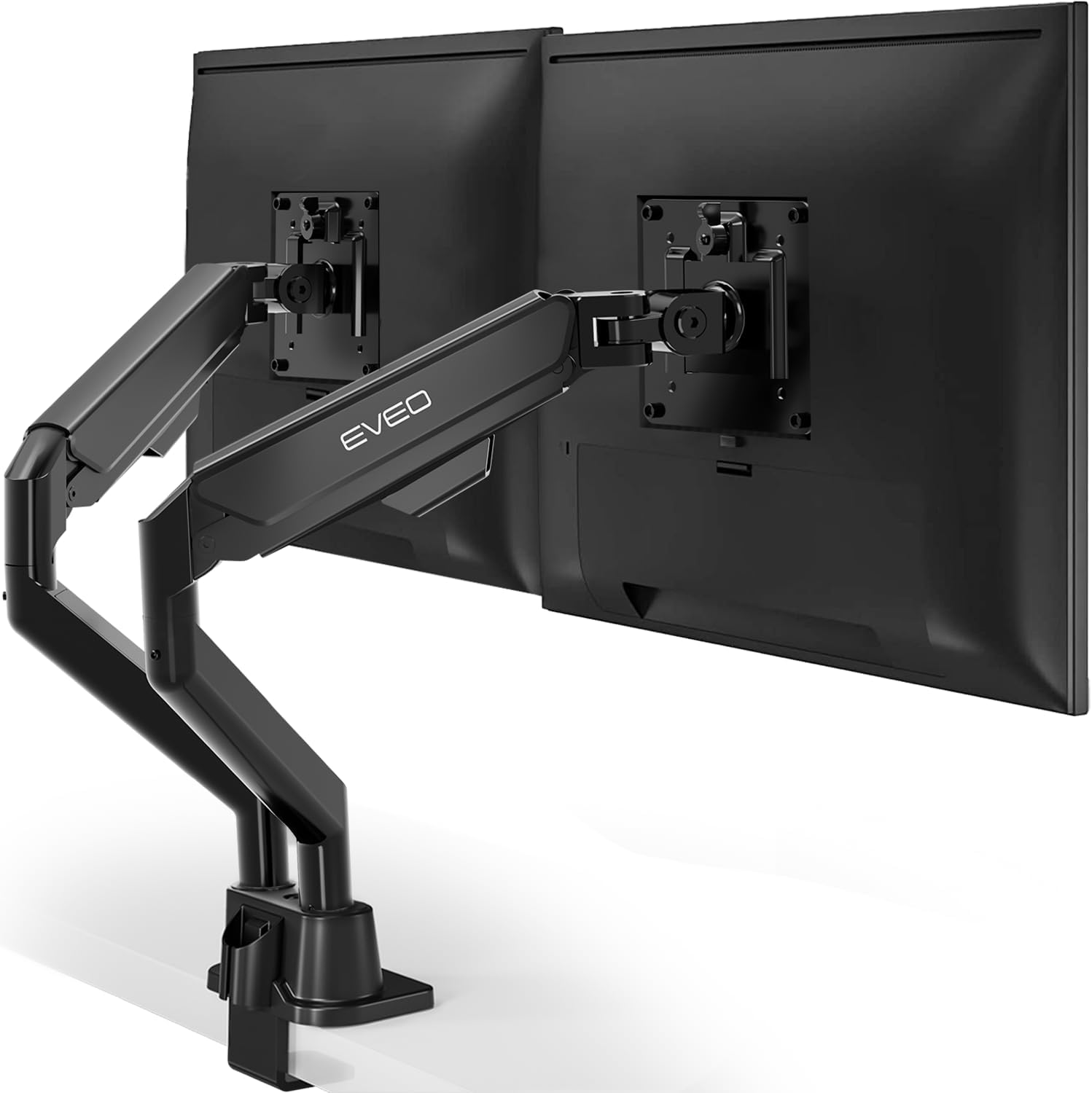
- Supports two VESA-compatible monitors up to 32 inches each.
- Full-motion arms provide independent rotation, tilt, and positioning.
- Spring-assisted adjustment makes changing monitor positions much easier.
- Supports both desk clamp and grommet mounting methods.
- Integrated cable management keeps dual-monitor wiring more organized.
This EVEO covers the dual-monitor essentials without demanding a complicated setup
The EVEO DMM Dual Monitor Mount takes the number seven position in our best monitor stand for 2 monitors comparison, but it still covers the features most people expect from a proper dual-screen desk arm. It supports two monitors, uses articulating spring-assisted arms, and works with standard 75 x 75 mm and 100 x 100 mm VESA mounting patterns.
The product is designed around conventional office and home monitor sizes rather than the enormous ultrawide displays supported by some of our higher-ranked choices. Available specifications place the supported screen range around 14 to 32 inches, which covers a lot of ordinary desktop monitors.
The alloy steel construction gives the mount a substantial structure while the two articulating arms let each screen move independently. Independent adjustment is the important part, because two monitors rarely need to remain locked into exactly the same position throughout the working day.
You can keep the primary monitor directly ahead while angling the secondary display inward. That is often more comfortable than placing two screens in one completely flat line across the desk.
The full-motion arms make a normal two-screen workstation much easier to arrange
A dual monitor stand becomes useful when the factory monitor bases start limiting where the screens can sit. One stand may offer height adjustment while the other barely moves, leaving the two panels at noticeably different levels.
The EVEO gives both screens a common mounting system. Its articulating design supports screen rotation and substantial tilt adjustment, with product specifications listing up to 90 degrees of tilt and full 360-degree rotation.
Full-motion adjustment helps align mismatched monitors, especially when the two displays are different brands or sizes. You can adjust the screens around their actual panel dimensions rather than accepting the positions created by two unrelated factory stands.
Consider somebody working with a 27-inch primary monitor and a smaller 24-inch secondary display. On their original stands, the screen centers may sit at completely different heights.
Mounting both displays on adjustable arms gives you another way to line them up. The top edges can match, the centers can match, or the secondary display can deliberately sit higher depending on how it is used.
The layout should follow your actual workflow, not an assumption that two monitors must always form a perfectly symmetrical pair.
If one display contains the application you look at for most of the day, keep that monitor near the natural center of your seated position. Put the secondary screen beside it for email, messaging, browser research, documents, dashboards, or other supporting information.
A programmer might keep the development environment on the primary screen while documentation and terminal windows remain on the second. A financial user could keep a spreadsheet centered and place source documents on the other display.
Rotation adds another possibility. One monitor can remain landscape while the second is turned into portrait orientation for long documents, coding, web pages, communication applications, or other vertically structured content.
Portrait mode can make the second screen more useful without increasing the horizontal width of the overall workstation. It is particularly practical when the secondary display is used for reading rather than widescreen media.
The spring-assisted movement also makes repositioning easier than a basic fixed monitor bracket. The installation guide includes adjustable arm tension, so the mechanism can be tuned around the monitors being used.
If a screen slowly drops after being positioned, the supporting tension may need adjustment. If it rises after you release it, the arm may be applying too much counterbalance force.
Correct tension keeps each monitor stationary while still allowing intentional movement. Make small adjustments according to the installation instructions rather than turning the tension hardware repeatedly without testing the result.
The two arms may need different settings. Even monitors with the same diagonal size can have different weights because of their chassis construction, panel technology, internal power hardware, and stand design.
Check the monitor weight without the original desktop base. Do not use the complete packaged shipping weight, which can include the stand, cables, accessories, protective materials, and retail box.
VESA compatibility needs to be checked separately too. The EVEO supports 75 x 75 mm and 100 x 100 mm mounting patterns, so both monitors should be verified before the original stands are removed.
Screen size does not guarantee VESA compatibility. Some monitors have recessed mounting holes or require a separate adapter before they can connect to a conventional monitor arm.
Use the correct mounting screws for each display. A screw that threads into the monitor is not automatically the correct length, and unnecessarily long hardware should not be forced into the rear housing.
Why the EVEO finishes seventh despite being a practical dual-monitor arm
The mounting system gives you two installation approaches. The EVEO can be attached using a desk clamp or installed through a suitable desk hole using the grommet mounting method.
The clamp is convenient when you do not want to drill or modify the desktop. The installation guide also provides different clamp positions for thicker tables, which helps the base accommodate varying desk dimensions.
Check the desk before choosing the mount position. A steel frame, drawer, cable tray, or reinforcement bar underneath the desktop can prevent the clamp from sitting where you originally planned.
The installation instructions also call for anti-slip protective pads at the base. Those should be installed as directed rather than skipped, since they help protect the desk surface and keep the mounting connection properly positioned.
The grommet option can be useful on desks that already have a suitable mounting hole. It also provides another solution when the back edge is inaccessible or unsuitable for the clamp.
Whichever method is used, the desktop needs adequate structural strength. Two monitor arms concentrate the weight of both screens around one relatively small mounting location.
Dual monitors create concentrated desk loading, and the forces increase when the arms are extended farther away from the mounting point. The desk is part of the support system, not simply somewhere to place the clamp.
Check the desktop material and condition. A substantial solid or engineered desk should not automatically be treated the same as a thin hollow-core top or damaged particleboard.
Wall clearance matters as well. Articulating arms can move backward when the monitors are pushed away from the user, so a desk sitting completely against a wall may restrict the available adjustment range.
Plan the screen positions before installing both monitors. Moving the base afterward is much harder once two displays, four primary cables, and the complete arm system are attached.
Cable management is included in the EVEO installation system. This becomes particularly useful with two monitors because wiring multiplies quickly.
There may be two power leads, two HDMI or DisplayPort cables, USB connections, and additional webcam or peripheral wiring. Routing those cables along the arms can make the workstation considerably cleaner.
Do not pull the wiring tight for appearance. Cables need slack for full arm movement, otherwise repositioning a monitor can put unnecessary pressure on its connectors.
Move each display through the positions you expect to use before finishing the cable routing. Test extension, rotation, tilt, and side-to-side movement while watching the cables.
The EVEO also removes both factory monitor bases from the desk. This is one of the everyday benefits that can matter more than a long specification list.
Two conventional monitor stands can occupy a large portion of the work surface. Wide V-shaped bases are particularly intrusive because their feet extend toward the keyboard and into areas that could otherwise hold useful equipment.
Removing two bases opens the desktop for speakers, notebooks, a laptop, docking station, keyboard, audio interface, or other accessories. It also makes the surface easier to clean.
The installation itself is fairly straightforward in concept. Attach the base, assemble the arms, connect the VESA plates to the monitors, mount the displays, adjust tension, and then install the cable-management components.
For larger screens, having another person available can make the monitor attachment stage easier. A 32-inch display may not be extraordinarily heavy, but its width can still make it awkward to control while aligning the VESA plate.
Install one monitor at a time, verify that the connection is secure, then move on to the second display. This makes troubleshooting easier if one arm requires adjustment.
So why does the EVEO sit at number seven? The products above it provide stronger specifications for larger, heavier, or more specialized two-monitor installations.
Our number one ErgoUnion supports monitors from 17 to 40 inches and up to 25 pounds each while offering a particularly useful vertical arrangement. The second ErgoUnion gives us another strong full-motion option with flexible independent adjustment.
The ARES WING is substantially more heavy-duty, supporting screens up to 49 inches and up to 44 pounds per arm. That gives it a clear advantage for large ultrawide and curved-monitor installations.
The PEGZONE and MOUNTUP models focus strongly on vertical stacking, while the monTEK provides another straightforward adjustable dual-arm alternative. The EVEO faces strong competition across this list, which is why it lands in seventh rather than because it lacks useful features.
Its maximum screen size is more conventional, and it does not provide the same standout heavy-duty headroom as the higher-ranked ultrawide options. Users planning a future upgrade to very large displays should take that into account.
But conventional capacity can be completely adequate for a normal office. Someone using two compatible 24, 27, or 32-inch monitors may gain little practical benefit from buying an arm engineered around extremely large ultrawide screens.
Compatibility matters more than ranking position. If your two displays fit the supported size and VESA requirements and the desk provides a suitable mounting surface, the EVEO can still deliver the main advantages expected from a dual monitor stand.
You get independently adjustable screens, full-motion positioning, spring-assisted movement, desk clamp or grommet installation, cable organization, and a large amount of desktop space back once the original stands are removed.
That is why we believe the EVEO DMM Dual Monitor Mount deserves the number seven ranking out of seven. It does not match the large-screen capability and specialized configurations of our highest-ranked options, but it remains a practical choice for a conventional two-monitor home or office workstation.
Verify the VESA pattern and stand-free weight of both monitors, inspect the desk before mounting the base, adjust each arm tension independently, and leave enough cable slack for the complete movement range. Set up properly, the EVEO provides a clean flexible two-monitor workspace and remains a positive option for users who do not need the extreme capacity of the heavier mounts above it.