


- Five Mechanical Carpenter Pencils for Daily Work: Provides multiple marking tools for carpentry, woodworking, construction layouts, and workshop projects without relying on a single pencil.
- Extended Deep Hole Tip for Recessed Marking: Helps reach narrow openings, drilled holes, and difficult marking positions where conventional carpenter pencils may not fit.
- Refillable Graphite Leads for Repeated Use: Allows worn or consumed leads to be replaced instead of discarding the entire pencil, supporting regular construction and woodworking tasks.
- Convenient Sharpener for More Accurate Layout Lines: Helps maintain a finer graphite point for marking measurements, cut locations, drilling positions, and joinery details.
- - Practical Mechanical Design for Workshop Marking: Combines replaceable leads with a construction-oriented pencil format suitable for woodworkers, carpenters, installers, and DIY enthusiasts.

These Carpenter Pencils Make Marking Wood and Tight Spaces Much Easier
The Nicpro MG413 Mechanical Carpenter Pencil Set is designed for carpenters, woodworkers, construction professionals, and DIY enthusiasts who need reliable marking tools for everyday projects. The package includes five mechanical carpenter pencils, 2.8mm replacement leads, a sharpener, and a storage case. For anyone searching for the best mechanical pencil for carpentry, this set offers a practical combination of durability, marking precision, and convenience.
One of the most useful features is the extended 45mm marking tip, which allows the pencil to reach areas that conventional carpenter pencils cannot easily access. This is particularly helpful when marking drill holes, measuring recessed fittings, or transferring positions through narrow openings. The 45mm extended deep hole marking tip makes the pencils useful for construction tasks where ordinary wooden pencils are too wide or difficult to position.
The set also uses thick 2.8mm replacement leads instead of the thin graphite commonly found in office mechanical pencils. This makes the pencils better suited to rougher marking surfaces and demanding workshop conditions. The heavy-duty 2.8mm mechanical pencil leads provide a useful balance between durability and the ability to create more precise lines when sharpened.
Another practical advantage is having five pencils available within one package. A carpenter can keep one in a tool belt, another near a workbench, and additional pencils in a toolbox or vehicle. This reduces interruptions when a pencil is misplaced or needed at another workstation.
The Deep Hole Marker and Refillable Leads Are Particularly Useful for Woodworking
The most important feature of the Nicpro MG413 set is its deep hole marking design. Many woodworking and installation tasks involve marking positions through narrow holes or recessed components. A conventional carpenter pencil may not reach these areas because its wooden body prevents the graphite point from contacting the surface.
Consider someone installing kitchen cabinet handles. The installer may need to mark screw positions through the mounting holes of a handle or drilling template. The extended carpenter pencil tip for recessed holes allows the graphite to reach through narrow openings and transfer the intended position onto the cabinet surface.
This is particularly useful when working with cabinet hardware, shelving brackets, electrical fixtures, and furniture fittings. Accurate marking reduces the likelihood of drilling holes in the wrong position. Even a small measurement error can become noticeable when several handles or fixtures need to align across a finished installation.
The 45mm extended tip also helps when marking around awkward corners or inside narrow spaces. For example, a carpenter fitting wooden panels around an existing structure may need to transfer a measurement into a recessed area. A longer marking tip can reach the surface without requiring the entire pencil body to fit inside the opening.
However, the extended tip should be used carefully. Applying excessive sideways pressure can place unnecessary stress on the graphite lead or marking mechanism. The precision deep hole marker for construction work performs best when the pencil is aligned with the marking position and used with controlled pressure.
The 2.8mm lead diameter is another important feature. Standard office mechanical pencils commonly use leads measuring 0.5mm or 0.7mm, which are suitable for handwriting but can break more easily during rough construction marking. Nicpro's thicker leads are intended for more demanding applications.
For example, someone marking cutting lines on rough timber may find that a conventional thin mechanical pencil breaks when the tip catches on the wood grain. A thicker lead provides more material at the point of contact, which can reduce this problem. The durable graphite leads for rough woodworking surfaces are particularly useful during framing, carpentry layouts, and general workshop marking.
However, thicker graphite does not automatically produce more accurate lines. A worn 2.8mm point can create a relatively broad mark, making it difficult to identify the exact cutting position. This is why the included sharpener is an important part of the set.
The sharpener is designed to maintain a more defined graphite point when precision is required. Nicpro describes a replaceable sharpener that screws into the top of the pencil, keeping it accessible during work. The integrated carpenter pencil sharpener for accurate marking reduces the need to carry a separate utility knife or traditional pencil sharpener.
Consider a woodworker preparing pieces for a cabinet frame. The person may need to mark several measurements before cutting the boards to length. A sharp pencil point makes it easier to place the line against a ruler or square without introducing unnecessary uncertainty.
For accurate cutting, the carpenter should also consider which side of the marking line represents the finished measurement. Saw blades remove material equal to their kerf, so cutting directly through the center of a thick pencil line can produce a piece that is slightly shorter than intended. Marking the waste side clearly helps prevent this mistake.
The mechanical refill system is another useful advantage over traditional wooden carpenter pencils. Instead of sharpening away the wooden body as the graphite becomes shorter, users can replace the lead and continue using the same pencil. The refillable mechanical carpenter pencil construction can reduce repeated pencil replacement during regular workshop use.
For example, a contractor working on several renovation projects may use marking pencils every day. Conventional wooden pencils gradually become shorter and can be inconvenient to sharpen when only a small amount remains. A refillable mechanical pencil maintains a consistent barrel length while allowing the graphite to be replaced.
The matching product information identifies a supply of 41 replacement leads, although some retailer descriptions present different counts or color assortments. Buyers should confirm the exact accessories included with their selected package. Regardless of the final assortment, having replacement leads available is useful for projects involving frequent marking.
Colored leads can also provide practical advantages when working with different materials. Black graphite is often suitable for pale timber, while colored marking leads may provide better contrast on certain darker or visually complicated surfaces. The multiple lead colors for construction marking can help workers distinguish different measurements or installation stages.
Imagine someone installing a wooden deck. Black marks might indicate the intended cutting positions, while a contrasting color could identify drilling locations or temporary layout references. Using separate colors can make the work easier to follow, particularly when several people are involved in the same project.
However, visibility depends on the material and surface condition. A light-colored lead may work well on dark timber but appear faint on pale plywood. Testing the lead on a small area before beginning a project helps determine which color provides the clearest mark.
Nicpro also describes the pencils as suitable for marking materials beyond wood, including metal, plastic, and paper. This makes the set relevant to installers, builders, and other tradespeople who work with different construction materials. The multi-surface carpenter pencils for workshop projects provide flexibility when moving between woodworking and general installation tasks.
For example, someone installing a metal bracket onto a wooden structure may need to mark positions on both materials. Using the same marking tool can simplify the process, although graphite visibility and adhesion may differ between surfaces. Smooth metal may require a different lead color or a dedicated marking tool for the clearest results.
Surface preparation also matters. Dust, sawdust, moisture, and oil can interfere with how clearly graphite appears. Wiping away loose debris before marking can improve visibility and reduce the chance of placing a line inaccurately.
The five-pencil package is particularly convenient for shared workshops. Different workers can keep a pencil nearby rather than repeatedly borrowing one marking tool. The five-piece carpenter pencil set for professional workshops is also useful when several workstations are used during the same project.
Consider a small furniture workshop where one person cuts timber, another assembles components, and a third installs hardware. Each worker can keep a pencil at their station. This avoids unnecessary interruptions and helps maintain a consistent marking process.
The included storage case is another practical feature. Mechanical pencils, replacement leads, and sharpeners are relatively small accessories that can become misplaced inside a large toolbox. Keeping them together in a dedicated case makes the set easier to organize and transport.
For example, a contractor moving between residential renovation projects may carry several measuring and marking tools in a vehicle. A storage case helps protect the replacement leads and keeps the accessories accessible when needed. The organized carpenter pencil storage case for job sites is particularly useful for people who regularly travel between different workplaces.
There are some limitations worth considering. Although the 2.8mm leads are thicker than ordinary mechanical pencil graphite, they can still break when excessive pressure is applied. Users should avoid extending more lead than necessary, particularly when marking rough surfaces.
The deep hole design is also more specialized than a conventional flat carpenter pencil. Traditional wooden carpenter pencils have a broad, flat body that resists rolling and can be convenient for rough construction marking. The Nicpro mechanical design provides better access to recessed areas but may not replace every advantage of the traditional format.
Another consideration is the need to maintain the sharpener and refill mechanism. Graphite dust can accumulate around the tip during frequent use, and damaged or incompatible replacement leads may affect performance. Cleaning the mechanism occasionally and using suitable 2.8mm refills can help maintain reliable operation.
Why We Believe the Nicpro MG413 Deserves Our Number One Ranking
We placed the Nicpro MG413 Mechanical Carpenter Pencil Set at number one among our seven selections because it combines several features that address common marking problems in carpentry and woodworking. The extended 45mm tip, thick refillable leads, integrated sharpener, and five-pencil package provide useful functionality for both professional tradespeople and DIY enthusiasts. Its design focuses on practical construction tasks rather than ordinary handwriting.
The main reason for its first-place position is the combination of deep hole access and marking precision. Recessed drilling positions and narrow openings can be difficult to mark with conventional carpenter pencils. The extended tip provides a practical solution without requiring a separate specialty marking instrument for every installation task.
The 2.8mm leads are another important advantage. Their thicker construction is better suited to rough marking surfaces than the thin graphite commonly used in office mechanical pencils. When sharpened correctly, they can also produce defined lines for measuring, cutting, and drilling.
The included sharpener contributes to the overall usefulness of the set. Accurate carpentry requires clearly defined reference marks, particularly when several pieces need to fit together. The replaceable sharpener for precise woodworking layout lines makes it easier to maintain a suitable graphite point throughout a project.
Another reason this set deserves a high ranking is its refillable construction. Traditional wooden carpenter pencils gradually become shorter as they are sharpened, while mechanical pencils retain their original body length. Having replacement leads available allows the marking tools to remain useful over repeated projects.
The five-pencil configuration also provides practical value. Contractors can distribute pencils between workstations, keep spares in a toolbox, or share them with other workers. The included storage case helps keep the accessories organized between projects.
There are disadvantages to consider, particularly the possibility of lead breakage under excessive pressure and the need to maintain the mechanical components. Some carpenters may still prefer traditional flat wooden pencils for rough framing work. However, these limitations are reasonable for a tool designed to provide additional precision and access to difficult marking positions.
The set's suitability for different surfaces is another positive feature. Woodworkers, installers, builders, and DIY enthusiasts can use compatible leads to mark timber, plastic, metal, and other materials. The versatile construction marking tools for multiple surfaces make the set useful beyond basic woodworking.
Its strongest advantage is the way several practical features work together. The extended tip reaches recessed locations, the thick leads support regular construction marking, the sharpener maintains a defined point, and the refill system allows continued use. This combination makes the set particularly relevant for people who regularly measure, cut, drill, and assemble materials.
Overall, we believe the Nicpro MG413 Deep Hole Mechanical Carpenter Pencil Set deserves its number one ranking among the best mechanical pencil for carpentry options. Although traditional carpenter pencils remain useful for certain rough construction tasks, this set provides additional flexibility through its extended marking tips, 2.8mm replacement leads, convenient sharpener, and five-pencil configuration. For carpenters, woodworkers, installers, and DIY enthusiasts who want a practical marking system for accurate everyday work, the Nicpro MG413 is an excellent choice worth considering.

- Three Mechanical Carpenter Pencils for Everyday Construction Work: Includes three reusable marking pencils for woodworking, carpentry layouts, furniture installation, and general construction projects.
- Deep Hole Marking Tips for Difficult Locations: Designed to reach recessed drilling positions, narrow openings, and awkward marking areas where conventional wooden carpenter pencils may not fit.
- Generous Supply of 36 Replacement Pencil Leads: Provides additional graphite refills for repeated workshop marking without requiring users to replace the entire pencil body.
- Built-In Sharpeners and Convenient Eraser Caps: Combines accessible lead sharpening with erasing functionality for adjusting layout marks and maintaining more precise marking points.
- - Durable Metal and Plastic Pencil Construction: Uses a combination of metal and plastic components intended for regular handling during carpentry, woodworking, installation, and DIY projects.
These Mechanical Carpenter Pencils Offer a Practical Balance of Precision and Everyday Convenience
The Worldity Deep Hole Mechanical Carpenter Pencil Set is designed for carpenters, woodworkers, construction professionals, and DIY enthusiasts who regularly need to mark measurements on different building materials. The package includes three mechanical carpenter pencils, 36 replacement leads, built-in sharpeners, and eraser caps. For anyone searching for the best mechanical pencil for carpentry, this set offers a useful combination of marking accessibility, reusable construction, and practical workshop accessories.
One of the most important features is the deep hole marking design. Conventional wooden carpenter pencils can be difficult to use when marking through narrow openings because their thick bodies prevent the graphite from reaching the intended surface. The extended deep hole carpenter pencil tips are intended to make recessed marking easier, particularly when installing hardware, assembling furniture, or preparing drilling locations.
The pencils also feature a combination of metal and plastic construction. This provides a reusable body that can accommodate replacement leads rather than requiring the entire pencil to be discarded when the graphite is consumed. The durable mechanical carpenter pencil construction is particularly useful for workers who mark measurements repeatedly throughout the day.
Another practical advantage is the inclusion of three pencils rather than a single marking instrument. A carpenter can keep one pencil in a tool belt, another near a workbench, and a third inside a toolbox. This arrangement can reduce interruptions when working across several areas of a construction project.
The Deep Hole Tips and Replacement Leads Make a Noticeable Difference
The most useful feature of the Worldity pencil set is its ability to mark locations that ordinary carpenter pencils may struggle to reach. Recessed drilling positions, narrow hardware openings, and awkward corners often require a longer marking tip. The deep hole marking system for woodworking projects provides a practical solution for these situations.
Consider someone installing kitchen cabinet handles. Each handle requires carefully positioned mounting holes, and even a small measurement error can become noticeable when several handles are installed across a row of cabinets. A deep hole pencil can help transfer the drilling position through a mounting template without requiring the entire pencil body to fit inside the opening.
This is particularly useful when working with cabinet hardware, shelving brackets, furniture fittings, and other components containing narrow mounting holes. The extended marking tip can reach through openings that would obstruct a conventional carpenter pencil. This reduces the need to improvise with smaller writing instruments that may not be suitable for rough workshop conditions.
However, accurate marking still requires careful positioning. Holding the pencil at an angle can shift the mark away from the intended center, particularly when working through a narrow opening. The precision marking of recessed drilling positions works best when the tip is aligned correctly and the workpiece remains securely positioned.
The mechanical lead system is another important advantage. Traditional wooden carpenter pencils gradually become shorter as they are sharpened, eventually becoming inconvenient to hold. A mechanical pencil maintains a consistent barrel length while allowing worn graphite to be replaced.
For example, a carpenter preparing timber for framing may need to mark dozens of cutting positions throughout the day. Repeatedly sharpening wooden pencils can interrupt the workflow and gradually consume the pencil body. The refillable mechanical pencil design for carpentry allows the worker to continue using the same marking instrument with replacement leads.
Worldity includes 36 replacement leads with this three-pencil set. This is useful for regular workshop projects because replacement graphite is available without requiring an immediate additional purchase. The quantity also makes the set convenient for workers who frequently break or consume leads during construction marking.
Lead durability is particularly important when working on rough materials. Ordinary office mechanical pencils often use graphite measuring 0.5mm or 0.7mm, which can break when dragged across uneven timber. Construction-oriented mechanical pencils generally use more substantial marking leads, although the exact diameter of the Worldity refills should be confirmed before purchasing replacements.
Consider someone marking rough plywood before cutting it with a circular saw. A thin office pencil lead may catch on the surface and break, especially when the wood contains raised fibers. The construction pencil leads for rough woodworking surfaces are intended to provide a more suitable marking option for this type of work.
However, thicker graphite does not automatically produce more accurate measurements. A worn pencil point can create a broad line that makes it difficult to identify the exact cutting position. Maintaining a defined point is important when preparing joinery, cabinet components, and other pieces requiring careful alignment.
This is where the built-in sharpener becomes useful. Worldity includes sharpening functionality within the pencil design, allowing users to maintain the graphite point without carrying a separate traditional sharpener. The built-in carpenter pencil sharpener for precise layout can be particularly convenient during repeated measuring and marking tasks.
For example, a woodworker preparing several boards for a cabinet frame may need to mark cutting positions against a combination square. A sharp graphite point makes it easier to place a narrow line against the measuring edge. This helps reduce uncertainty when transferring measurements from a drawing onto the actual material.
Accurate cutting also requires understanding the width of the saw blade. A blade removes material equal to its kerf, so cutting on the wrong side of a pencil line can produce a piece that is slightly shorter or longer than intended. The pencil provides the reference mark, but the worker must still identify the waste side correctly.
The eraser caps are another useful feature for everyday woodworking. Measurements sometimes need to be adjusted after checking the position of a component or discovering a mistake in the original layout. Having an eraser available can make small corrections more convenient.
Imagine someone assembling a wooden bookshelf and marking the positions of several shelf supports. After checking the measurements, the worker realizes that one mark is slightly misplaced. The convenient eraser caps for correcting layout marks can help remove or reduce the unwanted graphite before a new position is marked.
However, erasing performance depends on the material. Smooth finished wood and ordinary paper generally allow easier correction than rough unfinished timber. Graphite can become trapped within the grain of porous wood, making complete removal difficult.
For delicate woodworking projects, it is sensible to test the eraser on an inconspicuous area before using it on a visible finished surface. Excessive rubbing may also affect certain wood finishes or leave unwanted marks. The eraser should therefore be treated as a convenient correction tool rather than a guarantee that every mark can be removed completely.
The three-pencil configuration also makes this set useful for shared workshops. Different workers can keep a marking pencil nearby instead of repeatedly borrowing the same tool. The three-piece carpenter pencil set for workshop efficiency is particularly practical when cutting, drilling, and assembly tasks take place at separate workstations.
Consider a small furniture workshop where one person prepares timber, another assembles cabinet components, and a third installs hardware. Each worker can use a separate pencil while following the same project measurements. This reduces unnecessary interruptions and helps maintain a more organized working environment.
The metal and plastic construction is another feature worth considering. Mechanical carpenter pencils need to withstand repeated handling, occasional impacts, and regular contact with tools and building materials. The combination of materials provides a practical construction format, although the durability of individual components depends on their design and assembly quality.
For example, a carpenter working on a renovation project may frequently place a pencil inside a tool pouch or pocket. The pencil may come into contact with measuring tapes, screwdrivers, and other equipment. The reusable metal and plastic carpenter pencil body is intended for regular workshop handling rather than occasional desk writing.
Nevertheless, mechanical components require some care. Dust and graphite particles can accumulate around the lead opening, potentially affecting the feeding mechanism. Keeping the pencil reasonably clean and avoiding excessive pressure can help maintain consistent operation.
Another useful application is marking furniture assembly positions. Flat-pack furniture, custom shelving, and cabinet installations often involve transferring measurements onto several different pieces. A mechanical carpenter pencil can help create repeatable reference marks without requiring a new wooden pencil for every project.
For example, someone building a wooden storage cabinet might need to mark screw locations, shelf positions, and cutting measurements on multiple panels. Keeping a pencil available at each stage makes the process more convenient. The mechanical marking pencils for furniture construction are particularly useful when several components must align accurately.
The deep hole design can also be useful when working around installed hardware. A carpenter may need to mark through a bracket or existing opening while keeping the component in its intended position. A longer marking tip can reduce the need to remove and reposition the hardware repeatedly.
However, the pencil should not replace careful measuring. When drilling holes for cabinet handles or hinges, using a suitable template and checking alignment before drilling remains important. The marking tool helps transfer the position, but it cannot correct an inaccurate measurement.
There are some limitations worth considering. Mechanical pencil leads can still break when excessive sideways pressure is applied, particularly if too much graphite extends beyond the tip. Users should advance only the amount of lead needed for the current marking task.
The mechanical design also requires compatible replacement leads. Although the package includes 36 refills, future replacements should match the pencil's specifications. Purchasing an incompatible lead diameter can cause feeding problems or damage the mechanism.
Another consideration is that traditional flat wooden carpenter pencils remain useful for rough construction marking. Their broad bodies resist rolling, and they can be sharpened into different point shapes with a utility knife. The Worldity mechanical set provides greater convenience for recessed marking, but it may not replace every traditional marking technique.
Why We Ranked the Worldity Mechanical Carpenter Pencil Set Second
We placed the Worldity Deep Hole Mechanical Carpenter Pencil Set at number two among our seven selections because it offers a practical combination of recessed marking capability, refillable leads, built-in sharpeners, and convenient eraser caps. The three-pencil package also provides enough marking tools for different workstations or regular job-site use. These features make it particularly appealing for carpenters, installers, and DIY enthusiasts.
The main reason it did not receive our number one ranking is the smaller pencil quantity compared with the Nicpro five-pack reviewed previously. The Nicpro set provides five mechanical carpenter pencils, making it more convenient for larger workshops or users who want several spare marking tools. Worldity instead concentrates on a three-pencil configuration with a generous supply of replacement leads.
Our first-ranked Nicpro MG413 set also provides a documented 45mm extended marking tip and 2.8mm lead system. These confirmed specifications make it easier to evaluate its suitability for particular woodworking tasks. The deep hole construction pencil design from Worldity remains useful, although its exact tip length and lead diameter should be checked before making a direct specification comparison.
One of Worldity's strongest advantages is the inclusion of 36 replacement leads. Regular construction marking can consume graphite quickly, particularly when working with rough timber or frequently sharpening the point. Having additional leads available reduces the need to purchase replacement supplies immediately.
The built-in sharpener is another important feature. Accurate layout work depends on clear, well-defined marks, particularly when transferring measurements onto cabinet components or furniture panels. The convenient sharpening system for accurate woodworking measurements helps users maintain a more suitable graphite point during regular work.
The eraser caps also provide a practical benefit. Measurements sometimes need to be corrected, and having an eraser available can make adjustments easier. This is particularly useful for DIY projects where layouts may be revised several times before cutting or drilling begins.
The three-pencil package is another reason the set deserves a high ranking. Users can keep separate pencils in a tool belt, workshop drawer, and toolbox without relying on a single marking instrument. The reusable carpenter pencils for everyday construction projects provide convenient access to marking tools across different work areas.
There are disadvantages to consider, particularly the possibility of lead breakage and the need to maintain the mechanical feeding system. Traditional wooden carpenter pencils may still be preferable for certain rough framing tasks. Users should also verify replacement lead compatibility before purchasing additional supplies.
Nevertheless, the Worldity set offers a strong combination of features for everyday carpentry. Its deep hole design helps reach recessed positions, the refillable mechanism reduces repeated pencil replacement, and the sharpening accessories support more precise marking. These characteristics make it useful for woodworking, cabinet installation, furniture assembly, and general construction layouts.
Overall, we believe the Worldity Deep Hole Mechanical Carpenter Pencil Set deserves its number two ranking among the best mechanical pencil for carpentry options. Although the Nicpro five-pack offers more pencils and clearer published dimensional specifications, Worldity provides a practical alternative with three reusable marking tools, 36 replacement leads, built-in sharpeners, and eraser caps. For carpenters and DIY enthusiasts who want a convenient marking set for accurate everyday woodworking and installation tasks, this is an excellent option worth considering.

- Three Mechanical Carpenter Pencils for Daily Woodworking: Includes red, black, and yellow pencil bodies for convenient marking during construction layouts, furniture assembly, and workshop projects.
- Extended 45mm Deep Hole Marking Tip: Reaches recessed drilling positions, narrow hardware openings, and difficult marking locations that conventional wooden carpenter pencils cannot easily access.
- Thick 2.8mm Graphite and Colored Replacement Leads: Provides 39 advertised refills in black, red, and yellow for marking different materials and distinguishing layout references.
- Integrated Sharpeners for More Accurate Layout Marks: Helps maintain defined graphite points when measuring cutting positions, preparing joinery, and marking drilling locations.
- - Portable Storage Case With Refillable Pencil Design: Keeps marking tools and replacement leads organized while supporting repeated use without constantly replacing wooden carpenter pencils.
These Three Carpenter Pencils Make Precision Marking Much More Convenient
The Nicpro MG552 Mechanical Carpenter Pencil Set is designed for carpenters, woodworkers, builders, and DIY enthusiasts who regularly need to mark measurements on different construction materials. It includes three mechanical carpenter pencils in red, black, and yellow, along with an advertised 39 replacement leads and a plastic storage case. For anyone searching for the best mechanical pencil for carpentry, this set offers a practical combination of deep hole marking, refillable graphite, and everyday workshop convenience.
One of its most useful features is the extended 45mm metal marking tip. This allows the pencil to reach recessed drilling positions, narrow openings, and other difficult areas where conventional wooden carpenter pencils may not fit. The 45mm extended deep hole marking tip is particularly useful for cabinet installation, furniture assembly, and construction layouts involving predrilled hardware.
The pencils use thick 2.8mm leads rather than the thin graphite commonly found in ordinary office mechanical pencils. The replacement assortment includes black, red, and yellow marking leads, providing different options for visibility on construction materials. This heavy-duty mechanical carpenter pencil lead system is intended for repeated marking on wood, plastic, metal, and other compatible surfaces.
Another practical advantage is having three pencils available within one package. A carpenter can keep one in a tool belt, another near a cutting station, and a third inside a toolbox. This reduces interruptions when moving between measuring, cutting, and assembly tasks throughout the day.
The Extended Tip and Colored Leads Are Particularly Useful for Accurate Woodworking
The most important feature of the Nicpro MG552 set is its ability to mark recessed positions. Many construction and furniture installation tasks require transferring measurements through narrow openings or around installed components. A conventional carpenter pencil can be difficult to use because its thick wooden body prevents the graphite from reaching the intended marking surface.
Consider someone installing cabinet handles across a kitchen. Each handle requires accurately positioned screw holes, and even a small alignment error can become noticeable when several handles are installed in a row. The deep hole carpenter pencil for cabinet installation allows the marking tip to reach through narrow mounting holes and transfer positions onto the cabinet surface.
This is particularly useful when working with drilling templates, shelving brackets, drawer slides, and furniture fittings. The extended metal tip helps reach areas that would otherwise require a thinner marking instrument. However, the pencil should still be held carefully because an angled tip can shift the mark away from the intended center.
The 45mm tip length provides useful reach, but accuracy still depends on proper measuring technique. A carpenter should secure the template or hardware before marking and verify the position before drilling. The pencil transfers the reference point, but it cannot correct an incorrectly positioned template.
The 2.8mm lead diameter is another important advantage. Standard office mechanical pencils commonly use 0.5mm or 0.7mm graphite, which can break when dragged across rough timber. The thick 2.8mm carpenter pencil leads provide more material at the writing point and are better suited to demanding marking applications.
For example, someone preparing rough plywood for cutting may need to draw several reference lines across an uneven surface. Thin office pencil leads can catch on raised wood fibers and break. A thicker construction lead can make this process more manageable, although excessive sideways pressure may still cause breakage.
The included sharpener is important because thick graphite can become blunt during repeated use. A worn point produces broader lines, making it more difficult to identify the exact cutting position. The integrated pencil sharpener for precise woodworking layouts helps maintain a more defined marking point without requiring a separate utility knife.
Imagine preparing several boards for a cabinet frame. The woodworker measures each board using a tape measure and combination square, then marks the intended cutting position. A sharp pencil point helps create a narrow reference line that is easier to follow when cutting.
However, the width of the saw blade must also be considered. A blade removes material equal to its kerf, so cutting on the wrong side of the marking line can produce an inaccurate finished length. Marking the waste side clearly and positioning the blade correctly are essential parts of accurate carpentry.
The colored replacement leads provide another useful feature. Nicpro advertises black, red, and yellow refills, allowing users to choose different marking colors according to the material or purpose. The three-color graphite marking system for construction can help distinguish cutting lines, drilling positions, and temporary layout references.
Consider a carpenter installing a wooden staircase. Black marks could identify measurements that have already been checked, while red marks could indicate drilling positions or areas requiring additional attention. Using separate colors can make a complicated layout easier to follow, particularly when several workers are involved.
Yellow leads may also provide better visibility on certain dark materials where ordinary graphite appears faint. However, color performance depends on the surface texture, finish, and lighting conditions. Testing each lead on a small area before beginning an important project helps determine which provides the clearest mark.
The pencils are also suitable for marking different construction materials. Nicpro describes its carpenter pencil range as useful for wood, metal, plastic, and paper. This versatile mechanical marking pencil for multiple surfaces can be convenient for installers who regularly move between timber framing, plastic fittings, and metal hardware.
For example, someone assembling a storage cabinet may need to mark positions on wooden panels and plastic edge trim. Using the same pencil system can simplify the workflow. However, smooth or oily surfaces may not retain graphite as clearly as unfinished timber, so a dedicated marker may sometimes be more appropriate.
The refillable construction is another practical advantage over traditional wooden carpenter pencils. Conventional pencils gradually become shorter as they are sharpened, eventually becoming inconvenient to hold. Mechanical pencils retain their original barrel length while allowing worn leads to be replaced.
For a contractor who marks measurements every day, this can reduce the need to repeatedly purchase and sharpen wooden pencils. The refillable carpenter pencil design for repeated use also helps maintain a consistent grip and marking position throughout the life of the pencil body.
The advertised 39 replacement leads provide a useful supply for ongoing projects. However, some retailer descriptions differ in how they count the leads already installed inside the pencils, so the exact number of loose refills should be checked when purchasing. The important advantage is having replacement graphite available without immediately ordering additional supplies.
For example, a carpenter working on a home renovation may need to mark framing timber, cabinet panels, shelving, and flooring materials over several days. Repeated sharpening and marking gradually consume graphite. Keeping spare leads in the storage case helps prevent interruptions when one becomes too short to use.
The three-pencil configuration is also convenient for workshop organization. Instead of carrying one marking tool between every workstation, users can keep pencils near the cutting bench, assembly table, and installation equipment. The three-piece mechanical carpenter pencil workshop set is particularly practical when several tasks are being completed during the same project.
Consider a small furniture workshop where one person prepares timber, another assembles components, and a third installs hardware. Each worker can keep a pencil nearby. This reduces unnecessary movement and makes marking tools easier to access during time-sensitive tasks.
The plastic storage case provides another useful benefit. Replacement leads and sharpening accessories are relatively small items that can become misplaced inside a large toolbox. Keeping the pencils and refills together helps protect the supplies and makes them easier to transport between jobs.
The pencil bodies are also designed for portable use. Nicpro's construction pencil design includes a grip-oriented barrel and pocket clip, allowing the pencils to be carried with other measuring tools. The portable carpenter pencil design for job sites is useful for workers who frequently move between different areas of a building.
However, mechanical pencils require some maintenance. Graphite dust and wood debris can accumulate around the lead opening, potentially interfering with the feeding mechanism. Keeping the tip reasonably clean and avoiding excessive pressure can help maintain consistent performance.
Another common mistake is extending too much graphite beyond the metal tip. Although the 2.8mm leads are relatively thick, unsupported graphite can still snap when pressure is applied sideways. Advancing only the amount needed for marking helps reduce unnecessary breakage.
There are also situations where a traditional flat wooden carpenter pencil may remain preferable. Its broad body resists rolling and can be sharpened into different point shapes for rough framing marks. The Nicpro mechanical design provides better access to recessed areas, but it does not eliminate the usefulness of conventional marking tools.
Why We Ranked the Nicpro MG552 Third Instead of First
We placed the Nicpro MG552 Mechanical Carpenter Pencil Set at number three among our seven selections because it offers a useful combination of deep hole marking, thick replacement leads, and practical workshop accessories. Its three-pencil configuration and colored graphite assortment make it suitable for everyday carpentry and construction work. However, our higher-ranked selections provide different package advantages that may be more appealing to some users.
Our first-ranked Nicpro MG413 set includes five mechanical carpenter pencils, making it particularly useful for larger workshops or people who want additional spare marking tools. The MG552 provides three pencils instead, which may be sufficient for individual carpenters and smaller projects. The three-pencil construction marking set with colored refills offers a more compact alternative for users who do not need five separate pencils.
Our second-ranked Worldity set also includes three mechanical carpenter pencils, along with replacement leads and additional accessories. Both products emphasize reusable marking tools and practical workshop convenience. The Nicpro MG552 distinguishes itself through its documented 45mm extended tip and 2.8mm lead specifications.
One of the strongest reasons to consider the MG552 is its extended marking tip for recessed drilling positions. Cabinet installers, furniture makers, and carpenters frequently need to mark through narrow hardware openings. Having a pencil designed for these situations can make measuring and installation work more convenient.
The thick replacement leads are another positive feature. Their 2.8mm diameter provides a more substantial marking point than ordinary office mechanical pencils. When sharpened correctly, they can create defined reference lines suitable for woodworking and construction layouts.
The colored lead assortment also contributes to the set's practical value. Different marking colors can help distinguish cutting positions, drilling references, and temporary measurements. This is particularly useful when working with several materials or following a complicated installation plan.
There are disadvantages to consider. The package contains fewer pencils than our first-ranked Nicpro set, and mechanical components require occasional cleaning and careful handling. The graphite can also break if excessive pressure is applied or too much lead extends beyond the tip.
Nevertheless, these limitations are reasonable for a reusable construction marking system. The combination of refillable leads and convenient sharpening makes the MG552 practical for workers who regularly measure, mark, cut, and assemble materials. Its storage case also helps keep the marking accessories organized between projects.
The set is particularly appealing for cabinet installation and furniture assembly because these tasks frequently involve recessed marking positions. Its extended tip provides access to narrow openings, while the thick leads support regular workshop use. The different marking colors add flexibility when working on complicated layouts.
Overall, we believe the Nicpro MG552 Deep Hole Mechanical Carpenter Pencil Set deserves its number three ranking among the best mechanical pencil for carpentry options. Although the Nicpro MG413 offers more pencils and the Worldity set provides a different accessory combination, the MG552 delivers a practical balance of three reusable marking tools, 39 advertised replacement leads, a 45mm extended tip, and convenient sharpening accessories. For carpenters, cabinet installers, woodworkers, and DIY enthusiasts who want accurate marking tools for everyday construction projects, this remains an excellent choice worth considering.

- Mechanical Carpenter Pencil for Everyday Construction Marking: Designed for marking measurements, cutting positions, drilling references, and layout lines during woodworking and general carpentry projects.
- Convenient Sharpener for Maintaining Accurate Pencil Points: Helps restore a defined graphite tip when preparing joinery, measuring timber, or marking positions that require careful alignment.
- Construction-Oriented Design for Practical Workshop Applications: Suitable for carpenters, furniture installers, woodworkers, and DIY enthusiasts who regularly measure and mark building materials.
- Mechanical Lead System for Continued Pencil Use: Allows graphite to be advanced as the exposed tip wears down, reducing interruptions associated with repeatedly sharpening traditional wooden pencils.
- - Useful Marking Tool for Furniture and Woodworking Projects: Supports common tasks such as identifying cut lines, positioning hardware, marking drilling locations, and transferring measurements onto timber.
This Mechanical Carpenter Pencil Focuses on the Marking Tasks That Matter Most
The Deep Hole Mechanical Carpenter Pencil With Sharpener is intended for woodworkers, carpenters, furniture installers, and DIY enthusiasts who need a convenient marking instrument for construction projects. Its mechanical pencil format and sharpening accessory address two common requirements in carpentry: keeping graphite available and maintaining a defined marking point. For anyone researching the best mechanical pencil for carpentry, this type of tool is worth considering because accurate layout work begins with clear, properly positioned reference marks.
Unlike a traditional wooden carpenter pencil, a mechanical construction pencil advances graphite through a reusable body. This allows the user to maintain a relatively consistent pencil length rather than gradually shortening the instrument through repeated sharpening. The reusable mechanical carpenter pencil design can be particularly convenient for people who regularly measure timber, mark drilling positions, and prepare components for assembly.
The sharpener is another important part of the product's appeal. Graphite becomes blunt during repeated use, especially when marking rough timber or drawing against measuring tools. A sharpener helps restore a more defined point, making it easier to create narrow reference lines when accuracy matters.
The product is also positioned for woodworking and construction rather than ordinary handwriting. These activities frequently involve uneven materials, awkward working positions, and repeated measurements. A construction-oriented marking pencil can be useful in these situations, although its actual performance depends on the lead dimensions, tip design, and materials used.
The Sharpener and Mechanical Design Can Make Everyday Carpentry More Convenient
One of the most useful characteristics of a mechanical carpenter pencil is its ability to advance graphite as the exposed point wears down. Conventional wooden pencils require the surrounding wood to be removed whenever the graphite becomes too short. The mechanical lead advancement for construction marking provides an alternative that can reduce interruptions during repeated layout work.
Consider a carpenter preparing several pieces of timber for a shelving installation. Each board needs to be measured, marked, and checked before cutting. Having a mechanical pencil available allows the worker to continue marking without repeatedly removing wood from a traditional pencil body.
This becomes particularly useful during projects involving dozens of measurements. Cabinetmaking, flooring installation, and furniture construction often require reference lines across several separate components. Keeping a marking tool ready throughout the process can make the workflow more consistent.
However, a mechanical pencil does not automatically guarantee greater accuracy. The thickness of the graphite point, the angle at which the pencil is held, and the condition of the workpiece all influence the final mark. The precision marking of woodworking measurements still depends on careful technique and correctly positioned measuring tools.
The included sharpener is particularly relevant when preparing cutting lines. A blunt graphite point can produce a broad mark that makes it difficult to identify the exact measurement. Sharpening the lead helps create a more defined reference, especially when marking against a ruler or combination square.
Imagine someone preparing a wooden cabinet door that must fit within a precisely measured opening. A thick marking line introduces uncertainty about where the saw blade should pass. The sharpened graphite point for accurate cutting lines helps reduce this uncertainty when combined with proper measuring techniques.
Another important consideration is the saw blade's kerf. A blade removes material as it cuts, so positioning the blade on the wrong side of the pencil line can change the finished dimensions. Carpenters should identify the waste side clearly before making a cut.
For example, a board marked at 600mm should not automatically be cut through the center of a thick pencil line. The intended finished edge needs to be identified, and the saw blade should be positioned accordingly. Accurate marking and correct cutting technique work together.
Mechanical carpenter pencils are also relevant to furniture assembly. Installing hinges, handles, brackets, and other hardware often requires transferring measurements onto wood or adjacent components. The construction marking pencil for furniture installation can help create reference points before drilling or fastening.
Consider someone installing drawer handles across several kitchen cabinets. Each handle needs to be positioned consistently so that the finished installation appears aligned. Marking the drilling positions carefully before using a drill helps reduce the possibility of permanent placement errors.
For recessed holes, the actual length and diameter of the pencil's marking tip become particularly important. A sufficiently narrow extended tip can reach through openings that prevent a conventional pencil body from contacting the workpiece. The exact reach of this particular product was not independently verified, so buyers should confirm its dimensions when deep-hole access is essential.
This matters when working with cabinet hardware or predrilled brackets. Some openings are narrow enough that an ordinary carpenter pencil cannot pass through them. The deep hole marking approach for recessed fittings is useful only when the tip fits the intended opening without forcing the tool.
Another practical application is marking timber before drilling. Carpenters often need to identify the center of a hole or the position of a fastener. A clearly defined pencil mark helps guide the next stage of the work.
However, a pencil mark alone does not prevent a drill bit from wandering. On suitable materials, a center punch, pilot hole, or drilling jig may still be required. The pencil establishes the intended location, while the drilling technique determines whether the hole follows that reference accurately.
The mechanical design also has potential advantages for regular workshop organization. A reusable pencil can remain in a tool pouch, workbench drawer, or measuring kit between projects. The practical mechanical marking tool for carpenters can become part of an everyday measuring setup alongside a tape measure, square, and ruler.
For example, someone working on a home renovation may move repeatedly between measuring, cutting, and installation areas. Keeping a marking pencil close to the measuring tools reduces unnecessary movement between workstations. This is particularly useful when several components must be checked before assembly.
Graphite selection is another important consideration. Construction pencils often use thicker leads than ordinary office mechanical pencils because rough materials can place greater stress on the writing point. However, the exact lead diameter of this product could not be confirmed from accessible listing information.
Before purchasing replacement graphite, users should verify the pencil's required diameter and compatible lead format. The correct replacement leads for mechanical carpenter pencils are important because incompatible graphite can jam the feeding mechanism or fail to remain securely positioned.
Lead hardness also affects marking performance. Softer graphite generally creates darker marks but may wear down more quickly, while harder graphite can retain its point longer but produce lighter lines. Choosing an appropriate lead depends on the material and the visibility required.
For example, rough plywood may benefit from a darker marking lead because the uneven surface can make faint lines difficult to follow. Smooth finished timber may allow a harder, finer point to produce a clearer reference. Testing the graphite on a scrap piece helps determine which approach works best.
Surface preparation matters as well. Sawdust, dirt, moisture, and finishing products can interfere with the visibility of graphite marks. The clear construction layout marks on prepared surfaces are generally easier to produce when loose debris has been removed.
Consider someone marking a cutting line across a board covered in sawdust. The graphite may contact the loose debris rather than the wood itself, producing an interrupted or difficult-to-read mark. Brushing away the dust before marking can improve visibility.
The pencil may also be useful for general DIY projects. Installing shelves, assembling furniture, preparing wooden frames, and fitting trim all require careful measurement. A mechanical carpenter pencil can provide a reusable marking option for these activities.
For example, someone installing wall-mounted shelving might need to mark bracket positions on a wooden support panel. The pencil can establish the intended locations before the worker checks alignment with a level. This helps separate the measuring stage from drilling and installation.
Another useful habit is checking measurements before making permanent changes. A misplaced pencil mark can usually be corrected more easily than an incorrectly drilled hole. The accurate measurement and marking process for woodworking should therefore include verification before cutting or drilling begins.
Mechanical pencils also require some maintenance. Graphite dust and workshop debris can accumulate near the lead opening, potentially affecting the advancement mechanism. Keeping the pencil reasonably clean can help reduce feeding problems during regular use.
Users should also avoid extending excessive graphite beyond the tip. Unsupported lead can break when pressure is applied sideways, particularly on rough timber. Advancing only the amount needed for marking is generally a better approach.
The sharpener should be kept free of excessive graphite buildup as well. A clogged or worn sharpening mechanism may produce uneven points or damage the lead. The regular maintenance of mechanical carpenter pencil sharpeners helps preserve their usefulness during repeated workshop tasks.
There are limitations worth considering. Traditional flat wooden carpenter pencils remain useful because their broad bodies resist rolling and can be sharpened into different point shapes. A mechanical pencil may offer more convenient lead advancement, but it does not necessarily replace every traditional marking technique.
The exact accessory count, replacement lead quantity, and marking tip dimensions of this listing also remain unverified. Buyers who need a specific lead diameter or extended marking length should confirm those details before purchasing. These specifications can make a meaningful difference when comparing construction marking tools.
Why We Ranked This Mechanical Carpenter Pencil Fourth
We placed the Deep Hole Mechanical Carpenter Pencil With Sharpener at number four among our seven selections because its general design addresses useful carpentry requirements, particularly refillable marking and convenient sharpening. These characteristics make it relevant to woodworking, construction layouts, and furniture installation. However, the available product information does not establish the same level of detailed specifications as our higher-ranked selections.
Our first-ranked Nicpro MG413 set provides five mechanical carpenter pencils with documented 2.8mm leads and an extended 45mm marking tip. Those specifications make it easier to evaluate the set for recessed marking and regular workshop use. The confirmed lead and tip specifications for carpentry are particularly valuable when choosing a tool for precise installation work.
Our second-ranked Worldity set includes three mechanical carpenter pencils, replacement leads, and sharpening accessories. This provides a clearly described package for people who want several marking tools available. The fourth-ranked product may still be suitable for individual use, but its exact package contents require confirmation.
The Nicpro MG552 set ranked third also offers documented marking features, including 2.8mm leads and a 45mm extended tip. Its replacement lead assortment provides additional options for different marking tasks. These published details make direct comparison easier than with a listing that does not clearly establish all specifications.
One of the strongest reasons to consider this product is its mechanical pencil and sharpener combination for woodworking. Maintaining a defined graphite point is important when marking cutting positions, drilling references, and joinery measurements. Having sharpening functionality available can make these tasks more convenient.
The reusable pencil design is another positive characteristic. Instead of discarding the entire pencil when the graphite becomes short, a compatible mechanical system allows continued use with replacement leads. This can be practical for workers who mark measurements frequently.
There are disadvantages to consider, particularly the uncertainty surrounding the brand, lead diameter, and included accessories. These details matter because replacement compatibility and marking reach influence long-term usability. A product with clearly documented specifications may be easier to purchase confidently.
Mechanical construction pencils also require more attention to the feeding mechanism than ordinary wooden carpenter pencils. Dust, broken graphite, and incompatible leads can interfere with operation. Users should maintain the pencil properly and avoid excessive pressure when marking rough materials.
Nevertheless, the practical marking design for carpentry and construction remains useful for a wide range of projects. Woodworkers and DIY enthusiasts can benefit from a reusable pencil that supports repeated measuring and layout tasks. The included sharpening feature is particularly relevant when accurate reference lines are required.
Its fourth-place position therefore reflects the available information and the stronger documented package specifications of the higher-ranked products, rather than a demonstrated defect in this pencil. Direct testing would be needed to establish differences in lead durability, marking precision, and long-term mechanical reliability.
Overall, we believe the Deep Hole Mechanical Carpenter Pencil With Sharpener is a worthwhile fourth-ranked option among the best mechanical pencil for carpentry selections. Although the exact manufacturer and several technical specifications require confirmation, its mechanical marking format, sharpening accessory, and construction-oriented purpose make it relevant for woodworking and installation projects. For carpenters and DIY enthusiasts who want a reusable marking tool for everyday measuring, cutting, and drilling layouts, this product remains a practical option to consider.

- Two Mechanical Carpenter Pencils With Refillable Leads: Includes two reusable construction pencils designed for woodworking measurements, drilling positions, cabinet installation, and everyday carpentry marking.
- Three Additional Deep Hole Markers for Difficult Locations: Provides long-tip marking tools for reaching recessed screw holes, narrow openings, and awkward positions during furniture and hardware installation.
- Twenty-Six Thick Replacement Leads in Six Colors: Includes 2.8mm marking refills that offer different color options for identifying cutting lines, drilling references, and construction measurements.
- Replaceable Sharpener and 4B Eraser for Precision: Supplies sharpening and correction accessories for maintaining defined graphite points and adjusting layout marks before cutting or drilling.
- - Convenient Storage Case for Workshop Organization: Keeps pencils, replacement leads, markers, and accessories together for transportation between job sites, workbenches, and construction projects.
This Nicpro Carpenter Pencil Set Offers More Than Just Two Marking Tools
The Nicpro CP1000 Mechanical Carpenter Pencil Set is designed for carpenters, woodworkers, furniture installers, and DIY enthusiasts who need several marking options for everyday construction work. The package combines two mechanical carpenter pencils, 26 replacement leads, three deep hole markers, a sharpener, a 4B eraser, and a storage case. For anyone searching for the best mechanical pencil for carpentry, this combination is particularly useful because different marking tasks often require different tools.
The two mechanical pencils use 2.8mm replacement leads, which are substantially thicker than the 0.5mm and 0.7mm graphite commonly found in office mechanical pencils. This makes them more suitable for marking rough timber, construction materials, and workshop surfaces. The heavy-duty 2.8mm carpenter pencil leads provide a practical balance between visible marking and the ability to sharpen the point for more accurate measurements.
One of the strongest features is the inclusion of three additional long-tip markers. These are intended for reaching narrow openings and recessed positions that ordinary carpenter pencils cannot access easily. The combination is particularly useful during cabinet installation, furniture assembly, and construction work involving predrilled hardware.
The set also includes a replaceable sharpener, an eraser, and a plastic storage case. These accessories make the package more convenient for regular workshop use because the marking tools and replacement supplies can be kept together. Rather than purchasing several separate accessories, users receive a coordinated marking set intended for different stages of a project.
The Deep Hole Markers and Colored Leads Are Particularly Useful for Accurate Carpentry
The most practical feature of the Nicpro CP1000 set is its combination of mechanical pencils and dedicated deep hole markers. Construction work frequently involves marking positions through narrow openings, around installed hardware, or inside recessed fittings. The extended 45mm deep hole marking design helps reach locations where a conventional wooden carpenter pencil may be too wide.
Consider someone installing kitchen cabinet handles. The installer needs to mark screw positions through a mounting template before drilling into the cabinet doors. A long marking tip can reach through the template openings while allowing the pencil body to remain outside.
This becomes especially important when several handles must align across a row of cabinets. Even a small positioning error can become noticeable after installation. The precision deep hole markers for cabinet hardware provide a convenient way to transfer drilling positions before permanent holes are made.
The additional markers also offer an alternative to graphite for certain surfaces. The matching product description identifies them as quick-drying, waterproof, and smudge-resistant markers. These characteristics can be useful when a conventional graphite line is difficult to see or does not remain clearly visible.
For example, someone fitting metal brackets onto wooden framing may need to mark through narrow mounting holes. A long-tip marker can help establish the drilling position without removing the bracket repeatedly. However, users should test the marker on a hidden area first because permanent markings may be difficult to remove from finished surfaces.
The mechanical carpenter pencils serve a different purpose. Their refillable graphite system is useful for ordinary measuring, cutting, and layout work where marks may need to be adjusted. The reusable mechanical pencil system for woodworking allows users to advance fresh graphite instead of repeatedly sharpening away a wooden pencil body.
Imagine a carpenter preparing several plywood panels for a shelving project. Each panel requires measurements for cutting, drilling, and assembly. A mechanical pencil provides a familiar marking tool that can be used repeatedly throughout the process.
The 2.8mm lead diameter is particularly relevant when working on rough surfaces. Thin office pencil leads can catch on raised wood fibers and break when pressure is applied. Thicker construction leads generally provide greater resistance to this type of breakage, although excessive sideways pressure can still damage them.
Nicpro includes 26 replacement leads in six colors. This provides different marking options for construction layouts and materials where ordinary black graphite may not offer sufficient contrast. The multicolor carpenter pencil leads for construction layouts can also help distinguish different stages of a project.
For example, a woodworker could use black graphite for cutting lines and another color for drilling positions. A third color might identify measurements that still require verification. This approach can be useful when several components need to be assembled in a specific sequence.
Color visibility depends on the surface being marked. Yellow leads may be easier to distinguish on some dark materials, while black graphite generally provides better contrast on pale timber. Testing the available colors before starting a project helps identify the most readable option.
The replaceable sharpener is another important accessory. Thick graphite becomes blunt during repeated marking, and a broad point can make precise measurements difficult. The carpenter pencil sharpener for accurate cutting lines helps restore a defined tip when working against a ruler or combination square.
Consider someone preparing a cabinet frame that requires several pieces to fit closely together. A blunt pencil can produce a wide line, making it unclear exactly where the cut should begin. Sharpening the graphite helps create a narrower reference mark.
However, sharpening alone does not guarantee accurate cutting. The width of the saw blade, known as the kerf, must also be considered. Carpenters should identify the waste side of the line before cutting to avoid removing material from the finished measurement.
The included 4B eraser is useful when layout marks need correction. Measurements sometimes change after a component is repositioned or a drawing is checked. The convenient graphite eraser for woodworking corrections can help reduce unwanted marks before the final cutting or drilling stage.
For example, someone assembling a wooden bookshelf may discover that a shelf support was marked slightly too high. The original graphite mark can be reduced or removed before the correct position is established. This is much easier than attempting to correct an incorrectly drilled hole.
However, erasing results depend on the wood surface. Rough unfinished timber can trap graphite within its grain, making complete removal difficult. Smooth surfaces generally allow easier corrections, although excessive rubbing can affect delicate finishes.
The two-pencil configuration is another practical advantage for individual users. One pencil can remain near a workbench while the other is carried in a tool belt or pocket. The two-piece mechanical carpenter pencil set for daily work provides a spare without requiring a larger collection of identical tools.
The storage case helps keep the marking accessories organized. Replacement leads, sharpeners, and markers are relatively small items that can become misplaced inside a large toolbox. Keeping them together makes the set easier to transport between different work locations.
For example, a contractor moving between residential renovation projects may carry measuring tapes, squares, drill bits, and marking tools in the same equipment bag. A dedicated case helps separate the pencil accessories from heavier tools. This can also reduce the likelihood of replacement leads being damaged during transportation.
Another useful application is furniture assembly. Installing drawer slides, hinges, handles, and shelving supports frequently requires marking through narrow hardware openings. The mechanical carpenter pencil kit for furniture installation provides both ordinary graphite pencils and longer markers for these different situations.
Consider someone assembling a custom storage cabinet. The carpenter may use graphite to mark cutting dimensions on the wooden panels, then switch to a deep hole marker when positioning hardware. Having both tools available reduces the need to improvise with unsuitable writing instruments.
The set is also relevant for general construction work. Woodworkers, electricians, installers, and DIY enthusiasts often need to mark timber, plastic, metal, and other building materials. However, the effectiveness of graphite and marker ink varies with surface texture, moisture, and finish.
One common mistake is marking directly onto dusty or oily surfaces. Loose debris can interrupt graphite lines, while oil may interfere with marker adhesion. The accurate construction marking process on different surfaces begins with removing loose dirt and checking that the chosen marking tool is suitable for the material.
Mechanical pencil maintenance is another consideration. Graphite dust can accumulate around the lead mechanism, particularly during frequent sharpening and workshop use. Keeping the pencil reasonably clean helps reduce feeding problems.
Users should also avoid extending too much graphite beyond the pencil tip. Even thick 2.8mm leads can break when unsupported sections are subjected to sideways pressure. Advancing only the amount needed for the current marking task helps reduce unnecessary lead consumption.
There are some limitations worth considering. The package includes only two mechanical pencils, which may be insufficient for larger workshops where several people need marking tools simultaneously. Users who primarily need graphite pencils rather than additional markers may prefer a larger pencil-only set.
The separate deep hole markers may also require more storage and organization than a pencil with an integrated extended tip. Although the additional tools provide flexibility, workers need to choose the correct instrument for each task. This may be less convenient for someone who prefers carrying only one marking pencil.
Why We Ranked the Nicpro CP1000 Fifth Instead of Higher
We placed the Nicpro CP1000 Mechanical Carpenter Pencil Set at number five among our seven selections because it provides a useful combination of refillable pencils, colored leads, and additional deep hole markers. Its accessories make it particularly suitable for woodworking and installation tasks that require several marking methods. However, the smaller number of mechanical pencils limits its appeal for users who primarily want a larger pencil collection.
Our first-ranked Nicpro MG413 set includes five mechanical carpenter pencils, making it more convenient for larger workshops or people who want additional spare marking tools. The CP1000 provides two mechanical pencils and three separate long-tip markers instead. This makes the combination marking kit for woodworking and installation more specialized toward varied marking tasks.
Our second-ranked Worldity set includes three mechanical carpenter pencils and a substantial supply of replacement leads. That configuration may be more appealing for users who want several similar marking instruments available at different workstations. The Nicpro CP1000 instead emphasizes a combination of graphite and marker-based marking.
The Nicpro MG552 set ranked third also includes three mechanical pencils with 2.8mm leads and an extended marking tip. Its configuration is particularly useful for carpenters who prefer integrated deep hole marking within their mechanical pencils. The CP1000 offers additional separate markers that may be useful for more specialized applications.
One of the strongest reasons to consider the CP1000 is its three additional deep hole construction markers. These provide another way to mark narrow openings and recessed hardware positions. Their quick-drying and smudge-resistant characteristics may be useful when graphite does not provide sufficient visibility.
The 26 replacement leads are another positive feature. Regular carpentry work can consume graphite quickly, particularly when marking rough timber or repeatedly sharpening the point. Having spare leads available helps reduce interruptions during ongoing projects.
The six-color assortment also provides flexibility. Different lead colors can help distinguish cutting positions, drilling references, and temporary layout measurements. This is particularly useful when several installation stages must be completed in sequence.
There are disadvantages to consider, especially the smaller mechanical pencil quantity. The additional markers may also be unnecessary for carpenters who work almost exclusively with unfinished timber. These users may prefer a simpler set containing more graphite pencils and fewer accessories.
Nevertheless, the refillable construction pencil and deep hole marker combination offers useful functionality for cabinet installation, furniture assembly, and general woodworking. The sharpener helps maintain defined graphite points, while the eraser supports corrections before cutting or drilling.
The storage case also contributes to its practical value. Keeping the pencils, markers, and replacement leads together makes the set easier to transport between projects. This is particularly useful for contractors who regularly work at different locations.
Its fifth-place position therefore reflects the balance between pencil quantity and accessory variety rather than a demonstrated weakness in marking performance. Users who frequently need both graphite and long-tip marker ink may find this package more convenient than a larger pencil-only collection.
Overall, we believe the Nicpro CP1000 Deep Hole Mechanical Carpenter Pencil Set deserves its fifth-place ranking among the best mechanical pencil for carpentry options. Although our higher-ranked selections offer more mechanical pencils or different integrated marking features, the CP1000 provides a practical combination of two reusable pencils, 26 replacement leads, three deep hole markers, and useful workshop accessories. For carpenters, installers, and DIY enthusiasts who want several marking options in one organized kit, this remains an excellent choice worth considering.

- Three Heavy-Duty Mechanical Pencils for Carpentry Work: Includes three reusable marking pencils suitable for construction layouts, woodworking measurements, technical drawing, and everyday workshop tasks.
- Thick 1.3mm Graphite Leads for Controlled Marking: Provides stronger leads than conventional 0.5mm office pencils while supporting relatively fine reference lines for precise measurements.
- Durable Metal Barrel With Anti-Slip Threaded Grip: Combines metal and resin construction with a textured gripping section designed for better control during repeated marking and drawing.
- Replacement Leads and Erasers for Continued Use: Includes spare graphite and erasing accessories to support regular writing, measurement corrections, and extended workshop projects.
- - Portable Storage Case for Organized Construction Tools: Keeps pencils and replacement accessories together for convenient transportation between job sites, workbenches, and drafting areas.
This 1.3mm Carpenter Pencil Offers Better Control for Detailed Woodworking
The Nicpro MP2000 Mechanical Carpenter Pencil Set is designed for carpenters, woodworkers, construction professionals, and DIY enthusiasts who want a durable marking instrument with more precision than many traditional carpenter pencils. Its 1.3mm graphite leads, metal and resin construction, and textured anti-slip grip make it suitable for measuring, marking, drafting, and everyday workshop tasks. For anyone researching the best mechanical pencil for carpentry, this set is particularly interesting because it combines construction-oriented durability with a relatively narrow marking point.
The package includes three mechanical pencils, replacement graphite leads, erasers, and a plastic storage case. Unlike larger construction pencils that use 2.8mm leads, the MP2000 uses 1.3mm graphite, allowing users to create more controlled lines without relying on extremely thin office pencil leads. The heavy-duty 1.3mm mechanical carpenter pencil design provides a useful balance between marking precision and graphite strength.
One of its strongest advantages is the threaded metal grip. Woodworking often involves repeated measurements, awkward working positions, and marking against rulers or squares. The textured gripping section is designed to provide better control, particularly when the user's hands are slightly damp or dusty.
The metal and resin barrel also distinguishes the MP2000 from ordinary plastic mechanical pencils. Its construction is intended for regular workshop handling, while the reusable lead mechanism allows the pencil to maintain a consistent body length. This makes it suitable for people who frequently switch between woodworking, technical drawing, and general construction marking.
The 1.3mm Leads and Metal Grip Make Precision Marking More Practical
The most important feature of the Nicpro MP2000 is its 1.3mm graphite lead diameter. Standard office mechanical pencils commonly use 0.5mm or 0.7mm leads, which can be useful for writing but may break when dragged across rough construction materials. The thicker graphite leads for woodworking measurements provide more material at the marking point while remaining narrow enough for detailed layout work.
Consider someone preparing wooden boards for a cabinet frame. Each piece needs to be measured carefully before cutting, and a thick pencil line can make the intended cutting position difficult to identify. The MP2000's 1.3mm lead allows the worker to create relatively controlled reference marks without needing a much broader construction pencil.
This becomes particularly useful when working with rulers, combination squares, and measuring tapes. A narrow graphite point can be positioned close to the edge of a measuring tool, helping reduce uncertainty when transferring dimensions onto timber. However, the accuracy of the final mark still depends on how the pencil is held.
For example, a carpenter marking a board at 450mm should keep the pencil close to the measuring reference rather than drawing a wide line from an angle. Small positioning errors can become significant when several components need to fit together. The precision graphite marking for accurate carpentry layouts is most effective when combined with consistent measuring techniques.
The 1.3mm lead also offers a useful compromise between durability and line width. It is thicker than ordinary office graphite but narrower than the 2.8mm leads found in many deep hole carpenter pencils. This makes it particularly appealing for woodworkers who need detailed measurements more frequently than broad construction marks.
Imagine someone assembling a wooden jewelry box with several small components. A broad pencil line could make precise joinery more difficult, especially when working with narrow pieces of timber. The MP2000 can provide a more controlled marking option for these smaller woodworking tasks.
However, the narrower lead is not indestructible. Excessive sideways pressure can still cause graphite to break, particularly when too much lead extends beyond the pencil tip. The durable 1.3mm mechanical pencil lead system performs best when users advance only the amount of graphite needed for the current task.
The threaded metal grip is another important feature. Nicpro describes the gripping section as resistant to slipping, with a textured surface intended to improve handling. This can be useful when marking measurements repeatedly throughout a workday.
Consider a carpenter working outdoors during warm weather. Hands may become slightly damp from perspiration, making smooth plastic pencils more difficult to control. The threaded anti-slip metal grip for construction marking provides additional surface texture that can help maintain a secure hold.
The grip is also useful when working with measuring tools. Holding a pencil steadily against a combination square requires controlled movement, particularly when creating longer reference lines. A textured gripping section can make this process more comfortable for users who prefer a firmer pencil hold.
However, grip comfort is subjective. Some users prefer smooth rubber grips, while others appreciate the firmer feel of textured metal. The MP2000 may feel less comfortable for people who dislike rigid gripping surfaces during extended writing sessions.
The metal and resin barrel is another practical characteristic. Mechanical carpenter pencils are frequently carried in tool belts, placed inside workshop drawers, and transported alongside other equipment. The durable metal barrel for everyday workshop use is intended to withstand regular handling more effectively than a lightweight disposable writing instrument.
For example, someone renovating a house may repeatedly move between cutting timber, installing shelves, and assembling furniture. The pencil may spend much of the day inside a tool pouch alongside measuring tapes and screwdrivers. A robust barrel is useful in these conditions, although the internal mechanism still requires reasonable care.
The MP2000 also includes a metal pocket clip. This allows the pencil to be attached to a pocket or suitable tool pouch rather than placed loosely among other equipment. Keeping the pencil accessible can reduce interruptions when measurements need to be marked quickly.
For example, a carpenter installing skirting boards may repeatedly measure wall sections before transferring the dimensions onto timber. Having the pencil clipped to a pocket makes it easier to retrieve between measurements. The portable mechanical carpenter pencil with metal clip is particularly convenient when working across several rooms.
The refillable lead mechanism provides another advantage over conventional wooden carpenter pencils. Traditional pencils gradually become shorter as they are sharpened, eventually becoming inconvenient to hold. Mechanical pencils retain their original barrel length while allowing replacement graphite to be inserted.
For someone who marks measurements every day, this can reduce the need to replace entire pencils frequently. The refillable graphite pencil for repeated construction work allows users to maintain the same familiar marking instrument throughout multiple projects.
Nicpro includes replacement leads with the MP2000 set. Product descriptions for this configuration vary in their stated refill quantities, so buyers should confirm the exact number included with the selected package. Nevertheless, having spare graphite available is useful for projects involving repeated measuring and marking.
Consider a woodworker preparing several pieces of furniture over a weekend. The pencil may be used for marking cutting dimensions, drilling positions, and assembly references. Replacement leads allow work to continue when the original graphite becomes too short.
Lead hardness is another consideration. Matching product listings identify B-grade graphite, which is generally softer than HB and produces darker marks under similar conditions. The smooth graphite marking for woodworking and drafting can be useful when visibility matters, although softer leads may wear down more quickly.
For example, someone marking pale plywood may appreciate a darker graphite line that remains visible under workshop lighting. A B-grade lead can provide useful contrast without requiring excessive writing pressure. However, the final appearance depends on the wood surface and the amount of graphite deposited.
The MP2000 is also suitable for technical drawing and drafting. Its 1.3mm lead diameter makes it more versatile for detailed sketches than some larger construction pencils. This can be useful for carpenters who prepare rough project drawings before transferring measurements onto materials.
Imagine someone designing a custom bookshelf. The worker may begin by sketching dimensions and shelf positions on paper before cutting the timber. The versatile mechanical pencil for drafting and woodworking allows the same instrument to be used for both planning and physical layout work.
However, the 1.3mm lead may still be too broad for extremely detailed technical drawings. Drafting pencils with 0.3mm or 0.5mm leads are often better suited to very fine lines. The MP2000 is more appropriate for general technical sketches and workshop measurements than highly detailed engineering drawings.
The included erasers provide another practical benefit. Measurements sometimes need to be corrected after checking a drawing or repositioning a component. Having an eraser available makes small adjustments easier without requiring a separate accessory.
For example, someone preparing a wooden cabinet may discover that a shelf position needs to be moved slightly. The original graphite mark can be reduced before the corrected measurement is added. The convenient eraser accessories for woodworking layout corrections are useful when plans change during assembly.
However, graphite does not always erase completely from unfinished wood. Rough surfaces can trap graphite within the grain, making marks more difficult to remove. Testing the eraser on an inconspicuous area is advisable when working with visible finished components.
The three-pencil configuration also makes the set practical for workshop organization. One pencil can remain near a cutting station, another can be carried in a tool belt, and a third can be stored with drafting supplies. This reduces the need to move a single pencil between different work areas.
Consider a small woodworking workshop where measuring, cutting, and assembly occur at separate benches. Keeping a pencil at each location can make the workflow more efficient. The three-piece mechanical pencil set for carpentry workshops provides a convenient arrangement without requiring a large collection of marking tools.
The plastic storage case is another useful accessory. Replacement graphite and erasers are relatively small items that can become misplaced inside a toolbox. Keeping them together helps protect the supplies and makes transportation between projects more convenient.
For example, a contractor traveling between residential renovation jobs may carry several measuring tools and marking accessories in one equipment bag. A dedicated pencil case helps keep the replacement leads organized. This reduces the likelihood of loose graphite becoming damaged during transportation.
The MP2000 is also suitable for outdoor marking tasks, although environmental conditions can influence performance. Moisture, dust, and surface texture can affect how clearly graphite appears. The weather-resistant mechanical pencil construction for outdoor work may help protect the body, but it does not make every graphite mark permanent or waterproof.
For example, someone marking timber outdoors during light rain may find that damp surfaces produce less consistent graphite lines. Wiping the surface before marking can improve visibility. For critical markings exposed to heavy moisture, a dedicated waterproof construction marker may be more appropriate.
Another limitation is the absence of a specialized extended deep hole tip. Unlike some 2.8mm carpenter pencils designed specifically for recessed drilling positions, the MP2000 is primarily a heavy-duty mechanical pencil. This makes it better suited to accessible surfaces and detailed layout work than narrow hardware openings.
Consider someone installing cabinet handles through a deep mounting template. A standard pencil tip may not reach the marking surface if the surrounding pencil body is too wide. The limited deep hole marking capability of standard pencils is an important consideration when choosing between the MP2000 and a dedicated long-tip carpenter pencil.
Mechanical maintenance is another consideration. Graphite dust and workshop debris can accumulate around the lead mechanism, potentially affecting how smoothly the pencil advances. Keeping the pencil reasonably clean and using compatible replacement leads can help maintain reliable operation.
Why We Ranked the Nicpro MP2000 Sixth Instead of Higher
We placed the Nicpro MP2000 Mechanical Carpenter Pencil Set at number six among our seven selections because it offers a useful combination of durable construction, controlled 1.3mm marking, and practical workshop accessories. Its metal barrel, threaded grip, and refillable graphite system make it suitable for everyday woodworking and drafting. However, its design is less specialized for recessed construction marking than several higher-ranked alternatives.
Our first-ranked Nicpro MG413 set includes five mechanical carpenter pencils with 2.8mm leads and extended 45mm marking tips. Those features are particularly useful for reaching narrow drilling positions and marking rough construction materials. The MP2000 instead emphasizes controlled 1.3mm graphite marking for detailed woodworking.
Our second-ranked Worldity set also focuses on deep hole marking, providing three construction pencils with replacement leads and sharpening accessories. That configuration may be more suitable for cabinet installers who regularly work through recessed hardware openings. The MP2000 is better suited to accessible marking surfaces and general workshop measurements.
The Nicpro MG552 set ranked third provides another comparison. Its 2.8mm leads and 45mm extended tips are designed for construction marking in difficult locations. The MP2000 offers a narrower lead diameter, which may be preferable for detailed layout work but less convenient for rough marking.
Our fifth-ranked Nicpro CP1000 set also includes dedicated deep hole markers alongside mechanical pencils. That combination provides additional marking options for recessed hardware and different construction materials. The MP2000 concentrates on conventional graphite marking rather than combining several specialized instruments.
One of the strongest reasons to consider the MP2000 is its durable threaded metal grip and barrel. The textured gripping section provides a practical advantage for workers who prefer a firm hold during repeated measurements. Its metal and resin construction is also intended for regular workshop handling.
The 1.3mm lead diameter is another important advantage. It provides a more controlled marking point than many thicker construction pencils while remaining stronger than very fine office graphite. This makes the MP2000 particularly useful for furniture making, cabinet layouts, and technical sketches.
The three-pencil package also offers practical value. Users can keep separate pencils at different workstations or reserve one as a spare. The included erasers, replacement leads, and storage case make the set convenient for regular use.
There are disadvantages to consider, particularly the lack of a dedicated extended deep hole marking tip. Carpenters who frequently mark through cabinet hardware or recessed fittings may prefer a specialized long-tip pencil. The 1.3mm leads may also wear more quickly or break more easily than thicker 2.8mm graphite when used on rough materials.
Nevertheless, these limitations do not significantly reduce its usefulness for detailed woodworking. The precision mechanical pencil for carpentry measurements provides a practical combination of marking control, durable construction, and refillable convenience. Its versatility across drafting and workshop tasks makes it appealing to people who regularly alternate between planning and construction.
The sixth-place ranking therefore reflects its more conventional marking design rather than a demonstrated weakness in construction quality. For users who prioritize narrow graphite lines and a comfortable metal grip, the MP2000 may be more suitable than some larger deep hole marking pencils.
Overall, we believe the Nicpro MP2000 Heavy-Duty Mechanical Carpenter Pencil Set deserves its sixth-place ranking among the best mechanical pencil for carpentry options. Although our higher-ranked selections offer specialized deep hole tips and thicker construction leads, the MP2000 provides a strong combination of 1.3mm graphite precision, durable metal and resin construction, anti-slip grip, replacement leads, and convenient workshop accessories. For carpenters, woodworkers, and DIY enthusiasts who want a dependable mechanical pencil for accurate measurements and detailed everyday marking, this remains an excellent choice worth considering.
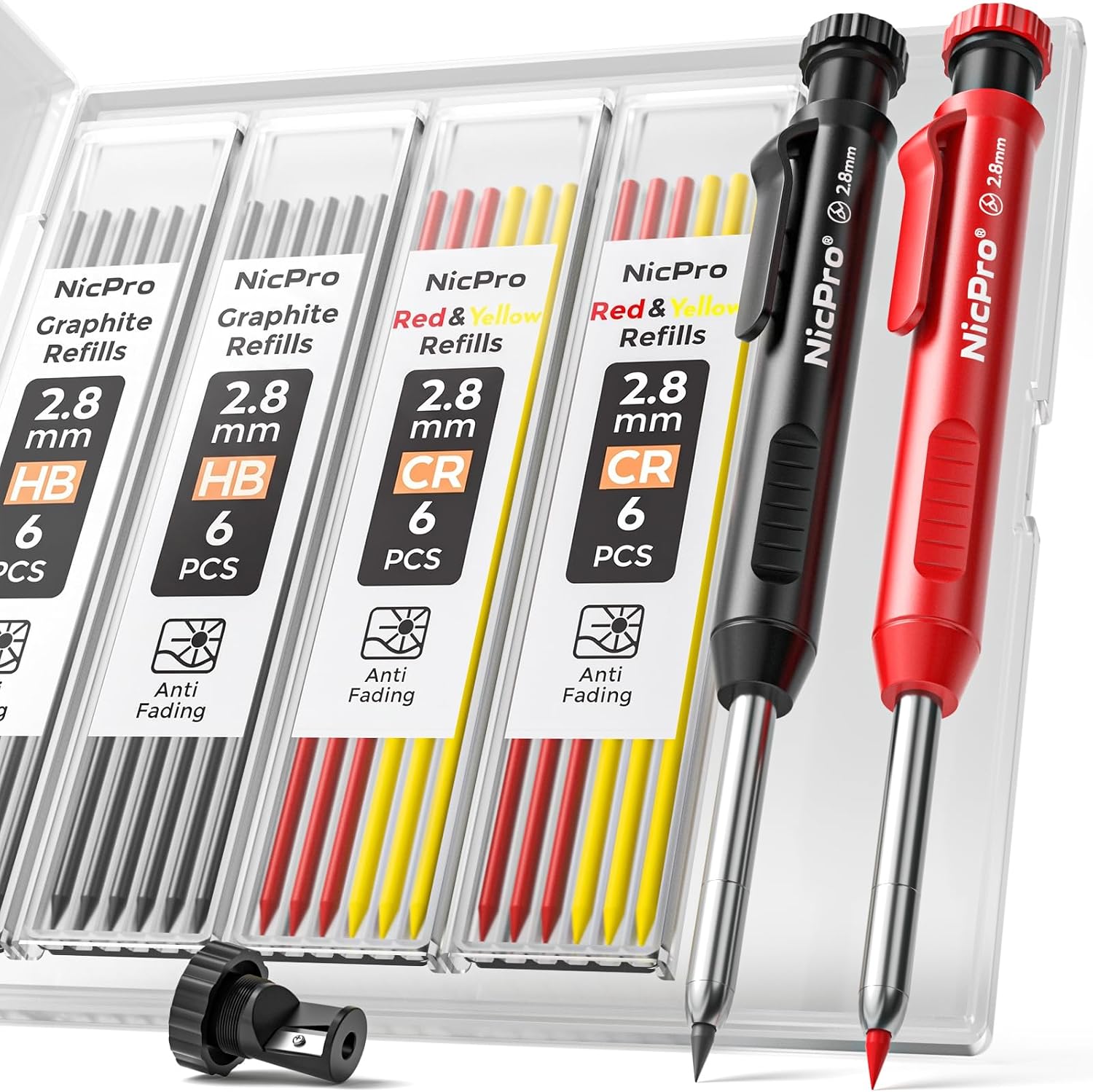
- Two Mechanical Carpenter Pencils for Everyday Construction Work: Includes black and red reusable marking pencils suitable for woodworking layouts, furniture assembly, cabinet installation, and general carpentry measurements.
- Extended 45mm Deep Hole Marking Tip: Reaches recessed drilling positions, narrow hardware openings, and difficult marking locations where conventional wooden carpenter pencils may not fit.
- Twenty-Six Thick 2.8mm Replacement Leads: Provides additional graphite in black, red, and yellow for repeated marking and improved visibility across different construction materials.
- Convenient Screw-In Sharpener for Precise Layout Lines: Features a replaceable sharpener attached to the pencil top, helping maintain defined graphite points during cutting and drilling preparation.
- - Durable Refillable Construction With Portable Storage Case: Combines reusable pencil bodies, metal components, and organized accessory storage for everyday workshop use and transportation between job sites.
These Two Carpenter Pencils Handle Recessed Marking Without a Complicated Setup
The Nicpro MG396 Mechanical Carpenter Pencil Set is designed for carpenters, woodworkers, cabinet installers, and DIY enthusiasts who regularly need to mark measurements on construction materials. The package includes two mechanical carpenter pencils, 26 replacement leads, a replaceable sharpener, and a plastic storage case. For anyone researching the best mechanical pencil for carpentry, this set provides a practical combination of deep hole marking, reusable graphite, and convenient everyday portability.
The pencils feature a 45mm extended marking tip designed to reach narrow openings and recessed positions. This is particularly useful when transferring drilling locations through hardware, cabinet fittings, and installation templates. The 45mm extended deep hole marking design addresses a common problem with conventional carpenter pencils, whose thick wooden bodies can prevent the graphite from reaching the intended surface.
Another important feature is the 2.8mm lead diameter. These leads are considerably thicker than the 0.5mm and 0.7mm graphite commonly used in office mechanical pencils, making them more suitable for rough construction marking. The heavy-duty 2.8mm carpenter pencil leads provide a useful combination of visible graphite lines and resistance to ordinary marking pressure.
The set includes black and red pencil bodies, with replacement leads available in black, red, and yellow. These colors provide different marking options when working with timber, metal, plastic, and other suitable surfaces. The package is relatively compact, making it appealing to individual tradespeople who do not need a large collection of identical marking tools.
The Deep Hole Tip and Thick Replacement Leads Make Workshop Marking More Practical
The most useful feature of the Nicpro MG396 is its extended 45mm marking tip. Construction and furniture installation frequently involve narrow openings that are difficult to access with conventional pencils. The deep hole carpenter pencil for recessed drilling positions allows users to reach these locations while keeping the main pencil body outside the opening.
Consider someone installing cabinet handles across several kitchen doors. The installer needs to mark the mounting holes accurately before drilling, and the pencil must reach through the hardware template. A conventional wooden carpenter pencil may be too wide to fit through the opening.
The MG396's extended tip can make this process more convenient. It allows the graphite to contact the cabinet surface through a narrow opening without requiring the entire pencil body to pass through. This is particularly useful when several handles must align consistently across a row of cabinets.
However, the extended tip does not automatically guarantee accurate positioning. The template must remain securely aligned, and the pencil should be held carefully to avoid shifting the mark. The precision marking of cabinet hardware drilling locations depends on both the marking tool and the accuracy of the original measurements.
The same principle applies to shelving brackets, drawer slides, and furniture fittings. These components often contain mounting holes that make ordinary marking difficult. A longer pencil tip can help transfer the intended position before the hardware is removed for drilling.
For example, someone installing a wall-mounted shelving system may need to mark several screw positions through a metal bracket. The pencil can reach through the bracket openings while the component remains in place. This reduces the need to repeatedly remove and reposition the hardware during layout.
The 2.8mm graphite leads are another important advantage. Ordinary office mechanical pencils use relatively thin graphite that can break when dragged across rough timber. The thick construction graphite for woodworking surfaces provides more material at the marking point and can be better suited to demanding workshop conditions.
Imagine someone preparing rough plywood for cutting. Raised wood fibers can catch a thin pencil point, causing the graphite to snap or produce an interrupted line. A thicker lead can make marking more manageable, although excessive pressure may still cause breakage.
The MG396 includes 26 replacement leads, providing additional graphite for repeated use. This is particularly convenient for people who mark measurements frequently and do not want to purchase replacement supplies immediately. The refillable design also allows the pencil body to remain in use as the original graphite becomes shorter.
Traditional wooden carpenter pencils gradually lose length as they are sharpened. Eventually, the remaining pencil can become uncomfortable to hold or difficult to retrieve from a tool pouch. The refillable mechanical carpenter pencil for daily construction maintains a consistent body length while allowing replacement leads to be inserted.
For example, a carpenter working on a home renovation may need to mark framing timber, cabinet panels, shelving, and trim over several days. Repeated marking consumes graphite, particularly when the point is sharpened frequently. Keeping replacement leads available helps reduce interruptions during the project.
The three available lead colors provide another practical benefit. Black graphite generally offers good visibility on pale timber, while red and yellow can provide alternatives for certain materials. The multicolor construction pencil leads for layout marking can also help distinguish different types of reference lines.
Consider someone preparing timber for a staircase installation. Black marks could identify cutting positions, while red marks could indicate drilling references or areas requiring additional checking. Using different colors can make complicated layouts easier to interpret when several measurements are present.
However, the visibility of each color depends on the material. Yellow leads may be difficult to see on pale plywood, while black graphite may appear faint on dark or heavily marked surfaces. Testing the lead on a scrap piece helps determine which color provides the clearest result.
The included sharpener is another useful feature. Nicpro describes a replaceable sharpener that screws into the top of the pencil, helping keep it accessible during work. The screw-in carpenter pencil sharpener for accurate layouts allows users to restore a defined graphite point without carrying a separate traditional sharpener.
Consider a woodworker preparing several boards for a cabinet frame. Each board needs to be measured and marked before cutting, and a blunt pencil point can create a broad line. Sharpening the graphite helps produce a narrower reference that is easier to follow.
Accurate cutting also requires understanding the saw blade's kerf. A blade removes material as it passes through timber, so cutting on the wrong side of the pencil line can change the finished dimensions. The marking tool establishes the reference, but the carpenter must still identify the waste side correctly.
For example, a board marked at 500mm should be cut with the intended finished edge clearly identified. Cutting through the wrong side of a thick line may remove additional material. The accurate cutting line preparation for woodworking therefore requires both a defined pencil point and careful blade positioning.
The MG396 is also useful for furniture assembly. Installing hinges, handles, drawer slides, and shelving supports frequently requires transferring measurements onto different components. The extended tip can help mark through narrow fittings, while the ordinary graphite point remains useful for general layout lines.
Imagine someone assembling a custom wooden storage cabinet. The carpenter may use the pencil to mark shelf positions, drilling locations, and cutting references across several panels. Having a reusable marking instrument available throughout the process can make the work more convenient.
The pencil is also suitable for marking different materials. Nicpro describes the MG396 as useful for wood, metal, plastic, and paper. The versatile mechanical carpenter pencil for multiple surfaces can be convenient for installers who regularly work with several construction materials.
For example, someone fitting a metal bracket onto a wooden support may need to mark positions on both surfaces. The same pencil can be used when the graphite provides sufficient visibility. However, smooth metal or oily plastic may require a different marking instrument for the clearest results.
Surface preparation is another important consideration. Sawdust, moisture, dirt, and finishing products can interfere with how clearly graphite appears. Removing loose debris before marking helps improve visibility and reduces the likelihood of interrupted lines.
For example, a carpenter marking a board covered in sawdust may find that the graphite contacts the loose debris rather than the timber. Brushing the surface clean before drawing the reference line can produce a more consistent result. The clear graphite marking on prepared woodworking surfaces is easier to achieve when the material is reasonably clean and dry.
The two-pencil configuration is practical for individual users. One pencil can remain near a workbench while the other is carried in a tool belt or pocket. This provides a spare without requiring a larger package containing several identical marking instruments.
For example, someone completing a weekend renovation project may work between a cutting station and the installation area. Keeping one pencil at each location reduces unnecessary movement. The two-piece carpenter pencil set for workshop organization provides a convenient arrangement for smaller projects.
The plastic storage case is another useful accessory. Replacement graphite and sharpening components are relatively small items that can become misplaced inside a large toolbox. Keeping them together helps protect the supplies and makes transportation between jobs easier.
Consider a contractor who regularly travels between residential installation projects. The pencil set can be stored alongside measuring tapes, drill bits, and other tools without leaving replacement leads loose in the equipment bag. This makes the accessories easier to locate when needed.
The pencil bodies combine ABS plastic and metal components, providing a reusable construction-oriented design. The durable mechanical pencil body for regular workshop use is intended for repeated handling during measuring and marking tasks. However, the longevity of the feeding mechanism still depends on proper use and maintenance.
Mechanical pencils can accumulate graphite dust around the lead opening. Workshop debris may also enter the mechanism when the pencil is carried in a tool pouch. Keeping the tip reasonably clean can help reduce feeding problems.
Another common mistake is extending too much graphite beyond the metal tip. Even thick 2.8mm leads can break when unsupported sections are subjected to sideways pressure. Advancing only the amount needed for the current mark helps reduce unnecessary lead consumption.
The MG396 also has limitations compared with larger carpenter pencil sets. Two pencils may be sufficient for an individual user, but a workshop with several employees may require additional marking tools. The compact two-pencil configuration for individual carpenters is therefore more suitable for smaller teams or personal tool collections.
Another consideration is the mechanical design itself. Traditional flat wooden carpenter pencils resist rolling and can be sharpened into different point shapes with a utility knife. The MG396 offers better access to recessed marking positions, but it does not replace every advantage of conventional carpenter pencils.
Why We Ranked the Nicpro MG396 Seventh Instead of Higher
We placed the Nicpro MG396 Mechanical Carpenter Pencil Set at number seven among our seven selections because it offers useful marking features but provides fewer pencils and a smaller overall package than several higher-ranked alternatives. Its 45mm extended tip, 2.8mm replacement leads, and screw-in sharpener make it suitable for everyday carpentry. However, our comparison gives additional weight to package quantity, accessory variety, and flexibility across different marking tasks.
Our first-ranked Nicpro MG413 set includes five mechanical carpenter pencils, making it particularly convenient for larger workshops or people who want several spare marking tools. The MG396 provides only two pencils, although both use a similar deep hole marking approach. The compact two-pencil construction marking package may still be more appropriate for individual users who do not need a larger collection.
Our second-ranked Worldity set includes three mechanical carpenter pencils and a substantial supply of replacement leads. That configuration provides an additional pencil for workshop organization. The MG396 instead emphasizes a smaller package with a documented 45mm extended tip and 2.8mm graphite system.
The Nicpro MG552 set ranked third also provides three mechanical pencils with thick replacement leads and extended marking tips. Its larger pencil quantity may be more convenient for people who work across several stations. The MG396 offers similar core marking functionality in a more compact format.
Our fifth-ranked Nicpro CP1000 set includes additional long-tip markers alongside its mechanical pencils. That combination provides different marking methods for recessed hardware and construction materials. The MG396 concentrates on refillable graphite marking with an extended tip rather than combining several separate marking instruments.
One of the strongest reasons to consider the MG396 is its 45mm deep hole tip. Cabinet installers and furniture makers frequently need to mark through narrow hardware openings. The extended tip provides a practical way to reach these positions without requiring a separate thin writing instrument.
The 2.8mm replacement leads are another positive feature. Their thicker construction is suitable for regular marking on rough timber and other compatible surfaces. The heavy-duty graphite leads for carpentry measurements also allow users to sharpen the point when more precise reference lines are needed.
The included sharpener contributes to the set's usefulness. Keeping the graphite point defined helps reduce uncertainty when marking cutting positions or drilling references. Its screw-in design also makes the sharpener easier to keep with the pencil during regular work.
There are disadvantages to consider, particularly the smaller pencil quantity and the possibility of graphite breakage under excessive pressure. Mechanical feeding components also require occasional cleaning. Users who work mainly on rough framing may still prefer traditional wooden carpenter pencils for certain tasks.
Nevertheless, the practical deep hole marking system for woodworking remains useful for cabinet installation, furniture assembly, and general construction layouts. The refillable design reduces repeated pencil replacement, while the storage case helps keep the accessories organized.
The seventh-place ranking therefore reflects the package's smaller scale rather than a demonstrated weakness in its marking performance. For someone who needs only two reliable mechanical carpenter pencils, the MG396 may offer a more appropriate configuration than a larger set.
Overall, we believe the Nicpro MG396 Deep Hole Mechanical Carpenter Pencil Set deserves its seventh-place position among the best mechanical pencil for carpentry options within this comparison. Although higher-ranked packages offer more pencils or additional marking accessories, the MG396 provides a practical combination of two reusable construction pencils, 26 replacement leads, a 45mm extended tip, and a convenient screw-in sharpener. For carpenters, woodworkers, cabinet installers, and DIY enthusiasts who want a compact marking set for accurate everyday projects, it remains an excellent choice worth considering.