

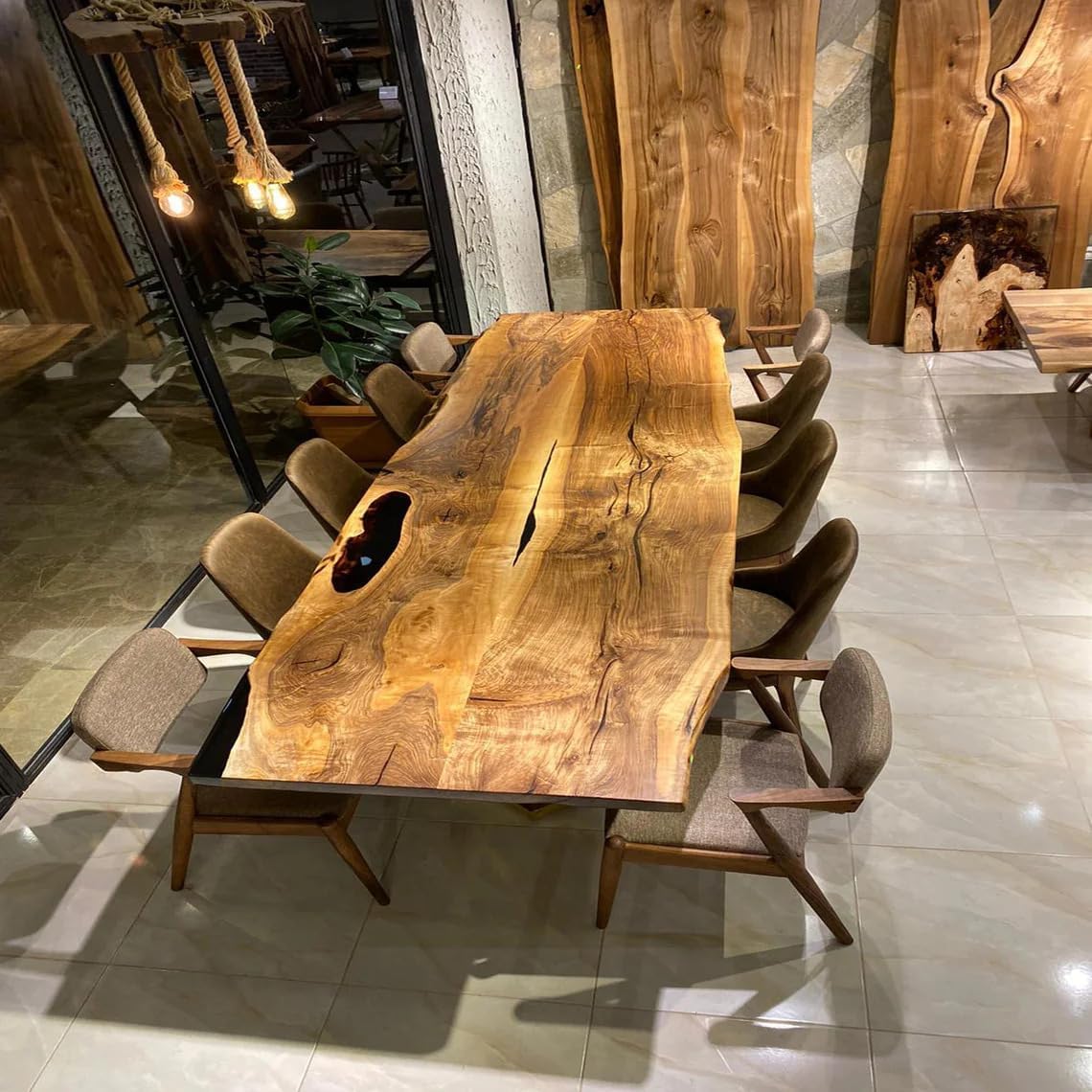
- Live edge inspired tabletop design brings natural-looking character to conference rooms and professional meeting spaces.
- Multipurpose table concept accommodates dining, collaborative meetings, home office activities, and everyday household use.
- Distinctive natural-edge appearance offers an alternative to conventional straight-edged office conference furniture.
- Broad tabletop format can provide shared working space for documents, laptops, presentations, and meeting materials.
- - Versatile decorative styling suits contemporary offices, creative studios, dining rooms, and residential interiors.

This Sophisticated Live Edge Table Has the Right Look for a More Inviting Conference Room
The Sophisticated Live Edge Table is marketed as a multipurpose furniture piece suitable for dining rooms, living rooms, hallways, conference rooms, and home offices. Its main appeal is the natural-edge inspired design, which offers a different appearance from conventional rectangular office furniture. For buyers comparing the best live edge conference table options, that visual distinction can be particularly useful in meeting spaces where furniture contributes to the overall atmosphere.
A live edge table typically preserves or imitates the natural outline of a tree along the tabletop edges. Instead of perfectly straight sides, the surface features irregular contours that create a more organic appearance. The distinctive natural edge tabletop design is the main reason this style has become popular in contemporary offices, creative studios, and residential interiors.
The product title identifies several possible uses, including conference meetings, dining, and general home office activities. This flexibility is useful for buyers who want furniture that can serve more than one purpose. However, the exact dimensions, materials, and construction details for this Amazon listing could not be independently confirmed.
That distinction matters because live edge furniture varies considerably in construction. Some tables use solid wood slabs, while others use joined boards, veneers, or manufactured surfaces designed to reproduce a natural appearance. Understanding the actual tabletop construction before purchasing is important when comparing durability, maintenance requirements, and price.
For example, a business purchasing a conference table for daily meetings should consider how frequently the surface will be used. A table used occasionally for client discussions has different requirements from one supporting laptops, documents, and office equipment throughout the working day. The material and finish need to suit those conditions.
Another important consideration is the table's overall size. A conference table must provide enough room for participants without restricting movement around the office. Buyers should confirm the selected dimensions rather than assuming that every size offered under a multipurpose furniture listing is suitable for meetings.
The natural-edge appearance is also relevant to interior design. A table with visible wood grain and irregular edges can coordinate with metal chairs, upholstered seating, neutral walls, and contemporary office furniture. The adaptable appearance for modern professional interiors makes this style worth considering beyond traditional dining rooms.
The Natural Edge Design Is Attractive, but Workspace and Practicality Still Matter
The most recognizable feature of this table is its live edge inspired appearance. Natural-edge furniture offers visual variation that conventional straight-edged conference tables generally do not provide. The irregular tabletop outline and natural wood appearance can make a meeting room feel less formal without sacrificing a professional setting.
Consider a small architecture studio that regularly meets with clients to review residential designs. A conventional office table may provide enough space, but a live edge table can coordinate more naturally with material samples, architectural models, and contemporary furniture. The appearance supports the studio's design-focused environment.
However, appearance should not determine the purchase on its own. The tabletop still needs to provide enough usable space for drawings, notebooks, and electronic equipment. An irregular edge can slightly reduce the practical width at certain points.
For example, a conference table may appear wide enough in its product photographs, but the narrowest section could provide less space than expected. Checking the minimum usable tabletop width is particularly important for meetings involving laptops and printed documents.
A typical conference meeting requires space for several items per participant. A laptop, notebook, smartphone, and drinking glass can occupy a substantial portion of the table. Participants also need enough room to move their arms without disturbing neighboring equipment.
For comfortable meeting arrangements, allowing approximately 24 to 30 inches of table edge per person is a useful planning guideline. This is not a manufacturer specification for the Sophisticated table, but it helps estimate seating capacity. Planning the seating arrangement around actual table dimensions prevents overcrowding.
Consider a business expecting six people to attend regular meetings. A table that comfortably accommodates four diners may not provide sufficient space for six laptops and documents. Buyers should calculate seating capacity according to their intended activities rather than relying only on decorative photographs.
The table's depth is another important consideration. Participants seated opposite each other need enough room for their equipment without creating an uncomfortable distance. Choosing an appropriate conference tabletop depth helps maintain practical working space.
For example, a meeting involving architectural drawings may require a wider surface than an ordinary discussion. Large printed plans need room to lie flat, particularly when several people are reviewing the same document. A narrow table may force participants to fold or overlap materials.
Natural-edge tables are also popular in creative workspaces because they can complement different furniture styles. Wood-look surfaces often coordinate with black metal frames, upholstered chairs, and minimalist office storage. This flexibility can make a table easier to incorporate into an existing room.
However, the actual color and grain pattern should be checked carefully. Product photography may show a particular appearance under controlled lighting. Understanding natural variation in wood grain and color is important when purchasing furniture intended to match other pieces.
If the table uses natural wood, individual pieces may show differences in grain, knots, and coloration. These characteristics are normal in many wood products. Buyers seeking a perfectly uniform appearance may prefer a manufactured surface with a consistent finish.
Another consideration is the difference between a true live edge slab and a manufactured live edge effect. A solid slab may retain a natural contour formed by the original tree, while a manufactured tabletop may use a shaped edge to achieve a similar appearance. Confirming whether the tabletop uses solid wood or engineered materials helps establish realistic expectations.
This distinction also affects maintenance. Solid wood can respond to changes in humidity, while some engineered surfaces have different moisture and temperature tolerances. The appropriate cleaning method depends on the actual construction and protective finish.
For example, a solid wood conference table installed near a heating vent may experience changing environmental conditions throughout the year. Depending on its construction and finish, the wood may expand or contract. Maintaining reasonably stable indoor humidity around wooden furniture can help reduce unwanted movement.
However, no particular wood species or finishing method has been verified for this Amazon product. Buyers should consult the seller's material specifications before applying wood oils, waxes, or other treatments. Using the wrong product can damage certain finishes.
For ordinary conference room use, surface protection is important. Coffee cups, water glasses, laptop stands, and office equipment can cause scratches or moisture marks depending on the finish. Protecting the tabletop during everyday office meetings helps maintain its appearance.
Consider a company that uses the table for daily staff meetings. Employees may place hot drinks and electronic devices directly on the surface. Coasters, desk mats, and appropriate cleaning practices can reduce unnecessary wear.
The same consideration applies to dining use. If the table is used for both meals and meetings, food spills and cleaning products may come into contact with the surface. Buyers should confirm that the finish is suitable for their intended activities.
For example, a small business may use one room for client meetings during the day and staff meals afterward. A multipurpose table can reduce the need for separate furniture. The flexibility to support both meetings and dining activities is useful when office space is limited.
However, a table intended for frequent dining requires appropriate cleaning and surface protection. Buyers should check whether the finish tolerates ordinary food spills and cleaning procedures. Decorative appearance alone does not establish resistance to moisture or heat.
The base construction is another important factor. A large conference table needs adequate structural support, especially when people lean against the edges or place equipment on the surface. Checking the table base and overall structural stability should be part of the purchasing process.
For example, a meeting room table may support several laptops, a projector, and printed presentation materials. Although those items are not unusually heavy individually, the combined load and repeated daily use require a stable structure. Buyers should confirm the manufacturer's load rating when available.
Leg placement also affects comfort. Some table bases provide generous clearance beneath the tabletop, while others restrict where participants can sit. The correct arrangement depends on the number of chairs and the table's dimensions.
Consider a six-person meeting where two participants sit near the ends. A poorly positioned table leg may interfere with their feet or knees. Checking the leg placement before arranging conference seating can prevent uncomfortable layouts.
The table should also be evaluated according to its intended location. Conference rooms need enough clearance around the furniture for chairs to move and people to walk comfortably. A table that fits physically into a room may still be too large for practical use.
As a general planning guideline, approximately 36 inches of clearance around a table can provide basic circulation space, while additional room may be preferable behind occupied chairs. These are planning guidelines rather than specifications for this product. Measuring the complete room before purchasing conference furniture is essential.
For example, an office may have enough floor space for a long table but limited clearance near the entrance. Once chairs are added, the doorway or walkway could become obstructed. Planning the layout before ordering helps avoid that problem.
Another practical consideration is delivery. Large live edge style tables may require substantial handling space, particularly if the tabletop is delivered as one piece. Buyers should verify the package dimensions and assembly requirements.
For example, a conference room on an upper floor may have narrow stairways or elevator restrictions. A large tabletop could be difficult to transport even when it fits comfortably inside the finished room. Checking the delivery route and package dimensions prevents unnecessary complications.
Assembly requirements should also be confirmed. Some tables arrive with separate legs or base components, while others may require more extensive installation. The exact assembly process for this listing has not been independently verified.
For a professional meeting room, stability should be checked after assembly. All supporting components should be installed according to the manufacturer's instructions. A table that rocks or shifts during use can be distracting and may create problems for equipment placed on its surface.
Technology requirements are another factor when selecting a conference table. Modern meetings frequently involve laptops, video calls, projectors, and charging cables. Planning electrical access and cable management around the conference table can make the room more functional.
For example, a company conducting regular video conferences may need several power outlets near the table. If the furniture does not include integrated cable management, external cable organizers may be necessary. Buyers should not assume that electrical connections are included unless the product specifications confirm them.
Another consideration is the tabletop finish during video meetings. Highly reflective surfaces can produce glare from overhead lighting or windows. The actual finish should be evaluated in the intended room whenever possible.
For example, a meeting room with large windows may receive strong afternoon sunlight. Reflections across a glossy tabletop can be distracting for participants working on laptops. Considering room lighting when selecting the tabletop finish can improve everyday comfort.
The multipurpose design is useful beyond formal conference rooms. A live edge table can also serve as a shared workspace in a creative studio, a dining table in a residential setting, or a collaborative work surface in a home office. Its suitability depends primarily on the selected dimensions and construction.
For example, a freelance designer may use a large table for reviewing samples, preparing presentations, and meeting clients. When the table is not being used for work, it can serve as ordinary household furniture. This flexibility can be valuable in spaces where dedicated conference furniture would be impractical.
However, the different uses listed in the product title should not be treated as proof that every available size performs equally well in each setting. A small side table and a full conference table have very different requirements. Selecting the correct table dimensions for the intended application remains the most important purchasing decision.
Why We Ranked This Sophisticated Live Edge Table Number One
We selected the Sophisticated Live Edge Table as our first-ranked option because its natural-edge inspired appearance and multipurpose design make it an appealing candidate for professional meeting spaces that need something different from conventional office furniture. It can potentially serve several functions depending on the selected size. The combination of distinctive design and flexible room applications is its main advantage.
The live edge appearance is particularly relevant to modern conference rooms. It introduces natural-looking contours and visual variation without requiring an elaborate furniture arrangement. This can work well in creative offices, design studios, and client-facing meeting spaces.
The product's broad range of stated applications also contributes to its appeal. It is marketed for conference rooms, dining spaces, home offices, and other indoor settings. The versatility across professional and residential environments makes it relevant to buyers who want furniture that can accommodate changing needs.
For example, a small creative business may need one large table for client presentations, team discussions, and occasional collaborative projects. A multipurpose table can provide a shared surface for those activities. The correct size and construction must still be selected.
Another advantage is the potential to coordinate with different interior styles. Natural wood tones can complement contemporary, industrial, and minimalist furniture arrangements. This makes the table suitable for offices that want a less conventional appearance.
However, several limitations need to be considered. The exact dimensions, tabletop material, thickness, load capacity, and leg construction could not be verified for the supplied Amazon listing. The importance of confirming product specifications before ordering is particularly significant for expensive furniture.
Another consideration is the irregular tabletop outline. Although visually appealing, a live edge design may provide less uniform working space than a conventional rectangular conference table. Buyers should measure the usable surface carefully.
The table may also require additional accessories for professional meetings. Cable management, charging connections, and protective desk mats are not confirmed as included. Planning the complete conference room setup beyond the table can help avoid unexpected expenses.
Maintenance requirements are another factor. The appropriate cleaning method depends on the actual tabletop material and finish. Buyers should obtain the seller's care instructions before using wood treatments or strong cleaning products.
The lack of independently verified specifications also limits direct comparison with other conference tables. A definitive performance ranking would require confirmed dimensions, construction details, and comparable product information for all seven selections. This first-place placement reflects the requested editorial ranking and the table's design appeal rather than independently tested superiority.
Despite these considerations, the Sophisticated Live Edge Table offers an attractive concept for modern meeting spaces. Its natural-edge inspired design can provide a more distinctive appearance than ordinary office tables, while its multipurpose positioning gives buyers flexibility in how the furniture is used. The appealing combination of natural styling and practical versatility makes it worth considering.
Ultimately, we believe the Sophisticated Live Edge Table is a strong candidate for the number one position because it brings distinctive live edge styling to modern conference and collaborative spaces while offering the possibility of use in several different environments. Buyers should confirm the exact dimensions, materials, finish, and construction before purchasing, particularly for regular commercial use. For offices, studios, and shared workspaces seeking a visually distinctive meeting table, it remains a promising and attractive choice.

- Personalized table concept offers potential customization for distinctive conference room and interior design requirements.
- Decorative tabletop styling provides an alternative to conventional rectangular office and meeting furniture.
- Multipurpose design is marketed for dining, living room, and shared interior spaces.
- Custom furniture approach allows buyers to consider dimensions and configurations suited to their available space.
- - Natural wood and resin style options can create a distinctive appearance when specified in the selected configuration.
This Personalized Table Is an Interesting Option for a Conference Room, but the Configuration Matters
The Personalized Dining and Coffee Table listed under Amazon ASIN B0B6CCHHMG is marketed as a decorative furniture option for dining and living spaces. Its personalized design concept makes it relevant to buyers looking beyond conventional office furniture. For anyone comparing the best live edge conference table options, the main attraction is the possibility of selecting a distinctive tabletop that suits the appearance of a particular meeting room.
There is an important limitation to establish immediately. The exact manufacturer, tabletop material, dimensions, and included components could not be independently confirmed from the supplied Amazon listing. Confirming the exact table configuration before purchasing is essential, particularly because the listing title includes the word Without, which may refer to an excluded component or accessory.
A conference table needs more than an attractive surface. It must provide sufficient room for participants, support ordinary meeting equipment, and remain stable during regular use. A personalized table can be an excellent choice, but only when its dimensions and construction match those practical requirements.
The live edge furniture category includes natural wood slabs, shaped wooden tabletops, and designs that incorporate decorative resin. These constructions can look similar in photographs while behaving differently in everyday use. The difference between natural wood and resin tabletop construction matters when evaluating durability, cleaning, weight, and maintenance.
For example, a solid wood tabletop may display distinctive grain patterns and irregular natural edges. A resin design may incorporate decorative colored sections or fill spaces between pieces of wood. The exact appearance and materials of this particular product should be confirmed through the selected Amazon variation rather than assumed.
Personalization can be valuable for a business that wants its meeting furniture to coordinate with a specific interior. A creative agency may prefer a dramatic natural-edge appearance, while a consulting office may want a more restrained finish. The correct choice depends on the room and the impression the business wants to create.
However, personalization should not distract from functional measurements. A visually impressive tabletop may still be too small for the intended number of participants. Choosing the correct dimensions for a conference meeting should take priority over decorative details.
The Custom Design Potential Is Appealing, but the Everyday Details Need Checking
One of the strongest reasons to consider a personalized table is the possibility of selecting a design suited to a particular space. Unlike standard office furniture, custom-style tables may offer choices in appearance, dimensions, or supporting components. The flexibility of personalized furniture for professional interiors can be useful when a conventional table does not fit the room.
Consider a small architecture studio with a narrow meeting room. The business may want a table that provides enough space for client presentations without obstructing the walkway. A suitable custom dimension could help achieve that arrangement, provided the seller actually offers the required size.
However, buyers should never assume that customization is unlimited. Some listings offer only a few predetermined variations, while others accept individual requests. The available choices and any associated costs need to be confirmed before ordering.
For conference use, table length directly affects seating capacity. A useful planning guideline is approximately 24 to 30 inches of table edge per participant, depending on the chairs and equipment involved. Planning seating capacity around the actual usable table length helps avoid overcrowding.
For example, a six-person meeting involving laptops requires more room than a casual discussion with only notebooks. Each participant needs enough space for a computer, documents, and normal arm movement. A decorative tabletop should still provide practical working dimensions.
Table depth is equally important. Participants seated opposite each other need enough room for equipment without placing everything at the center. Checking the usable tabletop depth for laptops and documents is especially important when selecting a natural-edge design.
Consider a design firm reviewing printed floor plans during client meetings. Large drawings need room to lie flat while participants examine details. A narrow table can force documents to overlap, making the discussion less convenient.
Live edge designs introduce another consideration because their sides may not be perfectly straight. The widest point of a tabletop may differ from its narrowest point. Buyers should request measurements that reflect the actual usable surface rather than relying only on maximum dimensions.
For example, a table advertised with a particular overall width may have a narrower section near one end. That section might provide less room for a laptop or notebook. Understanding the irregular dimensions of natural-edge tabletops helps prevent unpleasant surprises.
The material is another important factor. Natural wood can provide distinctive grain and color variation, while resin elements may introduce decorative patterns and contrasting colors. Neither construction should be assumed for this specific listing until the material information is confirmed.
For example, a business choosing a wooden conference table may appreciate the natural variation between individual pieces. However, buyers expecting a perfectly uniform surface should understand that genuine timber can vary in grain, knots, and coloration. Recognizing natural variation in decorative wooden furniture helps establish realistic expectations.
If a selected configuration incorporates epoxy resin, the quality of the resin, finishing process, and supporting construction become important. Buyers should ask about the surface's resistance to heat, scratching, and ordinary cleaning products. Resin should not automatically be considered resistant to every type of damage.
For example, a meeting room may regularly contain hot coffee cups and laptop chargers. Some finishes can be affected by heat or prolonged contact with certain materials. Using appropriate surface protection during everyday office meetings can help preserve the tabletop.
Coasters and desk mats are simple additions. They reduce direct contact between the furniture and objects that may scratch or mark the finish. This is particularly useful when a table serves both professional meetings and dining activities.
The multipurpose nature of the product is another potential advantage. A table suitable for dining may also work as a collaborative workspace when its height and dimensions are appropriate. The flexibility to support both dining and professional meetings can be valuable in smaller offices.
Consider a creative business operating from a converted residential property. The same room may host client discussions, team lunches, and collaborative design sessions. A suitable multipurpose table could reduce the need for separate furniture.
However, dining tables and coffee tables are not interchangeable with conference tables. A coffee table is usually much lower than a standard meeting table. Buyers should confirm the selected height before assuming the furniture can support ordinary conference seating.
For example, a low decorative table may work well in a lounge where participants sit on sofas. It would be uncomfortable for a formal meeting involving office chairs and laptops. Matching table height to the intended seating arrangement is essential.
The listing's incomplete Without description is another reason to check the included components. Some furniture products are sold as tabletops without supporting legs or stands. If that applies to the selected configuration, buyers must obtain a compatible base separately.
For example, a business may order a decorative tabletop expecting a complete meeting table. If the package contains only the top, installation cannot be completed without additional furniture components. Verifying whether the table base is included helps prevent unexpected costs.
Choosing a compatible base is not simply a matter of appearance. The supporting structure must accommodate the tabletop's weight, dimensions, and mounting requirements. An unsuitable base can create instability even when the tabletop itself is well made.
For example, a long tabletop supported by a narrow base may move when someone leans near the edge. This can be distracting during meetings and potentially unsafe for equipment. Checking the support structure and load capacity is important before installation.
Leg placement also affects seating comfort. Participants need enough clearance for their knees and feet, particularly near the ends of a conference table. A decorative base that looks attractive in photographs may interfere with certain seating arrangements.
Consider a meeting room where six chairs are arranged around a table. If the legs occupy positions intended for seating, participants may have difficulty sitting comfortably. Planning chair placement around the table base can prevent that problem.
Room clearance is another practical consideration. A table must fit inside the room while leaving space for chairs and circulation. As a general guideline, approximately 36 inches around the table provides basic circulation space, although more may be desirable behind occupied chairs.
For example, a conference room may accommodate a large tabletop but leave insufficient space when chairs are pulled away from it. The result is an awkward meeting arrangement. Measuring the complete conference room layout before ordering helps avoid that mistake.
Delivery requirements are particularly important for personalized furniture. A large tabletop may be difficult to transport through narrow doorways, staircases, or elevators. Buyers should confirm the package dimensions and delivery arrangements.
For example, an office on the second floor of an older building may have a staircase with limited turning space. A large rigid tabletop could be difficult to carry upstairs. Checking access routes for oversized furniture deliveries should happen before the order is placed.
Assembly requirements also need attention. Some tables arrive with separate legs, while others may require more extensive installation. The exact assembly arrangement for this Amazon listing could not be verified.
If the tabletop is supplied without a stand, professional installation may be appropriate depending on its weight and construction. The supporting components must be suitable for the intended use. Buyers should follow the seller's installation instructions rather than improvising.
Maintenance is another important consideration. Solid wood, engineered wood, and resin surfaces may require different cleaning methods. Following the correct care instructions for the selected tabletop material helps maintain the finish.
For example, a natural wood surface may require a particular cleaning product or periodic maintenance depending on its finish. A resin surface may have different restrictions concerning heat and chemicals. Buyers should obtain the actual care instructions before using specialized treatments.
Environmental conditions also matter. Natural wood can respond to changes in temperature and humidity, while mixed-material furniture may behave differently. A reasonably stable indoor environment is generally preferable for valuable furniture.
Consider a conference table positioned directly beside a heating vent. Repeated temperature changes may affect some wood finishes or constructions over time. Choosing an appropriate location for natural wood furniture can help reduce unnecessary exposure.
Technology requirements should also be considered. Modern conference rooms frequently need power connections for laptops, video conferencing equipment, and presentation devices. The supplied listing does not establish that integrated outlets or cable-management features are included.
For example, a business conducting regular online meetings may need several power connections near the table. If the furniture does not include built-in cable management, separate organizers may be necessary. Planning electrical access for conference room equipment helps keep the working surface organized.
Another consideration is the tabletop's appearance under office lighting. Highly polished surfaces may reflect overhead lights or nearby windows. This can be distracting when participants are using laptops or reviewing documents.
For example, a conference room with large windows may receive strong afternoon sunlight. A reflective finish could create glare across parts of the table. Considering surface reflections when planning conference room lighting can improve everyday comfort.
Overall, the personalized table concept offers an interesting approach to furnishing professional spaces. Its potential appeal comes from decorative flexibility and multipurpose use rather than a verified set of technical specifications. Buyers should confirm the exact configuration before treating it as a complete conference table.
Why We Ranked This Personalized Table Number Two
We placed this Personalized Dining and Coffee Table second out of seven because its customizable furniture concept could suit distinctive meeting rooms, but several important product details remain unverified. The exact material, dimensions, included base, and load capacity need confirmation. The potential for a distinctive personalized conference room centerpiece is its main attraction.
Customization can be valuable when a business wants furniture that coordinates with a particular interior. A natural-edge or decorative resin style may complement contemporary offices and creative studios. However, the exact appearance must be established through the selected product variation.
The multipurpose positioning is another advantage. The product is marketed for dining and living spaces, suggesting potential use in several indoor environments. The versatility of decorative furniture for shared spaces may appeal to buyers who want one table for multiple activities.
For example, a small design studio may use a suitable table for client meetings, collaborative work, and occasional dining. A personalized appearance can help coordinate the furniture with the room. The selected dimensions and height still determine whether that arrangement is practical.
However, our first-ranked Sophisticated Live Edge Table was selected for its straightforward multipurpose positioning and natural-edge inspired design. It presents a clear decorative concept for conference and dining applications. The Personalized listing introduces additional uncertainty because the exact configuration and included components could not be verified.
One important concern is the possibility that the selected product is supplied without a supporting stand. If that is the case, buyers would need to purchase a compatible base separately. The potential additional cost of completing the table installation contributes to its second-place position.
Another limitation is the lack of confirmed dimensions. Without reliable measurements, it is difficult to establish seating capacity or compare the usable surface with other conference tables. Buyers should obtain the exact length, width, and height before purchasing.
The tabletop material also needs verification. Solid wood, engineered wood, and resin constructions have different characteristics and maintenance requirements. The uncertainty surrounding the exact tabletop material and finish makes a direct durability comparison difficult.
Delivery and assembly requirements are another consideration. Personalized furniture can involve large components, and the installation process may depend on the selected configuration. Buyers should confirm package dimensions, assembly instructions, and any additional charges.
Another limitation is that a decorative dining or coffee table is not automatically suitable for formal conference use. A low table may be appropriate for lounge seating but unsuitable for ordinary office chairs. The intended application must match the actual furniture dimensions.
Despite these considerations, the Personalized table remains an appealing option for buyers interested in distinctive furniture. Its decorative concept could suit contemporary meeting rooms, home offices, and creative workspaces when configured appropriately. The opportunity to create a more individualized meeting environment is a meaningful benefit.
Ultimately, we believe this Personalized Table deserves second place because it offers attractive customization potential for modern collaborative and conference spaces, while uncertainty about its exact construction, dimensions, and included components prevents a stronger recommendation. Buyers who confirm the selected configuration and choose an appropriate supporting base may obtain a distinctive and practical piece of furniture. For businesses and homeowners seeking a more personalized alternative to conventional meeting tables, it remains a promising choice.

- Conference-focused table design is intended for professional meetings, collaborative discussions, and organized training sessions.
- Adjustable leveling functionality can help establish a steadier working surface on slightly uneven office floors.
- Shared tabletop arrangement provides a practical setting for laptops, notebooks, presentation documents, and meeting materials.
- Multipurpose conference and training applications make the table relevant to offices, classrooms, and collaborative workspaces.
- - Straightforward office furniture concept prioritizes usable meeting space and everyday functionality over decorative complexity.
The MAAOBR Conference Table Looks More Focused on Everyday Meetings Than Decorative Furniture
The MAAOBR Conference Table is marketed for professional meeting and training environments, with adjustable leveling functionality identified in its Amazon listing title. It is intended for spaces where people need a shared working surface for discussions, presentations, and collaborative activities. For buyers comparing the best live edge conference table options, its main attraction is practical office functionality rather than a confirmed natural wood edge design.
That distinction is important. The supplied product title does not establish that the MAAOBR has a genuine live edge tabletop, and the exact construction could not be independently verified. The difference between a functional conference table and decorative live edge furniture should be considered before including it in a specialized furniture comparison.
A conventional conference table can still be a useful choice for businesses that prioritize workspace and stability. The table needs to accommodate participants, support laptops and documents, and provide enough room for ordinary meeting activities. These requirements often matter more during everyday use than the appearance of the tabletop alone.
The adjustable leveling feature indicated in the listing title is particularly relevant to office installations. Tables positioned on slightly uneven floors may require adjustment to prevent movement during use. The ability to establish a stable and level meeting surface can make a practical difference in busy conference rooms.
However, the exact leveling mechanism, adjustment range, and supporting construction have not been verified for this Amazon product. Buyers should confirm those details with the seller before purchasing. The same applies to the tabletop dimensions, material, finish, and maximum load capacity.
For example, a business furnishing a meeting room for eight employees needs to know whether the selected table provides sufficient seating space. A product photograph alone cannot establish comfortable capacity. The actual dimensions and leg placement determine how the furniture will function.
The Leveling Feature and Shared Workspace Are What Matter During Real Meetings
One of the most useful characteristics indicated by the MAAOBR listing is adjustable leveling. This type of feature allows a table to compensate for minor differences in floor height when the appropriate mechanism is fitted. The adjustable leveling function for stable conference room furniture is particularly relevant in older buildings.
Consider an office located in a converted warehouse. The floor may appear level but contain small variations that cause ordinary furniture to rock. Properly adjusted leveling feet can help establish more consistent contact with the floor.
This matters during meetings involving laptops and documents. A table that shifts whenever someone leans against it can become distracting. It may also make writing or working with delicate equipment less comfortable.
However, leveling feet cannot compensate for every flooring problem. Significant slopes, damaged flooring, or unstable supporting surfaces may require additional attention. Checking the condition of the floor before installing conference furniture is still important.
For example, a training room with uneven flooring may need more than a simple adjustment. If the floor surface itself is damaged, the table could remain unstable even after the feet are repositioned. Buyers should address the underlying problem rather than relying entirely on the furniture.
The shared tabletop is another important consideration. Conference tables need to accommodate several participants working simultaneously. The available tabletop space for laptops and meeting documents directly affects how comfortably people can collaborate.
Consider a project meeting involving six employees. Each person may need a laptop, notebook, smartphone, and drinking glass. If the table is too narrow, equipment can become crowded and interfere with normal movement.
As a general planning guideline, approximately 24 to 30 inches of table edge per participant is useful for estimating seating capacity. This is not a verified specification for the MAAOBR table. The actual dimensions must be confirmed before calculating how many people can sit comfortably.
For example, a table intended for four people may not provide enough space for six participants using laptops. The meeting may become uncomfortable even when six chairs physically fit around the furniture. Planning seating capacity around realistic working requirements helps prevent overcrowding.
Table depth is another important factor. Participants seated opposite each other need enough room for equipment without placing everything in the center. A narrow tabletop may work for discussions but become restrictive during document-heavy meetings.
Consider an architecture firm reviewing printed building plans. Large drawings need room to lie flat while several people examine them. Choosing adequate tabletop depth for collaborative document review can make those discussions easier.
The MAAOBR is also marketed for training applications. Training rooms often require a different furniture arrangement from formal boardrooms. Participants may need to face a presenter while keeping laptops or notebooks in front of them.
For example, a company conducting employee training may arrange tables in rows or smaller groups. This can make it easier for participants to view a presentation while taking notes. The flexibility to support different meeting and training activities is valuable when a room serves multiple purposes.
However, the exact modular capabilities of this MAAOBR model have not been confirmed. Buyers should not assume that the table folds, connects to other units, or includes wheels. Those features must be established through the specific product configuration.
Another consideration is the tabletop material. Office conference tables may use solid wood, engineered wood, laminate, or other manufactured surfaces. Each construction has different maintenance requirements and characteristics.
For example, a laminate surface may be relatively convenient for ordinary office cleaning, while a natural wood finish may require more specialized care. Confirming the tabletop material and protective finish before purchase helps buyers understand the maintenance involved.
The supplied Amazon title does not establish whether the MAAOBR uses solid wood or a manufactured surface. It also does not confirm a live edge outline. Buyers seeking genuine natural-edge furniture should request detailed product photographs and material specifications.
A true live edge tabletop typically preserves the irregular natural contour of the wood. A conventional straight-edged conference table provides a more uniform working surface. The distinction between natural edge design and standard rectangular furniture is important for buyers focused on a particular aesthetic.
For example, a creative agency may want a natural wood slab with visible grain variation and irregular edges. A conventional conference table may not provide that appearance. However, it may still offer advantages in predictable dimensions and consistent seating arrangements.
Edge design also affects usable workspace. Natural-edge tables can have varying widths along their length, while straight-edged tables generally provide more uniform dimensions. The correct choice depends on whether appearance or consistent working space is the higher priority.
Another important consideration is the supporting frame. A conference table must remain stable when participants lean against its edges or place equipment on the surface. Checking the supporting structure and maximum weight capacity is essential.
For example, a meeting may involve several laptops, printed documents, and presentation equipment. Although these items are not unusually heavy individually, their combined weight should remain within the manufacturer's limits. Buyers should confirm the stated capacity rather than estimate it from photographs.
Leg placement also affects comfort. Participants need adequate space for their knees and feet, particularly near the ends of the table. A support positioned directly beneath a seating location can make that position uncomfortable.
Consider a six-person meeting with two participants seated near the ends. If the table legs interfere with their feet, those seats may be difficult to use. Checking the available legroom before arranging conference chairs can prevent that problem.
Room dimensions are equally important. A table may fit inside a conference room but leave insufficient clearance once chairs are added. Buyers should measure the entire working area rather than the empty floor space alone.
As a general planning guideline, approximately 36 inches of clearance around a conference table can provide basic circulation space. Additional room may be preferable behind occupied chairs. Measuring the room with chairs and circulation space included helps create a more comfortable layout.
For example, a narrow office may accommodate a long table against one wall. However, chairs positioned along the opposite side could obstruct the main walkway. Planning the seating arrangement before purchasing helps avoid that problem.
Conference rooms also need appropriate electrical access. Modern meetings frequently involve laptops, projectors, video conferencing equipment, and charging cables. Planning power connections and cable management for meeting equipment can improve the room's functionality.
For example, a company conducting regular online meetings may need several laptops connected to power. If the table does not include integrated outlets, external cable organizers may be necessary. The supplied MAAOBR listing does not confirm built-in electrical connections.
Loose cables can also create safety problems. Power cords stretched across walkways may become tripping hazards. Buyers should plan cable routes before installing the table.
Another consideration is the tabletop finish. A highly reflective surface may produce glare from overhead lighting or nearby windows. This can be distracting when participants are using laptops or reviewing documents.
For example, a conference room with large windows may receive strong afternoon sunlight. Reflections across the table can make working conditions less comfortable. Considering surface reflections when planning office lighting is useful.
The table's maintenance requirements also matter. Conference furniture may be used every day by different employees, increasing exposure to spills, scratches, and ordinary wear. Choosing a surface finish suitable for frequent office use can reduce maintenance problems.
Consider a shared meeting room where employees regularly place coffee cups and water bottles on the table. Moisture may damage certain finishes if left unattended. Coasters and appropriate cleaning practices can help preserve the surface.
However, the correct cleaning method depends on the actual material. Strong chemicals may damage some wood finishes or manufactured surfaces. Buyers should follow the manufacturer's care instructions.
Assembly is another practical consideration. Large conference tables may arrive with separate supporting components that need to be secured correctly. The exact assembly process for this MAAOBR model could not be independently confirmed.
For example, an office may receive the tabletop and legs in separate packages. The components should be installed according to the supplied instructions, and the table should be checked for stability before use. Correct assembly of the supporting frame and leveling components is important for dependable operation.
Delivery requirements should also be considered. Large conference furniture can be difficult to transport through narrow staircases, elevators, or doorways. Buyers should confirm the package dimensions before ordering.
For example, a business located on an upper floor may have limited elevator space. A long rigid tabletop could be difficult to move into the building. Checking delivery access for large office furniture helps prevent unexpected complications.
The table's intended use should also guide the purchasing decision. A conference table used for occasional client meetings has different requirements from one used daily for employee training. Buyers should consider frequency of use, seating capacity, and maintenance needs.
For example, a training center may rearrange its furniture regularly. A fixed table may be less convenient than a folding or mobile alternative. However, the MAAOBR's folding and mobility features have not been verified for this exact listing.
Overall, the MAAOBR Conference Table appears intended for practical meeting and training environments. Its advertised adjustable leveling functionality is a useful feature when properly implemented. Buyers should confirm the exact dimensions, materials, and construction before treating it as a complete solution for a particular room.
Why We Ranked the MAAOBR Conference Table Number Three
We placed the MAAOBR Conference Table third out of seven because its conference-focused design and advertised leveling functionality make it relevant to everyday professional use, but its exact construction and live edge characteristics remain unverified. It is a practical candidate for meeting rooms rather than a confirmed decorative wood slab table. The emphasis on stable and functional meeting space is its strongest potential advantage.
The adjustable leveling feature is particularly useful for offices with minor floor irregularities. A stable tabletop can make writing, laptop work, and collaborative discussions more comfortable. However, buyers should verify the actual leveling mechanism before purchasing.
The conference and training applications also contribute to its appeal. A shared table can support meetings, presentations, and group activities when its dimensions are appropriate. The practical suitability for collaborative office and training environments makes it worth considering.
However, our first-ranked Sophisticated Live Edge Table was selected for its natural-edge inspired appearance and broad decorative applications. It is more directly aligned with buyers seeking a distinctive conference room centerpiece. The MAAOBR listing does not establish the same visual characteristics.
Our second-ranked Personalized Table offers potential customization for buyers interested in distinctive furniture. That may be attractive for offices seeking a particular appearance or configuration. The difference between personalized decorative furniture and conventional conference tables contributes to this ranking.
Another limitation is the lack of verified dimensions. Without exact measurements, it is difficult to establish seating capacity or determine whether the table will fit a particular conference room. Buyers should request the selected size before ordering.
The tabletop material is also unconfirmed. Solid wood, engineered wood, and laminate surfaces can differ considerably in durability and maintenance. The importance of confirming actual tabletop construction and finish should not be overlooked.
Another consideration is the absence of verified live edge features. Buyers specifically searching for a natural wood slab or irregular tabletop outline may find that a conventional conference table does not meet their requirements. The product should be evaluated according to its actual design rather than the surrounding keyword category.
The supporting frame and load capacity also require confirmation. A table used for daily meetings needs to support ordinary office equipment and remain stable during regular use. Buyers should review the manufacturer's specifications before purchasing.
Assembly and delivery requirements are another potential limitation. Large conference tables may require additional handling or installation assistance. Planning the complete delivery and installation process can help prevent unexpected expenses.
The table may also require separate cable-management accessories. Integrated power connections are not confirmed for this listing. Offices using several laptops or presentation devices should plan electrical access accordingly.
Despite these limitations, the MAAOBR remains a reasonable candidate for buyers who prioritize practical meeting space. Its conference-focused positioning and advertised leveling functionality address common office requirements. The potential for a stable and organized collaborative workspace is a meaningful advantage.
Ultimately, we believe the MAAOBR Conference Table is a suitable third-place candidate because it emphasizes practical conference room functionality and adjustable leveling support, while uncertainty about its dimensions, materials, and live edge design prevents a stronger recommendation. Buyers who confirm the exact specifications may find it well suited to training rooms, shared offices, and everyday business meetings. For organizations seeking functional conference furniture with attention to stability, the MAAOBR remains a worthwhile option to investigate.

- Advertised 2.5cm tabletop thickness offers a substantial profile for professional meeting room furniture.
- Conference-focused design is intended for business discussions, collaborative work, and everyday office meetings.
- Shared tabletop arrangement can accommodate laptops, notebooks, presentation materials, and other meeting essentials.
- Versatile meeting table concept suits professional offices, team collaboration spaces, and conference room interiors.
- - Practical furniture format allows buyers to plan seating arrangements around their specific meeting room requirements.
The MAAOBR Conference Table Focuses on a Substantial Tabletop and Practical Meeting Space
The MAAOBR Conference Table, identified by Amazon ASIN B0GX133ZZK, is marketed as a meeting table with a 2.5cm tabletop. It is intended for professional spaces where employees need a shared surface for discussions, presentations, and collaborative work. For buyers comparing the best live edge conference table options, its main attraction is its conference-focused design, although a genuine natural-edge tabletop has not been confirmed.
The advertised 2.5cm thickness is equivalent to approximately 0.98 inches. That provides a useful reference when comparing tabletop profiles, but thickness alone does not establish strength or durability. The substantial tabletop profile for everyday office use is worth considering alongside the material, supporting frame, and maximum load rating.
The exact length, width, material, and finish could not be independently verified for this particular Amazon listing. Those details matter because a conference table needs to accommodate people and equipment without making the room difficult to navigate. Buyers should confirm the selected dimensions before deciding how many participants the table can support.
Another important distinction concerns the live edge design. A genuine live edge tabletop retains the natural outline of a piece of wood, while conventional conference tables generally use straight or uniformly shaped edges. The difference between natural-edge furniture and standard meeting tables is significant for buyers who prioritize appearance.
For example, an architectural firm may want a natural wood slab with visible grain variation for its client meeting room. A conventional office table may offer practical advantages but not the same decorative appearance. The MAAOBR should be evaluated according to its actual edge construction rather than the broader product category.
Even without a verified live edge design, the table remains relevant to buyers seeking functional conference furniture. A shared working surface is useful for team meetings, training activities, and project discussions. Its suitability depends on the selected size and the way the room will be used.
The 2.5cm Tabletop Is Worth Considering, but Stability and Seating Matter Just as Much
One of the clearest details in the supplied MAAOBR listing is the 2.5cm tabletop thickness. This measurement describes the vertical depth of the tabletop rather than its usable working area. The advertised tabletop thickness for professional meeting furniture provides one point of comparison with other office tables.
Consider a company furnishing a conference room used for daily meetings. Employees may place laptops, notebooks, water bottles, and presentation materials on the surface. The tabletop must remain stable during ordinary use.
However, a thicker tabletop is not automatically stronger than a thinner one. Solid wood, engineered wood, and other materials have different structural characteristics. The supporting frame and connection points also affect performance.
For example, a 25mm engineered wood tabletop with a properly designed support structure may perform differently from a solid wood tabletop of the same thickness. Checking the actual tabletop material and support construction is more useful than relying on thickness alone.
The material also determines how the table responds to ordinary wear. Some finishes resist minor scratches and spills better than others. Buyers should confirm the actual surface treatment before assuming it is suitable for intensive commercial use.
A conference table is regularly exposed to objects that can damage furniture. Laptop stands, metal accessories, coffee cups, and presentation equipment may create scratches or moisture marks. Protecting the tabletop during regular office meetings helps preserve its appearance.
Consider a meeting room where employees frequently bring hot drinks. A spilled cup of coffee may damage certain finishes if it is not cleaned promptly. Coasters and appropriate cleaning procedures are simple precautions.
The exact cleaning method depends on the material. A solid wood surface may require different care from laminate or another manufactured finish. Buyers should follow the manufacturer's instructions rather than applying strong cleaning chemicals without checking compatibility.
Tabletop dimensions are another important factor. A conference table needs enough usable length for each participant to work comfortably. Planning the seating capacity around actual tabletop measurements helps prevent overcrowding.
A practical planning allowance is approximately 24 to 30 inches of table edge per person, depending on the seating arrangement. This is general conference-room guidance rather than a verified capacity for the MAAOBR model. Larger laptops and extensive paperwork may require additional space.
For example, six people attending a short discussion may need less room than six employees reviewing technical documents. A table that accommodates six chairs may still feel crowded once everyone opens a laptop. The intended activities should determine the size.
Table depth matters for the same reason. Participants seated opposite one another need sufficient room for their equipment. The usable tabletop depth for laptops and shared documents can influence how comfortably meetings are conducted.
Consider a design studio reviewing architectural drawings. Employees may need to spread several large sheets across the table while discussing revisions. A narrow surface could force documents to overlap.
For this type of work, a wider tabletop can be more practical than a narrow table of the same length. However, excessive width can make it difficult for participants to reach materials in the center. The correct dimensions depend on the meeting format.
Another consideration is the supporting base. A conference table should remain stable when participants lean against its edges or move equipment across the surface. The stability of the supporting frame during daily meetings is essential.
For example, an employee may rest an arm against the table while taking notes. If the structure moves noticeably, writing and laptop use can become uncomfortable. Proper assembly and a suitable supporting frame help reduce that problem.
The exact base design of the MAAOBR could not be independently verified. Buyers should confirm the number and placement of supporting legs, along with the manufacturer's load capacity. Photographs alone may not reveal all the structural details.
Leg placement also affects seating arrangements. Some table bases leave the ends relatively open, while others position supports where participants would normally sit. Checking the available knee and leg clearance before purchasing helps prevent uncomfortable seating positions.
Consider a meeting room where eight employees regularly gather around one table. If the supporting legs interfere with two seating positions, the practical capacity may be lower than expected. The table should be evaluated with the intended chairs in place.
The surrounding room is equally important. A table may fit inside a conference room but leave insufficient space for people to move around it. Measuring the room with chairs and walkways included is a necessary part of planning.
For example, a company may select a long table for a narrow office. Once chairs are added, the available walkway could become uncomfortable. Measuring only the empty floor area can lead to this problem.
As general guidance, approximately 36 inches of clearance can provide basic space for chairs and movement in some layouts. More room is preferable when people need to walk behind occupied seats. Actual accessibility and circulation requirements should be checked for the building.
Another practical consideration is the table's appearance. The supplied title does not establish the exact finish, but conference furniture is available in a wide range of natural wood, laminate, and decorative styles. Matching the table finish to the surrounding office furniture can help create a consistent interior.
For example, a modern office with black chairs and neutral walls may benefit from a warm wood-tone tabletop. A more traditional boardroom may require a different finish. The correct choice depends on the existing furniture and lighting.
For buyers specifically interested in live edge furniture, the shape of the tabletop is particularly important. Natural-edge designs often feature irregular contours that vary along the length. This can affect both appearance and usable surface area.
For example, a live edge table may be wider in the middle than near one end. A participant seated beside the narrower section may have less space for a laptop. Checking the minimum usable width of an irregular tabletop is important.
However, the MAAOBR listing does not confirm that it uses this type of edge. Buyers should request detailed photographs showing the full tabletop outline if natural-edge styling is essential. A conventional rectangular table should not be described as a genuine live edge slab without supporting evidence.
The table's suitability for collaborative work is another consideration. Modern meetings frequently involve computers, notebooks, presentation devices, and printed materials. Providing enough shared workspace for collaborative office activities can improve the usefulness of a meeting room.
Consider a marketing team reviewing a new campaign. Employees may need to compare printed designs with digital presentations. A sufficiently large table allows materials to remain visible without repeatedly moving them.
However, the surface should not become permanently occupied by equipment. Leaving room for writing and discussion is important. A separate storage cabinet or presentation station may help keep the meeting table clear.
Electrical access is another practical requirement. Laptops, video conferencing equipment, and projectors may need power during longer meetings. Planning electrical outlets and cable routes around the conference table helps reduce clutter.
The supplied MAAOBR listing does not establish that integrated power connections are included. Buyers should confirm whether the table has cable openings or other management features. Separate accessories may be necessary.
For example, a company may install a conference table in the center of a room without considering nearby outlets. Extension cords could end up crossing walkways. Planning electrical access before installation can prevent that problem.
The table's weight and delivery requirements should also be considered. Large office furniture may arrive in multiple packages or require assistance during installation. The exact product weight and package dimensions were not verified for this ASIN.
Consider a business located on an upper floor. A large tabletop may be difficult to move through narrow staircases or elevators. Checking the delivery route before ordering oversized conference furniture can avoid complications.
Assembly requirements are another important detail. Some conference tables arrive with separate legs and supporting components. Buyers should confirm the included hardware and installation instructions.
For example, incorrectly tightened fasteners may allow movement during use. The table should be checked for stability before equipment is placed on it. Following the manufacturer's assembly instructions for a stable installation is essential.
Routine maintenance should include cleaning the tabletop, inspecting the supporting frame, and checking fasteners when appropriate. The correct maintenance schedule depends on the construction and frequency of use. These precautions help preserve the furniture during everyday office activities.
Overall, the MAAOBR Conference Table presents a practical option for buyers considering dedicated meeting furniture. Its advertised 2.5cm tabletop is a useful detail, but the actual dimensions, materials, and construction must be confirmed before purchase. Those specifications determine whether it can support the intended seating arrangement and workload.
Why We Ranked the MAAOBR Conference Table Number Four
We placed the MAAOBR Conference Table fourth out of seven because it offers a conference-focused design with an advertised 2.5cm tabletop, but several important specifications remain unverified. Its actual dimensions, material, supporting structure, and live edge characteristics need confirmation. The practical emphasis on shared meeting workspace is its strongest identifiable advantage.
The 2.5cm tabletop specification provides a useful starting point for comparison. It gives buyers an indication of the tabletop profile. However, the material and support structure determine whether that thickness provides the required durability.
The table's intended conference application is another positive characteristic. It is relevant to offices where employees regularly gather for meetings and collaborative work. The dedicated meeting table format for professional environments can be useful when the dimensions are appropriate.
However, our first-ranked Sophisticated Live Edge Table was selected for its natural-edge inspired appearance and multipurpose decorative applications. It is more closely aligned with buyers seeking a distinctive meeting room centerpiece. The MAAOBR listing does not establish comparable live edge styling.
Our second-ranked Personalized Table also offers a decorative furniture concept with potential customization. That may appeal to buyers seeking a particular appearance for their conference room. The difference between decorative furniture customization and conventional meeting table design contributes to the ranking.
The third-ranked MAAOBR Conference Table is marketed with adjustable leveling functionality. That feature may help establish stability on slightly uneven office floors. The fourth-ranked MAAOBR listing emphasizes its 2.5cm tabletop instead, and comparable leveling functionality has not been verified.
Another limitation is the absence of confirmed dimensions. Without accurate measurements, buyers cannot reliably calculate seating capacity or determine whether the table fits their room. The importance of verified dimensions for conference room planning should not be overlooked.
The tabletop material is also uncertain. Different materials have different resistance to moisture, scratching, and regular commercial use. Buyers should confirm whether the selected configuration uses solid wood, engineered wood, laminate, or another construction.
The lack of verified live edge characteristics is particularly relevant to this comparison. Buyers searching for a natural-edge conference table may specifically want irregular wood contours and distinctive grain patterns. A conventional office table may not provide those features.
Another consideration is the supporting structure. The number and placement of legs affect stability and seating comfort. Checking the base design and maximum load capacity is important before ordering.
Delivery and assembly requirements may also influence the purchase. Large conference tables can be difficult to move and install, particularly in smaller offices. Buyers should confirm package dimensions and the included assembly hardware.
Integrated electrical features are another unknown. The listing does not provide independently verified information about charging outlets or cable-management openings. Offices using laptops and presentation equipment may need separate accessories.
Despite these limitations, the MAAOBR remains a relevant option for businesses seeking a dedicated conference table. Its advertised tabletop thickness and meeting-focused positioning provide a reasonable starting point for evaluating the product. The potential for a functional and organized professional meeting area makes it worth considering.
Ultimately, we believe the MAAOBR Conference Table is a reasonable fourth-place candidate because it offers a substantial tabletop profile and practical conference room functionality, while uncertainty about its materials, dimensions, and natural-edge design prevents a stronger recommendation. Buyers who verify the selected configuration may find it suitable for collaborative meetings, training activities, and everyday office use. For businesses prioritizing a dedicated shared workspace with a straightforward furniture design, the MAAOBR remains a worthwhile option to investigate.

- Advertised 2.5cm thick tabletop provides a substantial working surface profile for everyday conference room activities.
- Conference-focused design accommodates collaborative meetings, training sessions, presentations, and shared office work.
- Large shared tabletop concept allows participants to organize laptops, notebooks, documents, and presentation materials.
- Practical office furniture styling can complement professional meeting rooms, classrooms, and collaborative workspaces.
- - Matching MAAOBR configurations offer reinforced metal support and adjustable foot pads for stable installation.
The MAAOBR Conference Table Looks Practical for Everyday Meetings, but Check Which Version You Are Buying
The MAAOBR Conference Table, listed under Amazon ASIN B0GX13SYJY, is marketed as a meeting table with a 2.5cm thick tabletop. Its intended applications include business meetings, collaborative discussions, and professional office environments. For buyers comparing the best live edge conference table options, this product is more clearly positioned as functional conference furniture than as a verified natural-edge wood table.
The advertised tabletop thickness is approximately 0.98 inches. That gives buyers a useful starting point when comparing furniture construction, although thickness alone does not establish durability or weight capacity. The substantial tabletop profile for professional meeting spaces is worth considering alongside the actual material and supporting frame.
One important detail is that this listing has a different ASIN from the MAAOBR conference table ranked fourth in this comparison. The visible product titles are nearly identical, so the two listings may represent different sizes or configurations. Their exact differences could not be independently confirmed.
A closely matching MAAOBR conference table is described with an engineered wood top, reinforced metal frame, and adjustable foot pads. However, those specifications should not automatically be attributed to this particular variation. Confirming the exact product configuration before purchasing is especially important when several listings use similar descriptions.
The exact length, width, tabletop finish, and supporting structure remain unverified for this ASIN. Buyers should obtain those details before estimating seating capacity or planning the room. A conference table must fit both the available space and the activities taking place around it.
Another distinction concerns the live edge design. The supplied listing title does not confirm a natural wood slab or irregular tabletop outline. Buyers specifically seeking genuine live edge furniture should verify that feature rather than assuming it is included.
The Thick Tabletop and Meeting Room Layout Are Useful, but the Measurements Decide Everything
The most identifiable specification in the MAAOBR listing is the 2.5cm tabletop thickness. This measurement describes the vertical depth of the tabletop rather than its overall working area. The advertised thick tabletop for regular conference room use provides one useful point of comparison.
Consider a business that holds several meetings every day. Employees may place laptops, notebooks, coffee cups, and printed documents on the table. The surface needs to remain stable during ordinary use.
However, tabletop thickness should not be confused with structural strength. The material, internal construction, supporting frame, and mounting points all affect performance. A thick tabletop made from unsuitable materials may not perform as well as a properly supported alternative.
For example, engineered wood and solid wood can behave differently under load. Both can be suitable for furniture when designed and supported correctly. Checking the actual tabletop material and load rating is more useful than judging durability from thickness alone.
The matching MAAOBR conference table description identifies an engineered wood surface. If that construction applies to the selected variation, it may provide a consistent appearance suitable for office furniture. However, buyers should confirm the actual material rather than assume all MAAOBR versions use the same construction.
Engineered wood can be practical for office use, but its durability depends on the surface finish and internal structure. Some finishes tolerate ordinary cleaning better than others. Understanding the protective tabletop finish before regular use helps buyers plan maintenance.
Consider a conference room where employees regularly bring drinks to meetings. Spilled water or coffee may affect certain surfaces if left unattended. Coasters and prompt cleaning can reduce unnecessary damage.
The correct cleaning method should follow the manufacturer's instructions. Strong chemicals and abrasive cleaning tools can damage some finishes. Buyers should avoid assuming that every office tabletop is resistant to moisture, heat, or scratches.
Another important consideration is the supporting frame. A closely matching MAAOBR model is described with reinforced metal construction. The potential benefit of a reinforced metal support frame is improved structural support when properly designed and assembled.
For example, a meeting involving several laptops and printed presentation materials creates a distributed load across the table. A suitable supporting frame helps keep the surface stable. However, the exact frame configuration and load capacity must be verified for this ASIN.
Some matching MAAOBR descriptions also identify adjustable foot pads. These can be useful when installing a table on a slightly uneven office floor. The usefulness of adjustable leveling feet for stable installation is particularly relevant in older buildings.
Consider an office located in a converted warehouse. Minor floor irregularities may cause ordinary furniture to rock. Properly adjusted leveling feet can help establish more consistent contact with the floor.
However, leveling feet cannot compensate for major floor problems. A damaged or significantly sloped surface may require additional attention. Buyers should also verify that this exact table includes the feature.
The overall tabletop dimensions are another important consideration. A conference table must provide enough room for participants and their equipment. Planning seating capacity around the actual table length helps prevent overcrowding.
As a general guideline, approximately 24 to 30 inches of table edge per participant can be useful for planning meetings. This is not a verified seating specification for the MAAOBR. The actual capacity depends on the selected dimensions and chair arrangement.
For example, a company may want a table for eight employees. Eight chairs might fit around a particular tabletop, but that does not guarantee enough room for eight laptops and notebooks. The intended activities should determine the seating arrangement.
Table depth is equally important. Participants seated opposite each other need enough room for their equipment without crowding the center. The usable tabletop depth for collaborative document review can affect how comfortably meetings are conducted.
Consider an architecture firm reviewing printed floor plans. Large drawings may need to lie flat while several people examine them. A narrow conference table could force documents to overlap.
For this type of work, a wider surface may be preferable. However, excessive width can make it difficult for participants to reach shared materials. The correct dimensions depend on the meeting format.
Another practical consideration is the shape of the tabletop. A conventional rectangular table provides predictable working dimensions along its edges. A genuine live edge table may have an irregular outline that changes the usable width.
For example, a natural wood slab may be wider near the middle and narrower at one end. This can affect laptop placement and seating comfort. Checking the minimum usable width of natural-edge furniture is important when evaluating live edge conference tables.
However, the MAAOBR listing does not confirm that its tabletop has this type of irregular contour. Buyers should request detailed photographs showing the entire edge if natural wood styling is essential. A conventional conference table should not be described as genuine live edge furniture without supporting evidence.
Leg placement is another important factor. Conference tables need to provide enough clearance for participants to sit comfortably. Checking the available knee and foot clearance beneath the table helps prevent awkward seating arrangements.
Consider a meeting where two participants sit near the ends of a table. If the supporting legs occupy those positions, the chairs may be difficult to use. Buyers should examine the base design before deciding on seating capacity.
The surrounding room also affects usability. A table may fit inside a conference room but leave insufficient space for chairs and circulation. Measuring the complete room layout before purchasing conference furniture is essential.
For example, a long table may fit against one wall but obstruct the main walkway when chairs are pulled away. The result is an uncomfortable meeting arrangement. Buyers should plan the room with the chairs in their normal occupied positions.
Approximately 36 inches of clearance around a conference table can provide a useful starting point for basic circulation planning. More space may be preferable behind occupied chairs. Actual accessibility and building requirements should also be considered.
The table's intended use is another important factor. A formal boardroom, training room, and collaborative office may require different furniture arrangements. Matching the table dimensions to the meeting format helps ensure practical use.
Consider a company conducting employee training sessions. Participants may need to face a presenter while keeping laptops or notebooks in front of them. A table arrangement that works for a formal boardroom may not be ideal for that activity.
However, the exact mobility and modular features of this MAAOBR model have not been verified. Buyers should not assume that it folds, rolls, or connects to other tables. Those characteristics must be confirmed through the specific listing.
Technology requirements should also be considered. Modern meetings frequently involve laptops, video conferencing equipment, and presentation devices. Planning power connections and cable management around the meeting table can improve everyday functionality.
For example, a company may conduct several online meetings each week. Participants may need to charge laptops while using a shared display. Without suitable cable management, cords can accumulate across the tabletop or floor.
The supplied listing does not establish that integrated electrical outlets are included. Buyers should confirm whether the table has cable openings or other management features. Separate accessories may be necessary.
Loose cables can also create safety problems. Extension cords crossing walkways may become tripping hazards. Planning electrical access before installation is preferable to adding temporary solutions afterward.
Another consideration is the table's appearance. Conference furniture can influence how a meeting room feels, particularly when clients visit regularly. Choosing a tabletop finish that coordinates with the office interior can create a more consistent environment.
For example, a modern office with neutral walls and black chairs may benefit from a warm wood-tone surface. A more traditional boardroom may require a different finish. The correct choice depends on the existing furniture and lighting.
However, the exact finish of this MAAOBR variation has not been verified. Buyers should check the selected color and product photographs carefully. Similar listings may offer different appearances.
Surface reflections are another practical consideration. Highly polished furniture can reflect overhead lights and nearby windows. This may become distracting when participants use laptops or review documents.
Consider a conference room with large windows facing the afternoon sun. A reflective tabletop could create glare across part of the working area. Considering room lighting when choosing a conference table finish can improve comfort.
Delivery requirements should also be planned. Large conference tables may arrive in multiple packages or require assistance during installation. The exact shipping weight and package dimensions were not verified for this ASIN.
For example, a business located on an upper floor may have narrow staircases or limited elevator space. A long tabletop could be difficult to transport even when it fits inside the finished room. Checking the delivery route and package dimensions before ordering helps prevent complications.
Assembly is another important consideration. The tabletop and supporting frame may require installation according to the supplied instructions. Buyers should confirm the included hardware and whether additional tools are necessary.
For example, improperly secured frame connections can cause unwanted movement during meetings. The assembled table should be checked for stability before equipment is placed on it. Following the correct assembly procedure for stable office furniture is important.
Routine maintenance should include cleaning the tabletop, checking supporting connections when appropriate, and inspecting the furniture for damage. The exact maintenance requirements depend on the materials and finish. These precautions help preserve the table during regular office use.
Overall, the MAAOBR Conference Table is a practical candidate for professional meeting spaces. Its advertised 2.5cm tabletop provides one identifiable specification, while matching MAAOBR descriptions suggest a conventional office furniture approach. Buyers should verify the exact variation before making a final decision.
Why We Ranked the MAAOBR Conference Table Number Five
We placed the MAAOBR Conference Table fifth out of seven because its meeting-focused design and advertised 2.5cm tabletop make it relevant to professional office use, but its exact specifications and live edge characteristics remain unverified. It may provide a suitable shared working surface when configured correctly. The emphasis on practical conference room functionality is its strongest identifiable advantage.
The advertised tabletop thickness is a useful starting point for evaluating construction. It gives buyers a reference when comparing the profiles of different tables. However, material and supporting structure are more important than thickness alone.
The table's intended meeting application is another positive characteristic. It is relevant to businesses that need a shared surface for discussions, presentations, and collaborative work. The dedicated conference table format for everyday business meetings can be practical when the dimensions are suitable.
However, our first-ranked Sophisticated Live Edge Table was selected for its natural-edge inspired appearance and decorative flexibility. It is more directly aligned with buyers seeking distinctive furniture for a conference room. The MAAOBR listing does not establish comparable live edge styling.
Our second-ranked Personalized Table offers potential customization for buyers seeking a particular decorative appearance. That may be useful for creative offices or client-facing meeting rooms. The difference between personalized decorative furniture and conventional meeting tables contributes to the ranking.
The third-ranked MAAOBR Conference Table is marketed with adjustable leveling functionality. That feature may help establish stability on slightly uneven office floors. The fifth-ranked listing does not independently confirm the same leveling mechanism.
The fourth-ranked MAAOBR Conference Table also advertises a 2.5cm tabletop. The two listings have different ASINs but nearly identical visible titles. The uncertainty surrounding the exact differences between product variations makes it difficult to establish a meaningful performance distinction.
Another limitation is the absence of verified dimensions. Without accurate measurements, buyers cannot reliably calculate seating capacity or determine whether the table fits their conference room. The selected length, width, and height should be confirmed before purchasing.
The tabletop material is also uncertain for this exact variation. A closely matching MAAOBR model is described with engineered wood construction, but that does not establish the material of every configuration. Confirming the exact material and protective finish is important for evaluating durability.
The lack of verified live edge characteristics is particularly relevant to this comparison. Buyers searching for a natural wood slab may specifically want irregular edges and distinctive grain patterns. A conventional conference table may not provide those features.
Another consideration is the supporting structure. The exact leg arrangement, frame construction, and load capacity have not been independently confirmed. Buyers should review those details before installing the table in a frequently used meeting room.
Delivery and assembly requirements may also influence the purchase. Large office furniture can require additional handling, particularly in buildings with narrow access routes. Planning the delivery and installation of substantial conference furniture helps avoid unexpected problems.
Integrated electrical features are another unknown. The listing does not establish whether charging outlets or cable-management openings are included. Businesses using several laptops or presentation devices may need separate accessories.
Despite these limitations, the MAAOBR remains a reasonable option for buyers seeking a dedicated conference table. Its advertised tabletop thickness and professional meeting focus provide a useful starting point for evaluation. The potential for a stable and organized collaborative workspace makes it worth considering.
Ultimately, we believe the MAAOBR Conference Table is a suitable fifth-place candidate because it offers a substantial tabletop profile and practical meeting room applications, while uncertainty about its exact dimensions, construction, and natural-edge design prevents a stronger recommendation. Buyers who confirm the selected variation may find it suitable for team meetings, collaborative discussions, and training activities. For businesses seeking straightforward conference furniture with a professional appearance, the MAAOBR remains a worthwhile option to investigate.

- Spacious 94.49-inch tabletop provides shared working space for approximately eight to ten meeting participants.
- Two integrated cable grommet holes help organize laptop, monitor, and presentation equipment cords.
- Thick E1 engineered wood tabletop features a melamine surface designed for everyday office cleaning.
- Powder-coated metal support frame and adjustable foot pads help maintain stability on slightly uneven floors.
- - Versatile eight-foot design suits conference meetings, training sessions, collaborative offices, and podcast production spaces.
The Tribesigns CT327 Has the Space and Practical Features a Busy Meeting Room Needs
The Tribesigns CT327 is an eight-foot conference table designed for business meetings, training sessions, collaborative work, and other professional activities. It combines a large engineered wood tabletop, powder-coated metal frame, two cable grommet holes, and adjustable foot pads. For buyers comparing the best live edge conference table options, its main advantage is the amount of usable workspace it provides, although it does not feature a genuine natural wood live edge.
The table measures approximately 94.49 inches long, 47.24 inches wide, and 29.53 inches high. Tribesigns advertises seating for eight to ten people, making it suitable for medium-sized meeting rooms. The spacious eight-foot tabletop for collaborative meetings is particularly useful when several employees need room for laptops, notebooks, and printed documents.
The tabletop uses E1 engineered wood with a melamine finish, while the supporting structure includes a powder-coated metal frame. This construction is intended for ordinary office use rather than the distinctive appearance of a solid timber slab. The light red maple finish provides a wood-look surface that can coordinate with contemporary office furniture.
One important distinction is that the CT327 is a conventional rectangular conference table. It does not preserve the irregular natural contours associated with genuine live edge furniture. The difference between wood-look office furniture and authentic live edge construction matters when choosing a table primarily for its decorative appearance.
However, conventional construction can offer practical benefits. A rectangular tabletop provides consistent dimensions along its edges, which makes seating arrangements easier to plan. It also provides predictable working space for laptops and documents.
The CT327 is particularly relevant to businesses that need a dedicated meeting surface rather than a decorative furniture centerpiece. Its cable-management openings and adjustable feet address common problems in modern conference rooms. Those features are worth examining more closely.
The Cable Grommets and Wide Desktop Make Everyday Meetings Easier to Organize
The most obvious advantage of the Tribesigns CT327 is its generous tabletop size. At approximately 94.49 inches long, it provides substantial space for multiple participants. The large conference tabletop for eight to ten people is useful when employees need to work together around one surface.
Consider a marketing team preparing a campaign presentation. Several employees may need laptops, notebooks, printed designs, and reference documents during the discussion. A large table allows those materials to remain accessible without constantly moving equipment.
However, the advertised seating capacity should be treated as a planning estimate. Eight people using laptops may require more space than ten people attending a short discussion. The appropriate arrangement depends on chair width and the activities taking place.
A practical guideline is to allow approximately 24 to 30 inches of table edge per participant when planning conference seating. Matching seating capacity to actual working requirements helps prevent overcrowding. Larger chairs and extensive paperwork may require additional room.
The table's 47.24-inch width is another useful feature. This provides space between participants seated on opposite sides. It also leaves room in the center for shared documents or presentation materials.
Consider an architecture office reviewing floor plans. Employees may need to spread printed drawings across the tabletop while discussing revisions. The wide shared surface for reviewing large documents makes that process more convenient than using a narrow meeting table.
However, a wide table can also create challenges. Participants may find it difficult to reach documents placed directly in the center. Organizing materials into accessible groups can make discussions more efficient.
The CT327 includes two cable grommet holes in the tabletop. These openings allow compatible cords to pass through the surface rather than stretching across the meeting area. The integrated cable grommets for organized conference equipment are among its most practical features.
For example, a company conducting weekly video conferences may use laptops, microphones, and presentation equipment. Routing cables through the grommet openings can help keep the tabletop organized. It also reduces the number of loose cords near notebooks and drinks.
However, cable grommets are not the same as integrated electrical outlets. The openings provide a route for cords but do not supply power independently. Buyers should plan suitable power connections beneath or near the table.
Consider a meeting room where six participants need laptop charging. The two grommet holes can help direct cables toward the available outlets, but additional power distribution may still be necessary. Planning electrical access before installing the conference table prevents inconvenient cable arrangements.
Loose cords should also be kept away from walkways. A power cable stretched across the floor can become a tripping hazard. Cable trays or suitable organizers may help when several devices are connected.
The engineered wood tabletop is another important feature. Tribesigns describes an E1 particleboard surface with a melamine finish intended to resist ordinary scratching and moisture exposure. The practical melamine tabletop for regular office use is useful in shared environments.
Consider a training room where different employees use the table throughout the week. Laptops, notebooks, pens, and drinking glasses may be placed on the surface repeatedly. A protective finish can help reduce ordinary wear when the furniture is used correctly.
However, scratch resistance does not mean the surface is impossible to damage. Sharp objects, heavy impacts, and abrasive cleaning tools can still affect the finish. Using desk mats and coasters is sensible for regular meetings.
For example, an employee may place a metal laptop stand directly on the tabletop. Repeated movement could eventually leave marks, depending on the stand's contact points. Protecting the meeting table from concentrated surface wear helps preserve its appearance.
The melamine finish also makes routine cleaning relatively straightforward. The product information recommends wiping the surface with a dry cloth. Buyers should follow the manufacturer's care instructions rather than assuming strong cleaning chemicals are appropriate.
Another consideration is moisture around the tabletop edges. Engineered wood can be vulnerable when water reaches exposed or damaged areas. Spills should be removed promptly instead of being allowed to remain on the surface.
For example, a coffee spill during a meeting should be cleaned before moisture reaches joints or panel edges. Maintaining the engineered wood tabletop during daily office use can help prevent avoidable damage.
The table uses a powder-coated metal frame for support. Matching product information describes substantial metal components intended to provide stability. The reinforced metal structure for professional conference furniture is relevant when the table supports several participants and their equipment.
Consider a board meeting where employees regularly lean against the table while reviewing documents. A stable frame helps prevent unwanted movement. Correct assembly is important for achieving that stability.
The supporting structure also affects legroom. Participants need space beneath the tabletop to position their feet comfortably. This becomes particularly important during meetings lasting several hours.
For example, a participant seated near a table support may have less freedom to reposition their legs. Checking the available legroom around the support frame helps determine the most comfortable seating arrangement.
The CT327 includes adjustable foot pads. These allow users to make small adjustments when the table is installed on slightly uneven flooring. The adjustable leveling feet for improved table stability are useful in older offices and converted commercial spaces.
Consider a meeting room with a carpeted floor that has minor variations beneath the furniture. One corner of a conventional table may not contact the floor evenly. Adjusting the feet can help reduce rocking.
However, leveling feet cannot correct major structural problems with the floor. The table should still be installed on a suitable, stable surface. Buyers should inspect the room before assembly.
The wood-look finish is another notable characteristic. Tribesigns identifies a light red maple color that contrasts with the darker metal frame. This combination works well in many contemporary offices.
For example, a modern conference room with black chairs and neutral walls may benefit from a lighter tabletop. The finish can provide visual contrast without requiring additional decorative furniture. The light wood-look finish for contemporary office interiors is a useful design option.
However, the finish is manufactured rather than a verified natural wood slab. Buyers seeking unique grain patterns, natural knots, or irregular edges should consider genuine live edge furniture instead. The CT327 prioritizes a consistent office furniture appearance.
Another advantage is its multipurpose design. The table can serve as a conference table, training surface, shared workstation, or podcast production desk. The flexible layout for different professional meeting activities makes it relevant to businesses with changing workspace requirements.
Consider a small company that uses one room for employee training and project discussions. A large table can accommodate both activities without requiring separate furniture. However, its fixed dimensions mean it cannot be folded away when additional floor space is needed.
The table's substantial footprint is also important. At nearly eight feet long and almost four feet wide, it requires a dedicated room. Buyers should measure the available space before purchasing.
For example, a conference room may accommodate the tabletop itself but leave insufficient room for chairs. Allowing adequate clearance around a large meeting table helps maintain comfortable circulation.
Approximately 36 inches of clearance around the table is a useful starting point for basic planning, although more space may be desirable behind occupied chairs. Building accessibility requirements should also be considered. A large table should not obstruct doors or essential walkways.
Assembly is another practical consideration. Matching product information recommends two people because the tabletop sections and supporting frame are heavy. The product includes assembly instructions and installation tools.
For example, attempting to assemble a large conference table alone may make aligning the components difficult. Having another person support the tabletop during installation can make the process safer. Following the assembly instructions for a stable conference table is essential.
Users should also inspect the assembled table before placing equipment on it. The frame connections should be secure, and the leveling feet should make proper contact with the floor. Any unexpected movement should be addressed before regular use.
Delivery requirements deserve attention as well. Large furniture packages can be difficult to transport through narrow hallways, staircases, or elevators. Buyers should check package dimensions and the intended assembly location.
For example, an office on an upper floor may have limited elevator access. A large tabletop package could be difficult to move even when the assembled table fits comfortably in the conference room. Planning the delivery route before ordering large office furniture helps avoid complications.
Routine maintenance should include cleaning the tabletop, checking frame connections, and inspecting the leveling feet when necessary. Users should also avoid dragging heavy equipment across the surface. These precautions help maintain the table during regular office use.
Why We Ranked the Tribesigns CT327 Number Six
We placed the Tribesigns CT327 sixth out of seven because it provides a spacious, functional conference table with useful cable management and a sturdy metal frame, but it does not offer genuine live edge construction. Its strongest advantages are practical rather than decorative. The combination of generous workspace and integrated cable management makes it useful for everyday business meetings.
The 94.49-inch tabletop is one of its strongest features. It provides enough room for approximately eight to ten participants according to the advertised capacity. The wide surface is particularly useful when meetings involve laptops and printed materials.
The two cable grommet holes also contribute to its appeal. They help organize electrical cords and presentation equipment. The built-in cable openings for modern conference room setups are useful for businesses conducting regular digital meetings.
The powder-coated metal frame is another positive characteristic. It provides structural support for the engineered wood tabletop. Adjustable foot pads add convenience when installing the furniture on slightly uneven flooring.
However, our first-ranked Sophisticated Live Edge Table was selected for its natural-edge inspired appearance and decorative versatility. That design is more closely aligned with buyers seeking a distinctive conference room centerpiece. The Tribesigns CT327 uses a conventional rectangular engineered wood tabletop.
Our second-ranked Personalized Table offers potential customization for buyers interested in distinctive furniture. Although its exact specifications require confirmation, the personalized design concept may appeal to businesses seeking an individual appearance. The difference between personalized natural-style furniture and standard office tables contributes to this ranking.
The third-ranked MAAOBR Conference Table emphasizes adjustable leveling functionality in its listing. The Tribesigns also includes leveling feet, but its stronger documented advantages are its large dimensions and cable-management openings.
The fourth and fifth-ranked MAAOBR tables advertise 2.5cm tabletops. Their exact configurations remain uncertain, making direct performance comparisons difficult. The Tribesigns has the advantage of clearer published specifications for its dimensions, construction, and intended seating capacity.
Another limitation is the CT327's large footprint. It requires substantial floor space and is not ideal for compact offices. The considerable space requirements of an eight-foot conference table should be considered before purchasing.
The engineered wood construction is another consideration. Although practical for ordinary office use, it does not provide the natural grain variation or solid timber appearance associated with genuine live edge slabs. Buyers prioritizing authentic wood construction may prefer another product.
The table also requires assembly. Its substantial components make two-person installation advisable. Buyers should allow sufficient time and space for the process.
Another limitation is the absence of confirmed integrated power outlets. The cable grommets help organize cords but do not provide charging connections. Businesses may need additional electrical accessories.
The table's fixed rectangular design may also be less flexible than modular training furniture. It cannot be easily reconfigured into several smaller tables. The limited flexibility of a large fixed conference table may matter in multipurpose rooms.
Despite these limitations, the Tribesigns CT327 provides several meaningful advantages. Its wide tabletop, metal frame, cable grommets, leveling feet, and practical finish address common conference room requirements. It is particularly suitable for businesses that prioritize everyday functionality.
Ultimately, we believe the Tribesigns CT327 deserves sixth place because it offers a spacious and dependable conference workstation with practical cable organization, while its conventional engineered wood construction and lack of genuine live edge styling make it less aligned with this particular comparison. Its eight-foot tabletop, advertised eight-to-ten-person seating capacity, adjustable feet, and straightforward office design provide substantial value. For businesses seeking a large, organized meeting table rather than a decorative natural wood slab, the Tribesigns CT327 remains an excellent and practical choice.

- Advertised multi-outlet functionality offers convenient power access for compatible laptops and meeting room electronics.
- Anti-collision design emphasizes safer everyday movement around the conference table and its corners.
- Rectangular tabletop layout provides consistent working space for notebooks, laptops, documents, and presentations.
- Conference-focused design suits professional meetings, team discussions, training sessions, and collaborative office environments.
- - Integrated power concept can help reduce reliance on separate desktop charging accessories during meetings.
The Chantmo Conference Table Is Built Around Modern Meeting Needs, Not Traditional Live Edge Styling
The Chantmo Rectangular Conference Table is designed for offices that need a dedicated surface for meetings, presentations, and collaborative work. Its advertised features include multi-outlet power functionality and an anti-collision design, two details that address practical concerns in busy meeting rooms. For buyers comparing the best live edge conference table options, this product offers a more conventional alternative focused on workplace convenience.
The first thing worth understanding is that the Chantmo is described as a rectangular conference table. A genuine live edge table typically preserves the irregular natural outline of timber, while this model appears to emphasize a more uniform furniture design. The difference between conventional conference furniture and natural edge tables matters when selecting a centerpiece for a professional office.
A closely matching Chantmo eight-foot model is described with a thick particleboard tabletop, integrated power panels, rounded corners, and a substantial supporting base. However, the exact specifications of Amazon ASIN B0H7MVC1WZ could not be independently confirmed. Buyers should verify the selected configuration before assuming that all those features are included.
The rectangular format is useful for predictable seating arrangements. Participants can position chairs along the straight edges without accounting for irregular tabletop contours. This makes it easier to organize a meeting room where people regularly use laptops and printed documents.
Consider a business that holds daily project meetings involving six employees. Each person may need a computer, notebook, smartphone, and drinking glass. A consistent tabletop layout for shared office equipment makes arranging those materials more straightforward.
However, the actual seating capacity depends on the dimensions of the selected variation. An eight-foot version may be appropriate for a medium-sized meeting room, but a shorter configuration would accommodate fewer participants. Exact measurements should always determine the final seating plan.
The Chantmo's advertised power functionality is another important characteristic. Modern conference rooms frequently need charging access for laptops, tablets, and other electronic devices. Integrated power connections can reduce the need for separate desktop charging accessories.
Its anti-collision design is also relevant to everyday use. Rounded or softened corners can reduce the severity of accidental contact compared with sharp furniture edges. The combination of convenient power access and safer corner detailing makes this style of conference table practical for shared workplaces.
The Integrated Power Connections and Rounded Corners Are the Features That Matter Most
The multi-outlet functionality is one of the Chantmo's most interesting features. A matching product configuration includes two power panels with conventional sockets, USB connections, and USB-C interfaces. These connections are intended to support multiple electronic devices during meetings.
Consider a marketing team preparing a presentation that lasts several hours. Employees may need to keep laptops connected to power while reviewing documents and discussing revisions. The integrated charging connections for collaborative business meetings can make this arrangement more convenient.
Without nearby power access, employees may need extension cords running from wall outlets. Those cords can create clutter and become obstacles around chairs and walkways. A properly installed integrated power system can help reduce these problems.
However, the electrical specifications must be checked carefully. The number of sockets, supported voltage, USB charging output, and maximum power rating may vary between configurations. Buyers should not assume that every connected device can be charged at its maximum supported speed.
For example, a high-performance laptop may require more power than an ordinary USB connection supplies. It may need its original charger connected to a suitable AC outlet. Checking the electrical ratings before connecting office equipment helps prevent charging problems and overloading.
The matching Chantmo model also includes cable-management openings. These allow cords to pass through the tabletop instead of remaining across the main working area. This is particularly useful when several participants are using electronic devices simultaneously.
Consider a conference room equipped with a presentation monitor and video conferencing system. Cables can be routed toward appropriate power sources rather than spread across the table. Keeping presentation cables organized around the conference table makes the workspace easier to maintain.
However, cable management requires planning before installation. The location of wall outlets, floor boxes, and presentation equipment determines where cords should run. Buyers should measure those distances before assembling the table.
The anti-collision design is another useful feature. A closely matching Chantmo model uses rounded corners rather than sharp rectangular edges. This can be particularly beneficial in meeting rooms where people frequently walk around furniture.
For example, an employee may stand up quickly after a meeting and move around the end of the table. A rounded corner reduces the sharpness of the contact point if someone accidentally brushes against it. The rounded corner design for busy shared office spaces is a practical consideration.
However, rounded corners do not eliminate the possibility of injury. The room still needs adequate clearance for people to move comfortably. Furniture placement remains important.
The matching Chantmo configuration also advertises PUR edge banding. This type of edge treatment is used on manufactured furniture panels to provide a finished border and help protect exposed edges. Its performance depends on the materials and quality of application.
For example, a conference table used every day may experience repeated contact from chairs, bags, and office equipment. Properly finished edges can help protect the underlying panel material. The protective edge treatment for frequently used office furniture is useful when the construction is appropriate.
However, edge banding is not equivalent to a genuine natural wood edge. It is a manufactured finishing technique rather than the preserved contour of a timber slab. Buyers specifically seeking authentic live edge furniture should recognize that distinction.
The tabletop construction is another consideration. A matching Chantmo model is advertised with a 5 cm thick particleboard tabletop and a substantial supporting structure. These details suggest an emphasis on a solid furniture profile.
However, thickness alone does not establish durability. The internal material, supporting frame, connection points, and weight distribution all affect performance. Evaluating the complete tabletop and supporting frame construction is more useful than relying on thickness alone.
Consider a meeting involving several laptops, presentation equipment, and printed materials. The combined weight should remain within the manufacturer's stated capacity. Users should also avoid placing unusually heavy equipment near unsupported edges.
The matching eight-foot Chantmo configuration advertises a 200 kg load capacity. That figure should not be applied automatically to every Chantmo conference table. Buyers should confirm the maximum load rating for the exact variation they intend to purchase.
Table dimensions are equally important. The matching model is described as approximately 240 cm long, 120 cm wide, and 76 cm high. These measurements represent a substantial meeting table rather than compact office furniture.
For example, a company furnishing a small meeting room may discover that an eight-foot table occupies too much floor space. Once chairs are added, circulation can become restricted. Measuring the available room space before ordering helps prevent this problem.
As a general planning guideline, approximately 36 inches of clearance around a conference table can provide basic circulation space. More room may be preferable behind occupied chairs. The final layout should also satisfy applicable accessibility and building requirements.
Seating capacity deserves similar attention. A matching Chantmo configuration is marketed for approximately four to eight participants, depending on the arrangement. The actual number of comfortable seats depends on chair width and equipment requirements.
For example, eight people attending a discussion may need less space than eight employees using laptops. Each participant requires room for their arms and personal materials. Planning realistic seating capacity for laptop-based meetings helps create a more comfortable working environment.
The supporting base also affects seating. A table with broad supports may provide stability but restrict legroom at certain positions. Buyers should examine the base dimensions before deciding where chairs will be placed.
Consider two participants sitting near the ends of a meeting table. If the supporting structure occupies the same area as their feet, those seats may become uncomfortable. Checking knee clearance around the supporting table base is important for longer meetings.
The tabletop finish is another practical consideration. A matching Chantmo model is available in wood-look finishes, including walnut styling. This can provide a warm appearance while retaining the uniform construction of manufactured office furniture.
However, a wood-look surface should not be confused with a solid wood slab. Genuine live edge furniture may display irregular grain patterns, natural contours, and individual variation. The Chantmo is better understood as conventional conference furniture unless the selected listing confirms otherwise.
Maintenance is also important. Conference tables are regularly exposed to drinks, laptop accessories, and cleaning products. Protecting the tabletop from moisture and unnecessary scratching helps maintain its appearance.
For example, a coffee spill should be cleaned promptly rather than allowed to remain near panel edges. Coasters and protective mats can reduce ordinary surface wear. Buyers should follow the manufacturer's cleaning instructions.
Delivery and assembly should also be considered. The matching eight-foot Chantmo model is shipped in multiple cartons because of its size. Buyers should confirm the number of packages and ensure all components have arrived before beginning installation.
For example, assembling a large conference table before receiving the supporting components can create unnecessary problems. It is better to inspect the packages and organize the hardware first. Planning the complete assembly process for large conference furniture can save time.
Once assembled, the table should be checked for stability and proper electrical installation. Cables should be routed safely, and the power connections should remain accessible. These precautions help prepare the workstation for regular office use.
Why We Ranked the Chantmo Conference Table Number Seven
We placed the Chantmo Rectangular Conference Table seventh out of seven because it offers practical office features but does not establish the authentic live edge styling central to this comparison. Its integrated power concept, anti-collision design, and conventional rectangular layout are useful for modern meeting rooms. The focus on electrical convenience and everyday office functionality is its strongest advantage.
The integrated power system is particularly appealing. A matching Chantmo configuration includes conventional outlets, USB connections, and USB-C charging. These features can support meetings where several participants need electronic devices.
The rounded corner design is another positive characteristic. It provides a less sharp furniture outline in busy shared spaces. The practical combination of safer corners and organized charging access distinguishes this product from simpler meeting tables.
However, our first-ranked Sophisticated Live Edge Table was selected for its natural-edge inspired appearance and multipurpose decorative applications. That makes it more closely aligned with buyers seeking a distinctive meeting room centerpiece. The Chantmo emphasizes conventional office furniture design.
Our second-ranked Personalized Table also offers potential decorative customization. That may appeal to businesses interested in distinctive furniture for client-facing spaces. The Chantmo provides a more standardized appearance.
The third, fourth, and fifth-ranked MAAOBR tables are also marketed for conference applications, with different advertised features and specifications. Their exact configurations require verification, so direct performance comparisons remain limited. The Chantmo's electrical features may be more useful for certain technology-focused offices.
Our sixth-ranked Tribesigns CT327 provides a documented eight-foot conference layout with cable grommets and adjustable leveling feet. Those features support ordinary business meetings without relying on integrated charging panels. The Chantmo may offer more electrical convenience, depending on the selected configuration.
One limitation is the lack of confirmed genuine live edge construction. A rectangular manufactured tabletop does not provide the natural irregular contours associated with solid timber slab furniture. The absence of verified authentic live edge characteristics is the main reason for its seventh-place position.
Another consideration is the large footprint of matching Chantmo configurations. An eight-foot table requires substantial room for seating and circulation. Smaller offices may need a more compact alternative.
The electrical system also introduces additional installation considerations. Buyers should confirm the supported voltage, outlet specifications, and cable requirements. Checking electrical compatibility before installing powered conference furniture is particularly important.
The exact Amazon variation also requires verification. The matching Chantmo product information provides useful context, but its dimensions, load capacity, and construction cannot be assumed to apply to every listing. Buyers should confirm those specifications before purchasing.
Despite these limitations, the Chantmo offers a practical concept for modern conference rooms. Integrated power access, rounded corners, and a substantial shared tabletop can make everyday meetings more convenient. Its design is particularly relevant to businesses that prioritize electronic equipment and organized workspaces.
Ultimately, we believe the Chantmo Conference Table deserves seventh place because it provides practical charging convenience and a professional meeting room layout, while its conventional rectangular construction makes it less suitable for buyers specifically seeking genuine live edge furniture. Its advertised multi-outlet functionality and anti-collision design remain worthwhile advantages. For offices that value technology integration, comfortable shared workspace, and straightforward furniture styling, the Chantmo remains a useful option to consider.