


- Adjustable drawing surface tilts from 0 to 50 degrees for sketching, painting, writing, and technical drafting.
- Four fabric storage drawers help organize pencils, brushes, sketchbooks, craft materials, and everyday art supplies.
- Separate flat desktop area provides convenient space for a laptop, reference drawings, or additional creative tools.
- Integrated power panel with three AC outlets and two USB ports supports convenient device charging.
- - Sturdy metal frame, 12mm MDF panels, rubber feet, and LED lighting create a practical home art workstation.

The QZJIKE Drafting Table Makes More Sense for Artists Who Need Drawing Space and Storage Together
The QZJIKE Adjustable Drafting Table is designed for artists, illustrators, students, and hobbyists who need a dedicated drawing surface without giving up space for supplies and everyday computer work. It combines a tilting tabletop, four fabric drawers, storage shelves, an organizer, LED lighting, and an integrated power panel. For buyers comparing the best L shaped drafting table options, its strongest advantage is the separation between an adjustable drawing area and a flat workspace for other tasks.
The drawing panel adjusts from a horizontal position to approximately 50 degrees. This allows users to choose different working angles for writing, sketching, technical drawing, and painting. The adjustable drawing surface for different creative activities is particularly useful for artists who regularly switch between techniques.
The desk has an overall footprint of approximately 42.9 inches wide and 19.6 inches deep, according to matching product information. Its structure combines a metal frame with 12mm MDF panels, while rubber feet help stabilize the desk and protect the floor. The relatively compact footprint makes it relevant to bedrooms, home offices, and smaller creative studios.
One important distinction is that this is not a traditional corner desk with two long perpendicular work surfaces. Instead, it offers a tilting drawing panel alongside a separate flat working area. The combination of angled and stationary desktop sections provides some of the practical benefits buyers may want from an L shaped drafting table, although the physical layout is different.
The built-in storage is another major selling point. Four fabric drawers, an elevated shelf, and a hanging organizer provide designated places for brushes, markers, notebooks, and smaller equipment. This is useful when a single desk needs to handle both creative projects and ordinary office work.
The Adjustable Tabletop and Storage Features Solve Several Everyday Studio Problems
One of the most useful features of the QZJIKE desk is its adjustable tabletop. The manufacturer describes a tilt range from 0 to 50 degrees, allowing the surface to accommodate different activities. The flexible tabletop adjustment for drawing and painting is particularly relevant for artists who spend long periods working on paper.
For ordinary writing and laptop work, the manufacturer recommends lower angles between approximately 0 and 15 degrees. These positions keep the working surface relatively flat. This is useful when completing written assignments, arranging reference materials, or working with a notebook.
For sketching and technical drawing, the suggested range is approximately 15 to 35 degrees. Raising the paper can make it easier to view the entire drawing without leaning as far forward. The intermediate tilt positions for comfortable sketching sessions provide flexibility that a fixed horizontal desk cannot offer.
Consider an illustrator working on a detailed pencil portrait. When the paper lies completely flat, the artist may repeatedly lean forward to inspect proportions and small details. Raising the drawing surface can create a more comfortable viewing angle.
However, the best angle depends on the task and the artist's working position. A steep surface is not automatically better for every technique. Users should adjust the tabletop gradually and choose a position that allows comfortable shoulder and wrist movement.
For painting and watercolor work, QZJIKE describes higher settings between approximately 35 and 50 degrees. These positions can be useful for certain drawing and painting techniques. The higher tilt settings for upright creative work provide additional flexibility.
However, watercolor painting requires particular attention to surface angle. Wet washes naturally flow toward the lower edge of the paper, and a steep tilt may cause unwanted drips. Artists using large amounts of water may prefer a flatter position or a carefully controlled incline.
For example, a watercolor artist working on a detailed botanical illustration may prefer a modest angle while applying wet washes. Once the paper is dry, the surface can be raised for pencil detailing or inspection. The adjustable design allows these changes without moving to another table.
The desk's separate flat workspace is another practical advantage. While the main panel is tilted, the stationary section can hold a laptop, sketchbook, or reference material. The dedicated flat workspace beside the drawing panel helps keep essential equipment accessible.
Consider a graphic design student following a digital tutorial while completing a pencil illustration. The laptop can remain on the flat section while the drawing paper sits on the angled panel. This reduces the need to balance electronic equipment on a tilted surface.
That separation also helps with reference images. An artist can keep a photograph or tablet nearby without covering the main drawing area. It is especially useful when working on projects that require frequent comparison between a reference and the artwork.
However, buyers should understand that the separate workspace is not equivalent to a full second desktop. Its dimensions are limited by the overall desk width. Checking the available flat surface before purchasing is important when planning to use a large laptop or monitor.
The four fabric drawers provide another major benefit. Art supplies often include dozens of small items that become difficult to organize when left on the desktop. The four storage drawers for everyday art supplies help keep those materials separated.
For example, an illustrator might use one drawer for graphite pencils, another for colored pencils, a third for erasers and sharpeners, and the fourth for sketchbooks or paper accessories. This arrangement makes supplies easier to locate during a project.
However, fabric drawers have limitations compared with rigid wooden or metal drawers. They are generally better suited to lightweight supplies than heavy equipment. Users should avoid overloading them with large paint containers, heavy books, or sharp objects.
The hanging fabric organizer adds another layer of storage. Its compartments are intended for brushes, markers, and frequently used tools. The accessible hanging organizer for brushes and drawing tools can reduce interruptions during creative work.
Consider an artist working with several marker colors. Keeping frequently used markers in an accessible organizer allows quick changes without opening a drawer repeatedly. This is particularly useful during detailed illustration sessions.
The elevated shelf provides additional space for smaller supplies or decorative items. It can help keep frequently used materials separate from the main drawing surface. However, heavy objects should not be placed on the shelf without checking the manufacturer's loading guidance.
One common mistake is filling every available shelf with equipment. This can make a compact desk feel crowded and interfere with drawing movements. Organizing supplies according to how frequently they are used is usually more effective.
For example, pencils and erasers used every few minutes should remain close to the drawing area. Extra paint tubes, replacement paper, and less frequently used materials can be stored farther away. This helps preserve usable workspace.
The integrated power panel is another interesting feature. Matching product descriptions identify three AC outlets and two USB ports. The built-in power connections for creative workspace equipment can make charging devices more convenient.
Consider an artist using a laptop, drawing tablet, and smartphone during a project. Having power connections close to the workstation can reduce the need for several separate extension cords. It also makes the desk more useful for ordinary computer work.
However, the power panel should be used according to its electrical rating. High-wattage equipment should not be connected without confirming compatibility. Buyers should also verify the plug type and voltage requirements for their country.
The integrated LED lighting is another convenience feature. It can provide supplementary illumination around the workstation. The integrated lighting for detailed drawing and craft activities may be useful during evening work.
However, the product information does not establish a precise brightness or color-rendering specification for the light. Artists working with color-sensitive materials may still need a dedicated adjustable studio lamp. Accurate color evaluation depends on the quality and consistency of the lighting.
For example, a painter mixing subtle skin tones may need a reliable neutral light source. Decorative or supplementary LEDs may not provide the same color accuracy. The built-in lighting should therefore be considered a convenience rather than a replacement for professional studio illumination.
The desk uses a metal frame combined with 12mm MDF panels. This construction is intended to provide a stable surface for drawing and craft activities. The metal frame and engineered wood desktop construction provide a practical balance between structure and everyday usability.
However, MDF should be protected from excessive moisture. Water spills, paint residue, and wet materials should be cleaned according to the manufacturer's instructions. Prolonged exposure to moisture can damage certain engineered wood surfaces.
For example, an artist using acrylic paints may occasionally spill water while cleaning brushes. A protective mat or waterproof work surface can reduce the risk of damage. This is particularly important around exposed panel edges.
The rubber feet are another useful detail. They help protect flooring and provide contact with the supporting surface. The protective rubber feet for stable studio placement are helpful on hardwood, laminate, and other indoor floors.
However, stability still depends on correct assembly and floor condition. Users should tighten the frame connections according to the instructions and check the desk before placing valuable equipment on it. An uneven floor may require additional attention.
The desk's compact dimensions are also worth considering. A width of approximately 42.9 inches provides a useful workstation without requiring a particularly large room. The compact drafting desk footprint for smaller creative spaces makes it appealing for home studios.
For example, a student living in a small apartment may not have room for a separate drawing table and computer desk. The QZJIKE can accommodate several activities in one location. This reduces the need for additional furniture.
However, the approximately 19.6-inch overall depth may be restrictive for particularly large drawing sheets. Artists working with architectural plans or oversized illustration boards should measure the actual tilting panel before purchasing. The overall desk dimensions do not establish the usable drawing surface size.
One common mistake is assuming that a desk with a wide overall footprint has an equally wide drawing panel. Storage compartments and the separate flat section occupy part of the total width. Checking the usable drawing panel dimensions for large projects helps avoid disappointment.
The desk is also intended for several types of creative work. In addition to sketching and painting, it can support diamond painting, craft projects, writing, reading, and certain design activities. This flexibility is useful for households where one workstation serves multiple purposes.
For example, a hobbyist might use the tilted surface for drawing during the afternoon and return it to a flat position for assembling craft materials later. The drawers can keep the supplies for both activities organized. This makes the desk practical for mixed creative routines.
Assembly is another consideration. The desk includes multiple structural and storage components that need to be installed correctly. The importance of careful assembly for adjustable drafting furniture should not be overlooked.
For example, incorrectly fitted adjustment components may prevent the tabletop from locking securely at the intended angle. Users should test the adjustment mechanism before placing artwork or equipment on the surface. The frame should also be checked for movement after assembly.
Routine maintenance should include cleaning the desktop, checking the adjustment mechanism, and inspecting the frame connections. Fabric drawers should be kept dry and free from excessive weight. These simple precautions can help maintain the desk's everyday usability.
Why We Believe the QZJIKE Drafting Table Deserves First Place
We ranked the QZJIKE Adjustable Drafting Table first out of seven because it combines a versatile drawing surface, separate flat workspace, extensive storage, and useful electrical features in one compact workstation. It is particularly appealing to artists who need a desk for several different activities. The combination of adjustable drafting and organized creative storage is its strongest advantage.
The 0 to 50-degree tilt range is a major reason for its position. It allows users to choose different working angles for writing, sketching, drafting, and painting. This provides more flexibility than a fixed horizontal desk.
The separate flat workspace also contributes to its usefulness. Artists can keep a laptop, tablet, or reference material nearby while using the angled drawing panel. The ability to separate drawing and reference work makes the desk practical for mixed digital and traditional workflows.
The four fabric drawers are another important feature. They provide dedicated storage for pencils, brushes, sketchbooks, and smaller supplies. This helps keep the main work surface available for drawing rather than permanent storage.
The hanging organizer and elevated shelf provide additional convenience. Frequently used materials can remain accessible without covering the drawing panel. The integrated storage arrangement for efficient daily studio work is particularly useful in compact rooms.
The built-in power panel also distinguishes the desk from basic drafting tables. Three AC outlets and two USB ports provide convenient connections for compatible devices. This makes the workstation more useful for artists who regularly use electronic references or equipment.
The LED lighting is another practical addition. It provides supplementary illumination without requiring a separate light to be installed immediately. However, artists needing precise color evaluation may still prefer dedicated studio lighting.
The metal frame and 12mm MDF panels also contribute to its appeal. They provide a practical structure for ordinary drawing and craft activities. The stable construction for everyday creative workstation use supports the desk's multifunctional purpose.
However, the QZJIKE has limitations. Its fabric drawers are less suitable for heavy supplies than rigid storage cabinets, and its relatively shallow footprint may restrict large-format drafting work. Buyers should consider these factors before purchasing.
Another limitation is its physical layout. Although the desk provides separate angled and flat working sections, it is not a conventional full-size L-shaped corner desk. The distinction between split-surface drafting desks and corner workstations matters for buyers who specifically need perpendicular desktop sections.
Its maximum tilt of 50 degrees may also be insufficient for artists who prefer a nearly vertical drawing surface. Some dedicated drafting tables offer steeper adjustments. However, the available range should accommodate many common drawing and painting activities.
The desk also requires assembly and appropriate maintenance. Users should check the adjustment mechanism, frame connections, and storage components regularly. This is especially important when the tabletop is frequently repositioned.
Despite these considerations, the QZJIKE provides an appealing balance of creative flexibility and organization. Its tilting panel, separate flat area, four drawers, hanging organizer, shelf, lighting, and power connections address several common studio needs. The compact footprint also makes it relevant to home offices and smaller art rooms.
Ultimately, we believe the QZJIKE Adjustable Drafting Table deserves first place because it offers a versatile drawing workstation with practical integrated storage, allowing artists to sketch, paint, write, and manage reference materials in one location. Its limited depth and nontraditional L-shaped layout should be considered, but its adjustable surface and convenient organizational features provide meaningful everyday value. For artists and hobbyists who want a flexible, organized drafting desk without dedicating an entire room to separate workstations, the QZJIKE is an excellent choice.
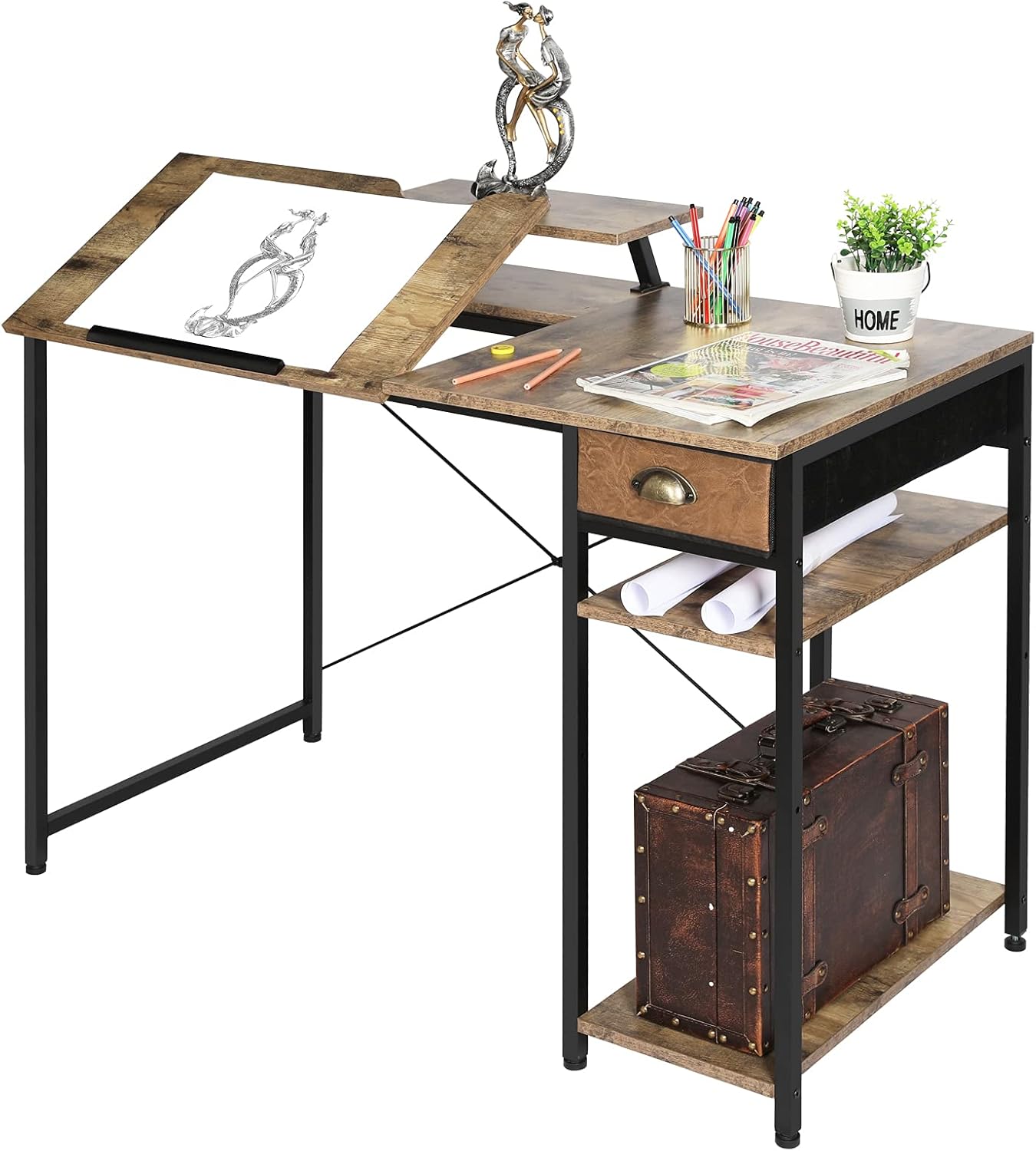
- Adjustable drawing surface tilts up to 45 degrees for sketching, drafting, painting, and comfortable creative work.
- Removable 4.3-inch monitor riser provides elevated screen positioning while keeping the main workspace organized.
- Separate stationary desktop section accommodates computer equipment and reference materials while the drawing panel is tilted.
- Two-tier side shelving and a fabric storage drawer keep art supplies, books, and office accessories accessible.
- - Durable metal frame, crossbar reinforcement, and adjustable leveling feet help maintain stability during everyday use.
The X-cosrack Drafting Table Gets the Drawing and Computer Workspace Balance Right
The X-cosrack 43-Inch Adjustable Drafting Table is designed for artists, students, designers, and home office users who need a drawing surface alongside a practical computer workstation. It combines a tilting desktop, removable monitor riser, fabric storage drawer, and two-tier side shelving. For buyers comparing the best L shaped drafting table options, its main advantage is allowing traditional drawing and computer-based work to happen at the same desk.
The desk measures approximately 43.3 inches long, 21.6 inches deep, and 30.7 inches high. Its adjustable drawing section tilts from a flat position to approximately 45 degrees, while the neighboring desktop section remains stationary. The separate drawing and computer working surfaces make it useful for artists who regularly switch between sketching, studying, and digital reference work.
The rustic brown desktop uses engineered wood supported by a metal frame with crossbar reinforcement. Adjustable feet help level the desk on suitable flooring, while the removable monitor stand raises a computer screen approximately 4.3 inches. These features give the workstation more flexibility than an ordinary fixed writing desk.
One important distinction is its shape. Although it can serve some of the same purposes as an L shaped drafting table, the X-cosrack is a rectangular desk rather than a full corner workstation. Buyers who specifically need two perpendicular desktops should consider that limitation before purchasing.
Still, the arrangement makes sense for artists working in smaller rooms. The desk combines several everyday functions without requiring separate furniture for drawing and computer work. The compact multifunctional design for creative home offices is one of its strongest practical advantages.
The 45-Degree Tilt and Removable Monitor Stand Are Genuinely Useful
The most important feature of the X-cosrack desk is its adjustable drawing panel. The surface can be raised from horizontal to approximately 45 degrees and secured at the selected position. The adjustable drawing surface for different artistic techniques provides flexibility that a conventional flat computer desk cannot offer.
Consider an illustrator working on a detailed pencil portrait. When the paper lies completely flat, the artist may repeatedly lean forward to inspect proportions and shading. Raising the drawing surface can improve the viewing angle and reduce the need to bend toward the paper.
However, the most comfortable angle depends on the activity. A moderate incline may suit pencil sketching, while a flatter position may be preferable for writing or wet painting techniques. Users should experiment with the adjustment rather than assuming the steepest angle is always best.
For example, watercolor artists need to consider how liquid moves across the paper. At a 45-degree angle, a wet wash may flow toward the lower edge more quickly than intended. Choosing the correct tabletop angle for watercolor painting helps prevent unwanted drips and uneven washes.
The 45-degree maximum tilt also provides a reasonable working range for technical drawing. Architects, students, and hobbyists can position paper at an angle that makes measurements and line work easier to inspect. However, buyers who require a nearly vertical drawing board may prefer a model with greater adjustment.
Another useful feature is the stationary desktop section. This area remains flat when the drawing panel is raised. The dedicated flat workspace for computers and reference materials makes the desk particularly practical for mixed creative tasks.
Consider a graphic design student following an online tutorial while drawing a character. The computer can remain on the stationary section while the sketchbook sits on the tilted panel. This reduces the need to move equipment whenever the drawing angle changes.
The separate sections also help prevent accidental movement of supplies. A laptop, water container, or reference book should not be placed on a steeply tilted surface where it might slide. Keeping those items on the stationary area provides a more sensible arrangement.
The removable monitor stand is another important feature. At approximately 4.3 inches high, it raises a compatible monitor above the desktop. The elevated monitor position for more comfortable computer work may help users achieve a better viewing arrangement.
For example, an artist using digital reference photographs may spend several hours looking between the screen and drawing paper. Raising the monitor can make the screen easier to position at a suitable height. However, correct ergonomics still depend on the chair, screen dimensions, and viewing distance.
The monitor riser can also be removed when it is unnecessary. This gives users additional flexibility when arranging the workstation. An artist who prefers working with a laptop may decide that the extra stand occupies space better used for supplies.
However, removing the riser does not turn the desk into a larger drafting table. The overall dimensions remain unchanged. Planning the available desktop space around actual equipment is important when choosing a compact workstation.
The desk includes a fabric storage drawer. This provides a convenient location for smaller art supplies, stationery, and accessories. The accessible storage drawer for frequently used drawing tools can help keep the main surface organized.
For example, an illustrator might store graphite pencils, erasers, sharpeners, and blending tools inside the drawer. Keeping those items together makes them easier to locate during a drawing session. It also prevents small accessories from covering the desktop.
However, fabric drawers are generally better suited to lightweight materials than heavy equipment. Large paint containers, dense books, and sharp tools may require more substantial storage. Buyers should avoid overloading the drawer or placing items inside that could damage its material.
The two-tier side shelving provides additional storage. These shelves can accommodate suitable books, office accessories, or computer equipment within the manufacturer's loading limits. The integrated side shelves for organizing studio equipment are useful when floor space is limited.
Consider a student using the desk for both art assignments and ordinary coursework. One shelf could hold textbooks and reference folders, while another accommodates computer accessories. This keeps the main working area available for drawing.
However, shelf organization matters. Filling the shelves with unrelated equipment may make supplies difficult to access. Frequently used materials should remain close to the working area, while heavier or less frequently used items can be stored appropriately elsewhere.
The desk uses a metal frame with crossbar reinforcement. This structure is intended to provide stability during ordinary drawing, writing, and computer use. The reinforced metal frame for everyday drafting work is useful when the drawing panel is adjusted regularly.
For example, an artist using rulers or drawing templates needs a surface that remains reasonably stable while applying pressure. Excessive movement can make precise lines difficult to produce. Correct assembly and proper leveling are important for obtaining the intended stability.
The adjustable feet help accommodate minor floor irregularities. This can be useful in home studios with hardwood, laminate, or other indoor flooring. However, the desk should still be positioned on a stable surface.
One common installation mistake is tightening every frame connection before all components are correctly aligned. This can make assembly more difficult and may contribute to uneven positioning. Following the correct assembly sequence for stable furniture helps prevent unnecessary problems.
The product documentation recommends two people for assembly. An Allen wrench is included, while a Phillips screwdriver is also required. Buyers should prepare the necessary tools and identify the components before beginning.
The rustic brown finish provides a warmer appearance than many industrial drafting desks. It can fit into home offices, bedrooms, and creative studios without looking like specialized commercial equipment. The metal frame gives the furniture a relatively simple, practical design.
However, the MDF desktop requires reasonable care. Water spills, wet brushes, and cleaning chemicals may damage certain engineered wood finishes. Protecting the drawing surface from moisture and paint spills can help maintain its condition.
For example, an artist working with acrylic paint may use a protective mat beneath mixing containers. This reduces direct exposure to moisture and paint residue. It also makes cleaning easier after a project.
The approximately 43-inch desk length is suitable for many sketchbooks, drawing pads, and ordinary computer setups. However, the tilting panel occupies only part of the total width. Artists working with large architectural sheets should verify the actual usable panel dimensions before ordering.
For example, a student working with an A3 drawing pad may find the desk practical. Someone regularly producing very large architectural plans may need a wider drafting surface. Checking the usable drawing area rather than overall desk dimensions helps prevent sizing mistakes.
The fixed desk height is another consideration. At approximately 30.7 inches, the workstation is intended primarily for seated use. It does not provide the broad height adjustment available on certain professional drafting tables.
Users should therefore choose a suitable chair and adjust their working position accordingly. A chair that is too low may encourage raised shoulders, while one that is too high may create an uncomfortable arm position. Proper seating remains important during extended drawing sessions.
Routine maintenance should include checking the frame fasteners, cleaning the desktop, and inspecting the tilt mechanism. The drawing panel should lock securely before artwork or equipment is placed on it. Regular inspection of the adjustable tabletop mechanism helps maintain dependable operation.
Overall, the X-cosrack provides a practical combination of drawing functionality and home office convenience. Its adjustable panel, monitor riser, storage drawer, and shelves address several everyday problems faced by artists working in compact spaces. The design is particularly useful when drawing and computer work share the same workstation.
Why We Ranked the X-cosrack Drafting Table Number Two
We placed the X-cosrack 43-Inch Adjustable Drafting Table second out of seven because it offers a useful balance of adjustable drawing space, computer functionality, and integrated storage. Its 45-degree tilting panel and removable monitor riser are particularly practical. The combination of flexible drafting and computer workstation features is its strongest selling point.
The separate stationary desktop section is another reason for its high ranking. Artists can keep reference materials or computer equipment nearby while using the angled drawing panel. This makes the desk suitable for traditional illustration, technical drawing, and mixed digital workflows.
The 4.3-inch removable monitor stand adds flexibility. It allows users to elevate a compatible screen without permanently sacrificing that area of the desk. The adjustable workspace arrangement for different creative activities is useful for people who alternate between drawing and computer work.
The two-tier side shelving also contributes to its appeal. It provides storage for books, accessories, and suitable computer equipment. The fabric drawer adds a convenient location for smaller art supplies.
However, our first-ranked QZJIKE drafting table offers a slightly greater maximum tilt of 50 degrees. It also includes four fabric drawers, additional organizing features, integrated LED lighting, and a built-in power panel. The additional storage and electrical convenience features are important reasons we placed QZJIKE first.
The X-cosrack provides one fabric drawer rather than four. That may be sufficient for a student or casual artist, but buyers with extensive collections of pencils, markers, and brushes may need separate storage furniture. The side shelves help, although they do not provide the same enclosed organization.
Another limitation is the 45-degree maximum tilt. This is suitable for many drawing activities but may not accommodate artists who prefer a steeper working angle. Buyers should consider their preferred techniques before choosing between models.
The desk is also not a conventional L-shaped corner workstation. Its rectangular design provides separate working sections, but it does not offer two long perpendicular surfaces. The limited workspace compared with full corner drafting desks may matter for buyers using multiple monitors or large drawing boards.
The approximately 43.3-inch length also limits the available drawing area. Although practical for many sketchbooks and ordinary projects, it may be restrictive for large-format architectural drafting. Users should verify the dimensions of the tilting section rather than relying only on the overall measurements.
The fixed working height is another consideration. Buyers cannot raise or lower the entire desktop to accommodate different seated or standing positions. A suitable chair is therefore important for maintaining a comfortable working arrangement.
The MDF desktop also requires care around water and paint. Artists who regularly use wet media may want additional surface protection. The importance of protecting engineered wood drawing surfaces should not be overlooked.
Assembly is another practical consideration. The desk contains several components, including the metal frame, adjustable panel, shelves, drawer, and monitor riser. Correct installation is necessary for stable operation.
Despite these limitations, the X-cosrack remains a strong option for home studios and creative workspaces. Its rustic brown finish, metal frame, adjustable drawing panel, and useful storage features provide a good balance between functionality and everyday convenience.
Ultimately, we believe the X-cosrack deserves second place because it offers a versatile drafting workstation with practical computer and storage features, while its smaller storage capacity, 45-degree tilt limit, and lack of integrated lighting or power connections place it slightly behind our first-ranked QZJIKE model. Its removable monitor stand, separate flat working area, two-tier shelving, and adjustable drawing surface make it especially suitable for artists who combine traditional sketching with computer-based work. For students, illustrators, and home office users seeking an organized, flexible drawing desk, the X-cosrack is an excellent choice.

- Adjustable drawing tabletop tilts up to 60 degrees for sketching, illustration, technical drafting, and creative projects.
- Height-adjustable workstation ranges from approximately 27.4 to 36.5 inches for different working positions.
- Two convenient storage drawers and an open shelf help organize pencils, brushes, sketchbooks, and art supplies.
- Included matching stool provides a coordinated seating option without requiring an immediate separate purchase.
- - Sturdy metal frame and natural wood-look tabletop create a practical workstation for home studios and classrooms.
The Yaheetech Drafting Table Gives Artists More Control Over Their Working Position
The Yaheetech Adjustable Drafting Table is designed for artists, illustrators, students, and designers who need a dedicated workspace for drawing, painting, and technical drafting. It combines a tilting tabletop, adjustable working height, two storage drawers, an open shelf, and a matching stool. For buyers comparing the best L shaped drafting table options, its strongest advantage is the flexibility to adjust both the drawing angle and the height of the working surface.
The tabletop tilts from a horizontal position to approximately 60 degrees, providing a wider adjustment range than many basic drafting desks. Its working height can be adjusted from approximately 27.4 to 36.5 inches, depending on the selected configuration. The adjustable height and sixty-degree tilting surface make it useful for artists who regularly change their working positions.
The desk measures approximately 47.5 inches wide and 23.6 inches deep, with a metal frame supporting an engineered wood tabletop. Its natural wood appearance gives it a relatively traditional studio look. The included stool also makes the package convenient for buyers setting up a new creative workspace.
One important distinction is the desk's shape. Although it can serve some of the same purposes as an L shaped drafting table, the Yaheetech uses a rectangular layout rather than two perpendicular desktop sections. The combination of adjustable drafting and integrated storage is more relevant to its design than a conventional corner workstation arrangement.
The desk also includes two drawers and an open storage area for art supplies. These features are useful for keeping pencils, brushes, notebooks, and other materials within reach. However, buyers who need extensive enclosed storage may prefer a larger workstation with additional drawers.
The Sixty-Degree Tilt and Adjustable Height Make a Real Difference During Long Drawing Sessions
One of the most important features of the Yaheetech drafting table is its adjustable drawing surface. The tabletop can be raised from flat to approximately 60 degrees, allowing artists to select an angle suited to their work. The flexible drawing angle for different artistic techniques is useful when switching between writing, sketching, and detailed illustration.
Consider an artist working on a pencil portrait. When the paper lies completely flat, the artist may need to lean forward repeatedly to inspect proportions and shading. Raising the drawing surface can make the artwork easier to view from a more upright position.
For example, a moderate incline may be comfortable for pencil sketching or technical drawing. A steeper position may be useful when examining proportions or adding details to an illustration. However, the ideal angle depends on the artist's posture and technique.
The 60-degree maximum tilt is particularly interesting because it provides more adjustment than desks limited to 40 or 45 degrees. The wider tabletop tilt range for detailed drawing gives users additional freedom when positioning their artwork.
However, a steeper angle is not always preferable. Artists using wet media need to consider how paint and water move across the paper. A watercolor wash applied at 60 degrees may run toward the lower edge much faster than intended.
Consider a watercolor artist working on a landscape painting. A flatter surface may be preferable when applying large washes, while a more upright position can help with dry detailing or visual inspection. The adjustable tabletop makes those changes possible without moving to another workstation.
Another practical consideration is keeping drawing materials secure when the surface is tilted. Pencils, rulers, and loose sheets may slide if they are not properly supported. Securing artwork and drawing tools on angled surfaces is important for preventing interruptions.
For example, an artist using a large sketchpad should make sure the paper remains stable before raising the tabletop. A suitable paper holder or drawing clip can help when compatible with the desk. Users should avoid placing open paint containers on the tilted section.
The adjustable working height is another major advantage. The desk can be positioned between approximately 27.4 and 36.5 inches high. The height-adjustable drafting workstation for different seated positions provides more flexibility than a fixed-height desk.
Consider two artists of different heights sharing the same workspace. One may prefer a lower tabletop while seated, while the other may need a higher position to avoid raising their shoulders. Adjusting the desk height can help accommodate those differences.
However, height adjustment does not automatically guarantee good ergonomics. Chair height, elbow position, viewing distance, and the angle of the drawing surface all matter. Users should make small adjustments until their working position feels comfortable.
A common mistake is raising the desk too high while keeping the stool at the same height. This may force the artist to lift their shoulders while drawing. Matching the tabletop height to the seating position helps reduce unnecessary strain.
For example, a student completing a long technical drawing assignment may spend several hours using rulers and pencils. A working surface positioned too high can make precise movements uncomfortable. Adjusting the desk before beginning is easier than changing position halfway through the project.
The matching stool is another useful feature. Buyers receive a seating option with the desk rather than needing to purchase a separate chair immediately. The included stool for a coordinated drafting workstation is convenient for students and hobbyists setting up a first art studio.
However, the included stool should be evaluated according to the user's comfort requirements. Long drawing sessions may benefit from a chair with adjustable height and back support. The stool is useful for basic seating, but it may not suit every artist.
For example, someone drawing for thirty minutes at a time may find a simple stool adequate. A professional illustrator working for six hours may prefer more supportive seating. The desk can still be used with another suitable chair if the dimensions allow.
The desk's metal frame provides the main structural support. It is designed to hold the adjustable tabletop and storage components during ordinary use. The sturdy metal frame for everyday creative work is important when the drawing surface is raised and lowered regularly.
For example, an artist using a ruler to produce precise technical lines needs a reasonably stable working surface. Excessive movement can make accurate drawing difficult. Correct assembly and secure adjustment mechanisms help maintain stability.
However, users should not assume that every adjustment position provides identical rigidity. The tabletop should be locked correctly before drawing begins. Checking the tabletop locking mechanism before each adjustment helps prevent unwanted movement.
The engineered wood tabletop provides a practical surface for ordinary sketching and craft activities. Its natural wood appearance also works well in home studios and classrooms. However, protective mats may be useful when working with paint, ink, or cutting tools.
Consider an artist using acrylic paints. Water containers and wet brushes may leave moisture on the surface during a project. Protecting the engineered wood tabletop from moisture can help preserve its condition.
The same consideration applies to cutting activities. A dedicated cutting mat should be used rather than placing a craft knife directly against the desktop. This helps prevent permanent scratches and damage.
The two storage drawers provide convenient space for smaller supplies. Artists can keep pencils, erasers, sharpeners, and other accessories separate from the main working surface. The integrated drawers for organizing everyday art materials help reduce desktop clutter.
Consider an illustrator who regularly switches between graphite pencils, colored pencils, and ink pens. One drawer could hold drawing instruments while the other contains erasers, blending tools, and smaller accessories. This makes the materials easier to locate during a project.
However, drawer capacity is limited. Large paint containers, heavy books, and extensive collections of art materials may require additional storage. Buyers should consider how much equipment they actually use before deciding whether two drawers are sufficient.
The open shelf provides another storage area. It can hold suitable reference books, sketchpads, or lightweight art supplies. The accessible open storage for frequently used materials is useful when artists need to retrieve items quickly.
For example, a student working on a perspective drawing may keep reference books or spare paper nearby. Having those materials within reach reduces interruptions. However, the shelf should not be overloaded beyond the manufacturer's recommendations.
One common mistake is using every available storage area for unrelated equipment. This can make the workstation crowded and difficult to organize. Keeping frequently used materials close to the drawing surface is usually more practical.
The overall width of approximately 47.5 inches provides a useful amount of workspace for many drawing activities. Its depth of approximately 23.6 inches accommodates common sketchbooks and drawing pads. The generous tabletop dimensions for everyday illustration work make it suitable for a variety of projects.
However, buyers should verify the usable drawing panel dimensions rather than relying entirely on the overall width. Storage components and supporting structures can affect the available working area. Artists using unusually large architectural sheets may need a dedicated professional drafting table.
For example, an artist working with A3 paper may find the desk convenient. Someone regularly drawing on 36 x 48-inch sheets will need substantially more surface area. Checking the drawing surface against actual paper dimensions helps prevent purchasing the wrong desk.
The desk is also suitable for several types of creative activity. It can support pencil drawing, illustration, reading, writing, certain craft projects, and technical drafting. This versatility is useful when a single workstation serves multiple purposes.
For example, a student may use the desk for drawing assignments in the afternoon and ordinary homework later in the evening. Lowering the tabletop provides a more conventional writing surface. This reduces the need for separate furniture.
However, the Yaheetech does not provide the same computer workspace arrangement as a full L-shaped corner desk. A large monitor, keyboard, and drawing tablet may occupy much of the available surface. The limited separation between computer and drawing equipment is worth considering.
For example, a digital artist who uses two monitors may prefer a larger corner workstation. A traditional illustrator who mainly works with paper may find the Yaheetech more suitable. The correct choice depends on the equipment used every day.
The desk's adjustable height also makes it useful for changing working positions during a project. However, its maximum height of approximately 36.5 inches may not provide a comfortable standing workstation for every adult. Buyers should compare the adjustment range with their own requirements.
For example, a taller artist may find the highest setting comfortable for elevated seated work but insufficient for standing drawing. A dedicated standing drafting table may be preferable in that situation. Understanding the difference between height adjustment and standing-desk capability helps establish realistic expectations.
Assembly is another practical consideration. The metal frame, tabletop, drawers, and adjustment components need to be installed correctly. Users should follow the manufacturer's instructions and check all connections before using the desk.
For example, a loosely secured frame connection may cause unwanted movement during drawing. Incorrectly fitted adjustment components may also make the tabletop difficult to reposition. Careful assembly of the adjustable drafting mechanism is important for dependable operation.
Routine maintenance should include checking frame connections, cleaning the tabletop, and inspecting the tilt and height adjustment mechanisms. The drawers should also be kept free from excessive weight. These precautions can help maintain the desk's everyday functionality.
Overall, the Yaheetech provides a practical workstation for artists who prioritize adjustable drawing positions. Its wide tilt range, adjustable height, included stool, and integrated storage make it useful for home studios and educational environments. It is especially appealing to people who want a dedicated drawing desk rather than a conventional computer workstation.
Why We Ranked the Yaheetech Drafting Table Number Three
We placed the Yaheetech Adjustable Drafting Table third out of seven because it offers excellent adjustment flexibility, useful storage, and an included stool, but its rectangular design and limited computer workspace make it less versatile for certain users. Its strongest advantage is the ability to adjust both the tabletop angle and working height. The combination of ergonomic flexibility and practical drawing functionality makes it a strong option.
The 60-degree maximum tilt is a particularly important feature. It provides a greater adjustment range than the first-ranked QZJIKE and second-ranked X-cosrack models. This may appeal to artists who prefer working at steeper drawing angles.
The height adjustment is another advantage. With a working range of approximately 27.4 to 36.5 inches, users can customize the desk to suit different seated positions. The adjustable working height for different artists and tasks provides flexibility that fixed-height desks cannot match.
The included stool also adds convenience. Buyers receive a complete basic drawing workstation without needing to purchase seating immediately. However, artists who work for long periods may prefer a more supportive chair.
The two storage drawers and open shelf provide useful organization. They can accommodate everyday drawing tools, sketchbooks, and smaller accessories. The practical integrated storage for creative supplies helps keep the drawing surface available for artwork.
However, our first-ranked QZJIKE drafting table offers four fabric drawers, additional organizers, integrated LED lighting, and a built-in power panel. Those features provide more convenience for artists who use electronic equipment alongside traditional materials. The Yaheetech does not offer the same integrated electrical functionality.
The first-ranked QZJIKE also provides a separate stationary working section. This allows a laptop or reference materials to remain flat while the drawing panel is tilted. The additional workspace separation for mixed creative activities is one reason we prefer it overall.
Our second-ranked X-cosrack drafting table includes a removable monitor riser and two-tier side shelving. Those features make it particularly suitable for combining computer work with traditional drawing. The Yaheetech provides more height and tilt adjustment but fewer computer-specific conveniences.
Another limitation is the rectangular desktop arrangement. Although it can serve buyers searching for the best L shaped drafting table, it does not provide two perpendicular working surfaces. Users who specifically need a corner desk may find its layout restrictive.
The available storage is also relatively modest. Two drawers and an open shelf may be sufficient for students and hobbyists, but professional artists with extensive supplies may need additional furniture. The smaller enclosed storage capacity for art materials contributes to its third-place position.
The engineered wood tabletop is another consideration. It provides a practical drawing surface but should be protected from excessive moisture, paint spills, and cutting tools. A protective mat may be necessary for certain craft activities.
The desk also requires careful assembly. Its height and tilt mechanisms must be secured correctly to maintain stability. Users should inspect the adjustment components periodically, especially when changing positions frequently.
Another consideration is the overall workspace size. Although the desk measures approximately 47.5 inches wide, it may not accommodate very large drawing sheets or extensive computer equipment. Buyers should compare the usable drawing area with their actual requirements.
However, the Yaheetech offers advantages that the higher-ranked models do not necessarily match. Its 60-degree tilt range and adjustable working height provide substantial flexibility for traditional drawing. The greater control over drawing angle and desk height is particularly useful for artists who prioritize working position.
The included stool and integrated storage also make the package practical for a first home studio. Buyers can begin working without immediately purchasing separate seating or small supply organizers. Its natural wood appearance is another positive feature for residential creative spaces.
Ultimately, we believe the Yaheetech Adjustable Drafting Table deserves third place because it provides excellent drawing flexibility with adjustable height and generous tilt control, while its limited computer workspace and smaller storage capacity place it behind our first two selections. Its sturdy metal frame, two drawers, open shelf, and matching stool provide useful everyday functionality. For artists, students, and hobbyists who prioritize comfortable drawing positions and a dedicated creative workstation, the Yaheetech remains an excellent choice.

- Ten-position drawing surface adjusts from flat to 40 degrees for sketching, painting, reading, and drafting.
- Three fabric storage drawers organize pencils, markers, brushes, paper accessories, and smaller art supplies.
- Separate stationary side countertop provides room for reference materials, a laptop, or a compact lamp.
- Long lower storage shelf and removable pencil ledge help keep creative supplies accessible and drawing tools secure.
- - Powder-coated steel frame, protective leveling feet, and included padded stool create a complete home art workstation.
The Yaheetech 689995854951 Gives Artists a Proper Drawing Area Without Losing Their Storage Space
The Yaheetech 689995854951 Adjustable Drafting Table is designed for artists, students, illustrators, and hobbyists who need a dedicated drawing surface with convenient storage nearby. It combines a tilting desktop, three fabric drawers, a separate stationary countertop, a lower storage shelf, and a matching padded stool. For buyers comparing the best L shaped drafting table options, its main advantage is keeping drawing activities and everyday supplies organized within one workstation.
The drawing surface adjusts between 0 and 40 degrees across ten available positions. This allows users to work with a flat tabletop for writing or raise it for sketching, illustration, and certain painting techniques. The ten-position adjustable drawing surface for creative work provides more flexibility than an ordinary fixed desk.
The complete workstation has an approximate footprint of 50.5 inches long and 23.6 inches deep. It combines a powder-coated steel frame with a laminated MDF desktop, while the black finish gives it a relatively simple studio appearance. The included stool means buyers receive basic seating alongside the desk.
One important detail is the physical layout. Although some product listings describe it as L-shaped, the Yaheetech has a rectangular footprint with a tilting drawing panel and separate stationary side section. The split-surface arrangement for drawing and reference work provides useful functionality, but it does not replace a full-size corner drafting desk.
The storage arrangement is another strong feature. Three fabric drawers, a long lower shelf, and a side countertop provide designated places for drawing tools, paper, and accessories. This is particularly useful when the same desk needs to support several creative activities throughout the day.
The Adjustable Surface and Separate Storage Areas Make Everyday Drawing More Convenient
The most important feature of the Yaheetech 689995854951 is its adjustable drawing panel. The tabletop can be positioned at ten different angles between horizontal and approximately 40 degrees. The flexible tabletop positioning for different drawing techniques allows artists to change their working angle without moving to another desk.
Consider an illustrator working on a detailed pencil drawing. When the paper lies flat, the artist may repeatedly lean forward to inspect proportions and shading. Raising the drawing surface can make the artwork easier to view while maintaining a more upright seated position.
For ordinary writing, a nearly flat angle is generally more practical. Notebooks, rulers, and other materials remain easier to manage when the surface is horizontal. The ability to lower the panel also allows the desk to function as a conventional writing workstation.
For sketching, a moderate incline can improve the viewing position. Artists may find it easier to inspect the entire drawing without constantly leaning over the paper. The adjustable drawing angle for more comfortable sketching is particularly useful during longer creative sessions.
However, the correct angle depends on the activity. A steep incline may be useful for pencil illustration but less suitable for watercolor painting. Wet paint can move toward the lower edge of the paper when the surface is raised.
For example, a watercolor artist working on a landscape may prefer a relatively flat surface while applying large washes. Once the painting has dried, the tabletop can be raised for pencil detailing or inspection. This flexibility is useful when a project involves several techniques.
The tabletop uses a locking adjustment mechanism. Users should confirm that the panel is securely positioned before applying pressure or placing equipment on it. The secure tabletop adjustment for stable drawing sessions depends on correct operation of the mechanism.
A common mistake is adjusting the panel while leaving loose supplies on its surface. Pencils, erasers, and small containers may slide when the angle changes. Removing those items before adjusting the tabletop helps prevent accidents.
The removable pencil ledge is another useful feature. It sits along the lower edge of the drawing surface and helps prevent suitable drawing tools or paper from sliding downward. The removable pencil ledge for securing drawing materials is particularly useful when the tabletop is tilted.
Consider a student completing a technical drawing with pencils and rulers. The ledge can help keep certain materials from rolling off the angled surface. This reduces interruptions while working on precise lines.
However, the ledge should not be treated as a universal holder for heavy equipment. Paint jars, laptops, and other substantial objects should remain on a suitable flat surface. The ledge is intended for ordinary drawing materials.
Another practical detail is that the ledge can be removed. When the tabletop is lowered, removing the ledge creates a more conventional working surface. This is useful when switching from drawing to writing or computer work.
For example, an art student may use the angled panel for sketching during the afternoon. Later, the same surface can be lowered for completing written coursework. The convertible drawing surface for multiple everyday tasks makes the desk suitable for shared creative and study spaces.
The separate stationary countertop is another important feature. Product information identifies an additional side surface measuring approximately 15.7 inches by 14.2 inches. This area remains useful when the main drawing panel is tilted.
Consider an illustrator following a digital reference image on a laptop or tablet. The device can remain on the stationary section while the artist works on the angled panel. The dedicated flat side countertop for reference materials helps separate electronic equipment from the drawing area.
This arrangement is also useful for keeping certain supplies stable. A closed paint container, reference book, or compact desk lamp may be more practical on the stationary surface than on the tilted panel. However, users should respect the manufacturer's loading recommendations.
The side countertop is relatively compact. It may accommodate a small laptop or reference materials, but buyers should measure larger equipment before purchasing. A wide monitor or extensive computer setup may require a separate workstation.
One common mistake is assuming that a split-surface drafting table provides the same workspace as a full L-shaped corner desk. The Yaheetech has two functional sections, but they share a relatively compact rectangular footprint. Understanding the available working surface before purchasing helps establish realistic expectations.
The three fabric drawers are another major feature. They provide concealed storage for smaller art supplies, stationery, and accessories. The three integrated drawers for organized art materials help keep the main drawing surface clear.
For example, an artist might dedicate one drawer to graphite pencils, another to colored markers, and the third to erasers, sharpeners, and blending tools. Keeping those materials separated makes them easier to locate during a project. It also reduces the amount of equipment left on the tabletop.
However, fabric drawers have different limitations from rigid wooden or metal drawers. They are generally better suited to lightweight supplies than heavy equipment. Users should avoid overloading them with dense books, large paint containers, or sharp tools.
The drawers also require reasonable organization. Small items can become difficult to find when everything is placed together. Using compact organizers or separate containers inside the drawers may help keep supplies accessible.
Consider an artist with dozens of colored pencils. Storing them loosely may make selecting a particular color inconvenient. Organizing frequently used supplies into separate storage compartments can make drawing sessions more efficient.
The long lower shelf provides additional storage beneath the main tabletop. It can hold suitable books, sketchpads, or other art materials within the manufacturer's capacity limits. This is useful when the side drawers are already occupied.
For example, a student may keep reference books and spare drawing pads on the lower shelf. The materials remain nearby without covering the main working surface. The accessible lower shelf for larger art supplies helps maintain a more organized workstation.
However, frequently used materials should be positioned where they can be reached comfortably. Constantly bending beneath the desk to retrieve supplies may interrupt the drawing process. The lower shelf is often better suited to items used less frequently.
The Yaheetech also includes a padded stool. Product specifications describe a seat approximately 16.3 inches across and 21 inches high, with a cushioned surface and footrest. The included padded stool for a coordinated art workstation provides a convenient seating option.
For example, a beginner setting up a home art studio may not already own a suitable drawing chair. Having a stool included allows the desk to be used without an immediate separate seating purchase. This can simplify the initial setup.
However, the stool has a fixed height and does not provide the adjustable back support available on many office chairs. Artists working for several hours may prefer seating with more ergonomic adjustment. The included stool is useful, but comfort requirements vary.
The manufacturer's specifications list a stool capacity of approximately 265 pounds. The tabletop has a stated maximum load of approximately 158.7 pounds. The specified weight limits for the table and stool should be respected during use.
These figures describe maximum loads rather than ideal everyday working weights. Users should avoid placing heavy equipment on the tilted panel, especially when the load could shift. Drawing materials should be distributed sensibly across the workstation.
The desk's powder-coated steel frame provides structural support. It is designed to hold the tabletop, storage sections, and adjustment mechanism during ordinary use. The steel frame construction for everyday drafting activities is useful when the drawing surface is adjusted regularly.
For example, an artist using a ruler to create precise technical lines needs a reasonably stable surface. Excessive movement can make accurate drawing difficult. Correct assembly and proper leveling are important for obtaining the intended stability.
The desk includes six protective leveling feet. These help protect the floor and accommodate minor unevenness in the supporting surface. The adjustable protective feet for stable studio placement are useful on hardwood, laminate, and similar indoor floors.
However, leveling feet cannot compensate for every flooring problem. The desk should be positioned on a firm, stable surface. Users should also check the frame connections periodically.
The laminated MDF desktop provides a smooth working surface for ordinary drawing and craft activities. Its black finish creates a modern appearance that can fit into home offices, bedrooms, and dedicated art rooms. However, the material requires reasonable care.
For example, an artist using acrylic paints may occasionally spill water while cleaning brushes. Moisture should be removed promptly, particularly near exposed panel edges. Protecting the laminated drawing surface from moisture damage can help preserve its condition.
A protective cutting mat is also useful for craft activities involving knives or sharp tools. Cutting directly against the desktop can leave permanent marks. The table is intended for creative work, but the surface is not a substitute for specialized cutting equipment.
The desk's footprint is another practical consideration. At approximately 50.5 inches long and 23.6 inches deep, it requires a dedicated area but remains manageable for many home studios. The compact multifunctional layout for smaller creative rooms is useful when space is limited.
For example, a student living in an apartment may need one desk for sketching, writing, and studying. The Yaheetech can support those activities without requiring separate drawing and computer tables. Its integrated storage further reduces the need for additional furniture.
However, buyers should measure the room before ordering. Enough clearance is needed for the stool, drawers, and normal movement around the desk. Placing the workstation too close to other furniture may make its storage sections difficult to access.
Another important detail is the size of the actual drawing panel. The overall desk length includes the stationary countertop and storage area. Checking the usable drawing panel dimensions for larger projects is important when working with oversized paper.
For example, an artist working with an A3 sketchpad may find the desk suitable. Someone regularly using large architectural sheets may require a wider dedicated drafting surface. The total desk width should not be confused with the available tilting panel width.
The Yaheetech is also intended for multiple activities. In addition to sketching and painting, it can support reading, writing, certain craft projects, and ordinary laptop work. This versatility is useful for households where a single workstation serves several purposes.
Assembly is another consideration. The frame, tabletop, drawers, shelf, and stool need to be installed according to the supplied instructions. Careful assembly of the adjustable drafting table mechanism is important for stable operation.
For example, incorrectly positioned frame components may cause the desk to wobble. Loose connections can also affect the feel of the drawing surface. Users should inspect the assembled workstation before placing valuable equipment on it.
Routine maintenance should include cleaning the desktop, checking fasteners, inspecting the tilt mechanism, and keeping the fabric drawers dry. The protective feet should also be checked when the desk is moved. These precautions help maintain its everyday usability.
Why We Ranked the Yaheetech 689995854951 Number Four
We placed the Yaheetech 689995854951 fourth out of seven because it offers useful drawing adjustments, three storage drawers, a separate countertop, and an included stool, but its limited tilt range and compact working sections make it less versatile than several higher-ranked alternatives. Its strongest advantage is the combination of drawing functionality and practical organization. The balanced design for sketching and everyday creative work makes it a capable workstation.
The ten-position tabletop adjustment is one of its most useful features. It allows artists to select angles between horizontal and approximately 40 degrees. This provides flexibility for sketching, reading, writing, and certain painting activities.
The separate stationary countertop is another advantage. It provides a convenient place for reference materials or compatible electronic equipment while the drawing panel is tilted. The dedicated flat surface for supporting reference work is useful for artists combining traditional and digital methods.
The three fabric drawers also contribute to its appeal. They provide more enclosed storage than a desk with only one small drawer. The lower shelf adds further organization for suitable books and art supplies.
However, our first-ranked QZJIKE drafting table offers a 50-degree maximum tilt, four fabric drawers, integrated LED lighting, and a built-in power panel. Those additional features provide greater convenience for artists using electronic equipment. The broader combination of storage and electrical features is a major reason we placed QZJIKE first.
Our second-ranked X-cosrack drafting table provides a removable monitor riser and side shelving designed for mixed computer and drawing work. Its 45-degree maximum tilt also exceeds the 40-degree range of this Yaheetech model. Buyers prioritizing computer equipment may prefer that arrangement.
The third-ranked Yaheetech drafting table offers a maximum tilt of approximately 60 degrees and a separately specified height-adjustment range. That provides more flexibility for users who need to change their working position. The difference in tabletop tilt and working height flexibility contributes to its higher placement.
Another limitation is the relatively compact drawing panel. Although the overall workstation measures approximately 50.5 inches long, part of that space is occupied by the stationary countertop. Artists working with large sheets should confirm the actual panel dimensions.
The three fabric drawers also have limitations. They are useful for lightweight supplies but may not provide the durability or load capacity of rigid drawers. Buyers with extensive collections of heavy materials may need additional storage furniture.
The included stool is convenient, but it offers limited ergonomic adjustment. Artists who work for extended periods may prefer a chair with adjustable height and back support. The limitations of fixed-height seating during long drawing sessions should be considered.
The tabletop's maximum tilt of 40 degrees may also be insufficient for artists who prefer a more upright working surface. Some professional drafting tables provide considerably steeper adjustment. However, the available range remains useful for many ordinary drawing activities.
Another consideration is the physical layout. Despite being categorized as L-shaped in some listings, the desk does not provide two full perpendicular desktop sections. Buyers seeking a true corner workstation may need a different design.
The laminated MDF surface also requires protection during wet or cutting activities. Water, paint, and sharp tools can damage the finish if used carelessly. The need for appropriate surface protection during art projects is worth considering.
Assembly is another practical requirement. The multiple storage components and adjustable tabletop need to be installed correctly. Users should check the frame connections and adjustment mechanism before beginning work.
Despite these limitations, the Yaheetech 689995854951 provides several useful features in one package. Its adjustable panel, three drawers, separate side countertop, lower shelf, pencil ledge, and included stool address common home studio requirements. The practical combination of drawing space and accessible storage makes it especially appealing to students and hobbyists.
Ultimately, we believe the Yaheetech 689995854951 deserves fourth place because it provides a versatile drafting workstation with convenient integrated storage, while its 40-degree tilt limit, fixed-height stool, and smaller drawing area place it behind our first three selections. Its ten-position adjustment system, separate countertop, three fabric drawers, and sturdy steel frame still provide meaningful everyday value. For artists, students, and creative hobbyists who want an organized drawing desk with a matching stool, the Yaheetech remains an excellent and worthwhile choice.

- Adjustable drawing surface tilts from zero to 75 degrees for sketching, painting, reading, and detailed illustration.
- Three spacious fabric drawers provide organized storage for pencils, brushes, markers, and other lightweight art supplies.
- Durable powder-coated steel frame supports a 15mm E1 MDF tabletop for everyday creative work.
- Multiple storage compartments and trays keep frequently used drawing tools conveniently within reach.
- - Included matching stool provides a ready-to-use seating option for home studios and art students.
This Adjustable Drafting Table Offers a Surprisingly Wide Drawing Angle for a Compact Art Desk
The Generic Adjustable Drawing Table with Three Drawers and Stool is designed for artists, students, illustrators, and hobbyists who want a dedicated drawing workstation without buying several separate pieces of furniture. It combines a tilting tabletop, three fabric storage drawers, organizing compartments, and an included stool. For buyers comparing the best L shaped drafting table options, its strongest feature is the unusually wide 0 to 75-degree tabletop adjustment.
The desk measures approximately 45.67 inches wide, 23.60 inches deep, and 29.50 inches high in the black configuration. It uses a 15mm E1 MDF tabletop supported by a powder-coated steel frame. The combination of adjustable drawing space and accessible storage makes it useful for smaller home studios.
The tabletop can be positioned horizontally for writing and ordinary desk activities or raised for sketching, illustration, and certain painting techniques. A maximum angle of 75 degrees is considerably steeper than the 40 to 60-degree ranges offered by several other desks in this comparison. That flexibility may appeal to artists who prefer working with their paper closer to vertical.
However, this is not a traditional L-shaped corner desk. Its footprint is rectangular, with storage integrated around the drawing workstation rather than a second perpendicular desktop. The compact rectangular layout with adjustable drafting functionality is better suited to dedicated drawing than extensive computer equipment.
The included stool is another practical advantage for beginners. It provides basic seating without requiring an immediate additional purchase. However, buyers should consider their own comfort requirements, particularly if they regularly work for several hours.
The 75-Degree Tilt and Three Storage Drawers Are the Features Worth Paying Attention To
The main attraction of this drafting table is its adjustable drawing surface. The tabletop can move from a horizontal position to approximately 75 degrees, allowing users to select different working angles. The extensive tabletop adjustment for detailed artistic work provides flexibility for several creative techniques.
Consider an illustrator working on a detailed pencil portrait. When the paper lies flat, the artist may need to lean forward repeatedly to examine facial proportions and shading. Raising the drawing surface can make the artwork easier to inspect from a more upright position.
A moderate angle may be suitable for pencil sketching, technical drawing, or reading reference material. A steeper position can be useful for certain illustration techniques and visual inspection. However, the correct angle depends on the task and the artist's working habits.
For example, an artist working with charcoal may prefer a relatively upright surface. This allows the artist to view the composition without looking down at a horizontal sheet. The steep drawing angle for upright illustration work is one of the product's most distinctive advantages.
However, artists using watercolor should be more cautious. Wet paint naturally moves downward when the paper is tilted, and a 75-degree position may cause excessive dripping. A flatter setting is generally more appropriate when applying large washes.
Consider a student painting a landscape. The tabletop can remain relatively flat while the student applies wet color, then be raised after the paper dries for pencil detailing. This allows different stages of the same project to be completed at one workstation.
The adjustable mechanism should be operated carefully. Users should remove loose supplies before changing the angle and confirm that the surface is securely positioned afterward. Checking the tabletop locking mechanism before drawing helps prevent unexpected movement.
Another important feature is the three fabric drawers. Each drawer measures approximately 12.79 inches wide, 12.79 inches deep, and 3.74 inches high according to the matching product information. These dimensions provide useful space for pencils, markers, brushes, and smaller accessories.
For example, an illustrator could dedicate one drawer to graphite pencils, another to colored markers, and a third to erasers and blending tools. This arrangement reduces the need to keep every item on the desktop. The three separate drawers for organized art supplies make everyday creative work more manageable.
However, the drawers are made from nonwoven fabric rather than rigid wood or metal. The matching listing specifies a load capacity of approximately 6.6 pounds per drawer. Heavy books, large paint containers, and sharp equipment should therefore be stored elsewhere.
One common mistake is treating fabric drawers like ordinary heavy-duty storage drawers. Overloading them can cause sagging or damage to the drawer structure. Respecting the fabric drawer weight limits during storage helps preserve their usability.
The desk also includes organizing compartments and trays. These provide convenient places for frequently used tools that would otherwise occupy the drawing surface. For artists working with many pencils or brushes, keeping supplies accessible can reduce interruptions.
Consider an artist switching between several pencil grades while shading a portrait. Having those pencils in an accessible organizer makes the process easier than searching through a large container. The integrated organizing compartments for frequently used drawing tools are particularly useful during detailed work.
However, organizers should not become overcrowded. A desk covered with unnecessary supplies leaves less space for actual drawing. Keeping only the most frequently used tools nearby is usually more practical.
The desk's 15mm E1 MDF tabletop is another important feature. This engineered wood surface provides a relatively smooth working area for drawing, writing, and craft activities. The powder-coated steel frame supports the structure during ordinary use.
For example, a student using rulers and drawing templates needs a reasonably stable surface for producing accurate lines. Excessive movement can make technical drawing difficult. The steel frame and engineered wood tabletop construction provide a practical arrangement when assembled correctly.
However, MDF requires reasonable care around water and paint. Moisture can damage certain engineered wood surfaces, particularly near exposed edges. Artists using wet media should consider a protective mat or suitable covering.
For example, an acrylic painter may place water containers and paint palettes on the desk. A spill should be cleaned promptly rather than left to soak into the surface. Protecting the tabletop from moisture and paint residue can help maintain its condition.
The same applies to cutting activities. Craft knives should be used with a proper cutting mat rather than directly against the desktop. This prevents unnecessary scratches and permanent surface damage.
The approximately 45.67-inch width provides a practical amount of workspace for ordinary sketchbooks and drawing pads. Its 23.60-inch depth also makes it suitable for many home studios. The compact drafting table dimensions for smaller creative rooms are useful when floor space is limited.
However, the overall dimensions do not necessarily equal the usable tilted drawing area. Storage components and the surrounding structure occupy part of the workstation. Buyers working with large architectural sheets should confirm the actual drawing panel dimensions.
For example, an artist using an A3 sketchbook may find the available workspace suitable. Someone regularly working with 36 x 48-inch architectural plans will need substantially more space. Measuring the largest paper size before purchasing can prevent disappointment.
The included stool is another convenience feature. It allows buyers to begin using the workstation without immediately purchasing separate seating. The included seating for a complete beginner art workstation may be useful for students and casual artists.
However, the matching information does not establish extensive ergonomic adjustments for the stool. Artists who spend several hours drawing may prefer a chair with adjustable height and back support. The included seating should be considered a basic starting option.
The desk height is listed at approximately 29.50 inches for the black configuration. Although the drawing surface tilts, the matching specifications do not establish a separate height-adjustment range. Buyers should not assume this is a standing drafting table.
For example, a taller artist may need a different chair to maintain a comfortable working position. A fixed desk height can limit ergonomic flexibility. Matching the chair height to the drawing surface is important during extended sessions.
The product also requires assembly. The frame, tabletop, drawers, and other components need to be installed according to the supplied instructions. The matching listing recommends two people for assembly.
One common mistake is beginning work before checking the adjustment mechanism and frame connections. A loose component may cause unwanted movement during drawing. Testing the assembled drafting table before regular use helps identify problems early.
Routine maintenance should include cleaning the tabletop, checking the frame fasteners, and inspecting the tilt mechanism. Fabric drawers should be kept dry and within their recommended load limits. These simple precautions can help maintain the workstation over time.
Overall, this drafting table provides useful functionality for artists who prioritize an adjustable drawing angle and convenient storage. Its 75-degree tilt, three fabric drawers, included stool, and metal frame address several everyday studio requirements. It is particularly relevant to students and hobbyists working in limited spaces.
Why We Ranked This Adjustable Drafting Table Number Five
We placed this Adjustable Drawing Table fifth out of seven because it offers excellent tabletop adjustment and practical storage, but its rectangular layout, fixed desk height, and relatively basic construction make it less versatile than several higher-ranked alternatives. Its strongest feature remains the 75-degree maximum tilt. The unusually wide drawing angle for detailed illustration is a meaningful advantage.
The 0 to 75-degree adjustment range exceeds the maximum tilt offered by the first four desks in this comparison. This can be useful for artists who prefer working at steeper angles. However, a greater tilt range does not automatically make a workstation more suitable for every technique.
The three fabric drawers also provide useful storage. They allow artists to separate pencils, markers, brushes, and smaller accessories. The accessible storage arrangement for everyday creative materials is practical for home studios.
The included stool adds further convenience. Buyers receive a basic seating option with the desk. This is useful when setting up a first drawing workstation.
However, our first-ranked QZJIKE drafting table offers four fabric drawers, a separate flat workspace, integrated LED lighting, and a built-in power panel. Those additional features make it more versatile for artists who combine traditional drawing with electronic equipment. The Generic model does not offer the same documented conveniences.
Our second-ranked X-cosrack drafting table includes a removable monitor riser and two-tier side shelving. These features are particularly useful for computer-based reference work. The additional computer workspace and equipment organization features contribute to its higher placement.
The third-ranked Yaheetech drafting table offers a verified height-adjustment range alongside its tilting surface. That provides more flexibility for different seated working positions. The Generic model's listed height is fixed at approximately 29.5 inches.
Our fourth-ranked Yaheetech 689995854951 includes a separate stationary countertop and an integrated lower shelf. Those features provide more clearly separated working areas for drawing and reference materials. The Generic desk focuses more heavily on the tilting surface and surrounding storage.
Another limitation is the fabric drawer construction. Although practical for lightweight supplies, the approximately 6.6-pound capacity per drawer restricts heavier storage. The limited load capacity of fabric storage drawers may matter for artists with extensive equipment.
The rectangular layout is another consideration. Despite appearing in a comparison of L shaped drafting tables, this product is not a conventional corner workstation. Buyers requiring two perpendicular desktop sections may prefer a different design.
The fixed overall height may also be restrictive. Users cannot rely on the tabletop tilt mechanism to adjust the entire workstation's height. A suitable chair is important for maintaining a comfortable position.
Another consideration is the absence of a distinctive verified manufacturer model or established brand identity. Buyers may find it more difficult to identify compatible replacement parts or accessories. The importance of checking warranty and replacement part availability should not be overlooked.
The MDF tabletop also requires protection from moisture and cutting tools. Artists working regularly with wet media may need additional surface coverings. Proper maintenance is important for long-term use.
Despite these limitations, the desk offers several worthwhile features. Its wide tilt range, organized storage, steel frame, and included stool provide a practical setup for drawing and studying. The balance of adjustable drawing functionality and compact storage makes it appealing to beginners.
Ultimately, we believe this Adjustable Drawing Table deserves fifth place because it provides excellent tabletop tilt flexibility with practical integrated art storage, while its fixed height, fabric drawer limitations, and lack of a true L-shaped layout place it behind our higher-ranked selections. Its 75-degree adjustment range, three drawers, organizing compartments, and included stool still offer useful everyday functionality. For artists and students who want a compact drawing workstation with a generous range of working angles, it remains a worthwhile choice.

- Twelve-position drafting surface tilts from zero to 80 degrees for sketching, illustration, painting, and detailed creative projects.
- Spacious 55.1-inch desktop combines an adjustable drawing panel with a stationary area for computer equipment.
- Built-in storage cabinet, drawer, and two open shelves provide organized space for art supplies and accessories.
- Integrated charging station includes two AC outlets, one USB port, and one USB-C connection.
- - Adjustable cabinet shelf can be removed to accommodate a computer tower or larger studio equipment.
The Verano Garden Drafting Table Has Plenty of Workspace, but Its Size Needs Some Planning
The Verano Garden VGO-IDYB054BK is a 55.1-inch drafting table designed for artists, designers, students, and home office users who need a drawing surface alongside computer equipment and storage. It combines an adjustable drawing board, a stationary desktop section, an enclosed cabinet, a drawer, open shelving, and built-in power connections. For buyers comparing the best L shaped drafting table options, its biggest advantage is the amount of functionality available within one workstation.
The desk measures approximately 55.1 inches wide, 23.6 inches deep, and 31.3 inches high. It uses engineered wood construction with a black wood-grain finish and weighs approximately 88.5 pounds. The spacious desktop with integrated art supply storage makes it suitable for people who regularly switch between drawing, computer work, and other creative activities.
The drawing board adjusts from a horizontal position to approximately 80 degrees across twelve available settings. This is a wider adjustment range than many conventional art desks, particularly those limited to 40 or 45 degrees. Artists can select a relatively flat position for writing or a steeper angle for illustration and visual inspection.
However, this is not a traditional L-shaped corner desk with two perpendicular work surfaces. The Verano Garden has a rectangular footprint with an adjustable drawing section and a separate stationary workspace. The combination of tilting and stationary desktop sections provides some of the practical advantages associated with larger drafting workstations, but buyers specifically needing a corner layout should recognize the difference.
Another important consideration is its weight. At approximately 88.5 pounds, this is substantial furniture that requires planning during delivery, assembly, and installation. It is better suited to a relatively permanent workspace than a desk that needs to be moved regularly.
The Eighty-Degree Drawing Surface and Built-In Cabinet Are Its Strongest Features
The most distinctive feature of the Verano Garden drafting table is its adjustable drawing board. The surface can be positioned at twelve settings between 0 and 80 degrees, allowing users to choose different working angles. The extensive tabletop adjustment for different artistic techniques makes it useful for sketching, drafting, illustration, and certain painting activities.
Consider an illustrator working on a detailed character drawing. When the paper lies completely flat, the artist may repeatedly lean forward to inspect proportions and shading. Raising the drawing surface can make the artwork easier to view from a more upright seated position.
A moderate incline may be suitable for ordinary pencil sketching or technical drawing. A steeper setting may help when examining proportions across a large illustration. However, the correct angle depends on the artist's technique and working position.
The 80-degree maximum tilt is particularly useful for artists who prefer a nearly vertical drawing surface. The steep drawing angle for upright illustration work offers more flexibility than desks with smaller adjustment ranges.
However, the highest setting is not appropriate for every activity. Wet painting techniques require attention to how liquid moves across the paper. A watercolor wash applied at 80 degrees may run downward much faster than intended.
For example, a watercolor artist painting a landscape may prefer a low angle while applying broad washes. Once the painting has dried, the board can be raised for detailed inspection or additional dry-media work. This allows several stages of a project to be completed at the same workstation.
Artists should also secure their paper properly when using steep settings. Loose sheets, rulers, and pencils may slide if they are not supported. Keeping artwork securely positioned on an angled drafting surface is important for preventing damage or interruptions.
Another major advantage is the separate stationary desktop area. While the drawing panel is raised, the neighboring surface remains flat for reference materials or suitable electronic equipment. The dedicated flat workspace for computer and drawing tasks is useful for artists combining traditional and digital methods.
Consider a graphic design student following a tutorial on a laptop while producing a pencil illustration. The laptop can remain on the stationary section while the paper is positioned on the tilted drawing board. This reduces the need to move electronic equipment whenever the drawing angle changes.
The arrangement can also be useful for keeping reference books, closed paint containers, and other supplies away from the tilted panel. However, users should consider the available space carefully. A large monitor or extensive computer setup may occupy much of the stationary section.
One common mistake is assuming that the entire 55.1-inch desktop can tilt. The desk includes both adjustable and fixed sections, so the usable drawing panel is smaller than the total width. Checking the actual drawing board dimensions before purchasing is important for artists working with oversized paper.
For example, someone using an A3 sketchbook may find the drawing area practical. An architect working with very large plans should verify that the panel accommodates the intended sheet size. Overall desk dimensions alone do not establish usable drawing capacity.
The integrated storage cabinet is another important feature. Unlike desks that rely entirely on fabric drawers, this model includes an enclosed cabinet beneath the desktop. The built-in storage cabinet for organizing larger studio equipment provides a practical place for supplies that would otherwise occupy the working surface.
Consider an artist who regularly uses acrylic paints, sketchbooks, and reference materials. Smaller items can remain in the drawer, while suitable larger supplies can be organized inside the cabinet. This keeps the desktop available for active projects.
The cabinet includes an adjustable shelf that can be removed. This allows the storage compartment to accommodate different equipment sizes, including a compatible computer tower. The removable cabinet shelf for flexible equipment storage is particularly useful for artists using desktop computers.
For example, a digital illustrator may use a desktop computer alongside a pen display or drawing tablet. Removing the cabinet shelf may provide space for the computer tower, depending on its dimensions. This can reduce the amount of equipment sitting on the desktop.
However, computer equipment needs adequate ventilation. A tower should not be placed inside a confined cabinet without checking its cooling requirements and available clearance. Providing proper airflow around enclosed computer equipment is important for preventing overheating.
The cabinet should also be organized according to the weight and size of its contents. Heavy materials should not be placed on an adjustable shelf without checking the manufacturer's loading guidance. Suitable storage arrangements help preserve the cabinet structure.
The desk includes one storage drawer. This provides a convenient location for pencils, erasers, markers, and smaller office accessories. The accessible drawer for frequently used drawing supplies can reduce unnecessary clutter.
For example, an illustrator might keep graphite pencils, blending tools, sharpeners, and erasers together in the drawer. These materials remain accessible without covering the main drawing surface. It also makes cleaning the workstation easier after a project.
However, one drawer may not provide enough enclosed storage for artists with extensive collections of markers, brushes, and paints. Buyers who need several separate compartments may prefer a desk with multiple drawers. The Verano Garden compensates partly through its cabinet and open shelving.
The two open shelves provide additional storage for suitable books, sketchpads, and other accessories. They allow frequently used materials to remain visible and accessible. The combination of open shelving and enclosed storage compartments gives users several ways to organize their equipment.
Consider an art student who regularly consults reference books while drawing. Keeping those books on an open shelf makes them easier to retrieve than storing them in a closed container across the room. This is particularly useful when switching between several projects.
However, open shelves can collect dust and become crowded. Frequently used items should be kept accessible, while less frequently used materials can be placed inside the cabinet. Organizing supplies according to how often they are needed usually makes the workstation more efficient.
The integrated charging station is another significant feature. Product information identifies two AC outlets, one USB connection, and one USB-C connection. The built-in power connections for digital art equipment can make charging compatible devices more convenient.
For example, an artist may use a laptop, smartphone, and drawing tablet while working on an illustration. Having power connections close to the desktop reduces the need for several separate charging adapters across the room. It can also help keep the workspace organized.
However, users should check the electrical specifications before connecting equipment. The power station has its own rating, and high-wattage devices should not be connected without confirming compatibility. Buyers outside the United States should also verify the supplied plug and voltage requirements.
The desk includes a cable-management opening. This allows compatible cords to be routed through the workstation rather than left across the drawing surface. The integrated cable management for cleaner computer setups is particularly useful when several electronic devices are connected.
Consider a digital artist using a monitor, drawing tablet, and computer tower. Routing cables through the desk can reduce the number of loose cords near the working area. This makes it easier to keep pencils, rulers, and other drawing tools away from electrical connections.
However, cables should not be pulled tightly around the moving drawing panel. Users need to allow sufficient slack for any equipment positioned near adjustable components. This helps prevent accidental disconnection or damage.
The Verano Garden uses engineered wood construction rather than a primarily metal-frame design. This provides a furniture-style appearance suitable for home offices and creative rooms. The engineered wood construction with black wood-grain finish gives the desk a more conventional office furniture look.
However, engineered wood requires appropriate care. Water, paint, and prolonged moisture exposure may damage certain surfaces or exposed edges. Artists working with wet media should consider protective mats and clean spills promptly.
For example, an acrylic painter may use a water container and mixing palette beside the drawing board. A waterproof mat can help prevent accidental spills from reaching the desktop. Protecting the engineered wood surface during painting projects is important for long-term maintenance.
The same applies to cutting activities. Craft knives should be used with a proper cutting mat rather than directly against the desktop. This helps prevent scratches and permanent surface damage.
The desk's dimensions also deserve attention. At approximately 55.1 inches wide and 23.6 inches deep, it provides a substantial workstation for drawing and computer use. The generous desktop width for combined creative activities is useful for artists who need multiple working areas.
However, the larger footprint may be inconvenient in small rooms. Buyers should measure the intended location and allow space for seating, cabinet access, and movement around the desk. Placing the workstation too close to other furniture can make its storage features difficult to use.
For example, a home office with a narrow walkway may accommodate the desk itself but leave insufficient room for opening the cabinet comfortably. Measuring the full working area before purchasing can prevent that problem. The desk is best suited to spaces where it can remain installed permanently.
The approximately 31.3-inch working height is another consideration. Matching specifications list the same minimum and maximum height, indicating that the overall desk height is fixed. The distinction between adjustable tilt and adjustable desk height is important for buyers expecting a standing workstation.
For example, a taller artist may find the fixed height comfortable for seated work but insufficient for standing drawing. A suitable chair may help improve the seated position. However, the desk does not provide the height flexibility of a dedicated sit-to-stand drafting table.
The product's approximately 88.5-pound weight also affects installation. Moving it upstairs or through narrow doorways may require assistance. Planning delivery and assembly for a heavy drafting workstation is important before ordering.
For example, an artist living in an upstairs apartment may need to consider stairway clearance and available assembly space. Assembling the desk near its final position can reduce unnecessary movement afterward. The cabinet and shelving components should be installed according to the supplied instructions.
Routine maintenance should include cleaning the desktop, inspecting the tilting mechanism, checking cabinet hardware, and keeping electrical connections free from moisture. The drawing board should be secured before applying pressure or placing equipment on it. These precautions can help maintain the workstation's everyday functionality.
Overall, the Verano Garden offers a substantial combination of drawing space, computer functionality, and storage. Its 80-degree tilt range, cabinet, drawer, shelving, and integrated power connections address several common studio requirements. It is particularly relevant to artists who need a permanent multifunctional workstation.
Why We Ranked the Verano Garden Drafting Table Number Six
We placed the Verano Garden VGO-IDYB054BK sixth out of seven because it offers excellent drawing flexibility, generous storage, and integrated power connections, but its substantial weight, larger footprint, and fixed working height reduce its convenience for certain buyers. It is a capable workstation, although it is not the most adaptable option for smaller rooms. The combination of wide drawing adjustment and integrated cabinet storage remains its strongest advantage.
The 80-degree maximum tilt is particularly impressive. It exceeds the adjustment range of the first five desks in this comparison. This may appeal to artists who prefer a steep drawing angle for illustration and detailed visual work.
The twelve available tilt positions also provide flexibility. Users can select different settings for writing, sketching, and drawing. The wide range of drawing surface adjustments makes it suitable for several creative techniques.
The built-in cabinet is another major advantage. It provides enclosed storage for supplies or compatible computer equipment, while the removable shelf allows different internal arrangements. This is particularly useful for artists who need to store larger equipment beneath the desktop.
The two open shelves and single drawer also contribute to its organization. They provide space for smaller accessories, books, and art materials. The combination of concealed and accessible studio storage makes the desk practical for mixed creative work.
The integrated power station is another useful feature. Two AC outlets, a USB port, and a USB-C connection provide convenient charging options for compatible devices. This helps support artists who regularly combine traditional drawing with computer-based work.
However, our first-ranked QZJIKE drafting table offers four fabric drawers, integrated lighting, and a more compact footprint. Its storage arrangement may be more convenient for artists who primarily use lightweight drawing supplies. The Verano Garden provides a larger cabinet but requires more room.
Our second-ranked X-cosrack drafting table includes a removable monitor riser and two-tier shelving within a smaller workstation. That arrangement may be more practical for students and home office users who want a compact computer and drawing desk. The difference in overall size and installation requirements contributes to our preference for X-cosrack in smaller spaces.
The third-ranked Yaheetech drafting table offers both tabletop tilt and adjustable working height. That provides greater flexibility for users who need to change their seated position. The Verano Garden has a fixed working height of approximately 31.3 inches.
Our fourth-ranked Yaheetech 689995854951 also includes a separate stationary countertop, three fabric drawers, and a padded stool. Those features provide a practical setup for artists who want an organized workstation without purchasing seating separately. The Verano Garden does not list an included stool.
The fifth-ranked adjustable drawing table offers a 75-degree tilt range and three fabric drawers within a smaller footprint. Although the Verano Garden provides a slightly steeper maximum angle and more substantial cabinet storage, the smaller desk may be easier to accommodate in limited spaces.
Another limitation is the Verano Garden's substantial weight. At approximately 88.5 pounds, it is less convenient to relocate than many lightweight drafting desks. The heavy construction and larger installation footprint may be inconvenient for renters or people who frequently rearrange their studios.
The engineered wood construction also requires care around moisture. Artists using watercolor, acrylic paint, or other wet materials should protect the surface. A protective mat can help reduce the risk of damage.
The fixed desk height is another consideration. Although the drawing board tilts through twelve positions, the overall workstation does not provide a verified height-adjustment mechanism. Buyers seeking a standing drafting table may prefer another model.
The product is also not a conventional L-shaped corner desk. Its rectangular split-surface design provides separate drawing and computer areas, but it does not offer two perpendicular desktop sections. The limited suitability for traditional corner desk arrangements is worth considering.
Despite these limitations, the Verano Garden offers several advantages that make it a worthwhile choice. Its wide 55.1-inch desktop, 80-degree tilting board, enclosed cabinet, adjustable shelf, and integrated charging station provide substantial functionality. It is particularly appealing to artists who need a dedicated workstation for both traditional and digital activities.
Ultimately, we believe the Verano Garden VGO-IDYB054BK deserves sixth place because it provides a spacious multifunctional drafting workstation with extensive storage, while its substantial weight, fixed height, and larger footprint make it less convenient than several higher-ranked alternatives. Its twelve-position drawing board, removable cabinet shelf, integrated power connections, and separate flat workspace offer meaningful everyday benefits. For artists, designers, and home office users who have enough space for a permanent workstation, the Verano Garden remains an excellent and practical choice.

- Adjustable tempered glass drawing surface tilts up to 75 degrees for sketching, drafting, painting, and illustration.
- Height-adjustable steel frame supports different working positions, including elevated drawing and suitable standing tasks.
- Two mesh storage drawers and integrated organizers keep pencils, brushes, stationery, and art supplies accessible.
- Retractable side work surface provides additional room for reference materials, tablets, palettes, and creative accessories.
- - Included matching stool, protective feet, and slide-up pencil ledge create a convenient and organized drawing workstation.
The Garvee Drafting Table Offers Excellent Adjustment, but Its Glass Surface and Compact Layout Need Some Consideration
The Garvee Adjustable Drafting Table is designed for artists, illustrators, designers, students, and hobbyists who need a drawing workstation with adjustable height, a tilting desktop, and integrated storage. The matching product configuration combines a tempered glass tabletop, powder-coated steel frame, two storage drawers, a retractable side surface, and an included stool. For buyers comparing the best L shaped drafting table options, its main advantage is the flexibility to change both the drawing angle and the working height.
The drawing surface tilts between 0 and approximately 75 degrees, allowing users to select different positions for writing, sketching, illustration, and technical drafting. The working height adjusts from approximately 31.5 to 49.5 inches according to the matching Garvee specifications. The combination of adjustable height and drawing angle makes this desk particularly interesting for artists who want greater control over their working position.
The tabletop measures approximately 38.5 inches wide and 23.6 inches deep. Its tempered glass surface is supported by a powder-coated steel frame, while the desk includes two storage drawers and several organizing compartments. These features provide a practical arrangement for everyday creative work.
However, this is not a conventional L-shaped corner workstation. The desk has a rectangular footprint with a retractable side surface that provides additional space when needed. The compact drafting layout with expandable side workspace offers some of the functionality buyers may want from a larger workstation without requiring two full perpendicular desktops.
Another important consideration is the glass tabletop. Tempered glass provides a smooth surface that can be cleaned relatively easily, but it behaves differently from wood or MDF. Artists should consider their preferred drawing techniques, equipment, and surface protection requirements before purchasing.
The Adjustable Glass Top and Retractable Side Surface Are Its Most Interesting Features
The most important feature of the Garvee drafting table is its adjustable drawing surface. The tabletop tilts from a horizontal position to approximately 75 degrees, providing a broad range of working angles. The flexible drawing surface for different artistic techniques makes it useful for several types of creative activity.
Consider an illustrator working on a detailed pencil portrait. When the paper lies flat, the artist may repeatedly lean forward to inspect proportions and shading. Raising the drawing surface can make the artwork easier to view from a more upright position.
A moderate incline may be useful for pencil sketching, technical drawing, or reading reference material. A steeper setting can be helpful when examining proportions across a larger illustration. However, the most comfortable angle depends on the task and the artist's working position.
The 75-degree maximum tilt is particularly useful for artists who prefer working with their paper close to vertical. The steep tabletop adjustment for upright illustration work provides greater flexibility than drafting desks limited to smaller angles.
However, steep angles are not appropriate for every technique. Watercolor painting requires particular attention because wet washes naturally move downward across an inclined surface. A 75-degree position may cause excessive dripping when applying large amounts of water.
For example, a watercolor artist working on a landscape may prefer a flatter setting while applying broad washes. After the paper dries, the surface can be raised for pencil detailing or visual inspection. This allows different stages of the project to be completed at one workstation.
The adjustable height is another significant advantage. The matching Garvee specifications describe a range from approximately 31.5 to 49.5 inches. The height-adjustable workstation for different drawing positions provides flexibility that fixed-height art desks cannot offer.
Consider two artists of different heights sharing the same workspace. One may prefer a lower position while seated, while the other may need the drawing surface raised for comfortable use. The adjustable frame allows the desk to accommodate different working preferences.
The height range may also support certain standing activities. For example, an artist may prefer standing while examining a large composition or making broad drawing movements. However, the correct standing height depends on the user's body dimensions and the tabletop angle.
One common mistake is assuming that the highest available setting is automatically the most ergonomic. A surface positioned too high can force the shoulders upward during drawing. Matching the working height to the artist's posture is important for reducing unnecessary strain.
The desk uses a tempered glass tabletop. This provides a smooth working surface that can be cleaned after ordinary drawing and craft activities. The smooth tempered glass surface for creative projects is one of the product's distinctive characteristics.
For example, an artist working with pencils and markers may appreciate a surface that can be wiped clean after a session. A protective drawing mat or suitable paper backing can provide the preferred amount of friction beneath the artwork. This is particularly useful when working with thin sheets.
However, glass can feel different from wood during drawing. The hard surface may provide less cushioning beneath paper, especially when using fine pencils or technical pens. Artists who prefer a softer drawing surface may want to use a suitable board or protective mat.
The transparency of the glass may also be useful for certain creative tasks. For example, an illustrator may place a suitable reference sheet beneath a drawing surface for comparison. However, the desk should not be assumed to function as a professional light table unless appropriate lighting is provided.
Another consideration is the weight and fragility of glass furniture. Although tempered glass is designed for improved strength compared with ordinary glass, it can still be damaged by sharp impacts or improper loading. Protecting the glass tabletop from concentrated impacts is important.
For example, dropping a heavy metal tool onto the edge of the tabletop could cause damage. Artists should avoid placing sharp or heavy equipment directly against vulnerable areas. The manufacturer's loading instructions should also be followed.
The desk includes a retractable side surface. Matching product descriptions identify an extension measuring approximately 23.6 inches by 15 inches. The slide-out side workspace for reference materials and tools provides additional flexibility when the main drawing panel is occupied.
Consider a graphic design student following a tutorial on a tablet while producing a pencil illustration. The tablet can remain on the side surface while the drawing paper sits on the angled glass panel. This reduces the need to move electronic equipment whenever the drawing angle changes.
The retractable design also helps conserve space. When the additional surface is unnecessary, it can be pushed back into the workstation. This is useful for artists working in smaller rooms.
However, the extension is not equivalent to a full second desktop. Its dimensions may be suitable for a tablet, reference book, or small palette, but not necessarily for a large monitor or extensive computer setup. Checking the available side workspace before purchasing helps prevent unrealistic expectations.
The desk also includes a slide-up pencil ledge measuring approximately 24 inches. This component helps keep suitable drawing tools and paper positioned when the tabletop is tilted. The integrated pencil ledge for securing drawing materials is particularly useful at steeper angles.
For example, an artist using several graphite pencils may need to prevent them from rolling toward the floor. The pencil ledge provides a convenient barrier along the lower edge of the drawing surface. This can reduce interruptions during detailed illustration work.
However, the ledge should not be used to support heavy equipment. Paint containers, laptops, and substantial tools should remain on a suitable flat surface. The ledge is intended for ordinary drawing materials.
The two storage drawers provide another practical feature. They are designed to hold smaller art supplies, stationery, and accessories. The two integrated drawers for organized drawing supplies help keep the main working area available for artwork.
Consider an illustrator who regularly switches between pencils, markers, and erasers. One drawer could hold drawing instruments while the other contains smaller accessories. This makes supplies easier to locate during a project.
However, the drawers use nonwoven materials rather than rigid wooden or metal construction. They are better suited to lightweight supplies than heavy equipment. Users should avoid overloading them with large paint containers or dense books.
The desk also includes organizing compartments and trays. These provide convenient locations for frequently used tools. The accessible organizer compartments for everyday art materials can help reduce desktop clutter.
For example, an artist working with several marker colors may prefer keeping the most frequently used pens in an organizer. This makes changing colors easier than repeatedly opening a drawer. It also keeps small items away from the adjustable drawing panel.
However, organizers should not become overcrowded. Too many supplies around the drawing area can restrict movement and make cleaning difficult. Keeping only frequently used materials nearby is usually more effective.
The powder-coated steel frame provides structural support for the glass tabletop and adjustment mechanism. It is intended for ordinary drafting, drawing, and craft activities. The sturdy steel frame for regular artistic work is important when the tabletop is frequently repositioned.
For example, an artist using a ruler to produce precise technical lines needs a reasonably stable surface. Excessive movement can affect drawing accuracy. Correct assembly and secure adjustment mechanisms are therefore important.
The desk includes protective feet intended to reduce unwanted movement and protect the floor. These are useful on suitable indoor surfaces. The protective feet for maintaining a stable workstation contribute to everyday usability.
However, the desk should still be positioned on a level, firm floor. Protective feet cannot compensate for every surface problem. Users should inspect the frame connections after assembly and periodically during use.
The included stool is another convenience feature. It provides basic seating without requiring an immediate separate purchase. The matching stool for a complete drawing workstation may be useful for beginners setting up a home studio.
However, the stool's ergonomic adjustment and long-session comfort should be considered separately. Artists working for several hours may prefer a chair with adjustable height and back support. The included stool is a convenient starting option rather than a universal seating solution.
The desk's compact footprint is another practical consideration. At approximately 38.5 inches wide and 23.6 inches deep, it occupies less space than many large drafting workstations. The compact drawing desk dimensions for smaller studios make it relevant to bedrooms and home offices.
For example, a student living in an apartment may not have room for a full-size architectural drafting table. The Garvee provides an adjustable drawing surface and storage within a smaller area. The retractable side section adds flexibility when additional workspace is needed.
However, the compact dimensions may limit large-format projects. Artists working with oversized architectural plans or large illustration boards should verify the usable drawing surface dimensions. Overall desk measurements do not guarantee compatibility with every paper size.
For example, an artist working with an A3 sketchbook may find the tabletop suitable. Someone regularly drawing on 36 x 48-inch sheets will need considerably more space. Checking the actual drawing surface against paper dimensions helps avoid purchasing the wrong desk.
The height-adjustment mechanism also requires attention during assembly. Users should follow the manufacturer's instructions and confirm that the tabletop is securely positioned before drawing. Correctly securing the height and tilt adjustment mechanisms is essential for stable operation.
For example, a loosely secured adjustment component may allow unwanted movement while the artist is working. This can interrupt precise drawing or cause materials to shift. Testing the mechanism before regular use is a sensible precaution.
Routine maintenance should include cleaning the glass surface, checking the steel frame, inspecting the adjustment components, and keeping the drawers dry. Users should also avoid excessive loading and sharp impacts. These precautions can help maintain the desk's everyday functionality.
Overall, the Garvee drafting table offers a useful combination of height adjustment, tabletop tilt, compact storage, and an expandable side surface. Its tempered glass top provides a distinctive working surface, while the included stool makes it convenient for new studio setups. It is particularly relevant to artists who prioritize flexibility within a smaller workspace.
Why We Ranked the Garvee Drafting Table Number Seven
We placed the Garvee Adjustable Drafting Table seventh out of seven because it offers excellent height and tilt adjustment, but its compact drawing area, limited enclosed storage, and nontraditional L-shaped layout make it less versatile for certain buyers. Its strongest advantage is the ability to adjust both the working height and drawing angle. The combination of flexible height adjustment and steep tabletop tilt remains a major benefit.
The 75-degree maximum tilt is particularly useful for artists who prefer upright drawing positions. It provides a wider adjustment range than several higher-ranked desks. This can be valuable for detailed illustration and certain technical drawing activities.
The adjustable height is another important advantage. A range of approximately 31.5 to 49.5 inches allows users to customize their working position. The greater flexibility for seated and elevated drawing activities may appeal to artists who dislike fixed-height desks.
The tempered glass tabletop also provides a distinctive working surface. It is smooth and relatively easy to clean during ordinary use. However, artists who prefer the feel of wood may need a protective drawing board or mat.
The retractable side surface is another useful feature. It provides additional room for reference materials or compatible equipment when required. The expandable side workspace for mixed creative activities helps make the compact desk more practical.
However, our first-ranked QZJIKE drafting table offers four fabric drawers, integrated lighting, and a built-in power panel. Those features provide more convenience for artists who need extensive organization and electronic equipment nearby. The Garvee does not provide the same documented electrical features.
Our second-ranked X-cosrack drafting table includes a removable monitor riser and two-tier side shelving. Those features make it particularly suitable for computer-based reference work. The Garvee's retractable side surface is useful but provides less permanent desktop space.
The third-ranked Yaheetech drafting table also offers height adjustment and a tilting drawing surface. It provides a larger overall workstation and includes integrated storage. The differences in working area and storage organization contribute to our preference for Yaheetech in certain applications.
Our fourth-ranked Yaheetech 689995854951 includes three fabric drawers, a lower shelf, and a separate stationary countertop. Those features provide more enclosed storage and a clearly defined reference-work area. The Garvee offers two drawers and a retractable extension instead.
The fifth-ranked adjustable drawing table also provides three fabric drawers and organizing compartments. Its 75-degree tilt matches the Garvee's maximum drawing angle. However, the Garvee offers a height-adjustment feature that may be more useful for some artists.
Our sixth-ranked Verano Garden drafting table provides a much larger 55.1-inch workstation with an enclosed cabinet, open shelving, and integrated power connections. It also offers an 80-degree maximum tilt. The greater permanent workspace and enclosed storage capacity are reasons we prefer Verano Garden for larger studios.
Another limitation is the Garvee's relatively small drawing surface. At approximately 38.5 inches wide overall, it may not accommodate large architectural sheets or extensive computer equipment. Buyers should measure their artwork before ordering.
The two nonwoven drawers also provide limited storage capacity compared with larger drafting desks. They are useful for lightweight supplies but may not accommodate extensive collections of art materials. The smaller enclosed storage capacity for professional art supplies contributes to its seventh-place position.
The glass tabletop is another consideration. Although tempered glass offers practical advantages, it may feel harder than wood and requires care around sharp impacts. Artists who prefer a softer drawing surface may need additional protective materials.
The desk also requires assembly and periodic inspection of its adjustment mechanisms. Both the height and tabletop angle must be secured correctly. Users should follow the manufacturer's instructions before placing valuable equipment on the surface.
Another important limitation is the physical layout. The Garvee is a rectangular drafting desk with a retractable side surface rather than a true L-shaped corner workstation. Buyers who specifically need two perpendicular desktops may prefer another design.
Despite these considerations, the Garvee offers several worthwhile features. Its adjustable height, 75-degree tilt, tempered glass surface, two drawers, organizing compartments, and included stool provide practical functionality. The compact design with versatile drawing adjustments makes it particularly appealing to artists working in smaller rooms.
Ultimately, we believe the Garvee Adjustable Drafting Table deserves seventh place because it provides excellent drawing flexibility with adjustable height and compact storage, while its limited workspace, smaller drawer capacity, and nontraditional L-shaped layout make it less suitable for some larger creative setups. Its smooth glass surface, retractable side extension, wide tilt range, and included stool still provide meaningful everyday value. For artists, students, and hobbyists who want a compact drafting workstation with extensive adjustment options, the Garvee remains a practical and worthwhile choice.