

Quick Buying Guide: The best keyboard for programming should support sustained, accurate input while keeping essential symbols and navigation keys easy to reach. Decide whether a compact layout saves useful mouse space or removes keys your workflow depends on. Switch feel, key spacing, and front height affect fatigue more than decorative lighting. Compare remapping software, dedicated arrow keys, function-layer logic, operating-system compatibility, and wired versus wireless latency. If possible, test your common shortcuts and a long coding session before committing to an unfamiliar ergonomic or split design.

- Full size 100 percent layout includes dedicated number pad and programmable rotary knob.
- Triple connectivity supports Bluetooth 5.1, 2.4GHz wireless, and USB C wired operation.
- QMK and VIA compatibility provide extensive key remapping and macro customization.
- Hot swappable Gateron Red mechanical switches allow easy future upgrades without soldering.
- Premium double gasket construction delivers a softer and quieter typing experience.


- Low profile mechanical switches deliver fast, comfortable, and quiet typing performance.
- Multi device connectivity supports Bluetooth and Logi Bolt wireless receiver.
- Smart backlighting automatically adjusts brightness based on surrounding lighting conditions.
- Easy Switch technology seamlessly connects and switches between three devices.
- Rechargeable battery provides extended usage with fast USB C charging.
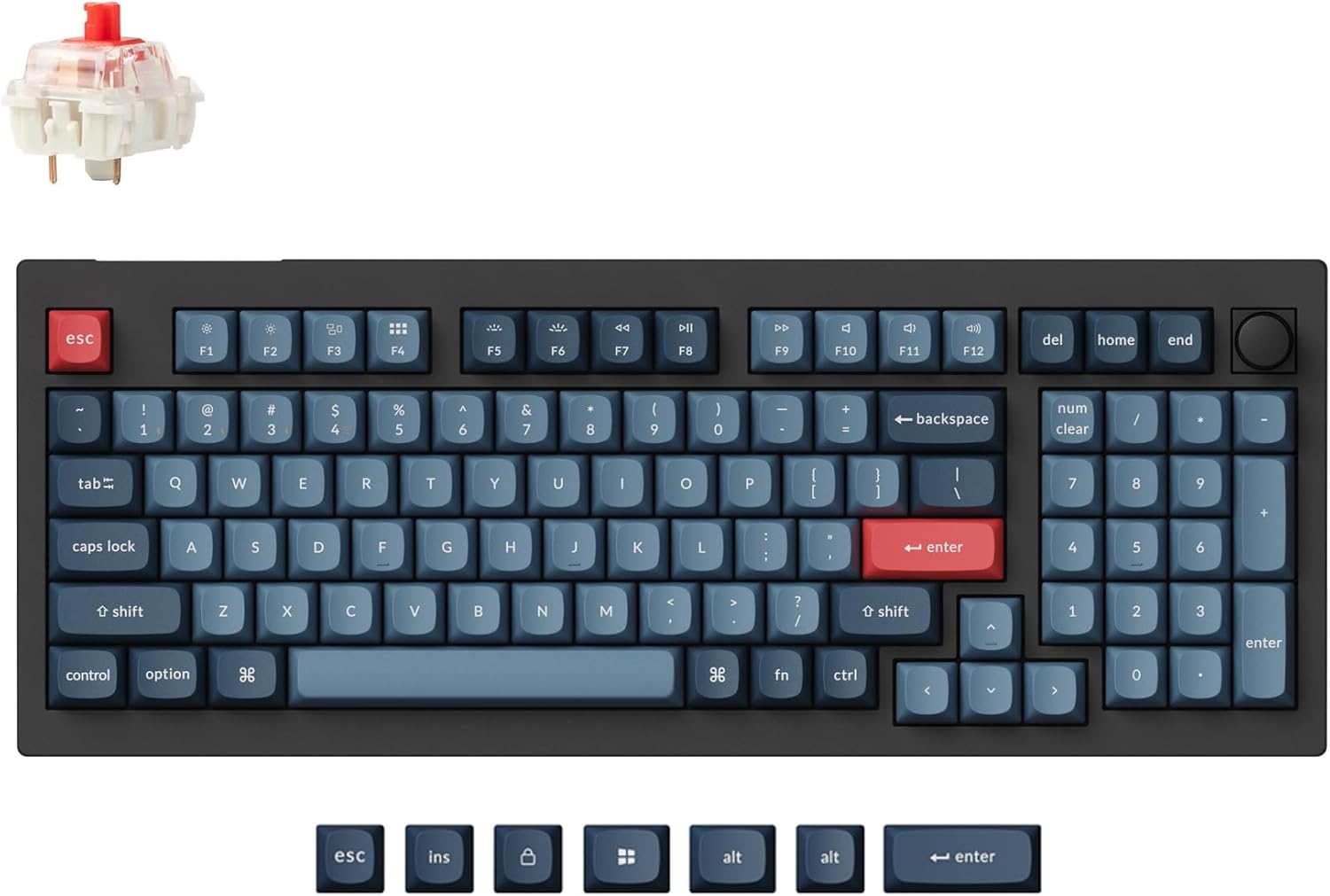
- Hall Effect magnetic switches provide adjustable actuation for personalized typing feel.
- Triple connectivity supports Bluetooth 5.1, 2.4GHz wireless, and USB C wired mode.
- QMK compatibility enables advanced key remapping, macros, and custom programming layers.
- Hot swappable magnetic switches allow future upgrades without soldering required.
- Compact 75 percent layout balances productivity features with efficient desk space.

- Triple connectivity supports Bluetooth 5.1, 2.4GHz wireless, and USB C wired operation.
- QMK and VIA firmware enable extensive key remapping and macro customization.
- Hot swappable mechanical switches simplify maintenance and future switch upgrades.
- Compact 75 percent layout preserves function keys while saving valuable desk space.
- PBT keycaps provide excellent durability and resist wear from heavy daily use.
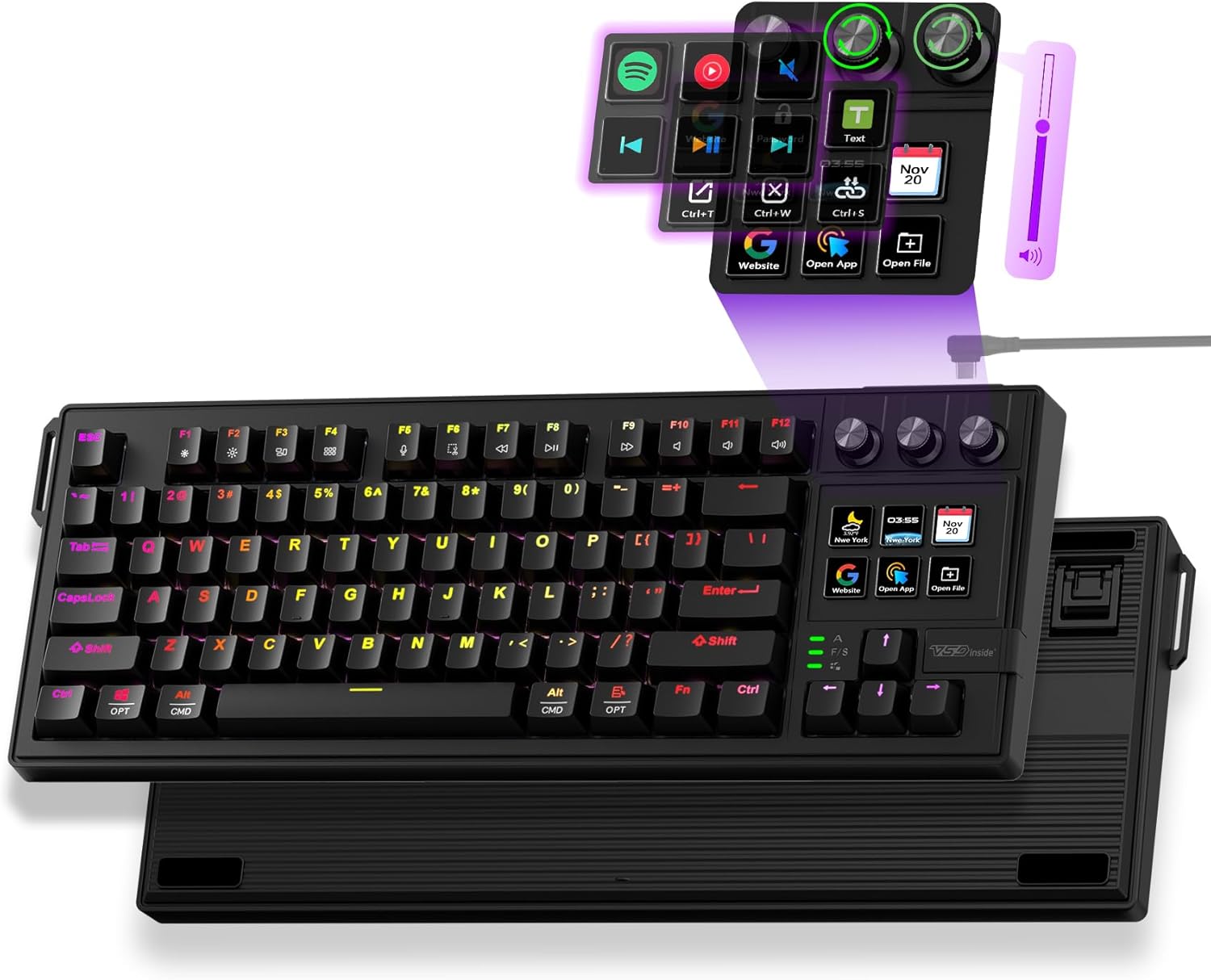
- Full key programmable layout supports custom macros and workflow automation.
- Built in TFT display and multifunction knobs improve shortcut management.
- Hot swappable mechanical switches allow simple customization without soldering.
- Five layer sound dampening structure creates a quieter and smoother typing experience.
- RGB backlighting with customizable LCD keys enhances productivity and personalization.

- Triple connectivity supports Bluetooth 5.0, 2.4GHz wireless, and USB C wired mode.
- Hot swappable mechanical switches simplify customization and future maintenance.
- Gasket mounted structure delivers softer keystrokes and reduced typing noise.
- Large 99 key compact layout includes number pad while saving desk space.
- High capacity rechargeable battery supports extended wireless productivity sessions.

- Triple mode connectivity supports Bluetooth 5.0, 2.4GHz wireless, and USB C wired connections.
- Hot swappable PCB supports both three pin and five pin mechanical switches.
- Gasket mounted structure with pre lubricated stabilizers produces smooth typing feedback.
- Durable side printed PBT keycaps resist shine during extended daily use.
- Programmable multifunction knob provides quick access to common productivity controls.
1. Map the Programming Workload Before Choosing a Layout
The most useful keyboard layout is the one that keeps frequently used commands accessible without consuming more desk space than the workstation can support. Start with a normal week of work rather than a percentage label. Record how often you use function keys, arrows, Home and End, Page Up and Page Down, Insert, a number pad, and dedicated media controls. A developer moving between an IDE, terminal, debugger, database client, and spreadsheet may need a different physical layout from someone who works mainly in a modal editor on a laptop.
Full-size boards preserve every conventional cluster and can suit numeric entry, but their width pushes the mouse farther outward. Tenkeyless boards remove the number pad while retaining function and navigation rows. Common 75-percent designs compress those keys into a smaller footprint, and 65-percent boards usually remove the function row. Smaller layouts can be efficient after adaptation, but a layer is not automatically an improvement when a command must be entered repeatedly under time pressure. Compare the exact diagram because two products using the same percentage can place keys differently.
Measure the usable desk area, not the total desktop. Include the mouse zone, notebook, monitor stand, microphone, and any edge that cannot support the keyboard. Programmers who perform frequent numeric work can consider a movable number pad instead of carrying that width all day. If typing comfort is the broader priority, compare mechanical keyboards intended for office typing and ergonomic keyboards for office productivity as separate categories; mechanical switches and ergonomic geometry describe different things.
Finally, confirm regional layout and operating-system conventions. ANSI and ISO boards differ physically, and legends do not control what the operating system outputs. Check modifier placement, language-specific keys, firmware support, and whether remapping tools run on every computer you use. A compact board is only productive when its layers are documented, memorable, and available before login as well as inside the main operating system.

2. Choose Switches by Force, Feedback, and Room Noise
Switch labels are useful shorthand, not complete specifications. Linear switches are designed to move without a deliberate tactile event; tactile switches add a change in resistance around actuation; clicky switches add an audible click mechanism. The assembled keyboard also depends on spring weight, travel, lubrication, keycaps, plate, stabilizers, case, and desk surface. A color name such as red, brown, or blue is not a universal standard across manufacturers.
For code entry, test more than continuous letters. Use modifier combinations, brackets, repeated arrow presses, function shortcuts, and correction sequences. A very light switch may reduce required force but can register accidental presses for some typists. A heavier spring may feel controlled to one person and tiring to another. Published actuation force and travel figures help narrow a list, yet they cannot predict whether a particular bump shape or bottom-out feel will suit an individual.
Sound deserves a room-specific test. Clicky switches can be disruptive during calls or in a shared office, while linear and tactile boards can still produce substantial bottom-out and return noise. Online recordings are affected by microphones, compression, room treatment, and desk material. Test the actual call microphone and listen from another seat if possible. A desk mat that changes surface acoustics may reduce some resonance, but it cannot make every keyboard quiet.
Hot-swap sockets can simplify switch replacement, but verify standard versus low-profile construction, pin format, orientation, and manufacturer instructions. Remove switches with the proper tool and support the plate to avoid bent pins or damaged sockets. A soldered keyboard is reasonable when the selected switches are already suitable. Treat switch life figures as laboratory ratings under specified conditions, not a guarantee for stabilizers, sockets, controller electronics, cables, or batteries.

3. Evaluate Remapping, Macros, and Firmware Safely
Programmable keys can reduce awkward reaches, but only when the configuration is reliable and understandable. List the actions that genuinely recur: opening a terminal, navigating tabs, invoking a build task, moving between virtual desktops, or entering a harmless text template. Then confirm whether the keyboard can remap those keys, store settings onboard, and retain them when moved between computers. Software-only mappings may disappear at login screens, in remote sessions, or on machines where the utility cannot be installed.
Open firmware ecosystems such as QMK and compatible configuration tools can provide deep control, but support varies by exact model and revision. A product family name does not prove that every wireless variant, knob, display, or regional layout has the same firmware. Check the manufacturer’s current documentation and device definition before buying. Download firmware only from an official or trusted project source, match the exact hardware, keep a wired connection when instructed, and do not interrupt a flash.
Macros should be designed with security and context in mind. Do not store passwords, recovery codes, private keys, or other secrets in keyboard memory. Avoid sequences that can delete data or deploy software after one accidental press. Prefer small, reversible actions and place powerful commands behind a deliberate layer or confirmation step. In managed workplaces, confirm policy before installing drivers, configuration applications, or unsigned firmware.
Developers who type long-form documentation as well as code may also want to compare mechanical keyboards for typists. The ideal mapping is not necessarily the most elaborate one. A printed or saved layer map, consistent modifier positions, and a simple fallback profile often contribute more to daily reliability than dozens of macros that are hard to remember.
- Confirm remapping works on every required operating system.
- Check whether settings live onboard or depend on a background app.
- Keep an exported backup of a working layout where the tool permits it.
- Document reset and recovery procedures before changing firmware.
4. Compare Wired, Bluetooth, and Receiver Connections
Connection mode affects startup access, device switching, charging, and desk organization. A wired keyboard is usually straightforward, but USB-C shape alone does not guarantee that every cable carries data or fits a recessed port. Verify behavior through the intended dock, KVM, hub, or monitor. If you need to enter firmware settings, unlock encrypted storage, or select an operating system before drivers load, confirm that the connection works at that stage.
| Connection | Verify before purchase | Typical tradeoff to plan for |
|---|---|---|
| Wired USB | Data-capable cable, port fit, dock or KVM behavior, startup access | Cable routing and an occupied port |
| Bluetooth | Pairing slots, supported systems, wake and reconnect behavior | Variable reconnection and battery use |
| USB receiver | Receiver storage, replacement availability, platform support | A small part to track and another occupied port |
Wireless product pages sometimes combine multiple variants, so verify the model number and included receiver. Bluetooth can reduce dongles and make tablet or laptop switching convenient, while a proprietary receiver may use a different latency and compatibility profile. The category overview of wireless keyboards for productivity can help frame those differences, but measured performance for one version should not be applied to another without evidence.
Battery estimates depend on lighting, connection mode, sleep settings, polling behavior, and test method. Check whether the keyboard can type while charging, how charge state is shown, and whether the battery is serviceable. Follow the manufacturer’s charging and storage guidance. Stop using a device if a battery swells, leaks, overheats, or is physically damaged.
Multi-device switching should be tested with the actual computers. Observe modifier mapping, first-keystroke behavior after sleep, reconnection time, and whether the selected profile is visible without guesswork. If a laptop is raised on a stand for a more practical screen position, an external keyboard and pointing device usually allow the display and hands to be positioned independently.

5. Check Keycaps, Stabilizers, Build, and Repair Boundaries
Keycap material and legend method influence texture and wear, but neither guarantees a good set. ABS often develops visible shine with use; PBT is commonly more resistant to shine but can vary in texture, straightness, and color. Double-shot, dye-sublimated, and printed legends each have manufacturing and lighting implications. Confirm contrast under normal room light, especially for secondary layer markings that programmers may need while learning a compact layout.
Replacement keycaps must match the stem and the physical arrangement. Check spacebar, bottom row, right Shift, Enter, profile, and regional keys. Low-profile systems often use less common or proprietary parts. A nominally standard board can still require unusual key sizes. If customization matters, locate a compatible complete set before purchase rather than assuming one will appear later.
Large keys rely on stabilizers. During a return window, press the center and both edges of Space, Enter, Backspace, and Shift. Listen for pronounced ticking, check consistent return, and make sure a key does not bind when pressed off-center. Do not lubricate or bend a new component before documenting a defect and checking the return policy. Unsupported modification can make warranty service harder.
Weight is not the same as quality. A metal case can remain planted but is cumbersome to move; a well-designed plastic case can be practical and durable. Check for even feet, a secure cable socket, clear indicators, case flex, accessible screws, and a stable angle. Warranty length, spare parts, battery replacement policy, and regional service can matter more over years than a decorative finish.
A separate support may be useful for some setups, but it should not force the wrists upward. Compare boards that include support with mechanical keyboards with wrist rests for programming and memory-foam wrist rests for keyboard and mouse use. Comfort is individual, and persistent pain, tingling, numbness, or weakness should be discussed with a qualified health professional rather than treated as a keyboard shopping problem.
6. Fit the Keyboard Into the Whole Workstation
Keyboard comfort depends on the desk, chair, display, and pointing device around it. Begin with a supported seat and relaxed shoulders. Place the keyboard close enough that the upper arms can remain near the torso, then keep the mouse beside it rather than beyond a wide number pad. Avoid an extreme upward or sideways wrist angle. No single posture should be held rigidly all day; ordinary movement and supported variation are useful.
Built-in rear feet increase positive tilt and may worsen wrist extension for some users. Test the keyboard flat before raising it. A palm or wrist support is generally better used during pauses than as a hard pressure point while actively typing. If desk height prevents a practical hand position, compare adjustable keyboard trays, an under-desk tray that includes a mouse platform, or an adjustable keyboard stand. Check knee clearance, stability, load rating, mounting requirements, and whether the mouse remains level with the keys.
Mouse reach is part of the layout decision. A compact keyboard can bring the pointer closer, but changing to a narrower board does not solve an unsuitable mouse shape or technique. Readers reviewing that side of the setup can compare a wireless mouse selected for ergonomic comfort and an ergonomic mouse pad with wrist support, while treating product claims cautiously.
Keep the top of the keyboard and the working area well lit without screen glare. A display that is too low can encourage a hunched position even when the keyboard is well placed; an adjustable monitor riser may help where the monitor stand lacks range. Take measurements before adding accessories so one correction does not create another conflict.

7. Plan Cable Management, Cleaning, and Daily Reliability
A programmable keyboard is only useful when it connects predictably. Route a wired cable with enough slack for desk movement and without a sharp bend at the keyboard socket. Do not trap it under monitor arms or drawer slides. Separate signal and charging cables from hot equipment, and keep connectors where they can be inspected. A guide to office-desk cable management and a comparison of under-desk cable trays can help, but every mounting surface and power load must be checked.
Store a wireless receiver in its provided compartment when traveling. If no storage is built in, use a labeled case rather than leaving it attached where it can be bent. Keep charging cables identifiable and avoid unverified adapters. A desk-clamp headphone holder with cable clips may organize a shared audio and keyboard area, provided the clamp suits the desk and does not pinch wiring.
For routine cleaning, disconnect power first and follow the manufacturer’s instructions. Remove loose debris with gentle air or a soft brush. Use only recommended cleaning materials, applied to a cloth rather than poured into the board. Photograph the key layout before removing caps and use an appropriate puller. Low-profile caps, stabilized keys, and integrated switch designs may need special procedures. Allow every part to dry fully before reconnecting.
Back up configuration files and record the keyboard model, revision, purchase date, receiver identity, and firmware version. Keep the original cable and a known-good basic profile for troubleshooting. If missed inputs appear, change one variable at a time: test another port, cable, connection mode, and computer before changing firmware. Note whether the problem occurs before login or only in one application. This process separates keyboard faults from software shortcuts, hubs, power management, or wireless interference.
Travel introduces different risks. Use a case that prevents keys and knobs from bearing the load of other items. Turn wireless boards off, protect detachable receivers, and do not pack a damaged battery. After a spill, disconnect power promptly and consult the manufacturer; repeatedly pressing keys or applying heat can spread damage.
8. Run a Structured Trial and Use a Final Checklist
A return period is an opportunity for a repeatable trial, not just a first impression. Start with the keyboard in its supported factory configuration. Verify every key with a reputable local test tool, then check startup access, login, sleep and wake, device switching, and each required application. Type real code, comments, documentation, terminal commands, shortcuts, and symbols. Avoid entering secrets into an unfamiliar web-based tester.
Test in sessions of ordinary length over several days. Record accidental presses, missed keys, uncomfortable reaches, layer mistakes, connection interruptions, and noise on calls. Ask another regular user to try the board if it will be shared. Compare the observations with the original requirements instead of adapting the requirements to justify the purchase. A keyboard that photographs well but hides a daily command behind an awkward layer is not the better tool for that workflow.
Check each advertised feature on the exact received model. Confirm the layout, switch variant, connection modes, included accessories, remapping support, and regional warranty. Save packaging until the decision is complete. If a defect appears, document it before opening the case or modifying stabilizers. The retailer and manufacturer may have different processes, deadlines, and responsibility for return shipping.
Final programming keyboard checklist
- The physical layout includes every frequently used key or a practical documented layer.
- Switch force, feedback, and sound suit the actual room and typing pattern.
- Remapping works on required operating systems and does not store secrets.
- Wired, Bluetooth, or receiver connections work through the intended dock or KVM.
- Keycaps, stabilizers, feet, indicators, cable socket, and case pass inspection.
- Keyboard height and width leave a practical mouse position and relaxed reach.
- Battery, receiver, firmware, cleaning, repair, return, and warranty terms are understood.
- The exact model and variant—not merely the product family—match the listing.
The ranked products above provide a starting set, while this checklist supplies a way to test fit without assuming one board is best for every programmer. Preserve receipts, configuration backups, and the working factory profile. Those simple records make future troubleshooting and replacement decisions easier.