


- Scans photos at speeds up to one per second.
- Automatic document feeder handles batches without constant manual loading.
- Single-pass duplex scanning captures both sides of documents automatically.
- Wireless connectivity provides flexible scanning around offices and workspaces.
- Dedicated FastFoto software helps organize and enhance scanned photographs.

The speed becomes obvious when the paper pile is actually large
The Epson FastFoto FF-680W takes our number one position in the best high speed scanner automatic document feeder comparison because it does something slightly unusual. It combines serious document scanning capability with extremely fast batch photo scanning, giving offices a machine that can handle ordinary paperwork while also digitizing printed photographs at speeds Epson rates as fast as one photo per second at 300 dpi.
That matters when the job contains hundreds of originals rather than ten or twenty. Feeding every photograph or document individually into a flatbed scanner turns a simple digitization project into hours of repetitive work.
The automatic feeder changes that workflow. Load a compatible batch, start the scan, and the scanner processes multiple originals automatically instead of waiting for someone to position each page by hand.
For an office clearing years of archived material, that difference is substantial. Employee files, receipts, correspondence, forms, photographs, and other records can accumulate surprisingly quickly when nobody has had time to digitize them properly.
The automatic feeder and duplex scanning are what make it useful for documents
The FF-680W is often discussed as a photo scanner, but it is also capable of handling normal office documents. Epson rates document scanning at up to 45 pages per minute and 90 images per minute at 300 dpi under specified conditions.
The difference between pages per minute and images per minute matters. With duplex scanning, each physical sheet has two sides, so a 45-page-per-minute feed rate can produce as many as 90 scanned page images when both sides contain information.
This is where single-pass duplex scanning saves real time. The scanner captures the front and back during the same trip through the machine instead of feeding the stack once, turning it over, and scanning everything again.
Imagine scanning 200 double-sided forms. A simplex scanner requires considerably more handling, while duplex capture can process both sides as part of the original batch.
The automatic document feeder is equally important. High scan speed means very little if somebody has to stand beside the machine feeding one sheet every few seconds.
An ADF lets the scanner become part of a proper batch workflow. Prepare the documents, remove staples and clips, align the stack, place it into the feeder, and allow the scanner to work through the pages.
Preparation matters more than people expect. Folded corners, sticky notes, staples, damaged edges, and pages stuck together can interrupt feeding and may cause jams or skipped sheets.
Before a large scanning session, fan and straighten the document stack. This separates pages that have been pressed together in storage and gives the feed rollers a cleaner job.
Paper condition should also determine whether something goes through the ADF at all. Very fragile historical documents, torn originals, delicate photographs, or unusually thick material deserve more careful handling rather than being forced through a high-speed feeder.
The FF-680W becomes especially interesting when photographs are mixed into the digitization project. Epson designed FastFoto specifically around rapidly scanning stacks of printed photos while attempting to handle them carefully.
It supports common photo sizes and can capture both sides in a single pass. That second side is useful because older photographs often have dates, locations, handwritten names, or processing information written on the back.
Instead of choosing between the picture and those notes, duplex scanning can preserve both sides. For family archives, historical offices, schools, clubs, and organizations, those handwritten details can be just as important as the photograph itself.
Why we believe the FF-680W deserves the number one position
Wireless connectivity makes placement more flexible. The scanner does not necessarily need to remain permanently beside one computer, which can help in offices where several users need access or desk space is limited.
A wired USB connection still has advantages when scanning very large batches because it removes wireless network conditions from the workflow. For occasional shared scanning, though, Wi-Fi can be much more convenient.
Epson's FastFoto software adds tools specifically intended for photo archiving. It can organize scanned images and perform automatic enhancements, including adjustments intended to improve older or faded photographs.
This can save time when hundreds of prints are being digitized. Instead of manually opening every photo in editing software, automatic enhancement provides a useful starting point for a large archive.
Keep the original scans as well when the photographs are important. Automatic color and contrast adjustments are subjective, so preserving an untouched digital copy gives you something to return to if an enhancement later looks too aggressive.
Resolution is another area where people often choose the largest number without considering the job. Higher resolution produces more detail but also creates larger files and takes more storage space.
For routine document archiving, extreme resolution is usually unnecessary. Text recognition, file size, scanning speed, and the eventual use of the document should determine the setting rather than simply selecting the maximum available resolution.
Photo archiving deserves more consideration. If the goal is simply viewing old prints on a screen, moderate resolution can be enough, while photographs intended for enlargement or restoration may benefit from higher-resolution capture.
Maintenance matters with any high-speed ADF scanner. Dust, paper fibers, and residue gradually collect around rollers and imaging surfaces, particularly when thousands of old documents or photographs pass through the machine.
Dirty imaging surfaces can produce repeated lines or marks across every scan. If the same streak appears in exactly the same position on several different pages, cleaning the scanner should be the first check rather than assuming every original has the same defect.
Rollers also wear over time. High-volume scanning equipment depends on consistent friction to separate and transport individual sheets, so feeding performance can deteriorate as consumable components age.
Another common mistake is overloading the feeder. A high-speed scanner works best when the paper stack remains within its specified capacity and the sheets are reasonably consistent in size and condition.
Forcing an oversized stack into the feeder does not increase productivity. It can create double feeds, jams, crooked pages, and additional time spent rescanning material that could have been processed cleanly in two batches.
File organization should be planned before starting a large project too. Scanning 5,000 pages quickly is less impressive if the resulting files are given meaningless names and dumped into one folder.
Create a sensible folder structure first. Dates, clients, departments, document types, photo events, or project names can make the resulting digital archive much easier to search later.
So why does the Epson FastFoto FF-680W earn our number one ranking out of seven? It combines high-speed document scanning, automatic feeding, single-pass duplex capture, wireless connectivity, and unusually fast photo digitization in one machine.
Its photo capability is particularly valuable because many conventional office document scanners are optimized almost entirely around sheets of paper. The FF-680W can handle ordinary business documents while also addressing boxes of printed photographs that would be painfully slow to process individually.
It is not the scanner we would use for every fragile historical original, and careful document preparation remains important. But for offices, archives, schools, photographers, families, and organizations dealing with large volumes of ordinary documents and printed photos, the combination of speed and versatility is difficult to ignore.
That balance is why we believe it deserves rank number one. The FF-680W is fast enough to make large scanning projects realistic, automated enough to reduce constant manual handling, and flexible enough to be useful after the original photo archive has finally been cleared.

- 100-sheet automatic document feeder handles substantial office scanning batches.
- Scans double-sided documents at speeds up to 45 ppm.
- Large 5-inch touchscreen provides customizable scanning profiles and controls.
- Wi-Fi 6 and USB-C provide flexible modern connectivity options.
- Ultrasonic double-feed detection helps prevent missed or overlapping pages.
The 100-sheet feeder is what makes this feel ready for real office work
The ScanSnap iX2500 takes the number two position in our best high speed scanner automatic document feeder comparison because it combines a 100-sheet ADF with 45 ppm duplex scanning, a large 5-inch touchscreen, Wi-Fi 6, USB-C connectivity, and automated document processing. It is clearly designed for offices that need to move through stacks of paperwork rather than scan one sheet every few minutes.
The 100-sheet automatic document feeder is the first specification that matters. A smaller feeder can be perfectly adequate for occasional paperwork, but once an office starts digitizing contracts, invoices, employee records, tax files, or archived correspondence, stopping constantly to reload the scanner becomes wasted time.
With capacity for up to 100 sheets, you can prepare a substantial batch and let the machine process it. Less manual feeding means better productivity, especially when scanning is one task among several rather than somebody's entire job for the afternoon.
The iX2500 scans at up to 45 pages per minute in its normal high-speed workflow. It also captures both sides, so double-sided paperwork does not need to be scanned once, flipped manually, and passed through the feeder again.
Forty five pages per minute only helps when the paper is prepared properly
High-speed duplex scanning can change a large office project quickly. A stack of double-sided forms that would be painfully slow on a flatbed can move through the scanner continuously while both sides are captured during the same pass.
The important part is preparing the stack before loading it. Remove staples, paper clips, sticky notes that could detach, and anything else that may interfere with the paper path.
Old documents should be fanned before scanning too. Pages that have spent years compressed inside a folder can stick together, and separating the sheets before loading matters when the goal is reliable automatic feeding.
The iX2500 includes ultrasonic double-feed detection. This is particularly useful during larger batches because two pages entering together can otherwise create a missing document that nobody notices until much later.
That can be a serious problem in business archives. If page 47 of a contract disappears because it traveled through the scanner attached to page 46, having a fast PDF at the end does not make the scanning project successful.
Double-feed detection helps identify that type of feeding problem before it quietly becomes part of the digital archive. It does not eliminate the need for sensible paper preparation, but it adds another layer of protection during unattended batches.
The 5-inch touchscreen is another meaningful improvement for shared offices. Instead of treating the scanner as a simple peripheral controlled entirely from one computer, users can access personalized scanning profiles directly from the machine.
That can simplify repeated workflows. One profile might send invoices into a specific computer workflow, another could handle receipts, while another employee may have settings intended for ordinary searchable documents.
This is where custom scanning profiles save repetitive setup. If the same document type is processed every week, employees should not have to rebuild the scanning settings every time they walk up to the machine.
Wi-Fi 6 adds more flexibility to placement. The scanner can work in environments where running a USB cable to one permanent computer is inconvenient, and supported workflows can send scans toward computers, mobile devices, or cloud services.
USB-C remains useful when a direct wired connection is preferred. For a large scanning job, a wired connection can also remove the office wireless network from the equation and provide a straightforward local workflow.
Why the iX2500 comes extremely close to our number one position
The iX2500 is built for more than ordinary letter-size paperwork. It can handle documents, receipts, photographs, business cards, and other common material, which makes it useful for offices where the scanning pile is rarely perfectly uniform.
Automatic image optimization reduces some of the cleanup that normally happens after scanning. Features that correct orientation, improve image appearance, and organize captured information matter because fast scanning should not create extra editing work afterward.
Resolution reaches up to 600 dpi depending on the selected scanning mode. For routine business documents, maximum resolution is usually unnecessary because it creates larger files without providing much practical benefit for ordinary text.
A moderate resolution is generally more sensible for searchable office records. Higher settings become more relevant when fine image detail matters, such as photographs or originals that may later need closer inspection.
OCR is another important part of document scanning. Converting printed text into searchable information makes a digital archive dramatically more useful than storing thousands of pages as images that can only be found by manually opening files.
Think about a five-year invoice archive. Searching for a supplier name, invoice number, or phrase is much easier when the documents have been processed into searchable PDFs rather than simple page photographs.
File naming deserves planning before a large project starts. Fast scanning can create files very quickly, and poorly organized output simply moves the paperwork problem from a filing cabinet onto a hard drive.
Create folders based on client, year, department, project, or document category before beginning. A consistent naming convention also helps staff understand what a file contains without opening it.
Paper condition remains one of the biggest variables with any automatic document feeder. Torn sheets, folded corners, very thin paper, adhesive residue, and heavily damaged originals should be separated from the normal batch rather than forced through at full speed.
Some documents simply deserve manual handling. A fragile original that cannot be replaced is not the place to test how much abuse an ADF can tolerate.
Maintenance matters too. High-speed scanners pull thousands of paper surfaces across rollers and imaging components, bringing dust and paper fibers into the machine over time.
If repeated lines begin appearing in exactly the same position on different scans, inspect and clean the scanning surfaces. Consistent streaks often point to scanner contamination rather than defects on every original page.
Feed rollers also wear with use. When pickup becomes inconsistent or double feeding increases despite properly prepared paper, the rollers and other consumable components should be inspected according to the manufacturer's maintenance guidance.
Do not overload the 100-sheet feeder either. The fact that it accepts a large stack does not mean pushing an oversized pile into it will save time.
Overloading can create skewing, jams, and feeding problems that require rescanning. Two clean batches are faster than one badly prepared batch that fails halfway through.
So why does the ScanSnap iX2500 finish number two rather than taking our top position? It is actually the more conventional office document scanner of the first two products, with a larger 100-sheet feeder, 45 ppm duplex performance, a 5-inch touchscreen, Wi-Fi 6, USB-C, and strong workflow automation.
Our number one Epson FastFoto FF-680W receives the top position because it adds an unusual advantage for mixed archives: extremely fast batch photo scanning alongside high-speed document handling. For organizations dealing with both office paperwork and large collections of printed photographs, that versatility gives the Epson an edge.
The ScanSnap counters with a stronger document-first office workflow. Its 100-sheet ADF is particularly attractive for businesses processing contracts, receipts, correspondence, financial records, applications, and other paper-heavy jobs every day.
For an office focused almost entirely on documents rather than photographs, the iX2500 could easily be the more appropriate machine. The touchscreen profiles, large feeder, fast duplex scanning, double-feed detection, and flexible connectivity are exactly the features that make repeated scanning less tedious.
That is why we believe the ScanSnap iX2500 deserves the number two position out of seven. It narrowly misses our top spot, but for high-volume document digitization and everyday office scanning, it remains one of the strongest automatic document feeder scanners in this comparison.
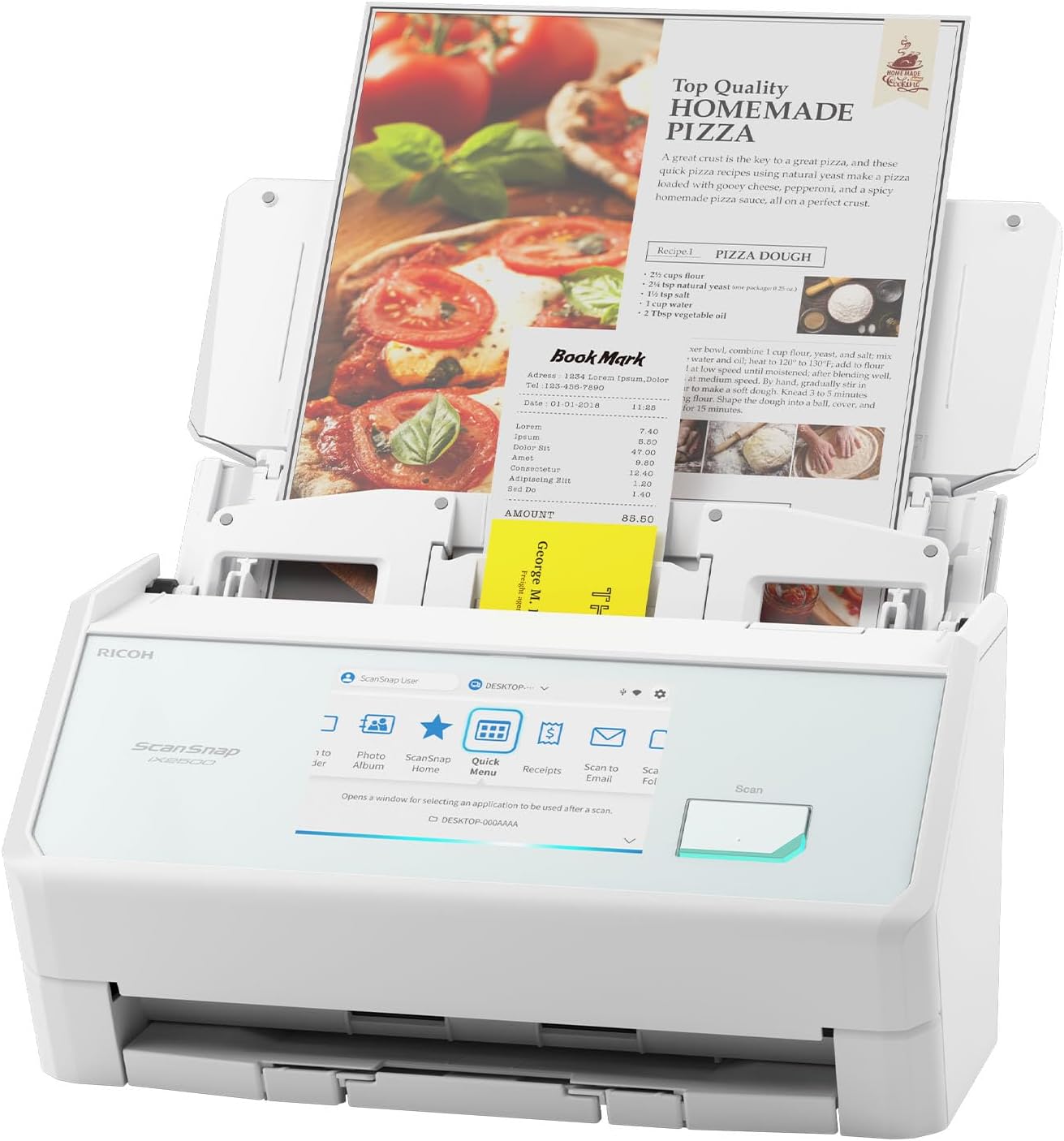
- 100-sheet automatic document feeder handles large scanning batches efficiently.
- 45 ppm duplex scanning processes double-sided paperwork quickly.
- Five-inch touchscreen provides direct access to customized scanning profiles.
- Wi-Fi 6 and USB-C offer flexible modern connectivity choices.
- Ultrasonic multi-feed detection helps prevent accidentally skipped document pages.
The big feeder is what makes this practical for a paper-heavy office
The ScanSnap iX2500 takes the number three position in our best high speed scanner automatic document feeder comparison, and its strongest feature is fairly straightforward: it can process a lot of paperwork without requiring someone to constantly stand beside it. The combination of a 100-sheet automatic document feeder, up to 45 ppm scanning, duplex capture, a 5-inch touchscreen, Wi-Fi 6, and USB-C gives it a very office-focused specification.
The 100-sheet ADF matters when the scanning job is more than a few invoices. Contracts, applications, financial records, employee files, receipts, and old correspondence can quickly turn into stacks several inches thick.
Instead of feeding ten or twenty sheets and returning to the scanner constantly, a larger batch can be prepared and loaded together. The 100-sheet feeder reduces manual handling, which is one of the main reasons to buy a dedicated high-speed document scanner rather than relying on a multifunction printer.
Scan speed reaches up to 45 pages per minute under the specified scanning conditions. That is fast enough to make larger digitization projects manageable without moving into the size and cost of departmental production scanning equipment.
Duplex scanning saves more time than the speed number suggests
The iX2500 performs duplex scanning, so the front and back of a document can be captured during the same pass. For double-sided business records, this is far more useful than simply having a fast feeder.
Consider a stack of 300 two-sided forms. A simplex scanner would require additional handling to capture the reverse sides correctly, while single-pass duplex scanning captures both sides together and keeps the document sequence easier to manage.
That sequence matters with contracts and applications. If pages become mixed up while somebody manually flips a large stack, the resulting digital document can be incomplete or assembled in the wrong order.
The ultrasonic multi-feed detection system adds another useful layer. Its purpose is to detect situations where more than one sheet enters the paper path together, which is one of the easiest ways for pages to disappear from a large scanning job.
This matters because a missed page may not be obvious immediately. Someone can scan a 90-page file, see a large PDF appear on the computer, and assume everything worked even though two pages passed through together somewhere in the middle.
Automatic detection reduces that risk, but document preparation is still important. Fast scanners still need clean paper preparation, particularly when dealing with records that have been sitting inside folders or storage boxes for years.
Remove staples and paper clips before loading a batch. Check for adhesive notes, folded corners, torn edges, and sheets that are stuck together.
Fan the stack gently before placing it into the feeder. Paper that has been compressed in storage can cling together, and separating the sheets gives the pickup system a better chance of feeding one document at a time.
Do not force fragile originals through the ADF just because the scanner can accept many document types. Thin historical paper, badly torn sheets, delicate originals, and irreplaceable records should be handled separately when their physical condition makes automatic feeding risky.
The 5-inch touchscreen improves repeated office workflows. Employees can access scanning functions and profiles directly from the scanner rather than treating the unit as something that can only be controlled through one computer.
This becomes useful when several people share the machine. An accounting workflow may need different destinations and file settings from HR, while somebody scanning ordinary correspondence may want a much simpler profile.
Saving those routines means less setup before repeated scanning jobs. A staff member can select the appropriate workflow instead of rebuilding resolution, destination, file type, and other settings every time.
Why this iX2500 configuration lands at number three
Connectivity is another strong part of the iX2500. Wi-Fi 6 gives the scanner modern wireless capability, while USB-C provides a straightforward wired connection when the scanner is positioned directly beside a computer.
Wireless operation can be useful in a shared office because the scanner does not have to belong permanently to one workstation. Depending on the configured workflow, documents can be routed without repeatedly moving cables between computers.
For a very large local scanning project, USB-C can still make sense. A wired connection removes wireless variability from the job, which is useful when hundreds or thousands of pages need to move through the scanner in one session.
The scanner can also work with different types of everyday business material, including standard documents, receipts, business cards, and other supported originals. This matters because real office scanning piles are rarely made from perfectly identical sheets.
A stack may contain a letter-size invoice followed by a receipt, then a signed form or business card that needs to be associated with the same project. Being able to process varied material reduces the need to keep another scanner nearby for every unusual document.
OCR and searchable document creation are equally important. Scanning paper into image-only files preserves the appearance, but it does not make a large archive particularly easy to search.
Searchable PDFs allow staff to locate words, invoice numbers, customer names, or other recognized text later. That can turn a filing cabinet into a genuinely useful digital archive rather than simply creating an electronic pile of pages.
File organization needs to be planned before scanning starts. High speed creates files very quickly, and a folder containing hundreds of documents with meaningless names can become nearly as frustrating as the original paper archive.
Set up folders by year, department, client, project, or document type first. Use a consistent naming convention so another employee can understand what each file contains without opening every PDF.
Resolution should also match the job. Routine office documents generally do not need the largest possible resolution because higher settings create bigger files and can slow the overall workflow without adding useful information to ordinary text.
Higher resolution makes more sense when fine visual detail needs to be retained. For normal contracts, invoices, and forms, readability and reliable OCR are usually more important than producing enormous image files.
Maintenance becomes important when a scanner works at this speed. Paper dust and residue gradually collect on rollers and scanning surfaces as thousands of sheets pass through the machine.
If a vertical streak begins appearing in exactly the same position across unrelated documents, inspect the scanning glass and internal imaging surfaces. Repeated marks often indicate scanner contamination rather than a defect on every sheet.
Feed rollers are wear items too. If the scanner begins struggling to pick up paper reliably after extensive use, maintenance and roller condition should be checked instead of repeatedly forcing larger stacks through the feeder.
Never overload the 100-sheet ADF. Its capacity is already substantial, and pushing additional pages into an overfilled feeder can create skewing, double feeds, jams, and more rescanning work.
So why does this ScanSnap iX2500 configuration receive the number three position rather than number one? The Epson FastFoto FF-680W at the top adds unusually strong high-speed photo digitization to its document capabilities, giving it an advantage for offices and archives containing both paperwork and large collections of printed photographs.
The iX2500 ranked directly above this one also represents essentially the same core scanner family, so there is naturally significant overlap in scanning speed, feeder capacity, touchscreen functionality, and connectivity. The exact package and listing therefore become part of the distinction rather than a dramatic difference in the scanning engine itself.
That overlap is why this version lands third, not because its document performance is weak. In fact, the iX2500 is exceptionally well suited to office documents, especially when the priority is processing large batches quickly with minimal manual intervention.
For an accounting department scanning invoices, a legal office digitizing case paperwork, an HR team processing employee records, or a small business finally clearing years of stored documents, the 100-sheet feeder and 45 ppm duplex scanning are the features that will matter every day.
That is why we believe this ScanSnap iX2500 deserves the number three position out of seven. It misses the top spots because of the specific advantages and package differences of the products above it, but as a high-speed automatic document feeder scanner for serious office paperwork, it remains one of the strongest choices in this comparison.

- 100-sheet automatic document feeder handles substantial scanning batches efficiently.
- Scans documents at speeds up to 45 pages per minute.
- One-touch operation simplifies repetitive office digitization and archiving tasks.
- Automatic image cleanup corrects skew, orientation, and blank pages.
- Handles documents, receipts, business cards, photos, and envelopes.
The one-button workflow is simple, but the 100-sheet feeder does the heavy work
The ScanSnap iX2400 takes the number four position in our best high speed scanner automatic document feeder comparison because it strips the scanning process down to something fairly direct. You get scanning speeds up to 45 pages per minute, a large 100-sheet automatic document feeder, one-touch operation, automatic image cleanup, and a stable wired USB connection.
That 100-sheet feeder is the specification that matters when an office has real paperwork to process. A scanner can be fast on paper, but if someone has to stop every few minutes and reload a tiny feeder, much of that speed advantage disappears.
With the iX2400, a substantial stack can be prepared before the scan begins. Large batches need less manual attention, which is useful for invoices, contracts, applications, customer records, receipts, and archived office files.
The rated scanning speed reaches up to 45 pages per minute. For an employee dealing with several hundred sheets before lunch, that is a very different workflow from using a flatbed scanner or slowly feeding pages through a multifunction printer.
One-touch scanning makes more sense when the same job happens every day
The iX2400 is deliberately simpler than the touchscreen-equipped iX2500 models ranked above it. Instead of building the workflow around a large display and wireless features, ScanSnap gives this model straightforward one-touch operation and a wired USB connection.
That simplicity can actually work well at a dedicated office workstation. If the scanner always sits beside the same Mac or PC and sends documents through the same workflow, there may be little reason to navigate menus on the scanner itself.
Press the button and the software can take over the processing. Repeated scanning becomes much less complicated when employees are dealing with the same types of paperwork every day.
The ScanSnap Home software handles organization and image processing after capture. Automatic functions can detect document size and color, correct skew, rotate pages, remove blank pages, and help clean up scanned images.
Those features matter because raw scanning speed is only one part of office productivity. If every batch requires another fifteen minutes of manually rotating sideways pages and deleting blank backs, the scanner has simply moved the work somewhere else.
Automatic blank-page removal is especially useful with mixed single-sided and double-sided paperwork. You can process the stack without manually separating every document based on whether information appears on the reverse.
De-skewing handles another common problem. Pages do not always enter an automatic document feeder perfectly straight, particularly when employees are moving quickly through several batches.
Instead of leaving slightly crooked documents inside the final PDF, the software can correct their orientation. Cleaner scans require less manual editing afterward, which becomes important when hundreds of pages are involved.
The iX2400 can also handle more than ordinary Letter or A4 paperwork. Receipts, business cards, photos, envelopes, ID cards, and other supported originals give it enough flexibility for the mixed material that actually appears around an office.
A bookkeeping workflow is a good example. One batch might contain normal invoices, narrow receipts, supplier correspondence, and supporting documents rather than fifty identical sheets of printer paper.
Being able to process those materials with the same scanner reduces the need for separate equipment. It also makes the scanning station more useful after the original archive project has been completed.
Why the iX2400 finishes fourth despite being genuinely fast
The wired USB connection is both a strength and a limitation. For a permanent workstation, USB provides a stable direct connection without depending on office Wi-Fi, network configuration, or wireless signal quality.
That can be useful during a major archive project. Connect the scanner to the computer and keep the workflow local and predictable while thousands of pages are being processed.
The tradeoff is flexibility. The iX2500 models above it offer wireless connectivity and touchscreen-driven workflows that make more sense when several people need to use the scanner or when it cannot remain permanently attached to one computer.
The iX2400 is therefore better suited to a dedicated scanning desk. That is not necessarily a disadvantage for accounting, administration, legal work, or records management, but it does narrow the way the scanner fits into a shared office.
Document preparation still matters even with a 100-sheet feeder. Remove staples and paper clips, unfold corners, check for adhesive notes, and separate pages that have been compressed together in storage.
Fan the paper stack before loading it. Proper preparation reduces feeding problems and is much faster than discovering halfway through a scan that two old sheets were stuck together.
Do not automatically put fragile originals into the feeder either. Torn documents, extremely thin paper, damaged historical records, and irreplaceable originals deserve individual inspection before being sent through a high-speed paper path.
The same applies to feeder capacity. A 100-sheet ADF is already large, so pushing extra pages into an overloaded tray is unnecessary and can create skewing, jams, or feeding errors.
Two clean batches are usually faster than one oversized batch that has to be stopped and rescanned. High-speed scanning works best when the machine receives properly prepared paper rather than being treated as a way to avoid preparation entirely.
The 600 dpi capability gives the iX2400 enough resolution for detailed scanning when required. Routine office documents generally do not need to be captured at the highest possible setting, though.
Higher resolution creates larger files. For normal contracts, invoices, correspondence, and searchable PDFs, choose a setting that preserves readable text without unnecessarily increasing storage requirements.
Organization matters just as much as image quality. A fast ADF scanner can create hundreds of digital files in a short period, so decide the filing structure before scanning rather than trying to sort everything afterward.
For example, create folders by year, client, department, project, or document type. Consistent filenames make the resulting archive much easier for another employee to understand months later.
Maintenance should also become part of the routine. Paper dust and residue collect around feed rollers and scanning surfaces as more documents pass through the machine.
If the same vertical line begins appearing on unrelated pages, inspect and clean the scanning surfaces. When feeding becomes inconsistent after extensive use, the rollers and other consumable parts should also be checked according to the manufacturer's maintenance instructions.
So why does the ScanSnap iX2400 receive the number four position out of seven? The models above it provide additional versatility, particularly the photo-focused capability of the Epson FastFoto and the wireless connectivity, touchscreen controls, and broader standalone workflow of the ScanSnap iX2500.
The iX2400 also lacks the 5-inch touchscreen found on the iX2500. For an office with several users and different scanning profiles, having those controls directly on the scanner can make daily operation more flexible.
But the iX2400 has a different appeal. If you want a scanner permanently connected to one Mac or PC, the simpler one-touch design avoids paying for workflow features that may not be necessary.
And the important hardware is still here. A 100-sheet ADF and 45 ppm speed provide the capacity required for serious document digitization rather than occasional home scanning.
That is why we believe the iX2400 deserves rank number four. It gives up wireless connectivity and the large touchscreen of the models above it, but its combination of speed, large feeder capacity, automatic image cleanup, versatile paper handling, and simple one-touch operation makes it a strong choice for a dedicated high-volume office scanning station.

- Scans double-sided documents at speeds up to 35 ppm.
- 50-sheet automatic document feeder handles substantial office scanning batches.
- Wireless connectivity supports flexible placement around shared office spaces.
- Single-pass duplex scanning captures both document sides automatically.
- Epson ScanSmart software supports searchable PDFs and document organization.
Thirty five pages per minute is enough to change a normal office workflow
The Epson WorkForce ES-500W II takes the number five position in our best high speed scanner automatic document feeder comparison because it gets the important office fundamentals right without becoming overly complicated. It combines scanning speeds up to 35 pages per minute, single-pass duplex capture, a 50-sheet automatic document feeder, wireless connectivity, and software designed around document organization.
The 50-sheet ADF is where the machine starts becoming useful for actual office work. Loading one page at a time is acceptable when scanning a signed form occasionally, but it becomes painfully inefficient when a filing cabinet contains hundreds of invoices, contracts, applications, or customer records.
With the feeder loaded, the scanner can work through a batch without somebody manually positioning every sheet. That reduction in repetitive handling matters when scanning becomes a regular administrative task rather than an occasional one.
Epson rates the ES-500W II at up to 35 pages per minute and 70 images per minute at 300 dpi. The second figure reflects duplex operation because each physical sheet can produce a front and back image during the same pass.
That is particularly useful with two-sided forms. You do not need to scan the entire stack, turn it around, and then figure out how to merge the reverse sides back into the correct order.
The wireless connection makes more sense when several people need the scanner
Wi-Fi connectivity gives the ES-500W II more placement flexibility than a scanner permanently tied to one computer. It can sit in a central office location rather than occupying space directly beside the employee who happens to scan the most paperwork.
This is useful for small teams. Accounting might scan receipts in the morning, administration can process correspondence later, and another employee can digitize signed forms without physically moving the scanner between desks.
A direct USB connection remains available when a wired workflow makes more sense. For a large archive project, a stable wired connection can be useful because it removes wireless network conditions from the scanning process.
The 35 ppm speed is not the fastest in this seven-product comparison, but it is still substantial. A 100-page single-sided job can theoretically move through the scanning mechanism in only a few minutes under appropriate conditions, although preparation, saving, processing, and document condition affect the complete workflow.
Paper preparation is one of the easiest parts to underestimate. Remove staples, clips, loose adhesive notes, and anything else that can interfere with the automatic document feeder before loading the stack.
Fan older documents too. Sheets that have been compressed inside folders for several years can stick together, and separating pages helps prevent feeding problems before they happen.
The ES-500W II includes ultrasonic double-feed detection, which helps identify situations where multiple sheets enter the paper path together. That matters because an unnoticed double feed can leave a page missing from the digital record.
Imagine scanning a signed 60-page agreement. If pages 32 and 33 travel through together and only one is captured properly, the resulting PDF may look complete at first glance while actually missing important information.
Automatic detection reduces that risk, although it does not eliminate the need to inspect important scans. For legal, financial, medical, or other critical records, verifying page count after scanning is still a sensible workflow.
The scanner also handles a useful range of document types. Standard office sheets, receipts, business cards, and other supported originals can be processed without requiring a completely different scanner for every paper size.
That flexibility is useful in bookkeeping. One session may include full-size invoices, narrow receipts, supplier paperwork, and business cards that need to be stored alongside the same client records.
Why the ES-500W II finishes fifth in this group
Epson ScanSmart software is an important part of the overall package. It provides tools for reviewing scans, organizing documents, naming files, and creating searchable PDFs rather than simply dumping page images into a folder.
Searchable PDF creation is particularly valuable for business archives. OCR turns scanned text into searchable information, making it possible to locate names, invoice numbers, account references, or phrases later without opening every document individually.
That is one of the real reasons to digitize paperwork properly. A cabinet full of paper is difficult to search, but a folder full of image-only PDFs can become surprisingly similar if nobody can find what is inside them.
File organization should therefore be decided before a major scanning project starts. Create folders based on client, year, department, document type, or another structure that makes sense to the people who will actually retrieve the files later.
Use consistent filenames too. A scanner capable of processing pages quickly can generate a lot of files in one afternoon, and random filenames make the cleanup afterward unnecessarily difficult.
Resolution should match the material being scanned. For ordinary text documents, extremely high resolution usually increases file size without adding much useful information.
For invoices, contracts, forms, and correspondence, prioritize clear text and reliable OCR. Higher-resolution settings make more sense when the original contains fine graphics or visual details that need to be retained.
Fragile documents should be treated separately. Not every original belongs in an ADF, particularly if the paper is torn, unusually thin, irreplaceable, or already damaged around the edges.
Trying to save thirty seconds by forcing a delicate original through a high-speed feeder is not worth damaging something that cannot be replaced. Inspect questionable documents first and use a more appropriate scanning method when necessary.
Maintenance becomes important as scanning volume increases. Paper fibers, dust, adhesive residue, and general office debris gradually collect on rollers and imaging surfaces.
If the same streak appears in the same position across several unrelated scans, inspect and clean the scanner before assuming all of the originals are damaged. Repeated marks are often a sign that something is sitting on the scanning surface.
Feed rollers also wear eventually. When pickup becomes less consistent after extensive use, cleaning and replacement schedules should be checked rather than simply loading smaller and smaller batches.
The 50-sheet ADF should not be overloaded either. Feeder capacity is a practical limit, not a challenge to see how many extra pages can be squeezed into the tray.
Overloading can create skewing, jams, and double feeds. Two properly prepared batches are normally faster than rescanning one oversized batch after something goes wrong halfway through.
So why does the Epson WorkForce ES-500W II receive our number five ranking out of seven? The scanners above it provide some meaningful advantages in raw speed, feeder capacity, interface design, or specialized scanning capability.
The ScanSnap iX2500 models above it reach 45 ppm and provide larger 100-sheet feeders along with 5-inch touchscreen controls. That extra feeder capacity becomes noticeable when an office processes several hundred sheets at a time.
The Epson FastFoto FF-680W at number one also brings an unusual advantage. It combines high-speed document scanning with exceptionally fast batch photo digitization, making it more versatile for mixed archives containing both business records and printed photographs.
The ES-500W II is a more conventional document-first machine. Its 35 ppm speed and 50-sheet ADF are not class-leading within this particular group, but they are still more than capable for a small or medium office.
That is why we believe it deserves the number five position. It gives up some speed and feeder capacity to the models above it, but wireless connectivity, single-pass duplex scanning, double-feed detection, searchable PDF support, and straightforward document management make it a strong everyday office scanner.
For accounting teams, home offices, administrative departments, small businesses, and anyone trying to clear regular stacks of paperwork without buying a larger production scanner, the ES-500W II remains a practical choice. It is fast enough to save substantial time, compact enough for an ordinary workspace, and automated enough to make routine document digitization much easier.

- Compact automatic document feeder design saves valuable desktop space.
- Scans double-sided documents at up to 30 ppm.
- Wi-Fi connectivity supports convenient cable-free office scanning workflows.
- U-turn and return scan paths handle different document types.
- Automatic image processing simplifies orientation, color, and blank-page cleanup.
The compact design is the reason this ScanSnap makes sense
The ScanSnap iX1300 takes the number six position in our best high speed scanner automatic document feeder comparison because it prioritizes a smaller footprint without giving up automatic feeding, duplex capture, or wireless connectivity. It scans at up to 30 pages per minute and uses a compact U-turn feed design that is particularly useful on crowded office desks.
That smaller physical footprint matters more than it sounds. A dedicated document scanner may stay on the desk permanently, so a machine that occupies too much working space can become annoying even when its scanning performance is excellent.
The iX1300 is designed to keep the paper path relatively contained. Documents feed without requiring huge desk clearance, which makes the scanner practical beside a laptop, monitor, keyboard, phone, and all the other equipment already competing for space.
This is particularly useful for a home office. Someone working from a smaller desk can keep a proper automatic document scanner available instead of storing a larger machine in a cupboard and only bringing it out when paperwork becomes unmanageable.
Thirty pages per minute is still fast when the feeder does the work
The iX1300 scans at up to 30 pages per minute in its high-speed workflow. That is slower than the 35 ppm Epson and 45 ppm ScanSnap models placed above it, but it is still substantially more practical than manually placing individual sheets onto a flatbed scanner.
Duplex scanning means both sides of a document can be captured during the same pass. If an office has a stack of two-sided contracts or application forms, there is no need to scan every front page and then manually repeat the entire job for the reverse sides.
This is where automatic duplex scanning saves substantial handling. The scanner can preserve the correct front-to-back sequence while the user concentrates on preparing the next batch or doing something else.
The automatic document feeder is useful for invoices, statements, correspondence, applications, signed forms, and other routine paperwork. Prepare the pages properly, load the batch, and the scanner can process the documents without requiring a separate button press for every sheet.
Paper preparation still matters. Remove staples and paper clips, unfold bent corners, check for sticky notes, and separate pages that may have become attached during storage.
Fanning an old stack before scanning is worth the few seconds it takes. Paper that has remained compressed in a folder for years can cling together, and two sheets entering at once may cause missing information or a feeding interruption.
Do not overload the feeder either. A clean smaller batch beats a jammed oversized one, because stopping a scanning session to separate pages and determine where the digital file went wrong wastes more time than loading another batch.
The iX1300 also has a return scan function for certain originals. Instead of sending everything through the normal U-turn paper path, supported items can enter through an alternative path and return toward the user.
This can be useful for thicker or less conventional material that does not suit the ordinary batch feeder as naturally. Receipts, cards, and other supported originals become easier to incorporate into the same digitization workflow.
That does not mean every fragile item belongs in the scanner. Irreplaceable photographs, badly torn records, delicate historical paper, or documents with loose pieces should be inspected individually before using any automatic feed mechanism.
Why the iX1300 lands at number six despite its clever design
Wireless connectivity is another useful feature. The scanner can fit into a workspace without being permanently dependent on a USB cable running to one computer.
This makes sense in a small shared office or home workspace where several devices may need access. Wireless scanning gives you more placement freedom, particularly when the best location for the scanner is not directly beside the main computer.
ScanSnap software handles much of the processing after the page is captured. Automatic functions can help with page orientation, color detection, blank-page removal, and other corrections that would otherwise require manual cleanup.
Blank-page removal is useful with mixed paperwork. Some sheets may contain information on both sides while others only use the front, and separating those documents before scanning is unnecessary when software can identify empty pages afterward.
Automatic orientation is useful for similar reasons. If one page enters sideways or a document was originally filed in landscape orientation, software correction can reduce the amount of manual rotation required in the final PDF.
OCR and searchable document creation make the resulting archive considerably more useful. A digital document that looks correct but cannot be searched is less convenient when thousands of pages eventually accumulate.
With searchable PDFs, staff can locate names, account numbers, invoice references, or phrases without opening every file. Searchable text is what makes digitization practical for long-term office records.
File organization should be planned before the first large batch. Decide whether documents will be grouped by client, year, department, project, or document category rather than scanning everything into one folder and trying to organize it later.
Use consistent filenames too. High-speed scanners create digital files much faster than people expect, and meaningless names can turn a well-scanned archive into a retrieval problem.
Maintenance also affects scan quality over time. Paper fibers, dust, fingerprints, and residue can accumulate on the rollers and scanning surfaces as hundreds or thousands of sheets pass through the machine.
If a vertical streak suddenly appears in the same location on several unrelated documents, inspect the scanner before rescanning everything. Repeated lines often come from dirty scanning surfaces rather than defects in the originals.
Feed rollers should be kept clean as well. As rollers accumulate residue or wear with use, paper pickup can become less consistent and the risk of feeding problems can increase.
The iX1300's main disadvantage in this comparison is capacity and speed. At up to 30 ppm, it is clearly behind the 45 ppm iX2500 and iX2400 models, while those larger machines are better suited to offices processing substantial batches every day.
The compact design also means this is not the scanner we would choose first for a department clearing thousands of pages every week. A larger feeder and higher throughput become more valuable as scanning volume increases.
Our number one Epson FastFoto FF-680W also has a major advantage for mixed archives because it combines high-speed document capture with specialized batch photo scanning. That makes it unusually versatile when an organization needs to digitize both paperwork and printed photographs.
The iX1300 takes a different approach. Its biggest advantage is compact efficiency, giving smaller offices a proper duplex ADF scanner without demanding the desk space of a larger high-volume machine.
That is why we believe the ScanSnap iX1300 deserves the number six position out of seven. It loses ground to the scanners above it on raw speed, feeder capacity, and high-volume productivity, but the compact design, 30 ppm duplex scanning, wireless connectivity, alternative paper path, and automated ScanSnap workflow still create a strong everyday package.
For a home office, consultant, accountant, freelancer, small business, or anyone who scans regular paperwork but does not process enormous batches every day, the iX1300 can actually be the more convenient size. It ranks sixth in this performance-focused comparison, but it remains a practical scanner when desktop space matters almost as much as scanning speed.

- 50-sheet automatic document feeder supports convenient batch document scanning.
- Duplex scanning captures both sides during a single pass.
- Compact desktop footprint fits comfortably into smaller office workspaces.
- One-touch scanning buttons simplify frequently repeated document scanning tasks.
- OCR software helps convert paperwork into searchable digital documents.
The 50-sheet feeder still makes this much faster than scanning manually
The Plustek SmartOffice PS186 takes the number seven position in our best high speed scanner automatic document feeder comparison, but it still provides the features that make a dedicated document scanner useful. It combines a 50-sheet automatic document feeder, duplex scanning, a compact desktop design, programmable one-touch functions, and software for turning paper records into searchable digital files.
The automatic document feeder is the first feature that changes the workflow. Instead of placing each invoice or form onto a scanning surface individually, you can prepare a stack and allow the scanner to feed the pages in sequence.
That matters when an office has accumulated several folders of paperwork. Batch feeding removes repetitive manual work, particularly when the alternative is scanning every page separately on a multifunction printer or flatbed scanner.
The 50-sheet capacity is a reasonable size for everyday administrative jobs. A stack of invoices, customer forms, statements, correspondence, or employee records can be processed without somebody standing beside the scanner continuously.
Duplex scanning is where the time savings really start adding up
The PS186 supports duplex scanning, allowing the front and back of a document to be captured during one pass through the scanner. This becomes important when business paperwork contains signatures, terms, notes, or other information on both sides.
Without duplex capture, somebody has to scan the first side, reorganize the stack, turn the pages, scan everything again, and then make sure the digital pages are returned to the correct sequence. That is a lot of handling for a basic document archive.
With both sides captured in one pass, the scanner reduces that work and lowers the chance of pages being matched incorrectly afterward. A 40-sheet double-sided agreement remains in its natural order instead of becoming two separate scanning jobs.
The compact design is another practical advantage. Dedicated scanners often stay on the desk permanently because putting the machine into storage after every job defeats much of the convenience.
The PS186 is designed as a desktop document scanner rather than a large departmental machine. That makes it easier to position beside a computer in a home office, reception area, accounting workspace, or small administrative department.
One-touch scanning controls can also simplify repeated jobs. If the same employee scans similar documents every day, frequently used settings can be configured so the process does not need to be rebuilt from the beginning each time.
That is useful with routine invoices. An employee can have a workflow intended for searchable PDF output rather than repeatedly selecting the same file type and processing options for every batch.
OCR support is important here because a searchable archive is much more useful than a folder containing thousands of image-only pages. Optical character recognition can identify printed text so information inside scanned documents can be found later.
Consider several years of supplier invoices. If the PDFs contain searchable text, an employee may be able to search for a supplier name, invoice number, product description, or another recognized term instead of opening files one at a time.
OCR accuracy still depends on the source material. Clean dark text on a light background is easier to recognize than faded photocopies, unusual fonts, handwriting, or documents that were scanned crooked.
This is why image cleanup and sensible resolution settings matter. A clearer original scan gives OCR software better information to analyze and can reduce the amount of manual correction required later.
Why the SmartOffice PS186 finishes seventh in this group
Document preparation remains essential with any automatic feeder. Remove staples and paper clips before loading the scanner, check for torn edges, and make sure sticky notes cannot detach inside the paper path.
Fan the pages as well. Older documents can cling together after years in storage, and separating the sheets reduces feeding problems before the scan begins.
Do not force badly damaged originals through the ADF. A fragile document that cannot be replaced should be scanned using a method appropriate for its physical condition rather than risking damage just to save a little time.
The same applies to feeder capacity. If the tray is designed for approximately 50 sheets, trying to compress a much larger stack into it does not create a higher-capacity scanner.
Overloading can lead to crooked feeds, jams, or several pages entering together. Two properly prepared batches are normally quicker than troubleshooting a failed oversized batch.
File organization needs attention before a large archive job too. A scanner can digitize paper faster than employees can manually organize hundreds of randomly named files afterward.
Create a folder structure first. Client names, years, projects, departments, or document categories can all provide a useful system depending on how the records will eventually be retrieved.
Consistent filenames matter for the same reason. Scanning quickly is only half the job if nobody can locate the document six months later.
Resolution should be chosen based on the material. Routine text documents generally do not need extremely high-resolution scans because the additional data increases file size without necessarily improving everyday readability.
Higher settings are more useful when fine visual detail must be preserved. For ordinary invoices, contracts, forms, and correspondence, readable text and dependable OCR are usually more important than generating very large image files.
Maintenance also affects long-term performance. Dust, paper fibers, and residue gradually accumulate as sheets move through the feeder.
If the same line begins appearing on several unrelated scans, inspect and clean the imaging area before assuming all of the originals are marked. A small piece of contamination can appear repeatedly in exactly the same position on every page.
Feed rollers need attention too. Reliable paper pickup depends on clean rollers, and heavily used components eventually wear and may require maintenance or replacement.
So why does the Plustek SmartOffice PS186 rank number seven out of seven? The main reason is that the scanners above it provide stronger combinations of speed, feeder capacity, wireless connectivity, automated workflow features, or specialized scanning capabilities.
The ScanSnap iX2500 and iX2400 models higher in our comparison provide 100-sheet feeders and substantially stronger high-volume office workflows. That difference becomes significant when several hundred pages need to be scanned in one session.
The Epson WorkForce ES-500W II also provides a strong combination of 35 ppm scanning, a 50-sheet ADF, wireless connectivity, and modern document-management features. For a shared office, wireless operation gives it an advantage over a more traditional wired scanning station.
The compact ScanSnap iX1300 above this model provides wireless connectivity and a clever paper path while maintaining respectable duplex performance. And our number one Epson FastFoto FF-680W adds extremely fast photo digitization alongside document scanning, making it much more versatile for mixed archives.
The Plustek therefore feels more traditional. Its core document features remain useful, but it does not provide as many advantages for a demanding modern scanning environment as the six products ranked above it.
That does not make the PS186 a poor choice for every office. A small business that needs a straightforward desktop scanner for invoices, forms, receipts, and routine records may not require Wi-Fi, a touchscreen, a 100-sheet feeder, or specialized photo scanning.
For those users, the 50-sheet ADF, duplex capture, compact footprint, one-touch controls, and OCR software cover the features that matter most. It can still turn a stack of paper into an organized digital archive much faster than manual scanning.
That is why we believe the SmartOffice PS186 deserves the number seven position out of seven. It is outperformed by the higher-ranked scanners in speed and workflow flexibility, but it finishes on a positive note as a practical compact ADF scanner for smaller offices that want straightforward document digitization without unnecessary complexity.