


- Heavy-gauge steel construction provides durable storage for valuable artwork, blueprints, and oversized paper documents.
- Five spacious horizontal drawers help keep large art prints flat without folding or rolling.
- Smooth ball-bearing drawer slides make accessing delicate drawings and paper collections more convenient.
- Built-in paper depressors and drawer label holders help organize artwork while reducing unwanted curling.
- - Stackable cabinet construction allows studios and offices to expand their flat document storage capacity.

The AdirOffice Flat File Cabinet Gets the Most Important Part of Art Storage Right
The AdirOffice Heavy Duty Flat File Cabinet is designed for artists, architects, designers, and anyone who needs to store large sheets of paper without folding or rolling them. Its horizontal drawer arrangement provides a dedicated space for artwork, technical drawings, posters, and architectural plans. For buyers searching for the best flat file cabinet for art, its strongest advantage is the combination of substantial storage space and durable steel construction.
The matching AdirOffice series features five wide, shallow drawers designed for oversized documents. Depending on the selected model, the cabinet can accommodate sheets measuring up to 30 x 42 inches or 36 x 48 inches. The spacious horizontal drawers for oversized artwork make it particularly useful for artists working with large-format paper.
Unlike ordinary filing cabinets, which typically store documents vertically, this cabinet keeps sheets in a horizontal position. That matters when storing delicate drawings, watercolor paintings, architectural plans, and limited-edition prints. Folding or repeatedly rolling these materials can create creases, curling, and handling damage.
The cabinet uses heavy-gauge steel construction with a scratch-resistant finish. Its drawer system includes ball-bearing slides, paper depressors, and labeling features designed to make organizing large documents more convenient. The durable steel construction and smooth drawer operation are important advantages for studios where artwork is accessed regularly.
However, this is substantial furniture rather than a lightweight desktop organizer. Buyers need to consider the available floor space, cabinet weight, delivery arrangements, and installation requirements. The correct size also depends on the dimensions of the artwork being stored.
The Five Drawers and Heavy Steel Construction Make a Difference in Daily Studio Work
One of the most useful features of the AdirOffice cabinet is its horizontal storage arrangement. Large paper sheets can be placed inside the drawers without being folded into smaller sections. The flat storage design for delicate artwork helps reduce unnecessary handling and physical distortion.
Consider an illustrator who produces original drawings on large sheets of heavyweight paper. Storing those drawings in ordinary folders may require bending the corners or placing several sheets against a wall. A properly sized flat file drawer provides a more suitable storage arrangement.
This is particularly important for artwork that will eventually be framed or sold. A crease running through the center of an original drawing can be difficult to correct. Keeping the sheet flat from the beginning reduces the need for later restoration or flattening.
The five-drawer configuration also provides useful organization. Different drawers can be assigned to completed artwork, unfinished projects, reference drawings, or archival materials. The separate drawers for organized art collections help prevent unrelated projects from becoming mixed together.
For example, a professional artist might use the first drawer for watercolor paintings, the second for pencil drawings, and another for finished prints awaiting shipment. This arrangement makes individual collections easier to locate. It also reduces unnecessary handling of artwork that does not need to be removed.
One common storage mistake is placing too many sheets into a single drawer without organizing them. Overloaded stacks can become difficult to separate, particularly when delicate paper surfaces are involved. Using archival folders or suitable interleaving materials can make individual pieces easier to retrieve.
The AdirOffice series also offers substantial sheet capacity. Matching product descriptions advertise storage for approximately 500 active sheets per cabinet, with higher quantities possible under less frequently accessed storage arrangements. The high-capacity drawer system for large paper collections can be useful in busy studios and architectural offices.
However, sheet capacity depends on paper thickness and how the materials are organized. Five hundred sheets of ordinary drafting paper occupy considerably less space than five hundred sheets of thick watercolor paper. Artists should plan storage according to the actual thickness of their work.
For example, a printmaking studio may store thin proof sheets in larger quantities. An artist working with 300 gsm watercolor paper will need more space for the same number of pieces. The manufacturer's stated capacity should therefore be treated as a general reference rather than a guarantee for every material.
The cabinet's heavy-gauge steel construction is another important feature. Steel provides a rigid structure suitable for supporting large drawers and substantial paper collections. The heavy-duty metal cabinet for professional art storage is designed for regular use in demanding work environments.
Consider an architecture office where employees retrieve plans several times each day. The drawers may be opened repeatedly as projects move through different stages. A sturdy cabinet with properly supported drawer mechanisms is valuable in that environment.
The scratch-resistant exterior finish also helps the cabinet tolerate ordinary studio use. Art studios often contain rulers, cutting mats, drafting equipment, and other tools that may come into contact with furniture. However, a scratch-resistant finish should not be confused with complete resistance to dents or surface damage.
The cabinet's ball-bearing drawer slides are particularly useful when handling large paper collections. These mechanisms are intended to provide controlled drawer movement. The smooth-gliding drawers for convenient artwork retrieval can reduce the effort required to access stored materials.
For example, an artist preparing a gallery exhibition may need to compare several large prints. Smooth drawer operation makes it easier to retrieve one collection, inspect the artwork, and return it to storage. This is preferable to struggling with a drawer that moves unevenly.
However, drawers should still be opened carefully. Pulling a heavily loaded drawer abruptly can cause the contents to shift. Users should follow the manufacturer's loading recommendations and avoid placing excessive weight in any individual drawer.
Another useful feature is the paper depressor system. These components are intended to help keep stored sheets positioned inside the drawer. The integrated paper depressors for reducing unwanted curling are useful when organizing large drawings and prints.
Consider a collection of architectural plans that has previously been stored in tubes. The sheets may retain some curvature after being unrolled. A suitable flat storage arrangement can help prevent further curling, although severely curled paper may require careful flattening before storage.
Paper depressors should not be treated as a substitute for professional conservation methods. Valuable or fragile artwork may require archival support boards, protective folders, or specialist handling. The cabinet provides physical storage, but preservation also depends on the materials placed inside it.
The drawer label holders are another practical detail. They allow users to identify the contents of each drawer without opening it. The convenient labeling system for organized artwork storage is useful when managing several projects or collections.
For example, a graphic design studio might label drawers according to client projects or artwork sizes. Staff can locate the correct materials without searching through unrelated drawings. This reduces handling and helps keep the workspace organized.
One common mistake is using labels that are too general. A drawer marked simply as artwork may become difficult to manage once the collection grows. Labels based on project names, dates, paper sizes, or artistic media are usually more useful.
The matching AdirOffice series is available in several cabinet sizes. Some models accommodate documents up to 30 x 42 inches, while larger versions support sheets up to 36 x 48 inches. The available cabinet sizes for different artwork dimensions help buyers choose a configuration suited to their work.
For example, an artist primarily producing 18 x 24-inch drawings may not require the largest available cabinet. An architectural office handling 36 x 48-inch plans will need considerably more storage space. Choosing the correct cabinet size helps avoid unnecessary expense and installation difficulties.
However, buyers should not choose a cabinet based only on its external dimensions. The usable internal drawer area determines whether a particular sheet will fit. Checking the actual drawer dimensions before purchasing is essential when storing oversized artwork.
For example, a cabinet measuring approximately 35 x 46 inches externally does not necessarily accommodate artwork of those exact dimensions. The drawer interior is smaller because of the surrounding structure. Users should compare their largest sheets with the manufacturer's stated document capacity.
The cabinet's stackable construction is another important feature. Matching AdirOffice descriptions indicate that compatible units can be stacked to expand storage capacity. The stackable flat file cabinet design for growing collections can be useful when studio storage requirements increase.
Consider a design office that initially needs five drawers for current projects. As the archive grows, another compatible cabinet may provide additional storage without requiring a completely different furniture arrangement. However, stacking must follow the manufacturer's instructions and approved configuration limits.
Stacking also introduces practical considerations. A taller installation may become more difficult to access, especially when upper drawers contain heavy paper collections. Users should consider stability, floor loading, and accessibility before expanding vertically.
The cabinet's weight is another important consideration. Heavy-gauge steel construction provides durability, but it also makes the furniture difficult to move. The substantial weight of professional steel flat files should be considered during delivery and installation.
For example, a studio located upstairs may require additional assistance when moving the cabinet into position. Narrow staircases, doorways, and corridors can complicate delivery. Buyers should measure the entire access route rather than checking only the final installation area.
Floor space also matters. Flat file cabinets have a relatively large footprint because they are designed to accommodate oversized sheets. Users need enough room in front of the cabinet to open the drawers and remove artwork safely.
A common mistake is placing the cabinet too close to another desk or piece of furniture. The drawer may open partially, but large artwork can still be difficult to remove. Allowing sufficient clearance for fully extended drawers helps prevent awkward handling.
The top surface can also provide a convenient place for temporarily organizing materials. For example, an artist may place a portfolio folder or a stack of reference drawings on top while sorting a collection. However, the cabinet should not be used as a cutting or work surface unless its construction and load rating permit that use.
Another important consideration is archival protection. A steel cabinet can protect artwork from casual handling, dust exposure, and physical clutter when properly closed. However, it does not automatically create a museum-grade conservation environment.
For example, valuable watercolor paintings and fine art prints may require acid-free folders or archival interleaving sheets. These materials can help reduce direct contact between artwork surfaces. Using archival storage materials inside flat file drawers provides additional protection.
Humidity control is also important. Paper can absorb moisture, which may contribute to warping, mold growth, or other deterioration. A flat file cabinet should therefore be installed in a reasonably stable indoor environment.
For example, storing original artwork in a damp basement may expose it to unfavorable conditions even when the cabinet itself is made of steel. A dry, climate-controlled studio is generally more suitable. Maintaining stable environmental conditions for paper artwork is an important part of long-term preservation.
Users should also avoid placing unprotected artwork directly against potentially abrasive surfaces. Suitable folders or support boards can help reduce friction when removing individual pieces. This is particularly important for charcoal drawings, pastel artwork, and other media with delicate surfaces.
The cabinet may also offer locking features depending on the selected configuration. These can be useful when storing important documents or original artwork in shared workspaces. Buyers should verify whether a lock is included with the exact product variation.
For example, an architectural office may need to restrict access to confidential drawings. A compatible locking arrangement can provide basic access control. However, cabinet locks should not be considered equivalent to high-security document storage.
Routine maintenance is relatively straightforward. Users should keep the drawer tracks free from dust, avoid overloading the drawers, and inspect the cabinet for damage. Regular drawer maintenance and careful loading practices help preserve smooth operation.
Finally, the AdirOffice cabinet is designed for buyers who need dedicated storage for large paper collections. Its horizontal drawers, steel construction, and organizational features address several common problems associated with oversized artwork. Proper sizing and archival handling remain essential for obtaining the best results.
Why We Believe the AdirOffice Flat File Cabinet Deserves First Place
We ranked the AdirOffice Heavy Duty Flat File Cabinet first out of seven because it combines durable construction, spacious horizontal drawers, and practical organization features in a design intended for oversized paper storage. These are the characteristics that matter most when choosing a cabinet for artwork. The combination of durable construction and flat artwork storage is its strongest advantage.
The five-drawer configuration is particularly useful for organizing large collections. Artists can separate completed pieces, unfinished work, reference drawings, and prints into different storage areas. This makes it easier to retrieve individual projects without disturbing unrelated materials.
The horizontal drawer arrangement also provides an important advantage over ordinary filing cabinets. Large sheets can be stored without folding or rolling them. The ability to store oversized artwork completely flat helps reduce unnecessary creasing and handling damage.
The heavy-gauge steel construction is another reason for its first-place ranking. It provides a sturdy cabinet structure suited to regular use in studios and professional offices. The scratch-resistant finish also helps the exterior tolerate everyday working conditions.
The ball-bearing drawer slides contribute to its practicality. Smooth drawer movement makes it easier to access large paper collections without unnecessary effort. The convenient drawer operation for frequent artwork access is particularly useful in busy creative environments.
The paper depressors are another thoughtful feature. They help keep sheets positioned inside the drawers and can reduce unwanted movement. This is useful when storing drawings that need to remain organized and reasonably flat.
The drawer label holders also provide an organizational advantage. They allow collections to be identified without repeatedly opening every drawer. The practical labeling system for managing art collections can save time in studios with multiple projects.
Another reason for its ranking is the availability of different cabinet sizes. Buyers can choose configurations suitable for larger drawings and architectural documents. This makes the series useful for artists, engineers, designers, and print shops with different storage requirements.
The stackable construction also contributes to its appeal. Compatible units can provide additional storage as collections grow. The expandable storage capacity for growing art archives makes the cabinet a practical long-term option.
However, there are limitations worth considering. The cabinet is large and heavy, making delivery and relocation more demanding than with lightweight storage furniture. Buyers should measure doorways, available floor space, and drawer clearance before purchasing.
The price may also be higher than that of simple portfolio boxes or lightweight organizers. However, those alternatives generally do not provide the same combination of steel construction, large drawers, and structured access. The additional expense may be reasonable for professionals who regularly handle oversized artwork.
Another limitation is that the cabinet does not automatically provide archival-grade protection. Valuable artwork may still require acid-free folders, protective interleaving, and suitable environmental conditions. The importance of combining flat storage with archival materials should not be overlooked.
The cabinet may also be unnecessary for artists who work exclusively with small paper sizes. A compact portfolio organizer may be sufficient for ordinary letter-size drawings. The AdirOffice is most useful when the collection includes larger sheets that cannot be stored conveniently in standard furniture.
Despite these considerations, the cabinet offers a strong balance of capacity, durability, and organization. Its wide drawers and substantial steel construction make it suitable for demanding creative environments. The ability to expand storage with compatible stacked units adds further value.
Ultimately, we believe the AdirOffice Heavy Duty Flat File Cabinet deserves first place because it offers professional flat storage for valuable oversized artwork, supported by durable steel construction, smooth drawer slides, paper depressors, and practical organizational features. Its substantial footprint and weight require planning, but those tradeoffs are understandable for a cabinet designed to store large paper collections. For artists, architects, designers, and printmakers who want to protect and organize their work without folding or rolling it, the AdirOffice is an excellent choice.

- Five spacious horizontal drawers accommodate oversized artwork, architectural plans, posters, and delicate paper collections.
- Reinforced steel construction provides sturdy support for heavy collections and regular studio use.
- Smooth ball-bearing drawer rollers make accessing large drawings and prints easier without excessive pulling.
- Hinged paper depressors and rear drawer hoods help keep stored sheets flat and organized.
- - Scratch-resistant gray powder-coated finish and stackable construction support long-term use in professional workspaces.
The Global Industrial 506825GY Is Built for Storing Large Artwork Without Constant Handling
The Global Industrial 506825GY Flat File Cabinet is a five-drawer steel storage cabinet designed for oversized drawings, artwork, architectural plans, posters, and other large paper documents. It measures approximately 40.75 inches wide, 28.38 inches deep, and 16 inches high, making it substantial enough for professional storage without requiring a full-height filing system. For buyers comparing the best flat file cabinet for art, its main advantage is the combination of reinforced construction, smooth drawer movement, and practical horizontal storage.
Each drawer provides approximately 37 inches of internal width, 30 inches of depth, and 2 inches of height. That makes the cabinet suitable for many common art paper sizes, including 18 x 24-inch and 24 x 36-inch sheets. The spacious horizontal drawers for oversized artwork allow artists to store large pieces without folding them into smaller sections.
The cabinet uses steel construction with internal channel reinforcements and a gray powder-coated finish. Its drawers operate on ball-bearing rollers and precision runners, with hinged paper depressors and rear drawer hoods designed to help control stored sheets. These are useful features for anyone regularly retrieving delicate artwork or technical drawings.
Another advantage is the relatively low cabinet height. At 16 inches tall, a single unit can fit beneath certain work surfaces or be incorporated into a dedicated storage area. However, buyers should measure the available space carefully, including the clearance required to open the drawers completely.
The main consideration is weight and installation. This is a substantial steel cabinet, with the manufacturer's current listing specifying approximately 150 pounds. The heavy-duty construction for professional paper storage provides stability, but moving the cabinet into an upstairs studio or narrow workspace may require additional assistance.
The Drawer Construction Is Practical, Especially When Artwork Needs Regular Access
One of the strongest features of the Global Industrial 506825GY is its five-drawer arrangement. Each drawer provides a separate horizontal storage area for artwork, documents, or prints. The five separate drawers for organized art collections make it easier to divide materials according to project, size, or medium.
Consider an illustrator producing drawings for several clients. One drawer could contain finished pencil illustrations, another could hold ink drawings, and a third could store reference sheets. This arrangement makes it easier to retrieve the correct project without disturbing unrelated work.
The horizontal design also helps avoid problems associated with rolling or folding artwork. Paper stored in tubes may develop a persistent curl, while folded sheets can develop creases that are difficult to remove. The flat storage arrangement for delicate paper artwork reduces the need for those storage methods.
For example, a watercolor artist may complete a large painting that needs to remain flat before framing. Placing it in a suitable protective folder inside the cabinet can reduce unnecessary handling. However, the painting must be completely dry before storage to avoid moisture-related damage.
The cabinet's internal drawer dimensions are particularly important. With approximately 37 inches of width and 30 inches of depth, the drawers can accommodate many large-format art sheets. However, a sheet measuring 36 x 48 inches would not fit without folding or another unsuitable alteration.
A common mistake is choosing a flat file cabinet based only on its exterior dimensions. The actual usable drawer space is smaller because of the surrounding cabinet structure. Checking internal drawer dimensions against artwork sizes is essential before purchasing.
For example, an artist working primarily with 24 x 36-inch paper can use this cabinet for those sheets when positioned within the available drawer area. An architect regularly handling larger plans may need a wider cabinet. Measuring the largest documents first prevents an expensive sizing mistake.
The drawer height is another useful detail. Each drawer has approximately 2 inches of internal vertical space, allowing multiple sheets or folders to be stored together. The shallow drawer design for layered paper storage helps keep collections accessible without creating extremely deep stacks.
However, users should avoid filling every drawer to its maximum physical capacity. Thick watercolor paper, mounted prints, and protective folders occupy considerably more space than ordinary drafting sheets. Overloading can make individual pieces difficult to retrieve safely.
For example, a printmaking studio may store dozens of thin proof sheets in one drawer. A collection of mounted illustrations may require substantially more space. The correct arrangement depends on the thickness and fragility of the stored materials.
The cabinet also includes hinged paper depressors. These components help keep stored sheets positioned inside the drawers and can reduce unwanted curling or movement. The hinged paper depressors for keeping drawings flat are useful when managing large paper collections.
Consider architectural plans that have previously been stored in tubes. After careful flattening, the sheets may still retain some tendency to curl. The paper depressors can help hold them in position during ordinary storage.
However, these components should not be used to force fragile or valuable artwork flat. Paper with severe curling, cracking, or other conservation problems may require professional treatment. The cabinet provides storage support rather than a substitute for restoration.
The rear drawer hoods provide another useful detail. They help contain sheets toward the back of each drawer and reduce the likelihood of paper moving into the surrounding cabinet structure. The rear drawer hoods for controlled document storage are especially relevant when handling large stacks of plans.
For example, a designer may retrieve several drawings from a drawer and return them after reviewing the project. Keeping the sheets properly positioned can make the drawer easier to close. It also reduces the chance of an edge catching against the cabinet interior.
The ball-bearing drawer rollers are another important feature. Global Industrial describes easy-glide rollers and precision drawer runners intended to provide smooth operation. The ball-bearing drawer system for convenient artwork access can make a noticeable difference when drawers are used repeatedly throughout the day.
Consider an architectural office where employees regularly retrieve plans for different projects. A drawer that moves smoothly is easier to operate while handling large sheets. It also reduces the temptation to pull abruptly when a heavily loaded drawer becomes difficult to move.
However, smooth movement still depends on proper loading and maintenance. Users should distribute materials evenly and avoid placing excessive weight toward the front of a drawer. Drawer runners should also be kept free from dust and debris.
The reinforced steel construction provides another practical advantage. The cabinet uses internal channel reinforcements intended to support the drawer structure and allow compatible units to be stacked. The reinforced steel cabinet construction for demanding studio use is suitable for environments where artwork is stored and retrieved regularly.
For example, a design studio may use the cabinet throughout the working day rather than opening it only occasionally. The structure needs to tolerate repeated drawer operation and the weight of stored paper. A sturdy steel cabinet is appropriate for that kind of use.
The gray powder-coated finish is designed to resist ordinary chips and scratches. This is useful in studios containing rulers, drawing tools, portfolios, and other equipment that may come into contact with furniture. However, the finish is not completely immune to damage from sharp objects or heavy impacts.
One practical advantage of the gray finish is that it fits easily into conventional office and studio environments. It also provides a neutral appearance alongside drafting tables, storage shelves, and other metal furniture. The durable powder-coated finish for everyday studio use supports long-term practicality.
The cabinet also includes chrome-plated drawer pulls and label holders. Each drawer has a dedicated area for identifying its contents. This makes the cabinet easier to organize when several projects or collections are stored together.
For example, an artist could label the drawers according to paper sizes, such as 18 x 24 inches or 24 x 36 inches. Another studio might organize them by client, project date, or artistic medium. The built-in label holders for managing artwork collections reduce unnecessary searching.
One common mistake is using vague labels that become meaningless as a collection grows. A drawer labeled simply as drawings may eventually contain dozens of unrelated projects. More specific labels make it easier to locate individual materials.
The cabinet's stackable design is another useful feature. Global Industrial identifies internal reinforcements that permit compatible flat file units to be stacked. The stackable construction for expanding horizontal art storage can help studios increase capacity without spreading additional cabinets across the room.
Consider a small printmaking studio that initially needs five drawers. As the number of finished prints increases, the owner may want additional storage. A compatible stacked configuration can provide more drawers while using a similar floor footprint.
However, stacking should follow the manufacturer's instructions and approved support arrangements. The combined weight of multiple steel cabinets and their contents can be substantial. Buyers should verify floor capacity, stability, and the permitted stacking configuration before installation.
Global Industrial also offers an optional closed base for this cabinet series. The base raises the unit approximately 4 inches above the floor. The optional raised base for easier cabinet access may be useful in studios where the lowest drawers would otherwise sit very close to floor level.
However, the base is a separate accessory and should not be assumed to be included. Buyers should confirm the package contents before ordering. They should also verify compatibility with the exact cabinet model.
The cabinet's footprint deserves attention. At approximately 40.75 inches wide and 28.38 inches deep, it occupies a substantial area even before the drawers are opened. Allowing sufficient floor space and drawer clearance is important for safe and convenient operation.
For example, placing the cabinet directly opposite a large workbench may leave insufficient room to open a drawer fully. An artist may then struggle to remove a 24 x 36-inch drawing without bending it. Measuring the surrounding workspace can prevent that problem.
Delivery is another practical consideration. The cabinet weighs approximately 150 pounds, so it is not something most users will want to reposition frequently. Buyers should plan its permanent location before installation.
For example, an upstairs studio may have narrow staircases or doorways that complicate delivery. The cabinet's dimensions should be checked against the complete access route. Planning delivery and installation for heavy steel furniture can prevent unexpected difficulties.
Artwork preservation also depends on the environment surrounding the cabinet. Steel construction can provide physical protection, but it does not automatically regulate humidity or temperature. Maintaining appropriate environmental conditions for stored artwork remains essential.
For example, original prints stored in a damp basement may experience moisture-related problems even when enclosed inside a metal cabinet. Paper can absorb humidity, which may contribute to warping or mold growth. A stable indoor environment is generally preferable.
Artists should also consider archival folders and suitable interleaving materials. These can help separate delicate surfaces and reduce direct contact between individual pieces. Using acid-free folders for long-term artwork protection is particularly important for valuable originals.
For example, charcoal drawings and pastel artwork may be vulnerable to smudging when stacked directly together. Appropriate protective materials can reduce unnecessary contact. The cabinet provides horizontal storage, but careful handling remains important.
Routine maintenance is relatively straightforward. Users should keep the drawer runners clean, inspect the cabinet for damage, and avoid excessive loading. Regular checks help preserve smooth drawer operation and reduce the risk of accidental damage to stored materials.
Finally, the Global Industrial 506825GY is designed for buyers who need a dedicated storage solution for large paper collections. Its five drawers, reinforced construction, and practical organization features address common problems associated with oversized artwork. Proper sizing and archival handling remain important for obtaining the best results.
Why We Ranked the Global Industrial 506825GY Number Two
We placed the Global Industrial 506825GY second out of seven because it provides durable steel construction, spacious horizontal drawers, and practical document organization features. It is particularly suitable for artists, architects, and designers who regularly handle oversized paper. The combination of reliable drawer construction and organized flat storage is its strongest advantage.
The five-drawer arrangement provides substantial storage capacity for artwork and technical drawings. Each drawer offers approximately 37 inches of internal width and 30 inches of depth. This makes the cabinet useful for many common large-format paper sizes.
The ball-bearing drawer rollers are another reason for its high ranking. They provide smoother operation than a basic drawer mechanism when properly maintained. The smooth drawer movement for frequent artwork retrieval is useful in professional studios.
The hinged paper depressors also contribute to its appeal. They help keep large sheets positioned inside the drawers and can reduce unwanted curling. This is particularly useful for drawings and plans that have previously been rolled.
The reinforced steel construction is another important feature. It provides a sturdy structure suitable for repeated use and supports compatible stacking arrangements. The durable steel construction for long-term art storage makes the cabinet appropriate for demanding workspaces.
The scratch-resistant powder-coated finish also provides practical value. It helps the cabinet tolerate ordinary studio use while maintaining a neutral appearance. The chrome drawer pulls and label holders add useful organizational details.
However, our first-ranked AdirOffice Heavy Duty Flat File Cabinet offers a similarly substantial steel design with several size configurations available in its product series. That broader selection can be useful for buyers handling particularly large sheets. The greater flexibility in available artwork storage sizes is one reason we prefer the AdirOffice series overall.
The Global Industrial 506825GY is also limited by its 37 x 30-inch internal drawer dimensions. Although sufficient for many artists, it cannot accommodate every oversized drawing or architectural plan. Buyers working with larger sheets may need a different cabinet.
Another limitation is its substantial weight. At approximately 150 pounds, the cabinet requires planning during delivery and installation. The considerable weight and floor space requirements may make it less suitable for small apartments or frequently rearranged studios.
The optional base also adds another purchasing consideration. Buyers wanting the cabinet raised above the floor may need to order the compatible accessory separately. This can increase the total cost of the installation.
Stacking capability is useful, but it also requires attention to stability and loading limits. Multiple cabinets filled with paper can create considerable combined weight. Users should follow the manufacturer's approved installation instructions.
Another consideration is that the cabinet does not automatically provide museum-grade archival protection. Valuable artwork may still require acid-free folders, protective interleaving, and suitable humidity control. The importance of proper archival handling inside flat file cabinets should not be overlooked.
Despite these limitations, the Global Industrial 506825GY provides a strong balance of storage capacity, construction quality, and everyday convenience. Its ball-bearing drawer rollers, hinged paper depressors, and reinforced steel structure address important requirements for professional paper storage.
Ultimately, we believe the Global Industrial 506825GY deserves second place because it offers durable flat storage with practical artwork organization features, while its fixed drawer dimensions, substantial weight, and optional base arrangement make it slightly less versatile than our first-ranked AdirOffice option. Its five spacious drawers, smooth rollers, sturdy steel construction, and scratch-resistant finish make it a dependable choice for artists and design professionals. For anyone who needs organized, accessible storage for large drawings and prints, the Global Industrial 506825GY remains an excellent investment.

- Heavy-duty 22-gauge steel construction provides stable support for compatible Safco flat file cabinets.
- Six-inch elevated design makes lower artwork storage drawers easier to access.
- Recessed front creates additional toe clearance when retrieving large drawings and prints.
- Compatible with Safco 4996 and 4986 cabinets for flexible art storage configurations.
- - Durable white metal finish provides a clean appearance for professional studios and design offices.
The Safco 4997WHR Makes a Flat File Cabinet Easier to Use, but It Is Not the Cabinet Itself
The Safco Products 4997WHR is a heavy-duty closed base designed to support compatible flat file cabinets used for storing artwork, architectural drawings, posters, and oversized documents. It measures approximately 46.38 inches wide, 32.75 inches deep, and 6 inches high. For buyers comparing the best flat file cabinet for art, this accessory offers an important improvement to a compatible storage setup, although it does not include drawers of its own.
The base is designed specifically for Safco 4996 five-drawer and 4986 ten-drawer flat file cabinets. Its main purpose is to elevate those cabinets approximately six inches above the floor while providing a stable support structure. The raised base for easier artwork drawer access is particularly useful when a cabinet is installed directly on the floor.
Safco manufactures the 4997WHR from 22-gauge steel with a white finish. The manufacturer specifies a weight capacity of 2,500 pounds, subject to proper assembly and the supported cabinet configuration. This substantial capacity makes it suitable for the heavy storage equipment it was designed to accommodate.
The base also features a front recess measuring approximately 2.75 inches. This creates additional space for a user's feet when standing close to the cabinet. The recessed front design for improved standing clearance is a practical detail when regularly handling large sheets of paper.
However, the product must be evaluated differently from a complete flat file cabinet. It cannot independently store artwork, and purchasing it without a compatible cabinet will not provide usable drawers. Buyers should confirm exactly what is included before ordering.
The Six-Inch Elevation and Steel Construction Are More Useful Than They First Appear
One of the most important features of the Safco 4997WHR is its six-inch height. A flat file cabinet positioned directly on the floor can require users to bend considerably when opening the lowest drawer. The six-inch elevation for more comfortable drawer access reduces some of that inconvenience.
Consider an architectural office where employees retrieve plans several times throughout the day. A cabinet resting directly on the floor places its lowest drawers close to ground level. Raising the cabinet can make those drawers easier to reach, particularly when removing large sheets.
The difference may seem small, but large artwork requires careful handling. A person retrieving a 30 x 42-inch drawing may need to support the sheet with both hands. Additional clearance can make the process less awkward.
However, raising the cabinet by six inches does not eliminate bending entirely. Users with particular accessibility requirements may need a taller approved support arrangement. Choosing the correct cabinet height for regular use should be part of the installation plan.
The recessed front is another practical feature. Safco specifies that the front of the base sits approximately 2.75 inches behind the cabinet front. This provides toe clearance when someone stands near the drawers.
For example, an artist retrieving a large watercolor painting may need to stand close to the cabinet while supporting the artwork. A recessed base allows the feet to move slightly farther beneath the front edge. The additional toe clearance for handling oversized sheets can make the working position more convenient.
This is particularly useful when removing delicate materials. Large drawings can bend or crease if they are lifted awkwardly. Providing adequate space in front of the cabinet helps users support the paper more carefully.
However, the recessed design does not replace the need for full drawer clearance. The surrounding workspace must still allow the cabinet drawers to open completely. Placing a workbench too close to the cabinet can make large sheets difficult to remove.
The 4997WHR uses steel construction rather than lightweight plastic or wood-based materials. Safco identifies 22-gauge steel as its primary construction material. The durable steel support structure for heavy flat files is appropriate for cabinets containing substantial paper collections.
Consider a professional design studio storing hundreds of architectural drawings. The combined weight of the cabinet and its contents can be considerable. A support base designed specifically for that equipment is preferable to placing the cabinet on improvised furniture.
The manufacturer specifies a maximum weight capacity of 2,500 pounds. This provides a useful indication of the base's intended structural capability. However, the rating should not be interpreted as permission to exceed the loading limits of the cabinets themselves.
For example, stacking several cabinets may create a heavy installation. The base must support the combined load, but the cabinets and surrounding floor must also be suitable. Checking the complete stacked cabinet weight and loading limits is essential before assembly.
Safco states that the base can support approved configurations containing up to five compatible flat file units. These may include combinations of five-drawer and ten-drawer cabinets. The precise arrangement should follow the manufacturer's installation instructions.
This provides useful flexibility for studios with growing collections. A business might begin with one five-drawer cabinet and add compatible storage later. The support for expandable flat file cabinet configurations makes the base relevant to long-term storage planning.
However, buyers should not assume that every cabinet can be stacked without additional requirements. Stability, cabinet compatibility, and total weight all matter. Improvised stacking can create serious safety problems.
For example, an art studio may want to expand from five drawers to fifteen. Before stacking additional cabinets, the owner should verify the approved configuration and the capacity of the supporting floor. This is especially important in older buildings or upper-floor workspaces.
The 4997WHR is specifically compatible with Safco 4996 and 4986 flat file cabinets. Those models are intended for storing documents up to approximately 30 x 42 inches. The compatibility with professional oversized document storage cabinets makes the base useful for architectural and artistic applications.
For example, an illustrator working with 24 x 36-inch sheets may use a compatible five-drawer cabinet to keep finished artwork flat. Adding the Safco base can improve access to the lower drawers. The base itself does not affect the internal storage dimensions.
That distinction matters when choosing a cabinet. The base cannot make a drawer accommodate larger paper. Buyers must select the correct flat file cabinet first and then choose the compatible support accessory.
A common mistake is purchasing a base because its external dimensions appear suitable for another manufacturer's cabinet. Similar measurements do not guarantee structural or mounting compatibility. Verifying the exact cabinet model before purchasing accessories helps avoid installation problems.
The 4997WHR has an overall width of approximately 46.38 inches and a depth of 32.75 inches. These dimensions correspond to its intended cabinet series. Buyers should measure the installation area before ordering.
For example, a small studio may have enough wall space for the base but insufficient clearance to open the cabinet drawers. The surrounding furniture arrangement should be considered. Planning floor space and full drawer clearance is essential for convenient artwork storage.
The white finish is another useful characteristic. It provides a clean appearance that can suit contemporary studios, design offices, and educational environments. The metal construction also allows ordinary exterior cleaning without requiring specialized furniture treatments.
However, the finish should still be protected from unnecessary damage. Dragging heavy equipment across the surface or using inappropriate cleaning chemicals may cause scratches or deterioration. Maintaining the protective finish on steel storage furniture can help preserve its appearance.
The base is manufactured in the United States, according to Safco's product information. It is supplied as an accessory requiring assembly. Buyers should account for this rather than expecting a completely assembled support structure.
Assembly should be completed according to the manufacturer's instructions. Components need to be correctly positioned and secured before a cabinet is installed above them. Following the specified assembly and installation procedure is important for stability.
For example, a studio may receive the base separately from the flat file cabinet. The base should be assembled and positioned in its final location before the heavy cabinet is placed on top. Attempting to move the complete assembly afterward may be difficult.
The base weighs approximately 24 pounds. This is much lighter than the compatible steel cabinets, but it is still substantial enough to require careful handling during assembly. The combined installation may need additional people or appropriate moving equipment.
Another practical consideration is floor condition. A heavy cabinet should stand on a stable, level surface. Uneven flooring may affect the overall installation and should be addressed according to the manufacturer's recommendations.
For example, a converted warehouse studio may have an uneven concrete floor. Installing heavy storage furniture without checking its stability can create problems. Ensuring a stable and level cabinet installation helps support safe everyday use.
The closed construction also creates a defined support area beneath the cabinet. Unlike a tall open stand, it does not provide additional shelving or a large open storage compartment. Buyers should understand that its primary purpose is support and elevation.
For some studios, that is exactly what is needed. The base raises the cabinet without substantially changing the overall furniture arrangement. However, buyers seeking additional shelves or general storage space may prefer another approved accessory.
Artwork preservation is another important consideration. A properly supported flat file cabinet can provide a suitable physical storage arrangement, but the base itself does not protect paper from humidity, light, or chemical deterioration. Combining flat file storage with archival handling practices remains important.
For example, valuable prints may require acid-free folders or protective interleaving. These materials help reduce direct contact between artwork surfaces. The base improves the cabinet's position, but preservation still depends on the storage conditions inside the drawers.
Humidity control also matters. Paper can absorb moisture and become warped or damaged over time. A steel cabinet should be installed in a reasonably stable indoor environment.
One advantage of raising the cabinet above the floor is the additional separation from direct floor contact. This can be useful in ordinary cleaning situations. However, the base should not be treated as waterproof protection against flooding or persistent dampness.
For example, a studio located in a basement may experience occasional moisture problems. Raising a cabinet by six inches does not eliminate the risk of water damage. Maintaining a dry environment for valuable paper artwork remains essential.
Routine maintenance should include checking the base for damage, inspecting the cabinet's stability, and keeping the surrounding floor clean. Any looseness or movement should be investigated before continuing to use a heavily loaded installation. Regular inspection is particularly important when multiple cabinets are stacked.
Finally, the Safco 4997WHR is a specialized accessory rather than a complete art storage system. Its steel construction, recessed front, and six-inch elevation address practical issues associated with heavy flat file cabinets. It is most useful when paired with the compatible Safco storage equipment.
Why We Ranked the Safco 4997WHR Number Three
We placed the Safco 4997WHR third out of seven because it offers a durable and practical way to improve an existing flat file storage arrangement. Its steel construction, six-inch elevation, and compatibility with professional Safco cabinets are useful features. The combination of structural support and improved drawer accessibility is its strongest advantage.
The six-inch elevation is particularly useful for studios where artwork is accessed frequently. Raising the cabinet can reduce the amount of bending required to reach lower drawers. This makes the accessory relevant to professional environments where large drawings are handled throughout the day.
The recessed front is another positive feature. Its approximately 2.75-inch setback provides additional toe clearance. The improved standing position for retrieving large artwork can make daily use more convenient.
The 22-gauge steel construction also contributes to its appeal. It is designed to support substantial storage equipment rather than serving as a lightweight decorative stand. The manufacturer's specified 2,500-pound capacity demonstrates its intended heavy-duty application.
Another advantage is compatibility with approved stacked cabinet configurations. This allows studios to expand their storage capacity while using a suitable support structure. The flexibility to support growing flat file collections makes the base useful for long-term planning.
However, our first-ranked AdirOffice Heavy Duty Flat File Cabinet provides actual horizontal storage drawers. Buyers can use that cabinet to organize artwork, prints, and architectural plans. The Safco 4997WHR cannot store artwork independently.
Our second-ranked Global Industrial 506825GY also provides five complete storage drawers. Its reinforced steel construction, drawer rollers, and paper depressors directly support the handling of large paper collections. The difference between complete storage cabinets and support accessories is an important reason the Safco ranks lower.
Another limitation is compatibility. The 4997WHR is designed for specific Safco flat file models rather than every cabinet on the market. Buyers who own another manufacturer's cabinet should not assume that the base will fit.
The product also requires assembly. Although the base is relatively straightforward in concept, it must be installed correctly before supporting heavy furniture. The additional assembly and compatibility requirements for installation may be inconvenient for some buyers.
Another consideration is the total cost. Purchasing the base does not include a flat file cabinet, so buyers starting from nothing must budget for both products. This can make the complete arrangement substantially more expensive than the base price alone suggests.
The six-inch elevation is useful but limited. It improves access to lower drawers without creating a full-height storage workstation. Buyers requiring a higher working position may need a different approved support arrangement.
The base also does not provide additional storage capacity. It cannot increase the number of drawers or expand the internal dimensions of a compatible cabinet. The absence of independent artwork storage space is its most significant limitation in this comparison.
However, these limitations do not reduce its usefulness for the correct application. A studio already using a compatible Safco cabinet may benefit considerably from the additional elevation and support. The base can improve an existing installation without replacing the storage cabinet.
The white steel construction also provides a clean appearance suited to professional environments. Its relatively low profile makes it less visually intrusive than a taller stand. The recessed front adds a practical ergonomic detail.
Ultimately, we believe the Safco 4997WHR deserves third place because it offers durable support and improved access for professional flat file cabinets, while its lack of storage drawers and limited model compatibility prevent it from ranking above complete cabinets. Its six-inch elevation, recessed front, heavy-duty steel construction, and support for approved stacked configurations make it a useful accessory for established art storage systems. For artists and design professionals who already own a compatible Safco cabinet, the 4997WHR remains a practical and worthwhile upgrade.

- Five spacious horizontal drawers accommodate artwork, architectural drawings, posters, and documents measuring up to 24 × 36 inches.
- Heavy-duty 22-gauge steel construction provides sturdy storage for valuable paper collections and regular studio use.
- Case-hardened ball-bearing drawer rollers deliver smooth operation, while courtesy stops help control drawer movement.
- Hinged front paper depressors and rear hoods help protect large sheets from unwanted curling and shifting.
- - Stackable modular design supports growing art collections, with optional bases and locking accessories available separately.
The Safco 4994TSR Gets the Storage Details Right, Especially for Large Drawings
The Safco Products 4994TSR is a five-drawer steel flat file cabinet designed for storing artwork, architectural plans, technical drawings, posters, and oversized paper documents. It accommodates sheets measuring up to 24 x 36 inches and uses a horizontal storage arrangement that helps prevent unnecessary folding and rolling. For buyers comparing the best flat file cabinet for art, its strongest advantages are durable construction, controlled drawer movement, and practical paper organization.
The cabinet measures approximately 40.375 inches wide, 29.375 inches deep, and 16.5 inches high. Each drawer provides approximately 37 inches of internal width, 26 inches of depth, and 2.125 inches of height. The spacious horizontal drawers for oversized artwork provide suitable storage for many common drawing and print sizes.
Safco manufactures the cabinet from 22-gauge steel with a Tropic Sand finish. It weighs approximately 157 pounds and includes case-hardened ball-bearing drawer rollers, positive drawer closures, courtesy stops, rear hoods, and hinged front paper depressors. These features are useful in studios where drawings need to be accessed regularly without unnecessary handling.
The manufacturer advertises capacity for approximately 500 sheets under active filing conditions, 750 sheets for semi-active filing, and 1,000 sheets for inactive storage. Those figures provide a useful indication of the cabinet's intended capacity, although actual storage depends on paper thickness and organization. The substantial sheet capacity for professional art collections makes it relevant to artists and design offices managing many projects.
However, this is a large piece of steel furniture. Buyers need sufficient floor space, a suitable delivery route, and room to open the drawers completely. The cabinet also requires assembly, while its optional support bases and locking accessories are purchased separately.
The Smooth Drawers and Paper Depressors Make Everyday Artwork Storage Easier
One of the most useful features of the Safco 4994TSR is its five-drawer arrangement. Each drawer provides a separate horizontal storage area for drawings, prints, or project documents. The five separate drawers for organized art storage make it easier to keep unrelated materials apart.
Consider an illustrator working on several commissions. One drawer might contain completed pencil drawings, another could hold ink illustrations, and a third could store reference sheets. This arrangement makes individual projects easier to locate without repeatedly handling the entire collection.
The horizontal storage design is particularly important for delicate artwork. Rolling paper into tubes can create persistent curling, while folding may leave permanent creases. The flat storage arrangement for protecting large drawings helps reduce those problems.
For example, a watercolor artist may complete a painting on a 22 x 30-inch sheet. After the artwork has dried properly, it can be placed inside a suitable archival folder and stored horizontally. This reduces the need to bend the paper when putting it away.
However, a flat file cabinet does not automatically provide complete archival protection. Valuable artwork may still require acid-free folders, protective interleaving, and appropriate environmental conditions. The cabinet provides physical storage, while preservation depends on how the materials are handled.
The internal drawer dimensions are another important consideration. With approximately 37 inches of width and 26 inches of depth, the drawers accommodate standard 24 x 36-inch sheets. The generous internal drawer dimensions for large artwork make the cabinet useful for many artists and designers.
However, the usable drawer dimensions must be checked against the largest artwork being stored. A 30 x 42-inch drawing will not fit properly inside this model. Buyers working with larger architectural plans may need a different Safco cabinet size.
A common mistake is selecting a cabinet based on its external measurements. The surrounding steel structure reduces the space available inside each drawer. Measuring the artwork first is the simplest way to avoid purchasing the wrong cabinet.
The drawers are approximately 2.125 inches high internally. This provides room for multiple sheets or folders while keeping the stored materials relatively accessible. The shallow drawer configuration for organized paper collections helps prevent the formation of excessively deep stacks.
For example, a printmaking studio may store several groups of proof prints in one drawer. Thin paper occupies relatively little space, allowing more sheets to be stored together. Thick watercolor paper and mounted artwork require considerably more room.
The manufacturer's sheet capacity estimates should therefore be treated as general guidance. Five hundred ordinary drawing sheets occupy less space than five hundred sheets of heavyweight watercolor paper. Users should organize the cabinet according to the thickness and fragility of their actual materials.
The ball-bearing drawer rollers are another major advantage. Safco uses case-hardened components intended to provide smooth, quiet operation. The smooth ball-bearing drawer system for frequent access is useful when artwork needs to be retrieved throughout the working day.
Consider an architecture office where employees repeatedly consult drawings during a project. A drawer that moves smoothly makes the process easier, particularly when handling large sheets with both hands. It also reduces the temptation to pull abruptly when accessing stored documents.
However, smooth operation still depends on correct loading. Heavy materials should be distributed evenly, and drawers should not be overloaded beyond their intended capacity. Regular cleaning around the runners can also help prevent unnecessary resistance.
The cabinet includes positive drawer closures. These help keep the drawers shut when they are not being used. The positive drawer closures for secure paper storage reduce the likelihood of a drawer remaining partially open.
For example, a studio may have several employees moving between drafting tables and storage cabinets. A drawer left open can obstruct the walkway and expose artwork to accidental contact. Properly closing the drawer helps maintain a safer, more organized workspace.
Safco also includes courtesy stops. These help control drawer movement when a drawer is opened. The integrated courtesy stops for controlled drawer access are useful when retrieving large or delicate sheets.
However, courtesy stops do not eliminate the need for careful handling. A heavily loaded drawer should still be opened gradually. Users should avoid leaning on an extended drawer or placing additional equipment on it.
Another useful feature is the hinged front paper depressor. This component helps keep stored sheets positioned inside the drawer. The hinged paper depressor for reducing unwanted curling is particularly relevant when storing drawings that have previously been rolled.
Consider a collection of architectural plans that has been transported in tubes. The paper may retain some curvature after being unrolled. A properly used paper depressor can help keep the sheets positioned during storage.
However, fragile artwork should not be forced flat. Paper that has become brittle, cracked, or severely curled may require specialist conservation treatment. The cabinet is intended for storage rather than restoration.
The rear hood provides another layer of practical protection. It helps keep paper contained toward the back of the drawer and reduces the likelihood of sheets shifting into the surrounding cabinet structure. The rear drawer hood for protecting stored documents is useful when handling large stacks.
For example, an artist may remove several prints for comparison and return them afterward. Keeping the remaining sheets properly positioned makes it easier to close the drawer without catching an exposed paper edge. This is particularly important for delicate originals.
The cabinet also includes drawer-front label holders. These allow users to identify the contents without opening every drawer. The convenient labeling system for managing art collections can save time in studios with multiple projects.
For example, an artist could label drawers according to media, such as watercolor, charcoal, pencil, or printmaking. An architectural office might organize them by client or project number. Specific labels are more useful than simply marking every drawer as drawings.
The cabinet's 22-gauge steel construction is another important feature. Steel provides a rigid structure suitable for supporting large drawers and substantial paper collections. The heavy-duty steel construction for professional flat storage is intended for demanding office and studio environments.
Consider a commercial design studio where the cabinet is opened repeatedly throughout the day. The drawer runners, cabinet frame, and supporting structure must tolerate regular use. A reinforced steel design is appropriate for that type of workload.
The Tropic Sand finish provides a neutral appearance. It works well alongside drafting tables, shelving, and conventional office furniture. The powder-coated surface also helps protect the exterior during ordinary use.
However, the finish should not be considered completely resistant to scratches or dents. Sharp tools and heavy equipment can still damage painted metal. Protecting the cabinet finish during daily studio work can help maintain its appearance.
The Safco 4994TSR also uses a modular construction. Compatible units can be stacked in approved configurations to increase storage capacity. The stackable flat file design for expanding art collections is useful when a studio needs additional drawers.
For example, a printmaking business may begin with five drawers and later require more space for finished editions. Adding a compatible cabinet can increase capacity without requiring a completely separate storage area. However, stacking must follow Safco's installation instructions.
The manufacturer identifies compatible support bases for different configurations. A low closed base can raise the cabinet approximately six inches above the floor, while an open high base provides a taller support arrangement. These accessories are sold separately.
For example, an artist who frequently accesses the lowest drawer may prefer the additional elevation of a compatible base. Raising the cabinet can reduce some of the bending required during retrieval. The optional support bases for improved drawer accessibility provide additional installation flexibility.
However, buyers should not assume that a base is included with the cabinet. The linked product is the five-drawer flat file itself. Additional bases and accessories need to be purchased separately when required.
Safco also offers an optional lock kit, identified as model 4981. This includes a lock and two keys for compatible installations. The optional locking accessory for controlled document access may be useful in shared offices or studios.
For example, an architectural firm may store confidential project drawings in a shared workspace. A compatible lock can help restrict casual access to the cabinet. However, a cabinet lock should not be considered equivalent to a dedicated security safe.
The cabinet's weight is another practical consideration. At approximately 157 pounds, it requires planning during delivery and installation. The substantial weight of professional steel flat file furniture makes frequent relocation inconvenient.
For example, a studio located on an upper floor may have narrow staircases or doorways. The cabinet's dimensions should be checked against the complete delivery route. Buyers may also need additional assistance when moving it into position.
Floor space is equally important. The cabinet measures approximately 40.375 inches wide and 29.375 inches deep, but additional space is required in front for opening the drawers. Allowing sufficient clearance for fully extended storage drawers helps prevent awkward handling.
A common mistake is placing a flat file cabinet too close to a desk or workbench. The drawer may open partially, but a large drawing can still be difficult to remove without bending. Measuring the surrounding workspace before installation prevents that problem.
Environmental conditions also affect artwork preservation. A steel cabinet provides physical storage, but it does not regulate humidity or temperature. Maintaining suitable indoor conditions for paper artwork remains essential.
For example, storing original prints in a damp basement may expose them to moisture-related deterioration. Paper can absorb humidity and become warped or damaged. A reasonably stable indoor environment is preferable for valuable collections.
Artists should also consider archival folders and interleaving materials. These help separate delicate artwork surfaces and reduce unnecessary contact. Using acid-free protective materials inside flat file drawers provides additional protection.
For example, charcoal drawings may be vulnerable to smudging when stacked directly together. Suitable protective materials can reduce friction and help preserve the original surface. The cabinet provides horizontal storage, but careful handling remains important.
Routine maintenance should include inspecting the drawer runners, checking closures, cleaning the cabinet, and avoiding excessive loading. Users should also inspect stored materials periodically for signs of moisture or physical damage. Regular maintenance helps preserve both the cabinet and its contents.
Why We Ranked the Safco 4994TSR Number Four
We placed the Safco 4994TSR fourth out of seven because it offers durable steel construction, five spacious drawers, and practical paper protection features, but its substantial weight and additional accessory requirements reduce its convenience. It remains a capable professional storage cabinet. The combination of smooth drawer operation and controlled paper storage is its strongest advantage.
The five-drawer arrangement provides useful organization for large drawings, prints, and architectural plans. Each drawer accommodates documents measuring up to 24 x 36 inches. This makes the cabinet suitable for many common art and design applications.
The ball-bearing rollers are another reason the cabinet performs well in this comparison. They provide smooth movement during ordinary use. The dependable drawer operation for regular artwork retrieval is particularly useful in professional studios.
The hinged paper depressors and rear hoods also contribute to its appeal. They help keep large sheets positioned inside the drawers and reduce unnecessary movement. These features are useful when storing delicate paper collections.
The positive drawer closures and courtesy stops provide additional control. They help keep drawers shut when not in use and manage their movement when opened. The practical drawer control features for protecting artwork make the cabinet suitable for busy work environments.
However, our first-ranked AdirOffice Heavy Duty Flat File Cabinet offers several size configurations within its product series. That broader selection may be more convenient for buyers storing unusually large artwork. The Safco 4994TSR is specifically designed around 24 x 36-inch documents.
Our second-ranked Global Industrial 506825GY also provides five drawers with reinforced steel construction and ball-bearing rollers. Its internal drawer dimensions offer approximately 37 inches of width and 30 inches of depth. The difference in usable drawer depth for oversized artwork contributes to our preference for that model.
The third-ranked Safco 4997WHR is a support base rather than a complete cabinet. It offers a different benefit by raising compatible flat files above the floor. The 4994TSR provides actual storage drawers, making it more directly useful for buyers starting a new art archive.
However, the Safco 4994TSR does not include a base as standard. Buyers wanting additional elevation must purchase a compatible support accessory separately. The additional cost of optional cabinet support accessories is worth considering.
The optional lock kit is another separate purchase. Although this provides flexibility, it also increases the cost when secure storage is required. Buyers should review the complete accessory requirements before ordering.
The cabinet's substantial weight is another limitation. At approximately 157 pounds, delivery and relocation require planning. This may be inconvenient for artists working in small studios or rented spaces.
The cabinet also requires assembly. Buyers should allow time for installation and follow the manufacturer's instructions. The assembly and installation requirements for heavy steel furniture may be more demanding than those of lightweight storage alternatives.
Another consideration is the fixed drawer size. The cabinet accommodates many common large-format sheets but cannot store every oversized drawing. Artists working with 30 x 42-inch or 36 x 48-inch paper will need a larger model.
The stackable design is useful, but approved support arrangements and loading limits must be followed. Multiple cabinets filled with paper can create substantial combined weight. Buyers should consider stability and floor loading before expanding vertically.
Despite these limitations, the Safco 4994TSR offers several advantages. Its steel construction, smooth rollers, paper depressors, rear hoods, and organized drawer layout address important requirements for professional artwork storage. The durable construction and practical document protection features make it a strong choice for regular studio use.
Ultimately, we believe the Safco 4994TSR deserves fourth place because it provides professional flat storage with dependable drawer protection and organization, while its fixed document size, substantial weight, and separately sold accessories make it less convenient than some alternatives. Its five spacious drawers, case-hardened ball-bearing rollers, positive closures, and stackable construction provide meaningful long-term value. For artists, architects, and designers who need reliable horizontal storage for 24 x 36-inch artwork, the Safco 4994TSR remains an excellent and worthwhile choice.
- Five spacious horizontal drawers provide organized storage for oversized artwork, drawings, prints, and architectural plans.
- Reinforced steel construction supports substantial paper collections and regular use in professional art studios.
- Smooth ball-bearing drawer rollers allow convenient access to large sheets without excessive pulling or resistance.
- Hinged paper depressors and protective rear drawer hoods help keep drawings properly positioned during storage.
- - Durable gray powder-coated finish and stackable cabinet construction support long-term use and expanding collections.
The Global Industrial 506825GY Is a Solid Cabinet for Artists Who Need Their Work Stored Flat
The Global Industrial 506825GY is a five-drawer flat file cabinet designed for storing large artwork, architectural plans, technical drawings, and oversized paper documents. It uses reinforced steel construction, ball-bearing drawer rollers, and a horizontal storage arrangement. For buyers comparing the best flat file cabinet for art, its most useful feature is the ability to organize large sheets without repeatedly folding, rolling, or moving them between storage containers.
The cabinet measures approximately 40.75 inches wide, 28.38 inches deep, and 16 inches high. It has five shallow drawers, providing separate compartments for different collections. The five-drawer horizontal artwork storage arrangement is particularly useful for studios handling multiple projects simultaneously.
The gray powder-coated steel exterior is intended for professional working environments. Internal reinforcements help support the cabinet structure, while the drawer mechanisms are designed for regular access. This is substantial storage furniture rather than a lightweight organizer.
One consideration is the cabinet's physical size and weight. It needs a permanent location with enough room for the drawers to open and for large artwork to be removed safely. Buyers should plan that space before ordering.
The Drawer Rollers and Paper Depressors Are the Features That Matter Most
The main advantage of a horizontal flat file cabinet is that artwork can remain flat during storage. Large drawings often become curled when stored in tubes, while folding can leave permanent creases. The flat storage design for oversized paper artwork reduces the need for either method.
Consider an illustrator producing original drawings on 24 x 36-inch sheets. Storing those drawings in a conventional filing cabinet would be difficult because the sheets are much larger than ordinary office paper. A properly sized flat file drawer provides a more suitable arrangement.
The five separate drawers also make organization easier. An artist could dedicate one drawer to finished drawings, another to prints, and another to current projects. This reduces the need to search through unrelated work.
For example, a printmaker preparing an exhibition may need to retrieve several prints from a particular series. Keeping those prints together in a labeled drawer makes the process more convenient. The separate compartments for organizing valuable art collections can also reduce unnecessary handling.
However, users should avoid stacking delicate artwork directly against other pieces without protection. Charcoal, pastel, and certain printmaking surfaces can be damaged by friction. Suitable archival folders or interleaving materials are important for these media.
The cabinet uses ball-bearing drawer rollers intended to provide smooth movement. This is particularly useful when drawers contain several large sheets or folders. The smooth drawer movement for frequent artwork retrieval helps make daily studio work more manageable.
Consider an architectural office where employees regularly retrieve plans for different projects. A drawer that opens smoothly allows the drawings to be accessed without excessive pulling. It also makes returning large documents to storage easier.
However, smooth drawer movement depends on correct loading. Paper collections should be distributed evenly, and the drawers should not be overloaded. Excessive weight can make operation difficult and may place unnecessary stress on the mechanisms.
The cabinet also includes hinged paper depressors. These components help keep large sheets positioned inside the drawers. The hinged paper depressors for controlling paper movement are particularly useful when storing drawings that have previously been rolled.
For example, an architect may receive plans that have been transported in tubes. Even after unrolling, the sheets may retain some curvature. A suitable flat storage arrangement can help keep them positioned while they are stored.
However, severely curled or fragile artwork should not be forced flat. Valuable paper may require specialist conservation treatment before storage. The depressors are intended for ordinary document management rather than restoration.
Rear drawer hoods provide another practical detail. They help keep stored sheets contained toward the back of each drawer. This can reduce the chance of paper shifting into the surrounding cabinet structure.
For example, a designer may remove several large drawings and return them after reviewing a project. Sheets that remain properly positioned are less likely to catch when the drawer closes. The rear drawer protection for delicate paper collections is useful when the cabinet is accessed frequently.
The reinforced steel construction is another advantage. It provides a sturdy structure suitable for professional storage environments. Artists working with large collections need furniture that can support the combined weight of paper, folders, and mounting materials.
However, heavyweight paper can occupy more space than expected. A collection of 300 gsm watercolor sheets is considerably thicker than the same number of ordinary drafting sheets. Planning drawer capacity around actual paper thickness helps prevent overloading.
The gray powder-coated finish is designed to tolerate ordinary studio use. It also provides a neutral appearance that works alongside drafting tables, shelving, and other office furniture. However, sharp tools and heavy impacts can still damage the surface.
Another practical feature is the cabinet's stackable construction. Compatible units can provide additional storage capacity when a collection grows. The stackable design for expanding art storage capacity can be useful for studios with limited floor space.
For example, a design business may begin with five drawers and later need additional space for archived projects. An approved stacked configuration can increase the number of drawers without requiring a completely separate storage area. The manufacturer's stacking and loading instructions must still be followed.
Stacking heavy cabinets requires careful planning. The supporting floor, cabinet structure, and installation hardware must be suitable for the combined weight. Improvised stacking should be avoided.
Another consideration is the cabinet's drawer dimensions. Buyers should compare the usable interior measurements with their largest artwork before purchasing. Checking the usable drawer space before ordering helps prevent a cabinet from arriving that cannot accommodate the intended paper size.
For example, an artist working with 18 x 24-inch sheets has different requirements from someone storing 36 x 48-inch architectural plans. The cabinet should be selected according to the largest material that needs to remain flat. External dimensions alone are not enough to establish compatibility.
Floor clearance is equally important. A cabinet may fit against a wall but still be difficult to use if a desk blocks the drawers. Buyers should allow enough space for the drawer to extend and for artwork to be lifted out safely.
For example, removing a large print may require supporting it with both hands. If the drawer cannot open fully, the paper may bend against the surrounding furniture. Providing sufficient working clearance around flat file drawers helps prevent avoidable damage.
The cabinet also requires a suitable storage environment. Steel construction provides physical support but does not automatically protect paper against humidity or temperature changes. Valuable artwork should be stored in a reasonably stable indoor environment.
For example, a damp basement may expose paper collections to moisture-related deterioration. Even inside a metal cabinet, artwork can become warped or develop mold under unfavorable conditions. Maintaining appropriate humidity for long-term artwork preservation remains important.
Routine maintenance should include keeping the drawer runners clean, checking the cabinet for damage, and inspecting stored materials periodically. Users should also avoid placing heavy equipment on extended drawers. These simple precautions help preserve the cabinet's operation.
Overall, the Global Industrial 506825GY provides a practical approach to organizing oversized artwork. Its steel construction, smooth drawer mechanisms, and paper-control features address common storage problems. It is especially relevant to artists and design professionals who regularly handle large paper collections.
Why We Ranked the Global Industrial 506825GY Number Five
We placed the Global Industrial 506825GY fifth out of seven in this requested ranking because, while it offers durable construction and useful organization features, its substantial size and conventional steel cabinet design may be less convenient for some smaller studios. Its strongest advantages remain the five horizontal drawers and smooth operation. The combination of durable construction and practical artwork organization makes it a capable storage solution.
The five-drawer arrangement is particularly useful for separating different projects. Artists can organize finished prints, original drawings, and reference materials without mixing them together. This can make daily retrieval more efficient.
The ball-bearing drawer rollers also contribute to its appeal. They support smooth movement during ordinary use, particularly when the drawers are properly loaded. The convenient access to large paper collections is an important benefit for busy studios.
The hinged paper depressors and rear hoods provide additional protection. They help keep sheets positioned inside the drawers and reduce unnecessary movement. These details are particularly useful when storing architectural plans or delicate drawings.
However, our first-ranked AdirOffice cabinet series offers multiple size configurations. That gives buyers more options when working with unusually large paper. The Global Industrial 506825GY is more limited by its particular drawer dimensions.
Our fourth-ranked Safco 4994TSR also provides five steel drawers, ball-bearing rollers, and paper-control features. It includes positive drawer closures and courtesy stops, which provide additional control during use. The differences in drawer mechanisms and available accessories may influence which cabinet is more suitable.
There is also an important comparison limitation: this exact Global Industrial model appeared earlier at rank two. The product itself has not changed, so its fifth-place position should be understood as the requested editorial placement rather than evidence of different performance or construction.
Another consideration is the cabinet's substantial footprint. Artists working in small rooms may find it difficult to allocate enough space for the cabinet and fully extended drawers. A smaller storage solution may be more practical for modest paper collections.
The steel construction also makes relocation inconvenient. Moving the cabinet between studios may require assistance, particularly when stairs or narrow doorways are involved. The installation and relocation requirements of heavy steel cabinets should be considered before purchasing.
Another limitation is that the cabinet does not provide complete archival protection by itself. Valuable artwork may still require acid-free folders, protective interleaving, and suitable environmental conditions. Buyers should account for those additional materials.
Despite these considerations, the Global Industrial 506825GY remains a strong storage option. Its reinforced steel structure, five spacious drawers, ball-bearing rollers, and paper depressors provide meaningful practical benefits. The stackable construction also supports future expansion.
Ultimately, we believe the Global Industrial 506825GY remains a worthwhile fifth-place selection because it provides durable horizontal storage for oversized artwork and professional drawings, although its substantial footprint and specific drawer dimensions may not suit every studio. Its smooth operation, organized compartments, protective paper-control features, and sturdy construction make it particularly useful for artists who regularly work with large sheets. For buyers who have the available space and need reliable flat storage, the Global Industrial 506825GY is still an excellent choice.
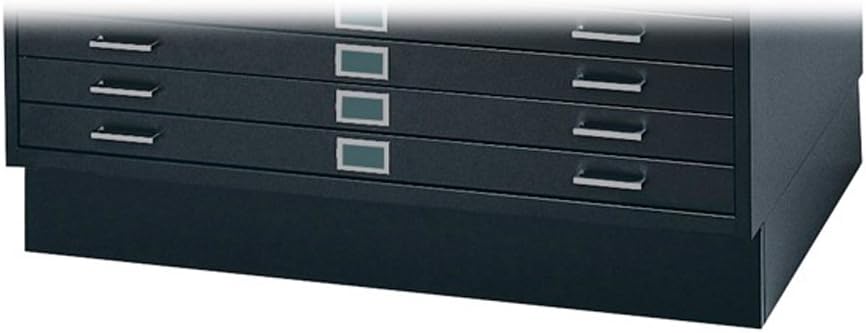
- Heavy-duty 22-gauge steel construction supports compatible flat file cabinets holding substantial artwork collections.
- Six-inch elevated design improves access to lower drawers containing large prints and architectural drawings.
- Recessed front provides additional toe clearance when standing close to the cabinet and retrieving artwork.
- Supports approved Safco 4994 storage configurations with a manufacturer-rated capacity of 2,500 pounds.
- - Black powder-coated finish provides a professional appearance suitable for art studios and design offices.
The Safco 4995BLR Is a Useful Upgrade for Flat File Storage, but You Need the Cabinet Separately
The Safco Products 4995BLR is a black steel support base designed for the Safco 4994 series of flat file cabinets. It raises a compatible cabinet approximately six inches above the floor, providing better access to drawers used for storing artwork, architectural plans, posters, and oversized paper documents. For buyers comparing the best flat file cabinet for art, this product is useful as an accessory, although it does not provide storage drawers by itself.
The base measures approximately 40.375 inches wide, 26.75 inches deep, and 6 inches high. It is constructed from 22-gauge steel and has a manufacturer-rated weight capacity of 2,500 pounds. The heavy-duty steel support for professional flat file cabinets makes it suitable for substantial paper storage installations.
One of its most practical features is the recessed front, which sits approximately 2.75 inches behind the front of the compatible cabinet. This provides additional space for a user's feet when standing close to the drawers. It is a relatively small design detail, but it can make retrieving large sheets more comfortable.
The base is manufactured in the United States and has a black finish that coordinates with compatible Safco storage furniture. Its approximate 21-pound weight makes it considerably lighter than the steel cabinets it supports. The compact six-inch base with recessed front clearance is intended to improve an existing installation rather than replace the cabinet.
However, buyers should understand exactly what they are purchasing. The 4995BLR does not include five drawers, paper depressors, or internal artwork compartments. Those features belong to the compatible Safco flat file cabinet, which is sold separately.
The Raised Design and Recessed Front Make More Difference Than You Might Expect
The main advantage of the Safco 4995BLR is its six-inch elevation. Flat file cabinets are often relatively low because they contain several wide, shallow drawers. The raised cabinet position for easier artwork retrieval can reduce the amount of bending required to reach the lowest drawers.
Consider an illustrator who stores large drawings in a Safco 4994 cabinet. If the cabinet sits directly on the floor, the lowest drawer may require the artist to crouch while removing a sheet. Raising the cabinet can make that process less awkward.
This matters because oversized artwork often requires both hands for safe handling. A 24 x 36-inch drawing can bend when lifted unevenly, particularly if it is made from lightweight paper. Providing a more accessible drawer position helps the user support the sheet during removal.
However, six inches of elevation does not make every drawer accessible from a standing position. Some bending may still be necessary, depending on the user's height and the cabinet configuration. Choosing an appropriate working height for large artwork storage should be part of the installation plan.
The recessed front is another important feature. Safco positions the front of the base approximately 2.75 inches behind the cabinet's front edge. This creates toe clearance when someone stands directly in front of the storage drawers.
For example, a graphic designer may need to remove a large print while keeping it supported with both hands. The recessed base allows the designer to stand slightly closer to the cabinet. The additional toe clearance for handling delicate paper sheets can make the movement more comfortable.
That benefit becomes more noticeable when drawers are accessed frequently. A professional studio may retrieve drawings dozens of times during a busy working day. Small improvements in the working position can make repeated tasks easier.
However, toe clearance should not be confused with drawer clearance. Users still need enough open floor space in front of the cabinet to extend its drawers completely. A workbench positioned too close to the cabinet can make removing large sheets difficult.
Consider a small art studio with a drafting table opposite the storage cabinet. The cabinet may fit against the wall, but an extended drawer could leave very little space for the artist. Allowing sufficient clearance for fully extended flat file drawers is essential.
The 4995BLR uses 22-gauge steel construction. This provides a rigid support structure designed specifically for heavy flat file furniture. The reinforced metal base for supporting large paper collections is more appropriate than placing a heavy cabinet on improvised furniture.
For example, an architecture office may store hundreds of drawings inside a five-drawer cabinet. The combined weight of the cabinet, paper, and protective folders can be substantial. A purpose-built support base provides a more suitable foundation.
Safco specifies a maximum weight capacity of 2,500 pounds for the base. This indicates the substantial load the product is designed to support under the manufacturer's specified conditions. However, the rating does not override the separate loading limits of the cabinets or the supporting floor.
One common mistake is assuming that a high weight rating makes every stacking arrangement safe. The cabinet configuration, mounting method, and floor structure still matter. Checking the complete installation weight and approved stacking limits is important before adding more storage units.
The base is designed for the Safco 4994 flat file series. These cabinets are intended for storing documents measuring up to 24 x 36 inches. The base supports the cabinet without changing its usable internal drawer dimensions.
For example, an artist working with 18 x 24-inch drawings may use a compatible cabinet to keep those sheets flat. Adding the 4995BLR improves the position of the cabinet but does not increase its paper capacity. The compatibility with Safco professional artwork storage cabinets is the main reason to consider this accessory.
However, buyers should not assume that every flat file cabinet will fit. Similar exterior dimensions do not guarantee compatible mounting points or adequate structural support. Checking the manufacturer's model numbers is more reliable than judging compatibility from photographs.
The 4995BLR also supports manufacturer-approved arrangements involving compatible stacked flat file cabinets. Safco describes support for up to five compatible file units in permitted configurations. This can be useful for studios with growing storage requirements.
Consider a design business that begins with one five-drawer cabinet. Over time, the business may need additional drawers for archived projects and completed drawings. The support for expandable flat file storage configurations allows the owner to plan for future capacity.
However, stacking several steel cabinets creates a substantial installation. The total weight can increase significantly when the drawers are filled with paper. The manufacturer's instructions should be followed, particularly regarding the approved number and arrangement of cabinets.
Another consideration is accessibility. A tall stack of flat file cabinets may provide excellent storage density, but the upper drawers can become difficult to reach. Users should balance storage capacity against comfortable everyday access.
For example, frequently used drawings might be stored in the lower or middle cabinets, while archived documents could be placed higher. This reduces the need to reach awkwardly for materials used every day. Organizing artwork according to frequency of access can improve the practicality of a stacked installation.
The base has a black finish intended to coordinate with Safco's black flat file furniture. This gives the complete installation a consistent appearance. It can work well in architectural offices, design studios, print shops, and other professional environments.
However, the finish is not completely resistant to scratches or damage. Moving heavy equipment across the surface or using inappropriate cleaning materials can affect its appearance. Maintaining the protective finish on steel storage accessories helps preserve the furniture over time.
The product's relatively low height is another practical detail. At six inches tall, the base raises the cabinet without creating a large open space beneath it. This makes it suitable for buyers who want additional elevation without using a much taller stand.
For example, an artist may want to keep a flat file cabinet beneath a large work surface. A six-inch base may improve access while maintaining a relatively low overall height. However, the combined cabinet and base dimensions must be measured before installation.
The Safco 4994 cabinet is approximately 16.5 inches high. Adding the six-inch base creates a combined height of roughly 22.5 inches before accounting for installation details. Checking the total assembled height before purchasing helps prevent clearance problems.
For example, a studio workbench may have support beams or drawers beneath its top. Even when the overall workbench height appears sufficient, those components may obstruct the cabinet. Measuring the actual available opening is important.
The base also requires assembly according to Safco's product specifications. Buyers should follow the supplied instructions and ensure the components are correctly secured. The proper assembly of heavy-duty cabinet support equipment is important for stability.
For example, a studio may receive the base separately from the cabinet. The base should be assembled and positioned before the heavy cabinet is installed above it. Attempting to assemble or reposition the support beneath a loaded cabinet is not advisable.
The product weighs approximately 21 pounds. This makes it easier to handle than the compatible steel cabinet, but installation still requires care. The cabinet itself may weigh well over 100 pounds before artwork is added.
Another important consideration is the supporting floor. A heavy flat file installation should stand on a stable, level surface. Ensuring a level and secure cabinet installation helps reduce unwanted movement.
Consider a converted industrial studio with uneven concrete flooring. A cabinet installed without checking the floor may not sit correctly. Users should address stability problems according to the manufacturer's instructions before loading the drawers.
The base does not provide independent storage space. Its closed construction is intended to support the cabinet rather than function as a shelf or drawer. Buyers who need additional storage capacity must purchase compatible flat file cabinets.
This distinction is important when comparing prices. The cost of the 4995BLR covers the support accessory, not a complete artwork storage system. Calculating the full cost of the cabinet and base together helps avoid unexpected expenses.
For example, an artist starting a new studio may see the base advertised at a much lower price than a complete steel flat file cabinet. Purchasing only the base would not provide anywhere to store artwork. The compatible cabinet must be included in the budget.
The base also does not include the paper depressors, drawer runners, or label holders associated with the Safco 4994 cabinet. Those features are part of the storage furniture itself. The 4995BLR contributes support, elevation, and clearance.
Artwork preservation is another consideration. A properly installed base can improve cabinet positioning, but it does not regulate temperature or humidity. Maintaining appropriate environmental conditions for valuable paper artwork remains essential.
For example, a basement studio may experience moisture problems during certain seasons. Raising a cabinet six inches above the floor does not make the contents waterproof. Valuable artwork should be stored in a suitably controlled environment.
Archival folders and protective interleaving materials may also be necessary. These help reduce contact between delicate artwork surfaces. The base does not replace proper handling and preservation practices.
For example, pastel drawings and charcoal artwork may require special protection against smudging. Appropriate storage materials can reduce friction between sheets. Using suitable archival materials inside the supported cabinet remains important.
Routine maintenance should include inspecting the base for damage, checking the cabinet's stability, and keeping the surrounding floor clean. Users should also confirm that the cabinet remains correctly positioned after any relocation. These checks become more important when multiple cabinets are stacked.
Overall, the Safco 4995BLR is a specialized support accessory for an existing flat file storage system. Its steel construction, six-inch elevation, recessed front, and substantial weight capacity address practical installation requirements. It is most useful when paired with the correct Safco cabinet.
Why We Ranked the Safco 4995BLR Number Six
We placed the Safco 4995BLR sixth out of seven because it offers durable support and improved access to compatible flat file cabinets, but it does not provide actual artwork storage. Its value depends entirely on the cabinet installed above it. The combination of strong support and improved drawer accessibility is its main advantage.
The six-inch elevation is particularly useful for accessing lower drawers. It reduces some of the bending required when retrieving large paper sheets. This can make a difference in studios where artwork is handled frequently.
The recessed front also contributes to its practicality. The approximately 2.75-inch setback provides additional toe clearance when standing close to the cabinet. The improved standing position for retrieving oversized artwork is a thoughtful design feature.
The 22-gauge steel construction is another positive characteristic. It provides a sturdy support structure intended for professional storage furniture. The manufacturer's 2,500-pound weight rating also indicates its heavy-duty purpose.
The base's compatibility with approved stacked configurations adds further value. Studios can plan additional flat file storage using suitable Safco equipment. The ability to support expanding artwork storage installations is useful for growing collections.
However, our first-ranked AdirOffice Heavy Duty Flat File Cabinet provides complete horizontal storage drawers. Buyers can use that cabinet directly for organizing prints, drawings, and architectural plans. The Safco 4995BLR cannot perform that function independently.
Our second-ranked Global Industrial 506825GY also provides five drawers with steel construction and smooth drawer rollers. Those features directly support the storage and retrieval of artwork. The difference between complete storage cabinets and supporting bases is a significant factor in this ranking.
The third-ranked Safco 4997WHR is another support base, but it is designed for larger compatible Safco cabinets. Its wider dimensions make it relevant to installations using the 4996 and 4986 series. The 4995BLR is specifically intended for the smaller 4994 series.
Our fourth-ranked Safco 4994TSR provides the actual five-drawer storage cabinet that this base is designed to support. It includes ball-bearing drawer rollers, paper depressors, and other features useful for storing large sheets. The 4995BLR is an accessory rather than a replacement.
The fifth-ranked Global Industrial cabinet also offers independent artwork storage. Its five horizontal drawers make it suitable for managing different projects and paper collections. The Safco base does not provide that organizational capacity.
Another limitation is the narrow compatibility range. The 4995BLR is designed for specific Safco flat file models rather than universal installation. The limited compatibility with selected flat file cabinet models reduces its usefulness for buyers who already own another brand.
The base also requires assembly. Buyers need to install it correctly before placing the cabinet above it. This adds another step to the overall storage setup.
Another consideration is the additional cost. The base must be purchased separately from the cabinet, increasing the total investment. The separate purchase requirement for a complete artwork storage system is important for budget-conscious buyers.
The six-inch height may also be insufficient for users who want a significantly elevated working position. It improves access but does not transform the cabinet into a standing-height workstation. Buyers requiring greater elevation should investigate other approved Safco support options.
The product also does not increase the cabinet's storage capacity. It cannot provide additional drawers or accommodate larger paper sizes. Its purpose is to support and elevate the existing cabinet.
Despite these limitations, the 4995BLR remains a practical accessory for the correct installation. Its black steel construction, recessed front, substantial weight capacity, and compact height provide useful benefits. The durable support structure for professional flat file furniture makes it relevant to established art studios.
Ultimately, we believe the Safco 4995BLR deserves sixth place because it provides reliable steel support and improved access for compatible art storage cabinets, while its lack of independent drawers and limited compatibility make it less versatile than complete flat file systems. Its six-inch elevation, recessed front, and heavy-duty construction address practical needs for artists and design professionals. For buyers who already own a compatible Safco 4994 cabinet, the 4995BLR remains a worthwhile upgrade that can make everyday artwork storage more convenient.

- Heavy-duty 22-gauge steel construction provides sturdy support for large professional flat file cabinets.
- Six-inch raised design makes lower artwork storage drawers easier to reach during everyday use.
- Recessed front offers additional toe clearance when retrieving oversized drawings and delicate art prints.
- Supports approved configurations of up to five compatible flat file units with a 2,500-pound weight rating.
- - Wide Tropic Sand finished base accommodates large Safco 4998 cabinets designed for oversized artwork.
The Safco 4999TSR Makes Large Flat File Cabinets Easier to Access, but It Is Not a Complete Storage Cabinet
The Safco Products 4999TSR is a heavy-duty steel support base designed for large flat file cabinets used to store artwork, architectural plans, posters, and oversized drawings. It is specifically compatible with the Safco 4998 series and raises the cabinet approximately six inches above the floor. For buyers comparing the best flat file cabinet for art, this accessory is useful for improving an existing storage installation, although it does not include drawers of its own.
The base measures approximately 53.375 inches wide, 38.75 inches deep, and 6 inches high. It uses 22-gauge steel construction and has a manufacturer-rated weight capacity of 2,500 pounds. The heavy-duty steel support for large flat file cabinets makes it suitable for substantial professional storage arrangements.
One of its most practical features is the recessed front, which sits approximately 2.75 inches behind the front of the compatible cabinet. This creates additional toe clearance when someone stands close to the storage drawers. It can make retrieving large sheets more comfortable, particularly when the lower drawers are accessed frequently.
The 4999TSR comes in a Tropic Sand finish and weighs approximately 28 pounds. It is manufactured in the United States and requires assembly before installation. The low-profile steel base for professional artwork storage is intended to improve the positioning and support of a compatible cabinet.
However, buyers need to understand what is included. The 4999TSR does not contain five drawers, paper depressors, or internal storage compartments. Those features belong to the compatible Safco 4998 cabinet, which must be purchased separately.
The Six-Inch Elevation and Recessed Front Are Useful for Handling Oversized Artwork
The primary advantage of the Safco 4999TSR is its six-inch elevation. Large flat file cabinets are often relatively low because they contain several wide, shallow drawers. The raised cabinet position for easier artwork retrieval can reduce the amount of bending required to access the lowest storage compartments.
Consider an architectural office where employees regularly retrieve large technical drawings. A cabinet positioned directly on the floor may require someone to crouch when accessing the bottom drawer. Raising the cabinet can make the process more comfortable.
This matters when handling oversized paper. A large architectural plan or original drawing may need to be supported with both hands to prevent bending. Providing a more accessible drawer position helps users remove the sheet carefully.
However, raising a cabinet by six inches does not eliminate bending entirely. Users may still need to crouch depending on their height and the drawer being accessed. Choosing a suitable cabinet height for frequent artwork handling remains important.
The recessed front is another useful design feature. Safco specifies that the front of the base sits approximately 2.75 inches behind the front of the cabinet. This creates additional space for the user's feet when standing close to the drawers.
For example, an artist removing a large watercolor painting may need to stand close enough to support the sheet evenly. The recessed base allows the artist to position their feet slightly farther beneath the cabinet front. The additional toe clearance for handling delicate artwork can make the process less awkward.
This becomes particularly useful when artwork is retrieved repeatedly. A busy design studio may have employees accessing the same storage cabinet throughout the day. Small improvements in positioning can make routine tasks easier.
However, the recessed design does not replace the need for adequate drawer clearance. The surrounding workspace must still allow the cabinet drawers to open completely. A nearby desk or workbench can obstruct access even when the base is installed correctly.
Consider a studio where a large drafting table sits opposite the flat file cabinet. The cabinet may fit comfortably against the wall, but an extended drawer could leave insufficient working space. Allowing enough clearance for fully extended storage drawers helps prevent unnecessary bending of large paper sheets.
The 4999TSR uses 22-gauge steel construction. This provides a rigid support structure designed for heavy flat file storage equipment. The durable steel construction for supporting professional art cabinets is appropriate for studios handling substantial paper collections.
For example, an architecture firm may store hundreds of technical drawings inside a large five-drawer cabinet. The combined weight of the cabinet, protective folders, and stored documents can be considerable. A purpose-built support base provides a more appropriate foundation than improvised furniture.
Safco specifies a maximum weight capacity of 2,500 pounds for the base. This indicates the substantial load the product is designed to support under approved conditions. However, the rating does not override the separate loading limits of the cabinets or supporting floor.
One common mistake is assuming that a high weight rating makes every stacked arrangement safe. Cabinet compatibility, installation hardware, floor strength, and total loading still matter. Checking the complete installation weight and approved stacking configuration is essential.
The base is specifically designed for the Safco 4998 series. These cabinets accommodate large documents measuring up to 36 x 48 inches. This makes the combination particularly relevant for architectural offices, engineering firms, printmaking studios, and artists working with oversized sheets.
For example, an artist producing large-format prints may use a Safco 4998 cabinet to store finished work horizontally. Adding the 4999TSR raises the cabinet while maintaining its existing drawer capacity. The compatibility with large-format artwork storage cabinets is the main reason to consider this accessory.
However, the base does not increase the usable drawer dimensions. It cannot make a cabinet accommodate larger artwork than its original specifications permit. Buyers must select the appropriate storage cabinet before choosing the supporting base.
The Safco 4998 cabinet has five drawers with approximately 50 inches of internal width and 38 inches of depth. These dimensions allow large drawings to be stored without folding or rolling. The support for cabinets designed around oversized artwork makes the 4999TSR useful in professional storage installations.
However, those dimensions describe the compatible cabinet rather than the base itself. The 4999TSR provides structural support and elevation, not internal paper storage. Buyers should avoid confusing the specifications of the two products.
The base also supports manufacturer-approved arrangements involving multiple compatible flat file units. Safco describes support for up to five file units in suitable combinations of five-drawer and ten-drawer cabinets. This can be useful for organizations managing growing archives.
Consider a design firm that initially stores current projects in one large flat file cabinet. Over time, completed projects may require additional drawers. The support for expandable professional flat file storage arrangements allows the business to plan for additional capacity.
However, stacking several large steel cabinets creates a substantial installation. The combined weight can increase significantly when the drawers are filled. Users should follow Safco's instructions rather than improvising their own stacking arrangement.
Accessibility is another consideration. A tall stack may provide excellent storage density, but upper drawers can become difficult to reach. Frequently used artwork should be stored where it can be accessed safely.
For example, a printmaking studio might place current projects in lower drawers and archived prints in higher compartments. This reduces the need to reach awkwardly for materials used every day. Organizing artwork according to frequency of access can make a large storage installation more practical.
The 4999TSR has a Tropic Sand finish. This neutral color coordinates with compatible Safco storage furniture and conventional office equipment. It can work well in architectural studios, design offices, and educational environments.
However, the finish should still be protected from unnecessary damage. Sharp tools, heavy impacts, and inappropriate cleaning chemicals may affect the surface. Maintaining the protective finish on steel storage accessories helps preserve the appearance of the installation.
The base's six-inch height is another important detail. It raises the cabinet without creating a large open storage area beneath it. This makes it suitable for buyers who want a relatively low-profile support arrangement.
For example, a studio may want to position a large flat file cabinet beneath a dedicated work surface. A six-inch base provides additional elevation while keeping the overall installation relatively compact. However, the combined height must be checked before ordering.
The compatible Safco 4998 cabinet is approximately 16.5 inches high. Adding the six-inch base produces a combined height of roughly 22.5 inches before accounting for installation details. Checking the total assembled cabinet height before installation helps avoid clearance problems.
For example, a workbench may have structural supports beneath its top that reduce the available opening. Measuring only the overall workbench height may give an inaccurate impression of the available space. Buyers should check the actual installation area.
The base requires assembly. Safco provides installation instructions for the support structure, and the components should be secured before placing a cabinet above them. Following the manufacturer's assembly instructions for heavy storage furniture is essential.
For example, a studio may receive the base and cabinet in separate shipments. The base should be assembled and positioned before the heavy cabinet is installed. Attempting to adjust the support beneath a fully loaded cabinet can create unnecessary safety risks.
The base weighs approximately 28 pounds. This makes it considerably lighter than the compatible cabinet, but installation still requires care. The large dimensions may make handling awkward in narrow rooms.
Another practical consideration is the supporting floor. A heavy flat file installation should stand on a stable, level surface. Ensuring proper floor support for heavy art storage equipment helps maintain stability.
Consider a converted warehouse studio with uneven concrete flooring. A large cabinet may not sit correctly if the support base is installed without checking the surface. Stability problems should be addressed before the drawers are filled.
The 4999TSR also has a substantial footprint. Its width of approximately 53.375 inches makes it considerably larger than the support bases designed for smaller Safco cabinets. This is appropriate for the compatible large-format cabinet but may be inconvenient in compact studios.
For example, an artist working in a small home studio may not have enough wall space for the cabinet and its fully extended drawers. A smaller flat file system may be more practical. Measuring available floor space before purchasing large storage equipment helps avoid expensive mistakes.
The product also requires a separate cabinet purchase. This is particularly important when comparing online prices. A support base may appear less expensive than a complete storage cabinet because it does not include the drawers.
For example, a buyer starting a new art studio might purchase the 4999TSR expecting a complete five-drawer cabinet. The delivered product would only provide the support structure. Understanding the difference between a flat file cabinet and its base prevents that misunderstanding.
The base also does not include the ball-bearing drawer rollers, paper depressors, or label holders associated with the Safco 4998 cabinet. Those components belong to the storage unit. The 4999TSR contributes elevation, support, and toe clearance.
Artwork preservation is another important consideration. A properly installed base improves cabinet positioning, but it does not regulate temperature or humidity. Maintaining suitable environmental conditions for valuable paper artwork remains essential.
For example, a basement studio may experience elevated humidity during certain seasons. Raising a cabinet six inches above the floor does not make its contents waterproof. Valuable artwork should be stored in an appropriately controlled environment.
Archival folders and protective interleaving materials may also be necessary. These help reduce contact between delicate artwork surfaces. The support base does not replace proper conservation practices.
For example, charcoal drawings and pastel artwork can be vulnerable to smudging when stacked directly together. Suitable protective materials can reduce friction and handling damage. Using appropriate archival materials inside flat file drawers remains important.
Routine maintenance should include inspecting the base for damage, checking the stability of the cabinet, and keeping the surrounding floor clean. Users should also review the installation after any relocation. These checks become particularly important when several cabinets are stacked.
Overall, the Safco 4999TSR is a specialized support accessory for large-format flat file storage. Its heavy-duty construction, six-inch elevation, recessed front, and substantial load rating address practical installation requirements. It is most useful when paired with the compatible Safco 4998 cabinet.
Why We Ranked the Safco 4999TSR Number Seven
We placed the Safco 4999TSR seventh out of seven because it offers durable support and improved access to large flat file cabinets, but it does not provide actual artwork storage. Its usefulness depends entirely on the compatible cabinet installed above it. The combination of structural support and improved drawer accessibility is its strongest advantage.
The six-inch elevation is particularly useful for accessing lower drawers. It reduces some of the bending required when retrieving large drawings and prints. This can make everyday studio work more comfortable.
The recessed front is another positive feature. Its approximately 2.75-inch setback provides additional toe clearance when standing close to the cabinet. The improved working position for handling oversized artwork can make retrieval more convenient.
The 22-gauge steel construction also contributes to its appeal. It provides a sturdy foundation intended for substantial professional storage equipment. The manufacturer's 2,500-pound weight rating reflects its heavy-duty purpose.
The support for approved stacked cabinet arrangements is another useful characteristic. Studios can plan additional storage capacity using compatible Safco equipment. The flexibility to support expanding large-format artwork archives provides long-term value.
However, our first-ranked AdirOffice Heavy Duty Flat File Cabinet provides complete horizontal storage drawers. Buyers can use that cabinet directly for organizing artwork and architectural plans. The Safco 4999TSR cannot perform that function independently.
Our second-ranked Global Industrial 506825GY also provides five drawers with reinforced steel construction and smooth drawer rollers. Those features directly support the storage and retrieval of large paper collections. The difference between complete artwork storage cabinets and support bases is a major factor in this ranking.
The third-ranked Safco 4997WHR is another closed support base, but it is designed for smaller compatible Safco cabinet series. Its narrower dimensions may make it more suitable for certain studios. The 4999TSR is specifically intended for the larger 4998 series.
Our fourth-ranked Safco 4994TSR provides an actual five-drawer cabinet for 24 x 36-inch documents. It includes ball-bearing rollers, paper depressors, and controlled drawer mechanisms. These are useful features for organizing and protecting artwork.
The fifth-ranked Global Industrial cabinet also provides independent horizontal storage. Its five drawers allow artists to separate different projects and paper collections. The 4999TSR offers no comparable storage compartments.
Our sixth-ranked Safco 4995BLR is a smaller support base designed for the Safco 4994 series. It provides similar elevation and toe clearance but occupies less floor space. The larger footprint and narrower compatibility of the 4999TSR make it less convenient for buyers who do not require the largest Safco cabinet.
Another limitation is the additional cost. Purchasing the 4999TSR does not include the compatible flat file cabinet. Buyers starting a new storage installation must budget for both products.
The base also requires assembly. Although the design is relatively straightforward, it must be installed correctly before supporting heavy furniture. The additional assembly and compatibility requirements for installation may be inconvenient for some buyers.
The six-inch elevation is useful but limited. It improves access to lower drawers without creating a standing-height storage workstation. Buyers requiring greater elevation may prefer Safco's compatible high-base options.
The product also does not increase storage capacity. It cannot provide additional drawers or expand the internal dimensions of a cabinet. Its purpose is to support and elevate existing storage equipment.
Despite these limitations, the 4999TSR remains a practical accessory for the correct application. Its steel construction, substantial load rating, recessed front, and compatibility with large Safco cabinets provide meaningful benefits. The durable support structure for professional large-format art storage makes it relevant to established studios.
Ultimately, we believe the Safco 4999TSR deserves seventh place because it provides reliable heavy-duty support for oversized artwork storage cabinets, while its lack of independent drawers, substantial footprint, and specific compatibility requirements make it less versatile than complete flat file systems. Its six-inch elevation, recessed front, 22-gauge steel construction, and support for approved stacked configurations address important installation needs. For artists, architects, and design professionals who already own a compatible Safco 4998 cabinet, the 4999TSR remains a worthwhile accessory that can make everyday artwork storage more convenient.