


- Four separate drawers provide substantial home document storage space.
- Locking design helps secure private paperwork and important files.
- Fluted drawer fronts give the cabinet a furniture-style appearance.
- Vertical four-drawer layout uses floor space more efficiently.
- Designed for home offices where storage and appearance both matter.

This actually looks like furniture you would want in a home office
The Perle Design 4 Drawer Fluted File Cabinet takes the number one position in our best filing cabinet for home comparison because it deals with one of the biggest problems home offices have with traditional filing cabinets. You need proper document storage, but you probably do not want a grey industrial metal box sitting beside a carefully furnished desk.
This cabinet uses four vertically arranged drawers with fluted front panels, giving it a more decorative furniture-style appearance. That makes it easier to use in a bedroom office, study, living area, or shared workspace where the cabinet remains visible throughout the day.
The tall four-drawer layout is useful too. Vertical storage uses floor space efficiently, which matters when a home office is squeezed into a smaller room and every section of usable floor area has already been considered.
Instead of spreading paperwork between desk drawers, boxes, shelves, and random folders, the cabinet gives documents a permanent location. That sounds simple, but it is usually the difference between actually maintaining a filing system and creating another pile of paper beside the printer.
Four drawers give you enough separation to build a filing system that stays usable
The biggest advantage of a four-drawer cabinet is not merely having more storage volume. Separate drawers let you divide documents by purpose rather than placing every piece of household paperwork into one enormous filing area.
For example, one drawer could hold household and property records, another could contain tax and financial documents, the third could store warranties and receipts, and the fourth could be reserved for work or business files. Separate categories make documents easier to retrieve months or years after they were originally filed.
This becomes particularly useful during tax season. Instead of searching through envelopes, desk drawers, and storage boxes for receipts or statements, relevant documents can already be organized in one defined section.
The same applies to household maintenance. Appliance receipts, renovation invoices, product manuals, and warranty information are often needed years after purchase, exactly when nobody remembers where they were originally placed.
A proper home filing cabinet gives those papers a fixed location. The important part is creating categories before filling every drawer rather than throwing paperwork inside and planning to organize it later.
Use labelled folders and keep the categories reasonably broad. Overcomplicated filing systems are difficult to maintain, especially when every new piece of paper requires deciding between fifteen nearly identical folder names.
A simpler system usually works better. Home, finance, tax, insurance, warranties, work, and personal records are easier to remember than dozens of narrow classifications.
The locking feature adds another useful layer for home storage. Financial records, contracts, identification documents, and other private paperwork should not necessarily remain exposed in an unlocked desk drawer.
A lock does not turn a furniture cabinet into a fireproof safe, and that distinction matters. Highly valuable original documents may still deserve purpose-built secure or fire-resistant storage depending on what they contain.
But for everyday privacy, a locking cabinet provides useful access control. It can prevent casual access to work files, financial paperwork, or personal documents in a household where the office space is shared.
Keep the key somewhere sensible but separate from the cabinet. Leaving the key permanently inserted in the lock removes most of the practical privacy benefit.
It is also worth keeping a backup key in a known secure location if one is supplied. Filing cabinets have a habit of remaining in service for years, and a tiny key can disappear surprisingly easily during a house move or office rearrangement.
Why we believe this cabinet deserves the number one position
The fluted design is more than a cosmetic detail in this particular category. Home office furniture has to coexist with desks, shelving, seating, lamps, and the rest of the room, so appearance can determine whether a cabinet actually stays in a convenient location.
An unattractive filing cabinet often gets pushed into a garage, spare room, or cupboard. Then retrieving documents becomes inconvenient, and people gradually stop using the filing system properly.
This model is easier to integrate into a furnished room. The fluted front gives it a softer residential look, which is useful when your home office is also a bedroom, guest room, or visible section of the living area.
The four-drawer vertical configuration also gives it substantial storage without requiring a very wide footprint. That is different from a lateral filing cabinet, which spreads document storage horizontally and can occupy much more wall space.
A tall cabinet does require sensible placement. Put it on a level, stable floor and follow the manufacturer's assembly and anti-tip instructions where applicable.
This becomes particularly important with multiple drawers. Pulling out a heavily loaded upper drawer changes the cabinet's center of gravity, especially if several drawers are opened at the same time.
Avoid opening several loaded drawers together. Store heavier material lower in the cabinet where possible, and secure the unit appropriately if anti-tip hardware is supplied.
That is not just about this particular product. Tall storage furniture in general needs to be treated carefully because drawer weight moves outward when the drawer is extended.
Paper becomes surprisingly heavy as it accumulates. A few folders feel insignificant, but hundreds of sheets, manuals, envelopes, and document wallets can create a substantial load inside one drawer.
Do not use a filing drawer as miscellaneous storage for dense objects just because there is empty space. Keep the cabinet focused primarily on the type of paperwork and office material it was designed to organize.
Drawer organization matters as the cabinet fills. If hanging or standard file folders are compatible with your setup, keep them arranged so labels remain visible without packing the drawer so tightly that individual folders become difficult to remove.
Leave a little movement between files. A completely packed drawer may technically store more paper, but it becomes frustrating to use and encourages documents to be placed loosely on top instead of filed properly.
Do a quick document review once or twice a year. Some papers need long-term retention, while outdated instructions, duplicate statements, expired warranties, and irrelevant receipts may no longer need valuable filing space.
For sensitive documents that no longer need to be retained, shredding is generally more appropriate than putting them directly into household recycling. This is especially relevant for paperwork containing account information or other personal details.
The cabinet top can also provide some secondary storage, but avoid turning it into another paper pile. A printer, decorative item, or small office accessory can make sense if the surface and weight limits allow it.
The point of buying a filing cabinet is to move paperwork off visible surfaces. Keeping the top reasonably clear preserves that benefit and makes the whole home office look more organized.
Assembly is another area where taking an extra ten minutes matters. Furniture-style cabinets depend on panels, drawer slides, handles, and other components being installed squarely for the drawers to operate smoothly.
Do not fully tighten everything before the structure is correctly aligned if the assembly instructions specify a staged process. A cabinet assembled slightly out of square can create drawers that rub, sit unevenly, or require unnecessary force to close.
Check the drawer slides before loading hundreds of documents. Open and close every drawer several times while the cabinet is empty and correct any assembly issue before adding significant weight.
The locking mechanism should also be tested before important paperwork goes inside. Check the lock before filling the cabinet, confirm the key operates smoothly, and make sure the intended drawers close completely.
So why does the Perle Design model take our number one position? It provides the four things we want most from a home filing cabinet in one package: meaningful document capacity, separation across four drawers, locking storage, and a design that does not make a residential office look like a commercial records room.
Some buyers may need a fire-resistant document safe instead, and others with extremely large archives may prefer wider commercial filing cabinets. Those are different use cases rather than weaknesses in what this cabinet is trying to accomplish.
For a normal household, the four-drawer format offers enough room to build a filing system that can grow over time. The combination of storage and home-friendly design is what gives this cabinet an advantage when the primary keyword specifically focuses on filing cabinets for home use.
That is why we believe the Perle Design 4 Drawer Fluted File Cabinet deserves the number one ranking out of seven. It does not merely hide paperwork. It provides a structured place for household, financial, work, and personal records while fitting much more naturally into a furnished home office.
Organize the drawers before filling them, keep heavier files lower, use the lock for paperwork that needs privacy, and follow the supplied anti-tip and assembly guidance. Set up properly, this is the kind of filing cabinet that can remain useful for years without making the room feel like an office supply warehouse.
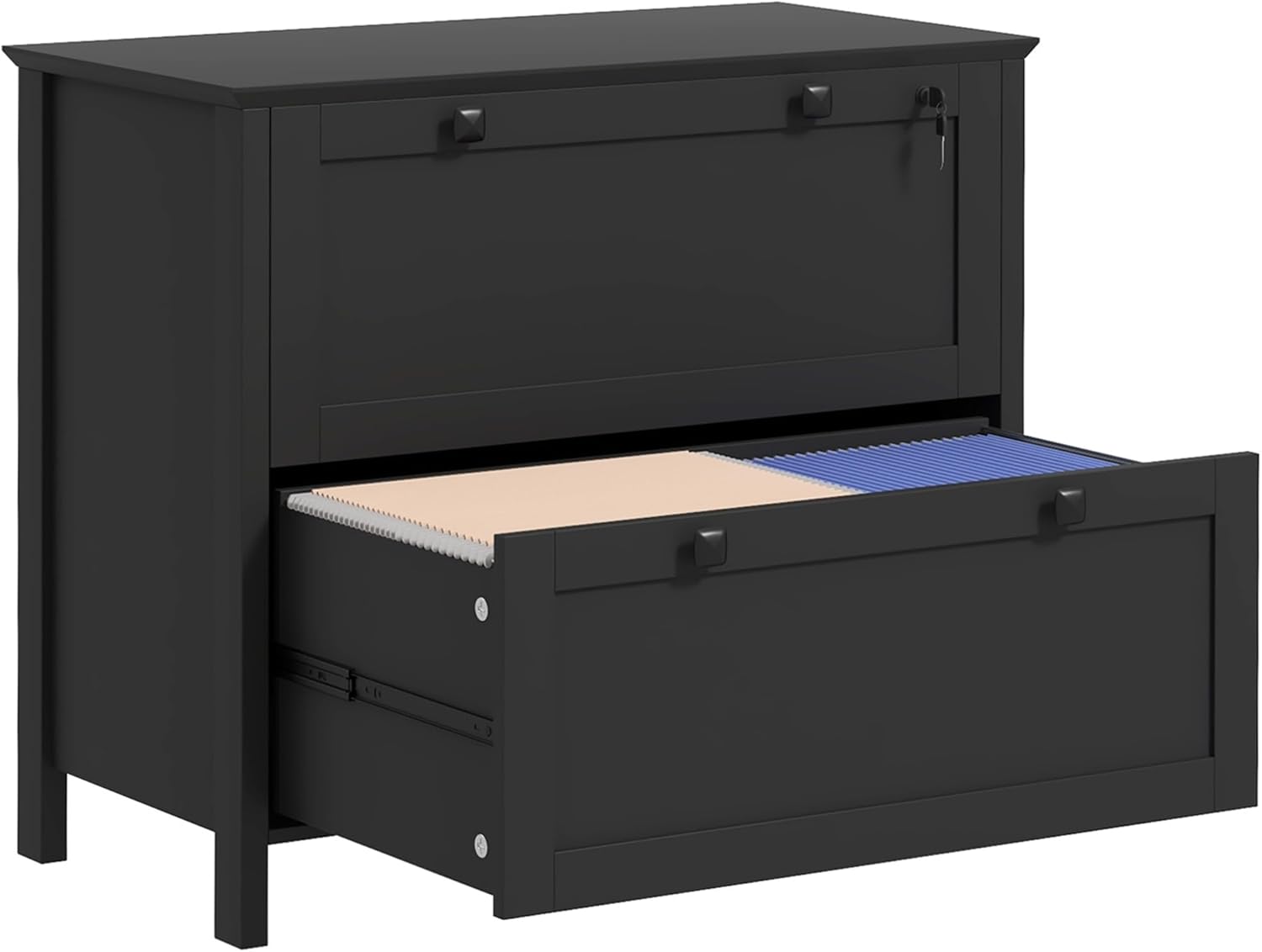
- Lateral filing storage keeps important home documents neatly organized.
- Wide cabinet top provides practical space for a printer.
- Open storage area keeps frequently used office supplies accessible.
- Furniture-style design fits naturally into modern home offices.
- Multi-purpose layout combines document filing with general office storage.
This works particularly well when the printer needs a permanent home too
The HOMCOM Lateral File Cabinet takes the number two position in our best filing cabinet for home comparison because it does more than provide a drawer for paperwork. The wider furniture-style design combines filing space with general office organization and a large top surface that can be used for a printer or other equipment.
That makes sense in a home office where space is already limited. A separate printer stand, filing cabinet, and storage shelf can consume a surprising amount of floor area once all three pieces are placed around a desk.
This HOMCOM combines those jobs into one unit. One cabinet handles several office needs, which can make a small bedroom office or study considerably easier to organize.
The lateral shape is quite different from the tall four-drawer cabinet in our number one position. Instead of building storage vertically, the HOMCOM uses a wider surface and gives you a useful worktop above the filing area.
The printer shelf solves a surprisingly common home office problem
Printers are awkward pieces of equipment to position. They are too large to disappear inside a normal desk drawer, but putting one directly on the main desk can consume the space you need for a monitor, keyboard, notebook, and everyday work.
A filing cabinet with a wide top gives the printer its own permanent location. The printer stays accessible without taking desk space, and the paper records associated with it can be stored directly underneath.
That creates a practical little document station. Print a tax form, invoice, shipping document, or household record and the relevant filing folders are immediately below rather than in another room.
This works particularly well for a home business. Someone printing invoices, shipping labels, purchase records, or customer documents can keep the printer and physical filing system together instead of spreading office equipment across several pieces of furniture.
The open storage section adds another level of organization. Frequently used supplies can remain visible and accessible rather than being buried inside the filing area with important paperwork.
Printer paper is an obvious example. Open storage works well for daily supplies such as paper, envelopes, notebooks, spare labels, or small office accessories that need to be reached regularly.
The important part is not allowing the open section to become a miscellaneous dumping area. Once loose cables, receipts, chargers, packaging, and random stationery begin accumulating, useful storage quickly becomes clutter.
Assign a specific purpose to each section before loading the cabinet. Keep active office supplies in the open area and reserve filing space for paperwork that actually needs to be retained.
A lateral filing arrangement can also make folders easier to browse. Because the cabinet is wider, files can be organized in broader groups rather than stacked vertically across several narrow drawers.
For a household, you might separate documents into finance, tax, property, insurance, warranties, vehicle records, and work files. Simple categories are easier to maintain than a complicated system where every document has its own tiny classification.
The filing system only works if everyone in the household understands it. A folder labelled Home Insurance is easier to use consistently than a collection of narrow labels that require remembering exactly where each type of document belongs.
Use folder tabs that can be read without pulling every file out. Leave enough room between folders to move them comfortably rather than packing the drawer completely full.
An overfilled filing area is frustrating. Documents become difficult to insert, folders bend, and eventually new paperwork gets placed loosely on top because filing it correctly takes too much effort.
Why the HOMCOM earns second place instead of taking our top position
The furniture-style appearance is important because this is intended for a home rather than a commercial records room. A filing cabinet in a bedroom office or living area has to sit alongside normal residential furniture without looking completely out of place.
That is one reason wood-style lateral cabinets have become useful alternatives to traditional metal filing cabinets. Home office storage should fit the room, particularly when the workspace remains visible outside working hours.
The wide cabinet top also gives you options beyond a printer. A scanner, small shredder, document tray, lamp, or decorative item can potentially use the surface depending on the manufacturer's stated weight limits.
Do not overload it, though. Printers can be surprisingly heavy, particularly laser models, so check the cabinet's top weight rating before placing a large office machine there.
The printer's dimensions matter as well. Measure the complete footprint, including any rear paper feed, output tray, and space needed to open lids or replace cartridges.
This is a common furniture mistake. Measure equipment before choosing its location, because the physical printer body may fit while the paper tray or scanner lid cannot operate properly.
Leave ventilation space around electronic equipment too. Laser printers in particular can produce heat during operation, and tightly surrounding the machine with paperwork is unnecessary.
Cable management is another consideration. Position the cabinet close enough to power and data connections that printer cables do not need to stretch across walkways or hang awkwardly behind the furniture.
If the printer uses Wi-Fi, you still need access to a power outlet. Keep enough space behind the cabinet that plugs can be reached without moving a fully loaded filing unit every time something needs resetting.
The lateral design does require more wall width than a tall vertical cabinet. Wider storage needs more horizontal room, so measure the intended location before ordering.
This is one of the reasons our number one Perle Design cabinet stays ahead. Its four-drawer vertical layout provides substantial filing capacity while occupying a narrower section of floor space.
The Perle Design model also includes locking storage, which gives it an advantage for households keeping private financial, business, or personal paperwork inside the cabinet. That extra privacy feature helped push it into first place.
The HOMCOM takes a different approach. Instead of prioritizing maximum vertical filing capacity and locking drawers, it focuses more on combining document storage with a practical printer and office organization station.
For some homes, that combination may actually be more useful. The wide top adds real everyday function, particularly when the alternative is putting the printer on the main desk.
Assembly deserves some care because furniture-style filing cabinets depend on the frame and drawer components being properly aligned. Follow the sequence in the instructions rather than tightening random panels as firmly as possible from the beginning.
Before loading the cabinet with files, open and close the drawer repeatedly. Make sure it moves correctly and that the cabinet sits level on the floor.
Paper becomes heavy when hundreds of sheets accumulate. Put the cabinet on a stable surface and follow any supplied anti-tip or wall-securing instructions.
This matters especially when a drawer is extended. An open loaded drawer shifts weight outward, changing the balance of the entire piece of furniture.
Avoid using the filing drawer to store dense miscellaneous objects simply because there is spare space. Keep heavier supplies distributed sensibly and use the filing section primarily for the paperwork it was designed to organize.
Document retention should be reviewed periodically too. A filing cabinet becomes much less useful if it slowly fills with expired warranties, duplicate statements, outdated manuals, and receipts that no longer serve any purpose.
Once or twice a year, review the folders and remove paperwork that no longer needs to be retained. Sensitive financial or identifying documents should be shredded appropriately rather than simply thrown into recycling.
Regular reviews keep filing space usable and prevent the cabinet from becoming permanent storage for every sheet of paper that enters the house.
The printer area should receive the same treatment. Keep fresh paper and frequently used supplies nearby, but remove empty packaging and outdated consumables before they start consuming the open storage area.
So why do we believe the HOMCOM Lateral File Cabinet deserves the number two ranking out of seven? It provides a strong combination of document storage, open organization, a useful printer surface, and furniture-style design that fits naturally into a residential workspace.
It misses first place mainly because the Perle Design model provides four dedicated drawers, a narrower vertical footprint, and locking storage. Those features make our top choice more focused specifically on secure household filing.
The HOMCOM is broader in purpose. It sacrifices some of that dedicated filing emphasis in exchange for a more versatile home office station that can organize paperwork while also giving a printer and everyday supplies a proper location.
For a small business owner, remote worker, student, or household trying to remove a printer from the main desk, that is a useful tradeoff. Measure the space and printer first, organize the file categories before filling the cabinet, keep heavier items sensibly positioned, and this HOMCOM can turn one section of a home office into a much cleaner document and printing area.

- Lockable filing storage helps keep important home documents private.
- Lateral drawer design provides organized storage for office paperwork.
- Spacious cabinet top creates a convenient dedicated printer station.
- Open shelving keeps frequently used office supplies within reach.
- Furniture-style construction fits naturally into residential home offices.
The lock and printer space make this much more useful than a basic file drawer
The HOMCOM Lateral Locking File Cabinet takes the number three position in our best filing cabinet for home comparison because it combines document storage, privacy, open organization, and a useful printer surface in one piece of furniture. That is a practical combination when a home office needs to store paperwork without adding a separate filing cabinet, printer table, and storage shelf.
The lateral design gives the cabinet a wider profile than a traditional vertical filing cabinet. That extra width creates a useful top surface where a home printer, scanner, document tray, or other office equipment can sit without consuming the main desk.
This can immediately improve a small workspace. The cabinet doubles as a printer station, leaving the desk available for the monitor, keyboard, notebooks, and the work you are actually doing.
The locking storage is another important feature. Financial records, contracts, household paperwork, work documents, and other private files can remain organized without being left completely accessible in a shared room.
The lateral layout works well when paperwork and office supplies need to live together
A home filing system needs more than empty storage space. It needs categories that are simple enough to maintain after the initial excitement of organizing the office has disappeared.
The filing area can be divided into broad sections such as tax records, household documents, insurance, property information, vehicle records, warranties, and work files. Broad categories make filing easier to maintain because every new document has an obvious general destination.
That is better than creating dozens of narrow categories. If filing a new receipt requires several minutes of deciding where it belongs, paperwork eventually starts accumulating on the desk instead.
The lateral arrangement can make browsing files comfortable because documents are organized across a wider section. Labels can remain visible, and folders can be separated into logical groups rather than squeezed into miscellaneous piles.
Do not pack the filing area completely full. Paper becomes difficult to browse when folders are compressed tightly together, and overfilled storage encourages users to put new documents loosely on top rather than filing them correctly.
Leave enough room for folders to move. A little unused capacity makes the entire filing system easier to use and gives new records somewhere to go during the year.
The lock is particularly useful when the home office is part of a shared room. Someone working from a bedroom, living area, or guest room may not want business or financial paperwork sitting in an unlocked drawer.
A lock provides a practical level of everyday privacy. It can help restrict casual access to contracts, statements, client documents, tax information, or other paperwork that should not simply be left open.
It is important to understand what the lock does not provide. A locking cabinet is not a fireproof safe, so irreplaceable documents or items requiring fire and water protection may still need purpose-built secure storage.
For normal office privacy, though, the lock is useful. Keep the key somewhere secure and separate from the cabinet rather than leaving it permanently inserted into the lock.
The open storage area gives frequently used supplies a different place to live. Printer paper, envelopes, notebooks, labels, folders, or other everyday items can stay accessible without occupying the filing drawer.
This separation is useful because active supplies and archived paperwork have different purposes. Paper used every day should be easy to reach, while tax records from three years ago can remain inside the filing section until they are actually needed.
The top surface is where the cabinet becomes especially practical for a home office. A dedicated printer surface frees valuable desk space, and the printer remains close to the files and supplies associated with document handling.
Imagine printing an insurance renewal, property document, or business invoice. Instead of carrying it across the room to another filing cabinet, the document can be organized directly underneath the printer after it has been reviewed.
Why this HOMCOM finishes third instead of moving into our top two
Before using the top as a printer stand, measure the printer carefully. Check not only its basic footprint but also the room required to open scanner lids, extend paper trays, access rear feeds, and replace cartridges or toner.
A printer can physically fit on a cabinet while still being awkward to operate. Measure the working dimensions before setup, not only the width and depth printed on the product specification sheet.
Weight matters too. Laser printers can be considerably heavier than small inkjet machines, so compare the printer's weight with the cabinet manufacturer's stated top load capacity.
Do not assume a wide surface can support any office machine placed on it. Furniture load ratings depend on the structure and materials, not simply the amount of available space.
Printer ventilation should remain open as well. Leave the recommended clearance around vents rather than surrounding the machine with paper stacks or pushing it tightly against a wall.
The open shelves can hold spare printer supplies, but organization matters. Keep frequently used supplies grouped together so the shelves do not gradually become storage for chargers, packaging, cables, and unrelated household objects.
Small storage boxes or document trays can help if the open areas start becoming visually messy. The goal is quick access without creating another cluttered surface.
Assembly is another part of getting good results from furniture-style filing cabinets. Drawer rails, cabinet panels, handles, and doors need to be aligned correctly for the unit to operate smoothly.
Follow the assembly sequence rather than tightening everything randomly at the beginning. If the cabinet frame is slightly out of square, the drawer may rub or fail to close evenly once it is loaded with paper.
Test every moving component before adding files. Check drawer movement while the cabinet is empty, because correcting an assembly problem is much easier before several kilograms of paperwork have been loaded inside.
Stability matters with lateral filing cabinets too. An extended drawer moves a substantial amount of weight outward from the cabinet body.
Paper is heavier than people expect when hundreds of sheets are stored together. Avoid opening multiple heavily loaded drawers or storage sections simultaneously, and use any anti-tip hardware supplied by the manufacturer according to the instructions.
Heavier material should generally remain lower where practical. This helps keep the cabinet's center of gravity closer to the floor.
Stable placement matters around loaded drawers, especially in households with children or where the filing cabinet sits in a frequently used room rather than a dedicated locked office.
The cabinet should also sit level. An uneven floor can cause drawers to move poorly or create additional stress on the furniture over time.
Document maintenance is another overlooked part of owning a filing cabinet. More storage does not mean every piece of paper needs to remain there permanently.
Review the files periodically and remove duplicate statements, expired warranties, outdated manuals, and paperwork that no longer needs physical retention. This preserves space for documents that actually matter.
Sensitive paperwork should be disposed of appropriately. Shred confidential documents before disposal rather than placing intact financial or personal records directly into recycling.
So why does this HOMCOM receive the number three ranking out of seven? It provides an excellent mixture of locking file storage, open organization, and a useful printer surface, but our first two products have advantages that fit the home filing category slightly better.
The number one Perle Design cabinet provides four dedicated drawers in a narrower vertical configuration. That gives households more clearly separated filing sections while using less horizontal wall space.
Our second-ranked HOMCOM model provides a particularly flexible lateral layout for combining document filing, printer placement, and general office organization. Those qualities give it a slight advantage for households prioritizing multi-purpose storage.
This third-ranked HOMCOM remains very competitive because of its lock. Lockable storage adds useful household privacy, particularly for financial records, business paperwork, or other files that should not remain freely accessible.
The wider lateral design is the main tradeoff. It requires more horizontal floor and wall space than a narrow vertical filing cabinet, so it may not fit as easily into a very small home office.
For a larger desk area, though, that width becomes useful because the top can support a dedicated printer setup and the cabinet can function as a broader office organization station.
That is why we believe the HOMCOM Lateral Locking File Cabinet deserves the number three position out of seven. It combines private document storage with practical open shelving and a printer-friendly surface while maintaining a furniture-style appearance suitable for a residential workspace.
Measure the available room and printer before ordering, organize the file categories before filling the cabinet, keep sensitive documents locked, and follow the supplied assembly and anti-tip guidance carefully. For a home office that needs filing, printer storage, and everyday organization in one place, this HOMCOM offers a very useful balance.

- Three separate drawers organize household and home office paperwork.
- Vertical design provides useful storage without excessive floor width.
- Dedicated filing drawer keeps important documents properly organized.
- Compact furniture-style design fits smaller residential office spaces.
- Upper storage drawers keep everyday office supplies conveniently separated.
The narrow three-drawer layout makes sense when floor space is already tight
The HOMCOM 3-Drawer Vertical Filing Cabinet takes the number four position in our best filing cabinet for home comparison because it gives smaller home offices useful document storage without requiring the width of a large lateral cabinet. Its vertical layout separates general office storage from the main filing area, making it useful beside a desk where horizontal floor space is limited.
That narrower footprint is important in bedrooms, apartment offices, study areas, and other rooms that were never originally designed to function as workplaces. A wide lateral filing cabinet can be useful, but sometimes there simply is not enough free wall space for one.
The HOMCOM builds upward instead. Vertical storage preserves valuable floor space, while the three-drawer format still gives you separate places for paperwork and smaller office items.
This can work particularly well beside a desk. Rather than spreading pens, notebooks, charging cables, envelopes, and household documents across the desktop, several categories can move into the cabinet while remaining close enough to reach from the chair.
Three drawers are enough to separate daily supplies from long-term files
The biggest organizational advantage is having more than one storage area. A filing cabinet becomes frustrating when everything from tax documents to spare printer cartridges ends up inside the same drawer.
With three drawers, the upper storage can be used for everyday office supplies while the dedicated filing area handles documents that need proper organization. Separating supplies from records reduces clutter and makes both types of storage easier to maintain.
One drawer could hold stationery, envelopes, labels, charging accessories, and other smaller equipment. Another could handle notebooks, printer supplies, or documents that are still actively being worked on.
The filing drawer can then remain dedicated to household and office records. That distinction is useful because long-term paperwork should not need to be moved around every time somebody wants a spare pen or USB cable.
A simple filing system works best at home. Categories such as tax, insurance, property, vehicle, finance, warranties, and work are usually easier to maintain than dozens of highly specific folder names.
That matters months later when you actually need something. Clear categories make documents easier to retrieve, especially when you cannot remember the exact month or reason a particular piece of paperwork was originally filed.
Tax records are a good example. Instead of keeping receipts and statements in different desk drawers throughout the year, documents can go directly into a defined tax folder as they arrive.
When tax preparation starts, the paperwork is already grouped together. The cabinet has not made the paperwork disappear, but it has prevented the documents from being scattered across the house.
Warranty records are another good use. Appliance receipts, product information, repair invoices, and warranty documents often become important several years after purchase.
Keeping them in one filing category avoids searching through kitchen drawers and old boxes when an appliance suddenly develops a problem. Permanent document locations save time later, which is really the point of having a filing cabinet at home.
Do not overfill the filing section, though. Folders should have enough room to move so labels remain visible and individual files can be removed without pulling several others out with them.
A drawer packed completely full technically stores more paper but becomes much less pleasant to use. Once filing becomes difficult, new documents tend to get placed loosely on top instead.
Why this HOMCOM finishes fourth rather than moving into our top three
The vertical format is the main reason someone might choose this cabinet over a lateral model. It can fit beside a desk, against a smaller section of wall, or in another narrow part of a home office where wider furniture would interfere with movement.
That makes measuring the room important. Check the cabinet dimensions against the intended location and remember to include enough clearance in front for the drawers to open fully.
This is a common mistake when planning office furniture. Drawer clearance matters as much as cabinet width, because a unit that technically fits between a desk and wall is not useful if the bottom drawer cannot open properly.
Think about your chair position too. A filing cabinet placed directly behind an office chair may require moving the chair every time a document is needed.
Ideally, the cabinet should remain accessible without interrupting the normal working position. Frequently used folders should also be placed where they can be reached with the least effort.
The cabinet top provides another small storage surface. Depending on the manufacturer's weight limits, it can hold lightweight office accessories, a document tray, decorative item, or supplies that need regular access.
Do not automatically place a large printer there without checking the rated load and dimensions. Printer weight can be substantial, particularly with larger laser models.
If you do use the top for equipment, make sure the cabinet remains stable and the device fits properly. Leave room for cables, ventilation, paper trays, and any lids that need to open.
Stability deserves attention with any vertical drawer cabinet. When a loaded drawer is pulled outward, the weight of its contents moves away from the cabinet body.
Paper becomes surprisingly heavy once hundreds of sheets accumulate. Several folders may feel light individually, but a fully loaded filing drawer can add substantial weight.
Follow any supplied anti-tip instructions carefully. Loaded drawers change the cabinet balance, so wall anchoring or other manufacturer-provided safety hardware should not be ignored.
Avoid opening multiple heavily loaded drawers at the same time. Store heavier items lower in the cabinet where practical, which helps keep the center of gravity closer to the floor.
The cabinet should also sit on a level surface. An uneven setup can affect how smoothly drawers operate and may make the unit feel less stable when one is extended.
Assembly quality matters because this is furniture-style storage rather than a welded commercial metal cabinet. Panels and drawer runners need to be aligned correctly for the finished unit to operate smoothly.
Follow the assembly order carefully and check the frame before loading it. Test every drawer before adding files, because correcting a misaligned runner is much easier when the cabinet is empty.
Open and close each drawer several times. Check that the gaps are even and that nothing catches or requires excessive force.
Once paperwork is loaded, correcting an assembly issue becomes more annoying. You have to remove the contents, move the cabinet, and partially disassemble something that could have been corrected during initial setup.
Document retention is another part of keeping the cabinet useful. More storage capacity should not become an excuse to keep every piece of paper indefinitely.
Review the files once or twice each year. Expired warranties, duplicate statements, outdated manuals, and documents that no longer need physical retention can consume a surprising amount of space.
Regular file reviews preserve useful capacity. Sensitive paperwork that no longer needs to be kept should be shredded appropriately rather than thrown intact into household recycling.
The upper drawers need occasional review too. Small office supplies have a tendency to multiply, and a useful drawer can slowly turn into a collection of dried pens, old cables, empty packaging, and adapters nobody recognizes.
Keep active supplies separate from items that can be discarded or stored elsewhere. The point is to make the cabinet easier to use, not simply move desktop clutter into hidden drawers.
So why does the HOMCOM 3-Drawer Vertical Filing Cabinet receive the number four ranking out of seven? It provides useful home filing capacity and a compact vertical footprint, but the three products above it offer broader storage or additional features.
The number one Perle Design cabinet provides four dedicated drawers along with locking storage and a decorative fluted design. That gives households greater filing separation and better privacy for sensitive paperwork.
The lateral HOMCOM models in our second and third positions provide wider storage surfaces that can double as dedicated printer stations. One also combines locking storage with broader office organization.
This vertical HOMCOM is more compact and straightforward. Its biggest advantage is space efficiency, but that narrower design naturally gives it less multi-purpose surface area than the lateral models.
For a very small home office, that can actually be the right tradeoff. There is little benefit in buying a wide printer cabinet if doing so leaves almost no room to move around the desk.
The three-drawer layout also makes sense for someone with a moderate paper archive rather than years of business records. It provides enough separation to organize household paperwork without turning one side of the room into a records department.
That is why we believe the HOMCOM 3-Drawer Vertical Filing Cabinet deserves the number four position. It does not have the maximum storage capacity or multi-purpose design of our top three choices, but it offers a practical balance for smaller home offices.
Measure the available space and drawer clearance before ordering, organize file categories before loading the cabinet, keep heavier contents lower, and follow any supplied anti-tip guidance. For a home workspace where floor width is limited, this HOMCOM provides a clean way to organize documents and everyday office supplies without requiring a large lateral cabinet.

- Four spacious drawers provide substantial storage for household paperwork.
- Lateral design makes stored folders easier to browse and organize.
- Farmhouse styling blends more naturally with residential office furniture.
- Wide cabinet top provides additional usable home office surface.
- Multiple drawers make separating financial and household records easier.
Four lateral drawers give you plenty of room before this cabinet starts feeling crowded
This 4-Drawer Farmhouse Lateral File Cabinet takes the number five position in our best filing cabinet for home comparison because it provides a large amount of separated document storage while still looking more like residential furniture than a commercial office cabinet. The four-drawer arrangement is particularly useful for households with several years of paperwork that need to be organized properly rather than pushed into boxes.
The lateral format is wider than a conventional vertical filing cabinet. That requires more wall space, but it also gives each drawer a broad filing area and creates a useful surface across the top of the cabinet.
Four separate drawers are the main attraction here. Separate drawers make organization much easier because household records, financial paperwork, business files, and warranties do not all need to occupy the same storage area.
A family with a substantial paper archive can create a simple system immediately. One drawer can handle taxes and financial records, another property and insurance documents, another vehicle and warranty paperwork, and the final drawer can hold work or business files.
The farmhouse design makes more sense in a home than an industrial metal cabinet
Appearance matters more with home filing furniture than people sometimes expect. A filing cabinet in a dedicated commercial office only needs to be functional, but a home office may also be a bedroom, guest room, study, or visible section of a living area.
The farmhouse styling gives this cabinet a more residential appearance. It blends more easily with home furniture, especially in rooms already using wood finishes, traditional desks, shelving, or farmhouse-inspired decor.
That can affect how useful the cabinet becomes over time. A cabinet that fits the room can stay beside the desk where documents are actually used rather than being hidden in a garage or distant storage area.
Convenient placement makes filing easier. If putting away one document requires walking to another room and opening a storage box, paperwork has a tendency to remain on the desk instead.
The four-drawer layout provides enough separation to avoid that problem. Each major document category can have a permanent location, and labelled folders can provide more detailed organization inside each drawer.
Keep the categories straightforward. A simple filing system is easier to maintain than an elaborate arrangement where every new receipt requires deciding between several similar folder labels.
For example, a general Warranties folder may be easier to maintain than separate folders for every small appliance in the house. Important products can still have their own folders when enough paperwork exists to justify it.
Tax documents are another good candidate for a dedicated drawer or section. Statements and receipts can be filed throughout the year instead of being collected from multiple rooms when tax preparation begins.
Property records may deserve another section. Mortgage paperwork, renovation invoices, contractor records, insurance documents, and important household receipts can remain together rather than being mixed with everyday office paperwork.
Permanent categories reduce document searching later, which is one of the biggest practical benefits of owning a filing cabinet in the first place.
Do not pack the drawers completely full when setting up the system. Leave enough movement between folders that labels remain visible and individual files can be removed without pulling half the drawer with them.
A completely packed drawer may maximize theoretical capacity, but it makes filing unpleasant. Once inserting a document becomes difficult, people start placing new paperwork loosely on top and the organization system gradually stops working.
Why this four-drawer cabinet lands in fifth place
The lateral format gives the cabinet a useful top surface. Depending on the manufacturer's stated weight limits, that area can potentially hold document trays, office supplies, decorative items, or compatible equipment.
If you intend to put a printer there, check both dimensions and weight first. A printer's listed width and depth do not always account for the extra clearance needed for paper trays, scanner lids, rear feeds, and cables.
Measure the complete working footprint first, especially with a larger multifunction or laser printer. A device that technically fits on the top can still be inconvenient if the scanner lid cannot open fully.
Do not exceed the cabinet's specified top load. Large laser printers can weigh considerably more than compact inkjet models, and furniture capacity should not be estimated from appearance alone.
The wide design also means this cabinet needs more horizontal floor space than our fourth-ranked vertical HOMCOM. Measure the wall where it will sit before ordering and include enough room for nearby doors, chairs, and other furniture.
Drawer clearance matters as well. You need enough open space in front of the cabinet to extend each lateral drawer without hitting a desk chair or another piece of furniture.
This is particularly important in smaller home offices. A wide cabinet needs proper clearance, otherwise the storage capacity is less useful because opening the drawers becomes awkward.
Paper weight deserves attention once the cabinet begins filling up. Hundreds or thousands of sheets become surprisingly heavy even though each individual folder feels light.
Distribute files sensibly rather than loading one drawer with every dense record in the house. Keeping heavier files in lower drawers where possible can also help maintain a lower center of gravity.
Follow any supplied anti-tip instructions and use manufacturer-provided wall anchoring hardware where required. An extended loaded drawer shifts weight outward from the cabinet body.
Never open several loaded drawers together. This is sensible practice with tall or lateral drawer furniture because multiple extended drawers can significantly alter the cabinet's balance.
Assembly needs to be done carefully too. Furniture-style filing cabinets depend on correctly aligned panels and drawer runners for smooth operation.
Follow the assembly sequence and avoid rushing through drawer installation. Before adding paperwork, open and close each drawer several times to check that it moves smoothly and sits correctly when closed.
If a drawer catches while the cabinet is empty, fix the alignment before loading it. Correcting the same problem after the drawer contains several kilograms of paperwork is much more frustrating.
The farmhouse finish should also be treated like furniture rather than industrial equipment. Use appropriate cleaning methods for the surface and avoid allowing spilled drinks or excessive moisture to remain on the cabinet.
A filing cabinet often sits close to coffee cups and office drinks, so this is more relevant than it sounds. Wipe spills promptly rather than letting moisture sit around panel joints or drawer fronts.
The four drawers provide substantial capacity, but capacity needs maintenance. Once or twice a year, review the stored paperwork and remove records that no longer need to occupy physical filing space.
Expired warranties, duplicate statements, outdated manuals, and unnecessary receipts can gradually consume entire sections. Shred sensitive records appropriately when they no longer need to be retained.
Regular file reviews preserve usable storage and prevent a large filing cabinet from becoming an archive of documents nobody will ever need again.
The main reason this model ranks fifth is that the products above it offer stronger combinations of home-office practicality, security, or space efficiency. Our number one Perle Design cabinet combines four dedicated drawers with locking storage and a narrower vertical arrangement.
The HOMCOM lateral models higher in the list provide useful printer-oriented storage and, in one case, lockable document organization. Those additional functions give them more flexibility around a working home office.
Our fourth-ranked vertical HOMCOM also has an advantage for particularly small rooms because it requires less horizontal wall space. This farmhouse model is wider and therefore needs a more generous location.
It also appears more focused on high-capacity furniture-style storage than advanced security. Private documents may need separate secure storage if locking access is important to your household.
That does not reduce the usefulness of having four full drawers. For a household with a large paper archive, capacity and separation can be more important than having shelves or several different types of storage compartments.
The farmhouse appearance is also a genuine advantage for certain rooms. It gives users an alternative to the institutional look associated with traditional office filing furniture.
That is why we believe this 4-Drawer Farmhouse Lateral File Cabinet deserves the number five ranking out of seven. It requires more wall space and does not offer the same mix of security or multi-purpose organization as our highest-ranked choices, but its four-drawer capacity is excellent for households with substantial paperwork.
Measure the room before ordering, build simple filing categories before loading the drawers, keep heavier files sensibly distributed, and follow all supplied anti-tip and assembly instructions. For a larger home office where document capacity and furniture-style appearance matter most, this four-drawer lateral cabinet remains a strong and practical option.

- Three drawers separate office supplies from hanging document files.
- Locking system helps protect private household and business paperwork.
- Five casters provide mobility with added anti-tip wheel support.
- Bottom drawer accommodates A4, letter, and legal hanging files.
- Durable steel construction supports substantial everyday document storage.
This one makes more sense under a desk than against a feature wall
The SONGMICS OFC030B01 takes the number six position in our best filing cabinet for home comparison because it approaches home filing from a practical office angle. It is a compact steel mobile pedestal measuring approximately 30 x 46 x 59.2 cm, with three drawers, locking storage, and five casters underneath.
That footprint is useful in a smaller home office. Instead of giving up a large section of wall to a lateral cabinet, you can position this model underneath or beside a desk and keep paperwork within reach while working.
The internal arrangement is straightforward. There are two smaller upper drawers for general office storage and a larger lower drawer designed to accommodate hanging files in A4, letter, and legal sizes.
The three-drawer separation works well because pens, notebooks, envelopes, chargers, and other small items do not have to share the same space as household records. The lower section can remain focused on proper filing while the upper drawers handle things you use more regularly.
The wheels are genuinely useful when your home office keeps changing
SONGMICS equips this cabinet with five casters rather than treating mobility as an afterthought. Four support the cabinet itself, while the additional wheel helps provide stability around the lower drawer when it is extended.
Two of the casters include brakes, so the cabinet can be rolled into position and then kept there during normal use. This is useful if you sometimes want the files beside your chair but prefer the cabinet pushed underneath the desk when you are finished.
Mobility gives a small office more flexibility. Someone working in a multipurpose bedroom, apartment study, or shared room may not want a filing cabinet permanently occupying the same visible position.
You could keep it under the desk most of the week, then roll it closer to a printer when sorting financial records or preparing paperwork. That is a small feature, but it solves a real problem when there is not enough space for a dedicated document station.
The steel construction also separates this SONGMICS from the furniture-style cabinets higher in our ranking. The two smaller drawers are rated for up to 15 kg each, while the larger bottom drawer is rated for up to 20 kg.
That matters because paper becomes heavy quickly. A single folder feels insignificant, but hundreds of statements, contracts, manuals, and records create a substantial load once they accumulate in one drawer.
The lower filing drawer can handle hanging folders in several common document formats. A4, letter, and legal file compatibility makes the cabinet more flexible when household paperwork comes from different organizations using different paper sizes.
Use labelled hanging folders rather than dropping loose papers into the drawer. Categories such as tax, insurance, property, vehicle, warranties, finance, and work are broad enough to remain understandable without making the system unnecessarily complicated.
One common mistake is creating too many categories on the first day. If filing a new statement requires deciding between five similar folders, the system becomes annoying and paperwork gradually starts accumulating on the desk again.
Keep it simple. A filing cabinet works because documents have an obvious permanent location, not because it contains the largest possible number of labels.
The upper drawers can handle stationery and smaller accessories. SONGMICS also provides a stationery organizer, which helps stop pens, clips, USB drives, and other small objects from becoming one loose pile.
Separating supplies from archived documents is useful because these items are accessed differently. You may open the stationery drawer ten times in one day while a property insurance document could remain untouched for months.
The locking system is another practical feature for home use. Private paperwork can remain less accessible in a shared room, particularly if the cabinet contains financial records, contracts, business files, or other personal documents.
A lock should still be understood correctly. This is document privacy and access control, not the same thing as storing irreplaceable originals inside a certified fireproof or waterproof safe.
For everyday records, though, having lockable storage is useful. Keep the keys somewhere secure and separate rather than leaving one permanently inserted into the cabinet.
Why the SONGMICS finishes sixth despite being very practical
The main reason this cabinet ranks below the furniture-style models is not a lack of basic functionality. It actually handles traditional filing duties well, but its compact metal pedestal design is more office-oriented than the cabinets we ranked higher.
Our number one Perle Design cabinet provides four dedicated drawers with a decorative fluted appearance that fits naturally into a furnished residential room. The lateral HOMCOM models above this SONGMICS also provide larger surfaces that can double as printer stations.
The SONGMICS does not give you that same broad furniture top. Its priority is compact mobile storage, so somebody looking for a cabinet that also anchors the visual design of a home office may prefer one of the larger choices.
On the other hand, this model can fit where those cabinets cannot. At only about 30 cm wide, it is substantially easier to place underneath a desk or into a narrow opening.
That can make sixth place misleading for a very small workspace. If your only available location is a narrow space beneath the desk, a large farmhouse lateral cabinet could rank highly on paper and still be completely unsuitable for the room.
The five-wheel arrangement also helps when the cabinet is loaded. Use the brakes once it reaches the desired position rather than allowing it to move every time a drawer is opened.
Keep the floor reasonably level and clear around the casters. Small objects can interfere with rolling cabinets, particularly cables, rugs with raised edges, and miscellaneous items stored underneath the desk.
The extra front caster is there to improve stability around the extended lower drawer, but sensible use still matters. Do not use an open drawer as a seat, step, or support surface, and do not allow children to climb on the cabinet.
SONGMICS specifically warns against children climbing or playing on the product. That is sensible guidance for any rolling storage furniture with extendable drawers.
The full-extension drawer slides are useful once the cabinet is loaded. Being able to pull a drawer farther outward makes folders at the rear easier to reach instead of forcing you to search blindly through the front half.
This matters with the lower hanging-file section. Full drawer access makes filing faster, especially after the number of folders grows and you need to reach categories stored toward the back.
Do not exceed the specified drawer loads simply because the steel cabinet feels solid. The two upper drawers are rated to 15 kg each and the bottom to 20 kg, so distribute contents sensibly.
Paper records should also be reviewed periodically. Filing capacity disappears quickly when expired warranties, duplicate statements, old manuals, and documents that no longer require physical retention remain indefinitely.
Once or twice a year, go through the folders and remove what no longer needs to be kept. Sensitive records should be destroyed appropriately rather than thrown intact into ordinary recycling.
Regular reviews keep the cabinet useful instead of turning the lower drawer into permanent storage for every document that has entered the house during the last decade.
One advantage is that the main steel body arrives largely prepared, with the caster installation being an important part of setup. That is less involved than assembling some larger particleboard filing cabinets panel by panel.
After installing the wheels, test the brakes and drawer movement before loading everything. Make sure the lower support caster contacts the floor correctly and that the cabinet remains stable when the filing drawer is extended.
The smooth, handle-free drawer fronts also keep the cabinet relatively clean visually. The drawers are opened from their sides, reducing protruding hardware that could catch clothing when the cabinet sits tightly beside a chair.
So why do we believe the SONGMICS OFC030B01 deserves the number six ranking out of seven? It provides excellent practical features including steel construction, three drawers, lockable storage, multiple file-size compatibility, full-extension slides, and five-caster mobility, but it offers less overall filing capacity and less furniture-style versatility than several models above it.
It also lacks the wide printer surface found on our higher-ranked lateral cabinets. For a home office where the filing cabinet needs to double as a substantial printer stand or decorative storage unit, those alternatives make more sense.
But for a compact workstation, the situation changes. This SONGMICS is particularly good under a desk, and the combination of narrow dimensions, rolling mobility, lockable storage, and proper hanging-file support makes it much more capable than a simple drawer pedestal.
Use the brakes once positioned, keep heavier files in the lower drawer, stay within the stated load limits, and organize the hanging folders before the cabinet becomes full. For someone who values compact secure storage more than furniture styling, the SONGMICS remains a practical home filing solution despite its number six position.

- Two spacious drawers organize letter-size hanging files neatly.
- Compact vertical footprint works well in smaller home offices.
- Lockable casters provide mobility while keeping placement more stable.
- Furniture-style finish blends naturally with residential office decor.
- Cabinet top provides useful additional space beside your desk.
This is a compact filing cabinet for homes that simply do not have much spare room
The VASAGLE ULCD027T46V2 takes the number seven position in our best filing cabinet for home comparison because it focuses on compact document storage rather than maximum filing capacity. With two drawers and a relatively small footprint, it makes the most sense beside a desk or in a home office where a four-drawer cabinet would simply occupy too much space.
The two-drawer arrangement is straightforward. It gives household paperwork a dedicated location without turning one side of the room into a large records area.
That can be enough for someone who has already moved most statements and bills to digital storage. Compact filing still solves paper clutter, particularly for the documents that remain important enough to keep physically.
Letter-size hanging file support makes the drawers useful for common household and business paperwork. Instead of stacking documents flat and searching through them later, hanging folders keep categories visible and easier to browse.
Two drawers can work well if you keep the filing system deliberately simple
The smaller capacity means organization matters more than it does with a huge cabinet. You cannot create endless categories and keep every document indefinitely without eventually running out of room.
That is not necessarily a bad thing. A compact cabinet encourages you to decide which records actually deserve physical storage and which can be digitized, discarded, or stored somewhere more appropriate.
One drawer could be reserved for household and financial records. The other could contain work documents, warranties, insurance paperwork, or whatever category generates the most physical paper in your home.
Broad categories work better in small cabinets. Tax, insurance, home, vehicle, warranties, and work are easier to maintain than dozens of narrow folders with only two sheets inside each one.
Hanging folders are useful because labels remain visible while browsing. Position the categories you use most frequently toward the front rather than organizing everything alphabetically just because that seems more formal.
If you access vehicle and household records every month but old tax documents only occasionally, accessibility matters more than perfect alphabetical order. A home filing system should reflect how the household actually uses documents.
Do not pack the drawers completely full. Files need room to move comfortably, otherwise pulling out one folder becomes a struggle and new documents start accumulating loosely on top.
Leave some spare capacity for future paperwork. A filing cabinet that is already completely full on the day it is organized has no room to absorb the documents arriving next month.
The compact design can work particularly well beside a home office desk. Instead of walking across the room every time a document needs filing, the cabinet can remain within reach of the working position.
This can make filing more consistent. A document is more likely to go into the correct folder immediately when the folder is right beside the desk rather than inside a storage box somewhere else in the house.
The mobile design is another practical feature. Casters make it possible to reposition the cabinet when cleaning, reorganizing the office, or changing how the desk is arranged.
Lockable wheels add useful flexibility, because mobility is convenient when you want it but annoying if the cabinet moves every time a drawer is pulled open.
Once the cabinet is in the intended working position, engage the locking casters. This keeps the unit more stable during normal filing and prevents unnecessary movement on smooth flooring.
Be careful around rugs and loose cables. Small casters can catch on raised rug edges, charging cables, and other objects commonly found underneath a home office desk.
Why the VASAGLE finishes seventh despite being useful in small spaces
The cabinet top gives you another small usable surface. Depending on the manufacturer's stated load limits, it can hold lightweight office supplies, a document tray, decorative items, or equipment that fits within the supported weight.
Do not automatically assume it should become a printer stand. Printers vary enormously in weight, and a large multifunction laser printer is very different from a compact inkjet machine.
Check the top load before adding equipment. Also measure the printer's complete working dimensions, including paper trays, rear feeds, scanner lids, cables, and ventilation clearance.
If the cabinet sits underneath a desk, the top may be more useful as temporary working storage. Documents waiting to be filed can sit there briefly without taking over the main desktop.
The important word is briefly. If every new piece of paper stays on top instead of entering a folder, the filing cabinet has simply moved the paper pile from one surface to another.
Set a simple rule for paperwork. Anything that needs permanent retention goes into the appropriate folder, anything requiring action stays in a separate active tray, and anything unnecessary gets recycled or shredded as appropriate.
This approach prevents the drawers from filling with documents that have no long-term value. Good filing includes regular document removal, not only adding more paper year after year.
Once or twice annually, review the folders. Expired warranties, outdated manuals, duplicate statements, and paperwork that no longer needs physical retention can consume a surprising percentage of a small cabinet.
Confidential records should be destroyed appropriately when no longer needed. Financial statements or paperwork containing personal information should not simply be placed intact into household recycling.
Assembly and alignment matter too. Furniture-style filing cabinets rely on the cabinet frame and drawer runners being installed squarely so everything opens and closes properly.
Test both drawers before filling them. Fix alignment problems while the cabinet is empty, because correcting a runner becomes considerably more annoying once the drawers contain heavy paper files.
Open and close each drawer several times and check that the cabinet remains stable. Make sure the casters are installed correctly and that any locking wheels actually hold the unit in position.
Paper weight can build quickly even in a two-drawer cabinet. Hundreds of sheets may not look substantial, but the combined weight becomes significant once folders are packed together.
Avoid placing dense miscellaneous objects into the drawers simply because spare space exists. Use the cabinet primarily for files and office materials appropriate to its stated capacity.
The two-drawer design is also the biggest reason this VASAGLE ranks below the other six products. Storage capacity is naturally more limited than the four-drawer and larger lateral cabinets higher in our comparison.
Our number one Perle Design cabinet provides four separate filing drawers and locking storage, giving a household much more room to divide documents into clearly defined sections.
The higher-ranked HOMCOM models also offer combinations of filing space, open shelving, locking storage, and wide printer-friendly surfaces. Those designs can function as broader home office organization stations rather than simply document cabinets.
The SONGMICS model directly above this VASAGLE provides three drawers, steel construction, lockable storage, and mobile under-desk positioning. That gives it greater organizational flexibility for someone who wants both stationery storage and hanging files.
The VASAGLE is simpler. Its strength is compact home filing, which also explains why it cannot compete with larger cabinets when overall capacity and versatility determine the ranking.
That simplicity can still be exactly right for certain homes. Someone living in an apartment or using a small bedroom desk may have nowhere sensible to place a large lateral filing cabinet.
If most paperwork is digital and only essential originals need physical storage, two drawers may actually be enough. Buying four large drawers and leaving three mostly empty would only consume additional floor space.
The furniture-style appearance helps here too. A compact cabinet that fits visually beside a residential desk is easier to integrate into a bedroom, study, or multipurpose living area than a large commercial metal file cabinet.
That is why we believe the VASAGLE ULCD027T46V2 deserves the number seven ranking out of seven. It loses points because the two-drawer configuration provides less filing capacity and fewer organizational options than the larger models above it, but it remains a sensible choice for smaller home offices.
Use labelled hanging folders, leave some room for future documents, lock the casters once the cabinet is positioned, and review stored paperwork periodically rather than allowing the drawers to become permanently full. For a household that wants straightforward letter-size filing without sacrificing much floor space, this VASAGLE provides a practical and tidy solution.