


- Built-in speakers provide audio without separate desktop speakers.
- 27-inch IPS panel delivers detailed 2560 x 1440 resolution.
- 100Hz refresh rate provides smoother everyday motion and gaming.
- Responsive 10-point touchscreen supports direct on-screen interaction.
- USB-C, HDMI, and DisplayPort provide versatile device connectivity.

The speakers are useful, but the 2K touchscreen is what makes this monitor unusual
This 27-inch touchscreen monitor takes the number one position in our best computer monitor with speakers comparison because it combines several features that normally require choosing between different types of displays. You get a 2560 x 1440 QHD IPS panel, 100Hz refresh rate, 10-point touch input, built-in speakers, USB-C connectivity, HDMI, DisplayPort, and VESA mounting.
The built-in speakers are the feature that puts it directly into this category. They let a desktop PC, laptop, or other compatible source produce everyday audio without requiring separate speakers to occupy more desk space.
That matters on a smaller workstation. A monitor, laptop, keyboard, mouse, docking station, and two external speakers can fill a desk quickly, while integrated speakers keep the setup simpler for video calls, online videos, background music, and general computer audio.
The screen itself is 27 inches with a native 2560 x 1440 resolution. At this size, QHD gives you considerably more working space than 1920 x 1080 while avoiding the very small interface elements that can appear when higher resolutions are used without scaling.
The 1440p IPS panel and 100Hz refresh rate work well beyond gaming
The 2560 x 1440 panel gives you roughly 3.7 million pixels. That additional detail becomes useful when working with text, spreadsheets, image-editing interfaces, timelines, browser windows, and other applications where more information needs to remain visible at once.
A 27-inch monitor is also large enough for split-screen work. You can keep a document on one side and reference material on the other without each window becoming excessively narrow.
QHD resolution suits 27 inches particularly well for this kind of everyday productivity. Text remains reasonably substantial while the desktop area feels noticeably larger than a comparable Full HD display.
The IPS panel is another useful part of the specification. IPS technology is generally chosen for consistent color and wide viewing angles, which matters when the monitor is being viewed slightly off-center or shared with another person.
That becomes particularly relevant because this is a touchscreen. Someone standing beside the desk may interact with the screen during a presentation, demonstration, or collaborative task rather than always sitting directly in front of it.
The 10-point touch capability allows several simultaneous contact points to be recognized. Multi-touch makes direct interaction more natural for compatible software, especially when zooming, moving, selecting, or manipulating interface elements.
Think about a small design studio where someone wants to enlarge an image quickly during a discussion. Reaching toward the display and using touch can be faster than passing a mouse around the desk.
The same applies to presentations. A presenter can tap through compatible controls directly on the display rather than constantly returning to a keyboard.
Touch input can also be useful for point-of-sale style applications, interactive dashboards, educational software, music controls, or any program built around larger on-screen buttons. It is less important for conventional typing and spreadsheet work, but the feature is there when the software benefits from it.
Touch should complement the mouse and keyboard, not necessarily replace them. For detailed desktop work, a conventional pointer remains more precise and usually more comfortable over long sessions.
The screen surface is glossy, which can help colors and images appear vivid. The tradeoff is reflections.
Do not position a glossy touchscreen directly opposite a bright window if you can avoid it. Reflections become much more noticeable on darker content, particularly when sunlight or strong room lighting hits the panel.
Adjust the monitor angle or control the light source first. Room placement matters with glossy displays, and that simple adjustment can improve visibility more than repeatedly changing brightness settings.
The 100Hz refresh rate is another feature that sounds gaming-focused but has practical benefits during ordinary computer use. A 100Hz display refreshes the image up to 100 times per second when the connected hardware and settings support it.
Scrolling through long web pages can look smoother than it does at 60Hz. Window movement, cursor motion, animations, and video editing timelines can also feel more immediate.
For casual gaming, 100Hz is a useful step above basic office monitors. The higher refresh rate improves motion clarity without turning the monitor into an expensive specialized esports display.
Make sure the computer is actually outputting 100Hz, though. Installing a 100Hz monitor does not guarantee the operating system automatically selects its highest refresh rate.
Check the display settings after installation. If the system is still configured at 60Hz, change the refresh rate to 100Hz where the connected device and interface support it.
The graphics hardware also needs to generate enough frames to take advantage of the higher refresh rate in games. A demanding game running at 40 frames per second will not suddenly become a 100-frame experience because the monitor supports 100Hz.
Refresh rate and frame rate are different, although they work together to determine how smooth interactive content can appear.
Why this monitor earns our number one position
The built-in speakers are convenient because they remove another piece of hardware from the desk. This is particularly useful for workstations where audio is needed regularly but high-volume music playback is not the primary purpose.
Video meetings are a good example. The monitor can handle normal playback audio without requiring a pair of desktop speakers sitting on either side of the screen.
The same applies to tutorials, news, casual YouTube viewing, system sounds, and background content. Built-in audio covers everyday computer use while keeping the workstation visually simpler.
There is an important expectation to set here. Monitor speakers are generally about convenience and space efficiency rather than producing the bass extension or stereo separation of larger dedicated speakers.
If you listen to music critically, edit audio, or want cinematic sound for games and movies, external speakers or headphones can still be worthwhile. The built-in speakers simply mean you do not need them for basic use.
That flexibility is better than buying a monitor without speakers and discovering later that every small system sound requires another audio device. You can start with the integrated audio and upgrade only if your needs justify it.
The speakers remove an immediate accessory requirement, which is exactly why they matter when comparing computer monitors with integrated sound.
Connectivity is another strong part of this monitor. The listing provides HDMI, DisplayPort, and USB-C connections, giving desktop and laptop users several ways to attach compatible hardware.
DisplayPort is useful for conventional desktop PCs, while HDMI provides broad compatibility with computers and other video sources. USB-C can simplify laptop setups when the connected computer supports the required display mode.
The USB-C interface is listed as supporting video input and data transfer. That can reduce cable clutter compared with a workstation where video and peripheral data need completely separate connections.
USB-C makes laptop setups much cleaner, although you should check the capabilities of the computer's USB-C port before assuming video output is supported.
Not every USB-C port carries a display signal. Some computers use USB-C only for charging or data, so the laptop specification needs to confirm the relevant video functionality.
The monitor is also VESA mountable using a 75 x 75mm pattern. That matters if the original stand does not provide enough ergonomic adjustment or if you want to recover more desk space.
A compatible monitor arm can raise the display, pull it forward, or move it farther back depending on the arm's design. This can be particularly useful with a touchscreen because touch interaction changes the ideal screen position.
Touchscreens benefit from flexible positioning. A monitor that feels perfect for viewing may sit slightly too far away when you need to reach the screen repeatedly.
With an adjustable arm, the display can be pulled closer for an interactive task and pushed back when returning to keyboard-and-mouse work. Just make sure the chosen arm is compatible with the monitor's weight and 75 x 75mm mounting pattern.
The included stand provides tilt adjustment, which is useful for changing the viewing angle. For touch use, a slightly different tilt may feel more natural than the nearly vertical position used for ordinary office work.
Do not press aggressively against the panel simply because it supports touch. Normal capacitive interaction requires light contact, and excessive pressure does not improve touch recognition.
The 10-point system is designed around responsive contact. Light touch is all that is required for compatible gestures and controls.
The glossy touchscreen will also collect fingerprints more readily than a non-touch monitor. Keep a suitable microfiber cloth nearby and follow the manufacturer's cleaning guidance rather than spraying cleaner directly onto the display.
Apply cleaning liquid to the cloth if the approved instructions call for it, not directly into the panel edges. Touchscreens naturally need more frequent cleaning because fingers are constantly contacting the surface.
For office productivity, the combination of QHD resolution and 100Hz is particularly appealing. The extra pixels create more working room while the higher refresh rate makes scrolling and interface movement feel smoother.
It balances productivity and entertainment well, rather than being narrowly designed only for office documents or only for gaming.
A spreadsheet user gets more visible columns. A photo editor gets a larger detailed canvas. A casual gamer gets smoother motion than a standard 60Hz office screen.
The IPS panel also makes the monitor more useful for collaborative viewing. If someone stands beside you during a presentation, the picture should remain more consistent than it would on displays with narrower effective viewing angles.
Touch input adds another layer to that collaboration. Instead of explaining where something is located with the mouse, a person can interact directly with compatible controls on the screen.
That combination is unusual at this price level, because many monitors with built-in speakers stop at basic display and audio functionality.
For gaming, QHD is more demanding on the graphics card than 1080p. Rendering 2560 x 1440 means the GPU has substantially more pixels to produce for every frame.
If the computer struggles to maintain the desired frame rate, game settings may need to be reduced. This is normal and not a monitor fault.
The 100Hz refresh rate provides a useful ceiling for casual and moderate gaming. Competitive players targeting 180Hz, 240Hz, or higher will want a more specialized gaming monitor.
This monitor is better as an all-rounder, which is actually an advantage for the ranking we are doing here.
The screen can handle work in the morning, touch-based interaction during a presentation, video content later, and casual gaming without requiring separate displays for each purpose.
The built-in speakers support that flexibility. You can move between tasks without having to switch audio equipment or dedicate additional desk space to speakers.
The 16:9 aspect ratio is also straightforward. Most games, video platforms, office applications, and operating systems are designed comfortably around this format.
For movie watching, some cinematic content will still show black bars because the film itself uses a wider aspect ratio. That is expected behavior rather than a problem with the panel.
The 16:9 format keeps compatibility simple, especially for a monitor intended to serve several different roles.
The 27-inch size is another reason this configuration works. It is large enough to benefit clearly from QHD resolution without becoming so large that normal desk viewing requires constant head movement.
Viewing distance still matters. Do not place the monitor extremely close simply because the touchscreen encourages reaching toward it.
Find a comfortable normal viewing distance first, then decide whether the stand or a VESA arm provides enough reach for occasional touch interaction. The display should still work well when you are not touching it.
Touch convenience should not compromise viewing comfort, particularly if most of the workday still involves a keyboard and mouse.
One thing I would verify during setup is touch functionality over the chosen connection arrangement. Video and touch data are separate functions in many monitor configurations, so follow the supplied instructions for connecting both correctly.
If the image appears but touch does not respond, do not immediately assume the panel is defective. Check whether the required data connection is present and whether the operating system recognizes the touch interface.
Windows is generally the most natural environment for multi-touch computer monitors because the operating system includes broad touch support. Application behavior still varies depending on whether the software itself was designed for touch.
Touch support depends on the complete system, including the connection, operating system, and application being used.
The monitor comes with an HDMI cable, power cable, 12V 5A DC adapter, user manual, and VESA mounting screws according to the product listing. That gives you the basic equipment needed for a conventional HDMI setup straight away.
If you plan to use USB-C or DisplayPort, check whether the appropriate cable is included with the exact package or whether you need to provide one separately. Use cables rated for the resolution and refresh rate you intend to run.
The VESA mounting screws are M4 fine-thread hardware for the 75 x 75mm pattern. Use the correct screws rather than substituting longer hardware that could extend too far into the monitor chassis.
Correct VESA hardware protects the display, particularly when the entire monitor will be suspended from an arm rather than supported by its original stand.
The glossy surface is probably the most obvious practical compromise. It can produce vivid-looking content, but fingerprints and reflections are easier to notice than on a matte office panel.
That tradeoff is more significant here because people will actually be touching the screen. Expect to clean it more frequently than a conventional monitor.
The integrated speakers are another area where expectations should remain sensible. They solve everyday audio needs, but they are not the reason to replace a dedicated speaker system if sound quality is a major priority.
Convenience is the speaker advantage, not pretending that a thin monitor enclosure can behave like large standalone audio hardware.
That is perfectly acceptable for this category. The primary keyword is Best Computer Monitor With Speakers, so having usable integrated audio alongside a strong display specification is more valuable than maximizing speaker size at the expense of everything else.
The 2K IPS panel, 100Hz refresh rate, touchscreen, and broad connectivity make the monitor useful even when the speakers are not being used. That is important because the best monitor with speakers should still be a good monitor first.
We believe this 27-inch touchscreen model deserves the number one ranking out of seven for Best Computer Monitor With Speakers because it combines integrated audio with a 2560 x 1440 IPS panel, 100Hz refresh rate, 10-point touch functionality, USB-C, HDMI, DisplayPort, tilt adjustment, and VESA mounting.
It covers more use cases than a basic office monitor with small speakers added to the chassis. Productivity users get QHD working space, casual gamers get 100Hz motion, laptop users get modern connectivity, and interactive workflows gain direct multi-touch control.
The glossy screen and modest expectations around built-in speaker performance are the main practical considerations. Neither takes away from the unusually broad feature set.
Set the operating system to the full 2560 x 1440 resolution and 100Hz refresh rate where supported, connect the required touch data interface, position the screen to control reflections, and use external audio only if you need something more powerful. Set up correctly, this monitor provides an unusually complete desktop package and earns our number one position for users who want integrated speakers without settling for a basic display.
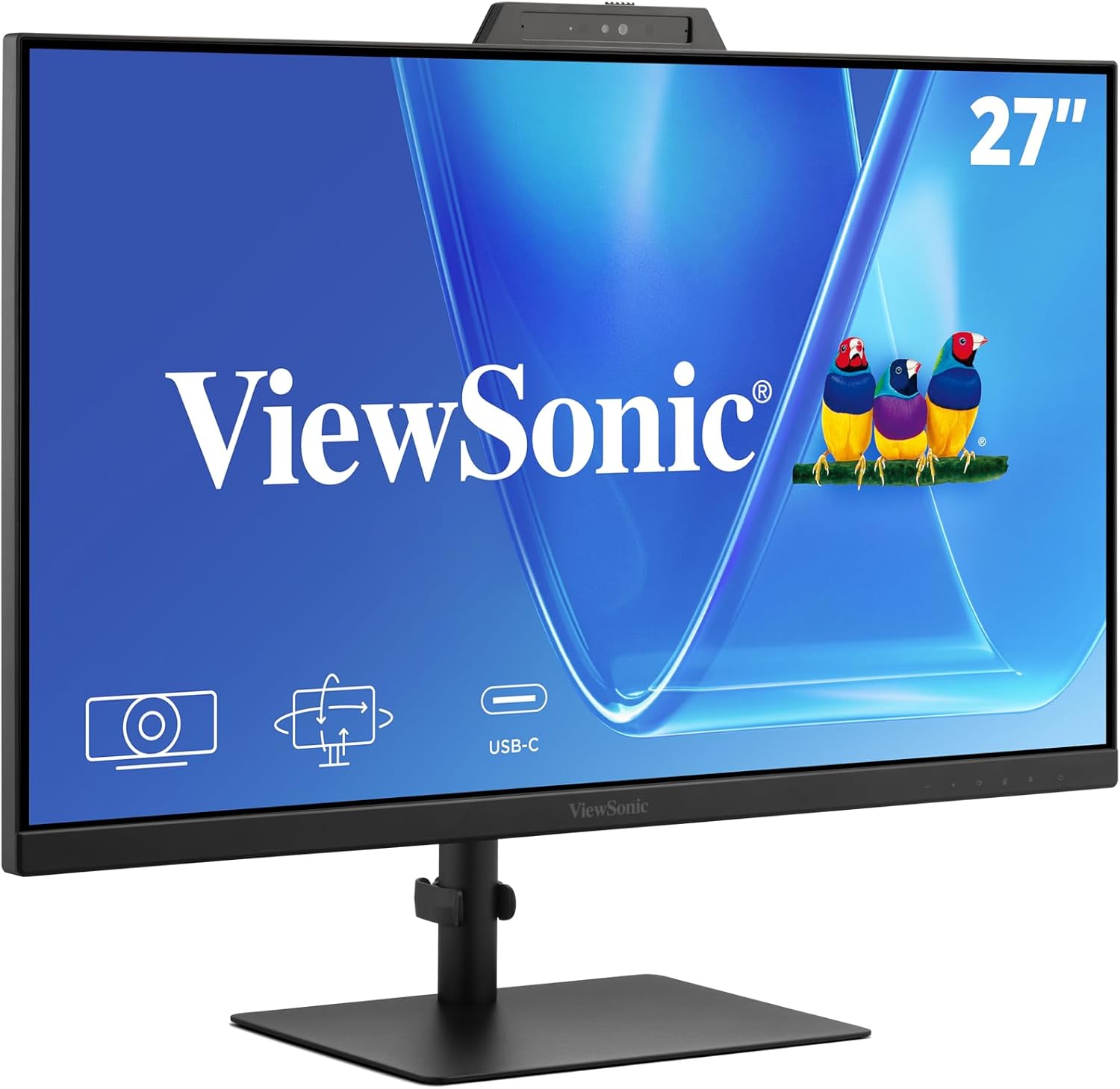
- Dual 5W speakers deliver integrated stereo audio for meetings.
- Built-in 5MP webcam simplifies everyday video conferencing setups.
- Integrated microphones support calls without additional desktop hardware.
- 120Hz IPS display provides smooth motion and wide viewing angles.
- USB-C supports video, data, and up to 100W charging.
This feels like a complete work monitor rather than a screen with speakers added
The ViewSonic VG2741V takes the number two position in our best computer monitor with speakers comparison because its integrated audio is part of a much larger conferencing setup. The 27-inch monitor combines dual 5W speakers with a 5MP webcam, integrated microphones, USB-C connectivity, an IPS panel, and a 120Hz refresh rate.
That combination is useful for anyone working from home or spending several hours per week in online meetings. Instead of placing separate speakers, a webcam, and a microphone around the monitor, the VG2741V brings those basic communication tools into one display.
The dual 5W speakers are substantial for monitor audio, especially compared with basic office displays that include much smaller integrated speakers mainly for notification sounds. Ten watts of combined rated speaker output gives this ViewSonic a stronger starting point for calls, training videos, presentations, and general desktop audio.
The 5MP webcam is another major reason the monitor stands out. It sits above the display where a conferencing camera naturally needs to be, so there is no separate webcam hanging from the top bezel or taking up another USB connection.
The speakers, webcam, and microphones make video calls much simpler
A normal desktop conferencing setup can become cluttered quickly. Add an external webcam, USB microphone, speakers, and laptop dock to a conventional monitor and suddenly there are several devices and cables around what should have been a fairly simple workstation.
The VG2741V handles much of that internally. Audio and video hardware are already integrated, so a compatible computer can use the monitor for both the meeting picture and the basic conferencing hardware.
The dual 5W speakers are particularly useful for spoken audio. During a meeting, voices need to remain clear enough that you are not constantly reaching for headphones simply to understand another participant.
They are also useful for webinars and online training. Someone working through several hours of instructional content may prefer playing the audio through the monitor rather than wearing headphones continuously.
For music, movies, or games, expectations should still be realistic. A thin monitor enclosure cannot provide the same low-frequency response or stereo separation as a larger pair of dedicated desktop speakers.
Integrated speakers prioritize convenience and clarity, which is exactly what makes sense on a business conferencing monitor. If stronger bass or higher playback volume becomes important, external audio can still be added later.
The advantage is that external speakers are optional rather than required. A clean office can start with the integrated system and only add more audio equipment when the user's work actually demands it.
The built-in 5MP webcam follows the same logic. A dedicated high-end camera may provide additional control for professional streaming, but most business meetings need a clear image and convenient placement more than specialized production features.
Five megapixels also gives the camera more image information to work with than the basic webcams found in many older laptops. Actual conferencing quality will still depend on lighting, software compression, network conditions, and the settings used by the meeting platform.
Good room lighting still matters for webcam quality. Even a capable camera can produce a noisy or flat-looking picture if the face is lit only by a bright monitor in an otherwise dark room.
Place a soft light in front of or slightly beside the user rather than directly behind them. A bright window behind the chair can force the webcam to choose between an overexposed background and an underexposed face.
The integrated microphones further simplify the setup. They eliminate the immediate need for a separate desktop microphone during ordinary Teams, Zoom, Meet, or other conferencing sessions.
This can be especially useful on a smaller desk. Microphone stands and boom arms take up physical space, and their cables add another connection to route around the workstation.
Built-in microphones keep the desk cleaner, while still giving the computer an audio input positioned close to the display and user.
Room acoustics still affect microphone quality. Hard floors, empty walls, and large bare rooms can create echo that no integrated microphone can completely ignore.
Soft furnishings, curtains, rugs, and sensible speaking distance can improve the experience. If you record podcasts or professional voiceovers, a dedicated microphone is still the better tool.
For normal business calls, though, the integrated arrangement makes much more sense. Turn on the computer, open the meeting application, and the essential video and audio hardware is already part of the monitor.
The monitor also includes privacy-focused webcam functionality. A physical privacy approach is useful on work monitors because it gives the user an obvious way to control the camera when it is not needed.
This matters in a home office where the monitor may remain powered throughout the day. You should not have to rely only on remembering whether a conferencing application still has camera access.
The display itself uses a 27-inch IPS panel. IPS technology is useful in an office monitor because it provides broad viewing angles and consistent image characteristics when the screen is viewed from different positions.
That becomes helpful during collaboration. If someone stands beside the desk to look at a spreadsheet or presentation, the picture remains easier to view than on a panel where contrast changes dramatically off-axis.
The 27-inch size gives useful working room, particularly for documents, browser windows, spreadsheets, and conferencing software where several interface panels may need to remain visible simultaneously.
The 120Hz refresh rate is another interesting feature because this is primarily a productivity monitor rather than a dedicated gaming model. It refreshes the image up to twice as frequently as a conventional 60Hz office display when the connected hardware and settings support 120Hz.
That can make scrolling through documents and web pages look smoother. Cursor movement, window dragging, interface animations, and compatible video can also feel more fluid.
You do not need to be gaming to notice it. Higher refresh improves ordinary desktop motion, which is useful when the monitor is being used for eight hours of work rather than a short gaming session.
Make sure the operating system is actually configured to use 120Hz. Computers sometimes default to a lower refresh rate after a new monitor is connected.
Open the display settings and verify the active refresh rate. The chosen cable, port, graphics hardware, and resolution all need to support the desired configuration.
Why the VG2741V earns second place instead of taking our top spot
USB-C is one of the strongest workstation features on this ViewSonic. A compatible laptop can send video and data through the connection while receiving up to 100W of power delivery.
That can transform the monitor into the center of a laptop workstation. One USB-C cable can simplify the desk dramatically, especially when the notebook supports video output, data, and charging through the same port.
Imagine returning home with a work laptop. Instead of connecting a charger, monitor cable, webcam, microphone, and several peripherals separately, the monitor's connectivity can consolidate much of that setup.
Connect the laptop and start working. At the end of the day, disconnect it and the monitor, speakers, webcam, and other permanent equipment stay at the desk.
This is particularly useful for hybrid workers. The laptop remains portable while the larger workstation stays assembled.
USB-C reduces repeated plugging and unplugging, and it can also remove the bulky laptop power adapter from the desktop when the computer's charging requirements fit within the monitor's 100W capability.
Check the laptop specification before relying on this. Not every USB-C port supports display output, and some high-performance laptops require more power than a 100W USB-C source can provide under maximum load.
For those machines, the original charger may still be necessary. The monitor can still handle video and data where supported.
DisplayPort and HDMI provide conventional video connectivity as well. That gives desktop PC users and other compatible devices alternatives to USB-C.
Multiple inputs make the monitor easier to reuse if the computer changes later. A monitor generally stays on the desk longer than a laptop, so connection flexibility has practical value.
The VG2741V also supports DisplayPort output for daisy-chain configurations with compatible equipment. This can simplify certain multi-monitor workstations because the second display can be connected through the first rather than requiring another long video cable directly to the computer.
Compatibility depends on the computer, operating system, connection standard, and downstream display. Check the complete chain before buying a second monitor specifically for this arrangement.
The integrated USB hub is another useful part of the workstation approach. Keyboard, mouse, storage, and other compatible peripherals can remain connected around the monitor rather than occupying every port on a laptop.
The monitor can function as a connectivity hub, which is more useful than simply adding speakers to an otherwise basic display.
Ethernet connectivity further supports that idea. A wired network connection can remain at the workstation and become available to a compatible USB-C laptop through the monitor's connectivity setup.
That is useful in offices where Wi-Fi is inconsistent or where wired networking is preferred for large file transfers and video meetings.
Video conferencing is one situation where stable networking matters. A high-quality webcam cannot compensate for a connection that is constantly dropping frames or losing audio.
The ergonomic stand is another important advantage. Height, tilt, swivel, and pivot adjustment let the display position change around the user rather than forcing the user to adapt to one fixed screen position.
Monitor height matters during long work sessions, especially when the screen is used every day for office work and conferencing.
Start with the monitor roughly centered in front of the normal seating position. Adjust the height so you are not repeatedly tilting the head upward or downward to see the main working area.
Tilt can then fine-tune the viewing angle. Swivel is useful when sharing the display with someone sitting nearby.
Pivot adjustment allows compatible portrait use, although the built-in conferencing hardware makes landscape orientation the more natural choice for most video meetings. Portrait mode can still be useful for documents or coding when the camera is not being used.
The adjustable stand reduces the need for accessories, because many users will not immediately need to purchase a separate monitor arm just to achieve a comfortable screen position.
VESA mounting remains useful if you do want an arm or wall mount. This can recover additional desk space and allow more extensive positioning in a multi-monitor workstation.
Always check the monitor's weight and VESA specification against the chosen mount. Do not select a monitor arm based only on the 27-inch diagonal size.
The ViewSonic's business focus also means it is designed around long periods of computer use. Eye-care features such as flicker reduction and blue-light management can be useful when the monitor is used throughout a full working day.
Comfort features matter more after several hours, even though they are less exciting on a specification sheet than refresh rate or webcam resolution.
Room lighting still matters. Avoid using any monitor at extreme brightness in a dark room simply because the backlight can reach that level.
Adjust brightness around the environment. A display should be comfortable to look at rather than acting as the brightest object in the room by a huge margin.
The 120Hz refresh rate also gives the VG2741V some entertainment flexibility. Casual gaming can feel smoother than it does on a traditional 60Hz office monitor.
It is not positioned as a high-refresh competitive gaming display, and that is fine. The 120Hz panel balances work and entertainment without turning the monitor into a specialized gaming product.
For a work computer that occasionally runs games after hours, that balance makes sense. You do not need two separate displays simply to gain smoother motion.
The dual 5W speakers help with entertainment as well. They are already available for streaming video or casual gaming when headphones are not desirable.
Dedicated speakers will still produce a larger stereo presentation, particularly for music. But the built-in system means there is no need to purchase them immediately.
The monitor remains functional without extra audio hardware, which is the important part for this comparison.
The webcam and microphones also remove more cables from the desk. An external webcam normally adds USB cabling, while separate speakers need power and an audio or USB connection.
Integrating those functions into the display can produce a noticeably cleaner workstation. This becomes particularly useful on narrower desks where every peripheral competes for surface area.
A keyboard, mouse, laptop, phone, notebook, and coffee cup already occupy plenty of space. Removing several standalone conferencing devices helps keep the work area usable.
Integrated conferencing reduces peripheral clutter, which is a real advantage rather than just a cleaner photograph for the product page.
The main reason this ViewSonic finishes second is that our number-one touchscreen model offers a broader combination for the particular seven-product comparison, including direct touch interaction and QHD resolution alongside built-in audio.
The VG2741V takes a different approach. It focuses much more heavily on business productivity, video conferencing, USB-C docking, integrated speakers, webcam functionality, and ergonomic adjustment.
For someone who spends most of the day in Teams or Zoom, that focus could actually be more relevant than touchscreen functionality. The ranking reflects our overall comparison, not a weakness in the ViewSonic's intended use.
Its strongest role is professional conferencing, and the hardware is unusually well aligned around that purpose.
There are still some practical compromises. Built-in speakers prioritize convenience rather than high-end audio, and a 27-inch office monitor with a webcam will not replace specialized production equipment for someone recording professional video.
That is not what it is trying to do. It is trying to reduce the number of separate devices required for a normal professional workstation.
The 5MP camera, microphones, dual 5W speakers, USB hub, Ethernet, USB-C charging, and ergonomic stand all support that same goal. There is very little wasted functionality in the package.
The features make sense together, which is one of the reasons the VG2741V ranks so highly.
For installation, connect the monitor using the interface that best suits the computer. USB-C is the most interesting option for compatible laptops because of the combined video, data, and charging capability.
Desktop users may prefer DisplayPort or HDMI. After connection, check the operating system's audio output and make sure the ViewSonic speakers are selected if sound continues coming from the laptop.
This is a common setup issue with monitors that include audio. The computer may continue using its previous speaker device until the user selects the new output.
Check the audio device after installation, particularly when switching between HDMI, DisplayPort, and USB-C connections.
Do the same for the webcam and microphone inside conferencing applications. Teams, Zoom, and similar software can remember an older camera or microphone even after new hardware has been connected.
Select the ViewSonic devices in the application's audio and video settings, then run a test call before an important meeting. It takes a minute and avoids troubleshooting while other participants are waiting.
If you use a laptop closed in clamshell mode, make sure the operating system and power settings support that configuration. The monitor can then become the primary display while the integrated webcam and speakers handle conferencing.
This creates a very clean desk. The laptop can effectively become the computer behind the monitor, rather than needing to stay open beside it throughout the day.
We believe the ViewSonic VG2741V deserves the number two ranking out of seven for Best Computer Monitor With Speakers because it combines dual 5W stereo speakers with a 5MP webcam, integrated microphones, a 27-inch IPS display, 120Hz refresh rate, USB-C connectivity with up to 100W power delivery, DisplayPort, HDMI, USB expansion, Ethernet, and a highly adjustable stand.
It falls just short of our first position because the number-one model offers a more unusual all-round feature combination for this particular comparison. The ViewSonic, however, is arguably the more focused choice for professional meetings, hybrid work, laptop docking, and anyone who wants to reduce the number of separate devices sitting around the monitor.
Set the display to 120Hz where supported, choose the monitor as the computer's audio output, configure the integrated camera and microphones in your conferencing software, and use USB-C when your laptop supports the full connection. Set up properly, the VG2741V creates an exceptionally clean conferencing workstation and earns a strong second-place position in this seven-monitor comparison.

- Dual 2W speakers provide convenient integrated stereo audio.
- Large 32-inch display uses an immersive 1500R curvature.
- 180Hz refresh rate delivers exceptionally smooth on-screen motion.
- 1ms MPRT response time helps reduce visible motion blur.
- FreeSync Premium helps reduce screen tearing during gaming.
The 32-inch curved screen makes this feel very different from a basic monitor with speakers
The ViewSonic VX3218-PC-MHD takes the number three position in our best computer monitor with speakers comparison because it combines integrated audio with a genuinely gaming-focused display. You get a large 32-inch curved screen, 180Hz refresh rate, 1ms MPRT response time, FreeSync Premium, dual 2W speakers, and a 1500R curve.
The built-in speakers are rated at 2 watts each, giving you 4 watts of integrated stereo output. That is enough for everyday computer audio, YouTube, dialogue, system sounds, casual gaming, and situations where adding separate speakers would take up more desk space.
The speakers remove another desktop accessory, which is useful because a 32-inch monitor already occupies a substantial amount of physical space. A smaller desk can stay simpler when there are no separate speaker cabinets sitting on both sides of the screen.
The monitor itself uses a 31.5-inch viewable MVA panel with a native 1920 x 1080 resolution. It has a 16:9 aspect ratio, 300 cd/m² rated brightness, wide 178-degree viewing angles, and a strong 4,000:1 static contrast ratio.
That contrast is useful for darker content. Blacks and shadowed areas can appear deeper than they typically do on lower-contrast panels, which suits games and movies where a lot of the image takes place in dim environments.
The 1500R curvature is another major part of the experience. The curved panel suits the large screen size, bringing the outer edges slightly toward the normal viewing position rather than leaving a very wide flat panel stretching away on both sides.
The 180Hz refresh rate is where this ViewSonic becomes much more interesting
The VX3218-PC-MHD can operate at up to 180Hz with supported connections and hardware. That means the display can refresh up to 180 times per second, considerably more frequently than a conventional 60Hz office monitor.
You notice this most clearly in fast games, but it also affects normal computer use. Cursor movement, scrolling, window dragging, and interface animations can look smoother when the operating system is actually configured to use the higher refresh rate.
Make sure 180Hz is actually enabled after connecting the monitor. A common mistake is buying a high-refresh display and leaving Windows configured at 60Hz because the user never checks the advanced display settings.
The graphics card and cable connection matter too. The monitor provides two HDMI 1.4 inputs and one DisplayPort 1.2 connection, giving you options for desktops, laptops, and other compatible sources.
For a gaming PC, DisplayPort is a straightforward connection choice. Use the supplied DisplayPort cable or another cable that properly supports the intended resolution and refresh rate.
The 1ms MPRT specification is designed around reducing perceived motion blur during fast movement. Fast response complements the high refresh rate, particularly in racing games, shooters, sports titles, and other content where objects move rapidly across the screen.
FreeSync Premium is another gaming feature that matters in practice. Variable refresh technology can coordinate the monitor's refresh behavior with compatible graphics output to reduce visible tearing and stuttering.
Without synchronization, the graphics card can deliver a new frame while the monitor is partway through displaying the previous one. The result can appear as a horizontal break where two portions of different frames are visible at the same time.
FreeSync Premium is intended to reduce that problem when used with compatible hardware and appropriate settings. It does not magically increase the frame rate produced by the computer, though.
Refresh rate and game frame rate are separate. A 180Hz monitor gives the system the ability to display frames very frequently, but the graphics hardware still needs to render those frames.
This is especially relevant when choosing game settings. If a demanding title struggles at maximum graphical quality, reducing selected settings can sometimes provide a smoother experience by increasing the achievable frame rate.
The 1920 x 1080 resolution helps here because Full HD is less demanding on a graphics processor than 2560 x 1440 or 4K. That can make higher frame rates easier to achieve with mid-range hardware.
There is a tradeoff. At 32 inches, Full HD has a relatively low pixel density compared with a 27-inch 1440p monitor or 32-inch 4K screen.
1080p looks less fine at 32 inches, particularly when sitting close and reading small text. Individual pixel structure can be easier to notice than it is on a smaller Full HD display.
Viewing distance helps. A large 32-inch gaming monitor generally makes more sense when positioned somewhat farther away than a compact 24-inch screen.
That is one reason desk depth matters. If the desk is extremely shallow, the VX3218-PC-MHD may sit closer to the eyes than you would prefer.
A compatible VESA monitor arm can help with positioning. The ViewSonic supports a 100 x 100mm VESA mounting pattern and weighs about 9.3 pounds without its original stand.
VESA mounting can recover useful desk depth, especially if the arm lets you position the display farther toward the rear edge than the original stand does.
Always compare the monitor's weight with the arm's supported load range. Do not select an arm purely because it says it works with 32-inch monitors.
The original stand provides tilt adjustment from approximately 5 degrees forward to 20 degrees backward. That is enough for basic angle correction, but there is no extensive height-adjustment system built into this particular stand.
If the screen sits too low, a monitor riser or VESA arm may provide a better ergonomic solution. Do not compensate for a low monitor by lowering your chair until the keyboard becomes uncomfortable.
Screen height and keyboard height are separate adjustments, particularly during long gaming or working sessions.
Why the VX3218-PC-MHD takes third place instead of our top two spots
The built-in dual 2W speakers are convenient, but they should be understood for what they are. They provide everyday audio without requiring separate hardware, which is exactly what many people want from monitor speakers.
They are not a replacement for a substantial pair of powered speakers if music quality, bass response, or room-filling volume is a major priority. The physical enclosure of a thin monitor limits how much low-frequency output the integrated drivers can produce.
Convenience is the main audio advantage. For game dialogue, videos, notifications, video calls, and casual listening, having speakers already inside the display can be much easier than maintaining another pair of devices and cables.
The monitor also provides a 3.5mm audio output. That gives you a straightforward route to headphones or external audio equipment when you want something beyond the internal speakers.
This creates a useful progression. Start with the built-in audio, then add headphones or external speakers only if your actual usage requires them.
The 1500R curvature also helps distinguish this model from ordinary office monitors. At 32 inches, the screen is wide enough that the curve is more noticeable than it would be on a much smaller panel.
The curve works best from a centered position. If several people are watching the monitor from widely separated seats, a flat display may be easier for everyone to view equally.
For a single user sitting directly in front of the screen, the curve makes more sense. Games can fill more of the visual field without the outer edges feeling quite as distant.
The monitor uses ViewSonic's ViewMode presets as well. These provide predefined display configurations for different types of content, including gaming and entertainment uses.
Game-specific visual settings can be useful when moving between very different content. A dark game may need different shadow visibility than a bright productivity application.
ViewSonic also provides Black Stabilization controls intended to improve visibility in darker scenes. Shadow visibility can matter during gaming, particularly when important objects or opponents occupy dark areas of the image.
Do not automatically push every enhancement to its maximum value, though. Excessive shadow boosting can make an image look washed out and reduce the deeper contrast that is one of the MVA panel's strengths.
Start with the default or appropriate preset and adjust only when something is actually difficult to see. Display settings should solve a visible problem rather than being changed simply because a slider exists.
Flicker-Free technology and a Blue Light Filter are included for longer viewing sessions. These features are useful additions when the same monitor is used for work during the day and gaming later.
Room lighting still affects viewing comfort, regardless of the eye-care features built into the monitor. Avoid using maximum brightness in a dark room when a lower level is comfortable.
The anti-glare surface also helps manage reflections. This is useful if the gaming desk is positioned near a window or under strong room lighting.
Anti-glare treatment does not make reflections disappear completely, so monitor placement still matters. Positioning a bright window directly behind the user can make dark scenes harder to see.
Connectivity is straightforward rather than elaborate. Two HDMI ports are useful if the monitor is shared between more than one source, while DisplayPort handles a typical gaming PC connection.
Two HDMI inputs make source switching easier, for example when a desktop PC and another compatible device share the same display.
There is no USB-C docking setup here like you find on some productivity monitors. That is one reason this ViewSonic is more gaming-focused than the conferencing model ranked above it.
If you use a modern laptop and want one cable for video, charging, USB peripherals, and networking, this is not the monitor designed around that workflow. A separate dock may be needed.
For a desktop gaming PC, that omission matters much less. DisplayPort, HDMI, and the built-in speakers cover the core requirements without adding connectivity that may never be used.
The feature set is focused on gaming performance, and that focus is one of the product's strengths.
The frameless-style design also helps the large screen feel cleaner on a desk. Thin bezels reduce the amount of visible frame surrounding the picture.
This can be useful if a second monitor is eventually added. The physical gap between adjacent screens still exists, but thinner bezels make it less visually dominant.
Two 32-inch displays would require a very wide workstation, though. Measure the desk before assuming a dual-screen arrangement will fit comfortably.
A single 32-inch screen already provides a large working area. Measure both desk width and depth, because the viewing distance is just as important as whether the monitor physically fits between the edges.
The monitor measures roughly 27.9 inches wide and 20.2 inches high with the stand. Its depth with the stand is approximately 9 inches.
Those numbers are useful when planning speakers, a laptop, or other desk equipment around it. Even though the monitor has built-in audio, you may still need space for a microphone, webcam, controller, or other accessories.
Power consumption is rated around 35 watts in typical operation, with a maximum around 41 watts. Standby consumption is listed at approximately 0.5 watts.
The external power supply means there is an adapter to account for in the cable setup. Plan power routing before finalizing the desk, particularly if the workstation already contains a PC, chargers, lighting, and other equipment.
The monitor supports Windows PCs and Macs at up to its native 1920 x 1080 resolution. The high-refresh experience still depends on the output capabilities of the connected computer and the selected connection.
For office use, the 32-inch size can be comfortable for large text, browser windows, and side-by-side applications. The lower pixel density is the tradeoff when fine text sharpness is a priority.
Someone primarily working with spreadsheets may enjoy the physical screen size but prefer a higher-resolution 32-inch panel if budget allows. Someone primarily gaming may prefer the easier-to-drive 1080p resolution because higher frame rates are the priority.
The intended workload changes the value proposition, and this ViewSonic clearly leans toward gaming and entertainment.
The 180Hz refresh rate is a major reason it earns third place rather than falling lower in our list. Many monitors with integrated speakers are ordinary 60Hz or 75Hz productivity displays.
Here, the speakers are attached to a monitor that also provides genuinely fast motion performance. That makes the integrated audio feel like part of a complete entertainment setup rather than the only notable feature.
The 1ms MPRT specification and FreeSync Premium reinforce that positioning. Fast movement is where the display is intended to perform at its best.
The gaming specifications are unusually strong here for a monitor that also gives you built-in stereo audio.
The main reason it does not reach our first two positions is balance. Our top-ranked monitor combines speakers with QHD resolution, 100Hz refresh, and touchscreen functionality, giving it a particularly broad range of uses.
The second-ranked ViewSonic is exceptionally well equipped for conferencing with its speakers, webcam, microphones, USB-C docking, and productivity features. The VX3218-PC-MHD is more specialized.
Its Full HD resolution at 32 inches is the clearest compromise. Users prioritizing fine text, detailed creative work, or higher desktop pixel density may prefer 1440p or 4K at this screen size.
That resolution tradeoff keeps it in third place, even though the 180Hz gaming performance is considerably faster than many general-purpose monitors above it.
For the right user, the compromise is completely reasonable. A gaming PC can drive 1080p at high frame rates more easily than QHD or 4K, and the 32-inch curved panel creates a physically large image.
The built-in speakers then handle casual audio without adding another purchase. Headphones can still take over when positional game audio or private listening matters.
This makes the monitor especially practical for a bedroom gaming setup, student desk, or multipurpose computer station where space and budget matter. One display handles gaming, everyday computer use, streaming, and basic audio.
You can add better audio later, but you are not forced to buy speakers on the first day simply to hear the computer.
During initial setup, connect the monitor and check the operating system's resolution and refresh settings. Set the display to 1920 x 1080 and select the highest supported refresh rate for the chosen connection.
If audio does not automatically play through the monitor, open the computer's sound settings and choose the display as the output device. HDMI and DisplayPort can both carry audio from compatible hardware.
Check the in-monitor audio settings as well. A muted or low monitor volume can make it look like the speakers are not working even when the computer is sending audio correctly.
Verify both computer and monitor volume settings before troubleshooting cables or drivers.
For FreeSync Premium, enable the appropriate variable-refresh functionality in the monitor and compatible graphics settings. Exact options depend on the graphics hardware being used.
Then test a game where the frame rate varies. Variable refresh is most useful when the graphics output is not perfectly synchronized to one fixed display refresh rate.
For general desktop work, you can leave the monitor at 180Hz if the connected system supports it. Smooth scrolling is not reserved only for games.
The higher refresh rate improves everyday responsiveness, which helps this ViewSonic work as more than a dedicated gaming screen.
We believe the ViewSonic VX3218-PC-MHD deserves the number three ranking out of seven for Best Computer Monitor With Speakers because it combines dual 2W speakers with a 32-inch 1500R curved MVA panel, 180Hz refresh rate, 1ms MPRT response time, FreeSync Premium, 300 cd/m² brightness, strong 4,000:1 static contrast, two HDMI inputs, DisplayPort, audio output, and VESA mounting.
It sits below our first two choices because 1920 x 1080 is relatively modest for a 32-inch screen and because it lacks the broader productivity features offered by those higher-ranked monitors. What it gives back is much faster gaming performance and an immersive curved format.
Set the refresh rate correctly, use FreeSync Premium with compatible hardware, position the large screen at a sensible viewing distance, and treat the integrated speakers as convenient everyday audio rather than a substitute for a dedicated

- Dual 2W speakers provide convenient integrated desktop audio.
- 27-inch QHD Fast IPS panel delivers sharp visuals.
- 200Hz refresh rate overclocks up to 210Hz.
- Included shielding hood helps reduce distracting ambient reflections.
- Fully adjustable stand supports height, tilt, swivel, and pivot.
The built-in speakers are useful, but the 210Hz QHD panel is the bigger story
The KTC 27M1 takes the number four position in our best computer monitor with speakers comparison because it combines integrated audio with specifications that are much closer to a serious gaming monitor. You get a 27-inch 2560 x 1440 Fast IPS panel, a native 200Hz refresh rate that can reach 210Hz through overclocking, 1ms MPRT response time, Adaptive Sync, HDR support, and dual built-in speakers.
The integrated audio consists of two 2W speakers. That gives you 4W of combined rated speaker output, enough for everyday computer audio, online videos, system sounds, casual gaming, and situations where putting separate speakers on the desk would just create more clutter.
The speakers save valuable desk space, particularly on a workstation that already has a large monitor, keyboard, mouse, microphone, controller, or laptop sitting around it. You can always connect better audio later, but you do not need another speaker system just to hear the computer.
The 27-inch QHD panel is the more significant feature for visual performance. At 2560 x 1440, the screen provides substantially more working space and detail than a 1920 x 1080 monitor while staying at a size that works comfortably on a normal computer desk.
The Fast IPS panel and high refresh rate make this much more than an office screen
The KTC 27M1 runs at 200Hz natively and can reach up to 210Hz through overclocking. That is a substantial jump over conventional 60Hz and 75Hz office monitors, and even noticeably higher than many 120Hz or 144Hz gaming displays.
Higher refresh matters most when the computer is producing enough frames to use it. Fast motion looks noticeably smoother in competitive games, while mouse movement, scrolling, window animations, and other desktop interactions can also feel more immediate.
The monitor is rated for a 1ms MPRT response time. That specification is aimed at reducing visible motion blur during fast movement, which becomes more relevant when the display is refreshing hundreds of times per second.
There is an important setup detail here. DisplayPort 1.4 is the connection to use when targeting the monitor's highest refresh modes, while the HDMI 2.0 inputs are listed at up to 144Hz for the native QHD resolution.
If someone connects the monitor through HDMI and then wonders why 200Hz or 210Hz does not appear in the computer's settings, the connection can be the reason. Use DisplayPort for maximum refresh performance and then verify the selected refresh rate inside the operating system.
The graphics card matters too. A monitor capable of 210Hz does not automatically make a game run at 210 frames per second.
At 2560 x 1440, the GPU has roughly 3.7 million pixels to render for every frame. Demanding modern games may need reduced graphics settings to reach very high frame rates, depending on the graphics hardware being used.
Adaptive Sync helps when the game's frame rate changes. It is designed to coordinate display refresh behavior with compatible graphics output, reducing the screen tearing that can occur when the two are out of step.
Adaptive Sync is useful outside perfect 200fps conditions, which is important because real games rarely remain at one completely fixed frame rate.
The Fast IPS panel gives the KTC another advantage. IPS technology provides broad viewing angles and generally consistent color behavior, while the faster implementation is intended to improve motion performance compared with traditional slower IPS panels.
KTC lists a 130% sRGB color gamut along with 99% DCI-P3 coverage for this model. The monitor is also specified around 450 cd/m² brightness and Delta E below 2, giving it a much broader color specification than a basic office display.
That can be useful beyond gaming. Photo editing, graphics work, video content, and general media all benefit from a panel capable of producing a wide range of color.
Wide gamut and accuracy are different things, though. A monitor displaying a large color gamut does not automatically mean every application is color managed correctly, so users doing professional color-critical work should still use the appropriate display mode and calibration workflow.
The QHD resolution is particularly comfortable at 27 inches. Text and interface elements can remain reasonably sized while providing more desktop area than Full HD.
A spreadsheet can show additional columns. An editing application can leave more room around the timeline and preview, while two browser windows can sit side by side without feeling excessively narrow.
For gaming, QHD also produces visibly finer detail than 1080p at the same screen size. The resolution and refresh rate are well balanced for a powerful gaming PC that can drive high frame rates without moving all the way to the heavier rendering demands of 4K.
The included shielding hood is another unusual feature. It surrounds the upper and side portions of the display to reduce ambient light reaching the screen from those directions.
This can be genuinely useful in a bright room. Imagine a desk sitting beside a window where afternoon light reaches one side of the monitor and creates distracting reflections or changes how the screen appears.
The hood blocks some of that stray light before it reaches the panel. It will not solve every lighting problem, but the shielding hood reduces environmental distractions without requiring the room to remain dark.
It can also help when doing image work where consistent viewing conditions matter. External light reflecting around the panel can affect how contrast and darker tones appear to the viewer.
Room lighting should still be arranged sensibly. Avoid putting a strong lamp directly behind the user where it can reflect into the screen, and do not run the monitor unnecessarily bright in a dark room.
Why the 27M1 lands in fourth place instead of our top three
The integrated speakers are convenient, but two 2W drivers are not intended to replace substantial external speakers. They make sense for general desktop sound, video playback, voice content, and casual gaming where simplicity matters more than powerful bass.
This is actually a useful distinction for the primary keyword. Built-in speakers remove an immediate accessory requirement, which is what many buyers want when searching for a monitor with speakers.
If you mainly use headphones for gaming, the integrated speakers can handle everything else. You can take the headset off during web browsing or a quick video without having to maintain another audio system on the desk.
For music production, cinematic playback, or someone who cares heavily about stereo imaging, separate speakers remain the better option. Thin monitor enclosures simply do not provide the cabinet volume of dedicated audio hardware.
The monitor also includes an earphone output. That provides another convenient way to connect headphones or external audio equipment around the display rather than always reaching behind the computer.
The audio setup is about flexibility, not pretending that 4W of monitor speakers can replace every other listening device.
The stand is one of the stronger physical features. Height adjustment is approximately 150mm, giving the screen a useful vertical range without immediately requiring a monitor arm.
Tilt runs from roughly minus 5 degrees to 35 degrees, swivel reaches about 60 degrees in either direction, and pivot adjustment allows the monitor to rotate vertically. That is far more useful than a stand that only provides a small amount of backward tilt.
Start by adjusting height before changing everything else. The screen should sit where the normal viewing position does not require constantly bending the neck downward or tilting the head upward.
Good stand adjustment matters every day, particularly when the monitor is used for several hours of work followed by gaming later.
Swivel becomes useful if someone beside you needs to see the screen. Instead of dragging the entire monitor across the desk, turn the display toward them and return it afterward.
Pivot allows portrait orientation. This can be useful for long documents, coding, chat applications, vertical content, or a secondary-monitor setup.
The monitor also supports 100 x 100mm VESA mounting. A compatible monitor arm can recover additional desk space and provide even greater positioning freedom.
VESA mounting keeps future setup options open, which matters because a monitor may remain in service through several different computers and desk arrangements.
If you install an arm, check its weight rating against the monitor rather than selecting one based solely on the 27-inch screen size. Also use the correct mounting hardware.
Eye-comfort features include flicker-free operation and a low-blue-light mode. These are useful for longer sessions, although basic room lighting and monitor brightness still have a large effect on comfort.
KTC recommends viewing conditions that avoid direct reflections and keep screen brightness appropriate for the surrounding room. That is sensible advice for any monitor, particularly one capable of fairly high brightness.
Do not run maximum brightness unnecessarily, especially when using the monitor late at night in a dim room.
The two HDMI 2.0 ports are useful when several devices share the display. A desktop computer could use DisplayPort while a console or second computer remains attached through HDMI.
That avoids physically swapping the same cable every time the input changes. It also makes the KTC more useful as a combined work and entertainment monitor.
The HDMI refresh limit is lower than the DisplayPort capability, though. If high-refresh PC gaming is the priority, connect the main gaming computer through DisplayPort.
Connection choice affects available performance, so it is worth spending a minute checking the specifications rather than simply using whichever cable happens to be nearby.
HDR support adds another display mode for compatible content. The 450 cd/m² brightness specification gives the monitor more brightness headroom than many inexpensive SDR office displays.
Still, HDR performance depends on more than accepting an HDR signal. Contrast capability, local dimming, peak brightness, content mastering, and operating-system settings all influence the final result.
Do not buy the monitor expecting the same HDR experience as a premium Mini LED or OLED display. The more convincing reasons to choose the 27M1 are its QHD resolution, refresh rate, Fast IPS panel, color coverage, speakers, and stand.
The core SDR and gaming specifications are stronger than relying on HDR branding as the main selling point.
The shielding hood also makes the monitor physically deeper around the screen. That is worth considering on a very small desk.
If you do not need the hood, check whether your setup allows it to be removed or simply configure the monitor according to the supplied instructions. Users working in controlled lighting may gain less from it than someone beside a bright window.
The 27-inch size itself is a comfortable middle ground. It provides a noticeably larger image than a 24-inch monitor without becoming as physically imposing as a 32-inch display on a shallow desk.
Viewing distance still matters, especially for gaming where the eyes may track movement across the complete panel for long periods.
Position the screen far enough away that you can see the important areas without constantly moving your head. The adjustable stand makes this easier because screen height and angle can be tuned after the desk position is established.
The 210Hz overclock should also be treated correctly. The monitor's standard high-refresh operation is already very fast, and the overclocked mode is an additional setting rather than something every user must enable.
If 200Hz works perfectly for your system, there is little reason to obsess over the extra 10Hz simply because the option exists. Use the configuration that is stable and supported by the connected hardware.
200Hz is already extremely smooth compared with conventional 60Hz office displays, so the monitor remains high-refresh even without its maximum overclock.
For productivity, the high refresh rate can be surprisingly pleasant. Long web pages and documents move more smoothly while scrolling, and the pointer looks more continuous as it crosses the screen.
That does not make office work faster by itself, but it makes interaction feel more immediate. Once someone becomes accustomed to a high-refresh desktop, returning to 60Hz can feel noticeably less fluid.
The speakers also make a work-and-gaming setup easier. During the day they can handle meetings, tutorials, and notifications, while gaming audio can move to a headset when privacy or directional sound matters.
That mixed-use flexibility is the KTC's strength. It does not force the monitor into one narrow role.
So why does it rank fourth rather than higher? Our first three monitors provide stronger overall combinations for this particular comparison, especially around integrated audio, conferencing, or broader everyday functionality.
The KTC is more gaming-focused. The dual 2W speakers are convenient, but the audio system is not as substantial as the dual 5W arrangement on our second-ranked ViewSonic conferencing monitor.
It also lacks the integrated webcam and microphone system that makes that ViewSonic particularly strong for office communication. The number-one model adds touchscreen functionality, creating another kind of versatility.
The KTC prioritizes display performance first, with built-in speakers serving as a useful convenience rather than the centerpiece of the product.
For gamers, that may actually be the preferred tradeoff. A 200Hz native QHD Fast IPS display with 1ms MPRT and Adaptive Sync has a very different performance focus from a standard business monitor.
The 130% sRGB gamut, 99% DCI-P3 coverage, approximately 450-nit brightness, adjustable stand, and shielding hood add further value beyond raw refresh rate.
It is also a good option for someone using one monitor for both work and gaming. QHD provides useful desktop space during the day, while 200Hz or 210Hz gives the gaming PC considerably more refresh headroom afterward.
You do not need separate work and gaming monitors when one display covers both roles reasonably well.
Setup is straightforward, but check the important settings afterward. Select 2560 x 1440 as the native resolution and verify the active refresh rate in the operating system.
If using DisplayPort, confirm that the high-refresh option is available. If using HDMI, remember that the listed maximum refresh at QHD is lower.
Then select the KTC as the audio output if the computer continues sending sound to another device. Windows and other operating systems may remember the previously selected speakers after a new display is connected.
Check both refresh rate and audio output after installation, because those two settings determine whether you are actually using the features that justify buying this model.
Adaptive Sync may also need to be enabled through the monitor settings and compatible graphics software. Follow the relevant GPU and monitor instructions rather than assuming it is active automatically.
For color-sensitive work, select the appropriate display mode and consider calibration according to the demands of the project. Wide color coverage is useful, but professional color workflows benefit from verification rather than assumptions.
The stand should be adjusted last, once the chair and desk are in their normal positions. Set height first, then fine-tune tilt and swivel.
Physical setup matters as much as display settings when the monitor is going to be used for several hours at a time.
We believe the KTC 27M1 deserves the number four ranking out of seven for Best Computer Monitor With Speakers because it combines convenient dual 2W audio with a 27-inch 2560 x 1440 Fast IPS panel, 200Hz native refresh rate, up to 210Hz overclocking, 1ms MPRT, Adaptive Sync, broad color coverage, a shielding hood, and extensive ergonomic adjustment.
It sits below our top three because the speakers are more about convenience than powerful audio, while the higher-ranked models offer stronger conferencing or broader all-purpose features. But the KTC has an important advantage of its own: it is the more performance-focused gaming display in this part of the ranking.
Use DisplayPort when targeting maximum refresh, select the correct audio output after connection, adjust the stand around your normal seating position, and keep expectations realistic about what integrated 2W speakers are designed to do. Set up correctly, the 27M1 delivers an excellent gaming and desktop combination while keeping everyday audio built directly into the monitor.

- Built-in dual speakers provide convenient everyday desktop audio.
- 27-inch 1500R curved display creates a wider immersive view.
- High refresh rate provides smoother motion during fast gaming.
- FreeSync support helps reduce distracting screen tearing.
- 130% sRGB color gamut delivers vibrant gaming visuals.
The curved 27-inch screen gives this speaker-equipped monitor a gaming focus
The SANSUI ES-G27C1 takes the number five position in our best computer monitor with speakers comparison because it combines integrated audio with a display clearly designed around gaming. You get a 27-inch 1920 x 1080 panel, 1500R curvature, a high refresh rate, 1ms MPRT response time, FreeSync, HDR support, and built-in stereo speakers.
The speakers are useful because they remove another piece of hardware from the desk. For YouTube, game dialogue, system sounds, online videos, or ordinary computer audio, you can use the monitor immediately without finding room for separate desktop speakers.
That can matter on a smaller gaming desk where the keyboard, mouse mat, controller, microphone, and computer accessories already consume plenty of space. Integrated speakers keep the setup simpler, even if dedicated speakers or headphones remain an option when stronger audio is wanted.
The 27-inch screen uses a 1500R curve. This is noticeably different from a flat office monitor because the left and right sides angle toward the normal viewing position rather than sitting on one completely flat plane.
For gaming, that shape can feel natural when the user sits near the center of the display. It is particularly suited to racing games, open-world titles, simulators, and other content where a wider-feeling field of view is part of the experience.
The refresh rate and FreeSync are the features gamers will notice first
The current ES-G27C1 specification reaches up to 200Hz, although earlier Canadian listings for the same ASIN describe a 180Hz version. Either way, this is substantially faster than a conventional 60Hz office monitor, but buyers should confirm which revision is being shipped before treating 200Hz as guaranteed.
A higher refresh rate allows the screen to update more frequently when the connected computer is producing enough frames. Fast motion can look noticeably smoother, particularly in shooters, racing games, competitive multiplayer titles, and other content involving rapid camera movement.
There is an important distinction between refresh rate and frame rate. A 200Hz monitor can display up to 200 refreshes per second, but the computer still needs to render the game quickly enough to make full use of that capability.
If a game is running at 70 frames per second, buying a high-refresh display does not magically turn that into 200 frames. The graphics card, processor, game engine, resolution, and quality settings all influence actual frame rate.
FreeSync becomes useful when the frame rate varies. Adaptive synchronization helps reduce screen tearing by coordinating compatible graphics output more closely with the monitor's refresh behavior.
This matters in real gaming because frame rates rarely remain completely fixed. A game might run at 150fps in one scene and fall substantially lower when the environment becomes more demanding.
The listed 1ms MPRT response specification is also aimed at motion performance. Lower motion response times can help moving objects appear clearer, although the exact visual result depends on the monitor's response settings and how those modes are implemented.
Do not automatically enable every aggressive response setting. Some overdrive modes can introduce visible artifacts when pushed too far, so use the setting that produces the cleanest motion rather than simply choosing the highest option.
Motion quality is more than one number. Refresh rate, frame rate, synchronization, response behavior, and game settings all work together.
The 1920 x 1080 resolution is easier for a gaming computer to drive at high frame rates than 2560 x 1440 or 4K. That can be useful if the priority is reaching high refresh rates without requiring an extremely powerful GPU.
There is a tradeoff. At 27 inches, Full HD has a lower pixel density than 1440p, so text and fine desktop details will not look as sharp when viewed from the same distance.
For gaming from a normal desk distance, some users will consider that acceptable because performance matters more to them than maximum pixel density. For someone spending eight hours per day reading small text, QHD may be preferable.
The FHD resolution favors gaming performance, which fits the overall purpose of the ES-G27C1.
The 1500R curvature also affects how the monitor should be positioned. Sit reasonably close to the center rather than viewing the display constantly from a sharp side angle.
The curve is designed around one primary user. It makes less difference if several people are standing around the monitor looking at it from different positions.
SANSUI lists a 3000:1 contrast ratio for this model. Higher native contrast can help darker game scenes retain stronger separation between bright and dark areas compared with lower-contrast panel types.
Contrast matters in darker games, where washed-out blacks can make shadow areas look grey and reduce the visual depth of the scene.
The monitor is also specified at around 300 nits of brightness. That is suitable for many normal indoor environments, although room lighting still matters.
Do not position the display directly opposite a bright window if possible. Even with an anti-glare treatment, strong reflected light can make dark scenes harder to see.
The 130% sRGB color gamut is another notable specification. It allows the monitor to produce a broad and vivid range of color, which can make games and entertainment content look more saturated.
Wide gamut does not automatically mean perfect accuracy, though. If you are doing professional photo or design work, use an appropriate color mode and calibration workflow rather than assuming the most vivid setting is the most accurate.
Why we placed the ES-G27C1 at number five
The built-in speakers are the feature that makes this monitor relevant to our primary keyword. SANSUI integrates two speakers into the display, so a basic computer setup can produce audio without another pair of boxes sitting beside the monitor.
That is particularly useful for someone who normally games with headphones. When the headset comes off, the monitor speakers remain available for browsing, videos, music in the background, or system notifications.
The speakers provide convenient backup audio, which is often more useful than buying separate speakers that are only used occasionally.
For serious music listening or cinematic gaming, dedicated audio will still have advantages. Larger speakers can provide stronger bass, greater stereo separation, and more overall output than drivers fitted inside a thin monitor chassis.
That is normal for this product category. Built-in monitor speakers are mainly about convenience, reduced cable clutter, and saving desk space.
The monitor also provides a 3.5mm audio connection. That gives users another way to route headphones or external audio around the display rather than always reaching behind the computer.
Audio flexibility is the real advantage here, because you can start with the integrated speakers and add headphones or external speakers only when they are actually needed.
Connectivity includes HDMI and DisplayPort. The exact maximum refresh behavior should be checked against the supplied revision and connection because high-refresh monitors do not necessarily expose every refresh option through every input.
After connecting the monitor, open the operating system's display settings and check the active refresh rate. One common mistake is buying a high-refresh monitor and then accidentally leaving Windows configured at 60Hz.
If the higher refresh option is missing, check the cable, graphics hardware, input being used, and monitor settings. Do not assume the panel is defective before checking the complete connection path.
Verify the refresh rate after installation, because that setting determines whether one of the monitor's most important features is actually being used.
The same applies to the speakers. HDMI and DisplayPort can carry audio, but the computer may continue using its old audio device after the monitor is connected.
Open the sound settings and choose the SANSUI monitor as the output device if audio is still coming from the laptop or another speaker system. This is a simple setup step but a common source of confusion.
The metal stand gives the monitor a more substantial physical base than some lightweight budget displays. Tilt adjustment lets you change the vertical viewing angle, although this is not the same level of ergonomic flexibility as a stand offering full height, swivel, and pivot adjustment.
The limited stand adjustment costs it some points in a broader everyday monitor comparison. Users who need greater positioning flexibility may want to use a monitor arm.
Fortunately, the ES-G27C1 supports 100 x 100mm VESA mounting. A compatible arm can add height adjustment, reclaim some desktop space, and make the curved panel easier to position around the user's normal seating location.
Check the monitor weight against the arm rating before installation. Screen size alone is not enough to determine whether a VESA arm is suitable.
The 27-inch size is comfortable for gaming, but the 1080p resolution is one reason this model does not rank higher. Our higher-ranked monitors offer stronger combinations of resolution, integrated audio, conferencing hardware, touchscreen functionality, or overall versatility.
Full HD at 27 inches is the main compromise for someone who also wants very sharp productivity text. The pixels are spread across a larger physical area than they would be on a 24-inch Full HD display.
For gaming, the compromise makes more sense because the lower resolution is easier to render at very high frame rates. A midrange gaming computer has a better chance of approaching 180Hz or 200Hz at 1080p than it would at 4K.
That is the important context. This SANSUI is not trying to be a high-resolution professional editing monitor with speakers.
It is a curved high-refresh gaming display that happens to integrate useful everyday audio. The priorities are speed, immersion, and convenience, and the specifications make much more sense when viewed that way.
HDR support adds another option for compatible content. Keep expectations reasonable, though, because convincing HDR depends on several display characteristics beyond simply accepting an HDR signal.
Brightness, contrast, local dimming capability, and content mastering all affect HDR performance. The ES-G27C1's stronger selling points remain the high refresh rate, 1500R curve, FreeSync, 1ms MPRT, broad color gamut, and integrated speakers.
Low-blue-light and flicker-reduction features are also included for longer sessions. They can be useful, but room lighting and sensible brightness remain important.
A comfortable monitor should match the room, rather than running at maximum brightness regardless of the surrounding light.
During evening gaming, reducing brightness can make the screen easier to look at in a darker room. During daytime use, a brighter setting may be needed to compensate for ambient light.
The curved screen works best when the monitor is positioned directly ahead. If you are building a dual-monitor setup, think carefully about where the curve places the second display.
Two curved monitors can be angled inward to create a wider continuous working area. A curved primary monitor and flat secondary display can also work, but their edges may not align as naturally.
Plan multi-monitor placement before buying an arm, particularly if the second screen will be used in portrait orientation.
The included HDMI cable is useful for getting started. If you are specifically targeting the maximum refresh mode, confirm whether HDMI or DisplayPort is recommended for the exact revision you receive.
Use a cable rated for the required bandwidth. A poor or older cable can create signal problems at higher refresh rates even when lower modes appear to work normally.
For general productivity, the 27-inch size gives plenty of physical room for documents and browser windows. The lower pixel density is more noticeable with fine text than it is during games or video playback.
Someone using the monitor mostly for spreadsheets and text-heavy office work may prefer a 1440p model. Someone prioritizing high-frame-rate gaming may prefer the easier GPU workload of 1080p.
The right choice depends on the workload, which is why the same specification can be a compromise for one user and an advantage for another.
Gaming consoles can also connect through HDMI, although supported resolution and refresh combinations depend on the console and monitor input capabilities. Check the console's output settings after connection.
If the console sends audio over HDMI, the integrated speakers can provide sound without requiring another audio device. This creates a simple bedroom or compact gaming setup with just the console and monitor.
That is one of the better real-world uses for built-in speakers. A full external audio system may be unnecessary for a secondary gaming station.
Console setups benefit from integrated audio, especially when desk or shelf space is limited.
The monitor's anti-glare surface is useful for normal daytime environments. It reduces strong mirror-like reflections compared with a glossy display, although no coating can completely eliminate the effect of badly positioned lighting.
Try to keep bright light sources away from the direct reflection path between the screen and your eyes. This is particularly helpful with darker games.
For competitive gaming, adjust the monitor settings around visibility rather than simply maximizing saturation and contrast. Excessively crushed dark areas can hide details even if the image looks dramatic.
Use game-specific settings where useful, but keep the basic picture balanced. More vivid does not always mean more visible, particularly in dark scenes.
The ES-G27C1 also makes sense for someone building a budget-conscious gaming workstation. Built-in speakers remove one additional purchase, while the high refresh rate means the monitor does not need an immediate upgrade when moving from casual to faster PC gaming.
The 100 x 100mm VESA pattern gives the physical setup room to evolve as well. The monitor can start on its metal stand and later move onto an arm if the desk layout changes.
This ability to upgrade around the monitor is useful. You can improve the audio, stand, or mounting arrangement later without replacing the display itself.
The core gaming hardware remains the main value, and the integrated audio simply makes the initial setup easier.
We believe the SANSUI ES-G27C1 deserves the number five ranking out of seven for Best Computer Monitor With Speakers because it combines built-in stereo audio with a 27-inch 1500R curved Full HD panel, high refresh performance, 1ms MPRT, FreeSync, 130% sRGB color coverage, HDR support, HDMI, DisplayPort, and VESA mounting.
It ranks below our first four because the 1080p resolution is less sharp at 27 inches than QHD alternatives, the stand offers less ergonomic adjustment than some competitors, and the integrated speakers are designed more for convenience than powerful audio. The exact 180Hz versus 200Hz specification should also be checked because different listings for this ASIN reflect different revisions.
Those compromises do not erase what the SANSUI does well. For someone who wants a curved gaming monitor that can handle its own everyday audio without separate speakers, the ES-G27C1 remains a strong practical option, particularly when high refresh gaming matters more than maximizing resolution.

- Dual built-in speakers provide convenient everyday desktop audio.
- 23.8-inch Full HD display keeps text and video sharp.
- 100Hz refresh rate delivers smoother scrolling and screen movement.
- 1500:1 contrast ratio improves separation in darker content.
- Compact 23.8-inch size works well on smaller desks.
This HP keeps the setup simple, and that is really its main appeal
The HP 524sa takes the number six position in our best computer monitor with speakers comparison because it focuses on straightforward everyday use. You get a 23.8-inch Full HD display, integrated stereo speakers, a compact footprint, and a refresh rate that reaches 100Hz rather than stopping at the traditional 60Hz office standard.
The built-in speakers are important here because they remove another pair of devices from the desk. For video calls, tutorials, streaming video, system sounds, and ordinary background audio, you can use the monitor without immediately adding external speakers.
That is particularly useful on a smaller desk. Integrated audio keeps the workspace cleaner, leaving more room for a keyboard, mouse, laptop, phone, documents, or whatever else normally ends up around the monitor.
The 23.8-inch screen is also easier to accommodate than a 27 or 32-inch display. It works well in bedrooms, compact home offices, study spaces, and dual-monitor configurations where two larger screens might simply consume too much physical room.
The Full HD panel and 100Hz refresh rate make everyday work feel comfortable
The monitor uses a native 1920 x 1080 resolution. At 23.8 inches, Full HD remains a practical resolution because the pixel density is high enough for normal office text, browser windows, video playback, spreadsheets, and general computer use.
This is one advantage of using 1080p on a smaller panel rather than stretching the same number of pixels across a much larger 27-inch or 32-inch screen. Full HD fits 23.8 inches well, especially for users who do not need the additional desktop area of QHD or 4K.
The 100Hz maximum refresh rate is another useful specification. It allows the display to update more frequently than a conventional 60Hz office monitor when the computer and connection are configured correctly.
You can notice this during ordinary work, not just gaming. Scrolling through a long webpage looks smoother, mouse movement appears more continuous, and dragging windows around the desktop can feel more responsive.
Video playback and interface animations benefit as well. 100Hz makes general desktop motion smoother without requiring the monitor to become a specialized high-refresh gaming display.
After connecting the monitor, check the operating system's display settings. A common mistake is buying a 100Hz screen and leaving Windows configured at 60Hz because that was the automatically selected setting.
Choose 1920 x 1080 and verify that 100Hz is available with the connection being used. If the option does not appear, check the graphics hardware, cable, and selected input before assuming there is a problem with the monitor.
The display also offers a 1500:1 contrast ratio. That helps create stronger separation between lighter and darker portions of the image than a basic panel with a lower native contrast specification.
Better contrast helps everyday content, including photographs, films, darker application interfaces, and websites that mix bright text with dark backgrounds.
Brightness is rated around 300 nits, which is sensible for normal indoor computer use. You probably will not need maximum brightness in a typical home office.
Adjust the backlight around the room rather than automatically pushing it to 100 percent. In a darker environment, excessive brightness can make long work sessions less comfortable.
The monitor also includes HP's eye-comfort features. These are useful for long periods of computer work, although sensible room lighting and correct screen positioning still matter.
Eye comfort starts with the complete setup, not one monitor setting. Keep the display at a comfortable viewing distance and avoid placing a strong light source directly behind it.
The integrated speakers are the feature that matters most for our primary keyword. HP builds the audio into the monitor enclosure, so the basic workstation can handle sound without two additional speaker cabinets.
This is useful for online training. Someone working through a two-hour tutorial may not want to wear headphones for the entire session.
The monitor speakers can handle the lesson audio while keeping the desk free of additional hardware. The same applies to a quick YouTube video, video meeting, or system notification.
Built-in speakers are about convenience first. They are not intended to replace a substantial pair of dedicated speakers for someone who prioritizes powerful music playback or cinematic bass.
That distinction matters. Monitor speakers have limited physical enclosure space, so expectations around low-frequency output should remain realistic.
If you edit audio professionally, listen critically to music, or want more powerful gaming sound, external speakers or headphones are still worthwhile. The advantage is that you can add them only when they are actually needed.
Why the HP finishes sixth instead of moving higher in our ranking
The strongest argument for this HP is simplicity. It gives you a compact monitor with Full HD resolution, smoother 100Hz operation, integrated audio, and a design suited to normal productivity work.
Our higher-ranked monitors simply offer more ambitious specifications. Some provide QHD resolution, much higher refresh rates, touch capability, stronger conferencing hardware, or more advanced gaming features.
The HP is intentionally more straightforward, and that is the main reason it lands at number six rather than because there is something fundamentally wrong with the monitor.
The 23.8-inch size can actually be an advantage for the right workstation. Two of these displays can create a useful dual-monitor setup without becoming as wide as a pair of 27 or 32-inch screens.
A dual-monitor office could keep email and communication on one screen while the main application remains open on the other. Integrated speakers mean you still do not need another audio device occupying the remaining desk space.
The compact dimensions are also useful when the desk has limited depth. A very large monitor placed on a shallow desk can sit uncomfortably close to the user.
A smaller display can suit compact desks better, particularly in apartments, bedrooms, and shared home offices where the workstation cannot dominate the room.
Full HD is another sensible match for the size. You get a straightforward 16:9 desktop without needing aggressive scaling or unusually powerful graphics hardware.
For basic office applications, the computer workload is relatively modest. Even integrated graphics can often handle normal Full HD productivity comfortably, although actual performance depends on the computer.
The 100Hz refresh rate does require the connected system to support the necessary output mode. For gaming, the graphics hardware also needs to produce enough frames to take advantage of it.
Refresh rate and game frame rate are different. A 100Hz monitor provides the display capability, while the computer determines how quickly the game itself can render.
For casual gaming, 100Hz is a useful improvement over 60Hz. It is not designed to compete with the 180Hz, 200Hz, or 240Hz gaming monitors aimed at competitive players.
That is another reason the HP sits lower in this seven-product list. Buyers specifically looking for very fast gaming performance have stronger options above it.
For office work, though, the difference is less important. Going from 60Hz to 100Hz already produces a meaningful improvement in desktop smoothness.
The HP balances smoothness with everyday practicality, rather than chasing specifications that many office users will never fully use.
Connectivity should be checked against the exact package purchased. Use the appropriate video connection for the computer and make sure the operating system sends audio through the monitor when using a digital connection that supports sound.
If the picture works but there is no sound, open the computer's audio settings. The system may still be using laptop speakers, headphones, or another previously selected output device.
Select the HP monitor as the audio output where appropriate. This is one of the most common setup issues with displays that contain integrated speakers.
Check the selected audio device first before assuming the monitor speakers are not working.
Volume also exists in more than one place. The operating system can have its own volume setting while the monitor has another level in its on-screen controls.
If audio seems unusually quiet, check both. Also confirm that the application itself has not been muted.
The monitor's compact size makes speaker placement interesting because the sound originates directly around the display. For spoken content, that can feel natural because voices appear to come from the same general location as the person or video on screen.
For music, external speakers can provide a wider stereo image because they can be physically separated farther apart. Monitor speakers trade soundstage for simplicity, which is a reasonable compromise in a compact office.
The display can also work as part of a cleaner laptop workstation. Connect the laptop to the monitor, use an external keyboard and mouse, and let the built-in speakers handle everyday sound.
This reduces the number of accessories around the computer. If the laptop travels regularly, the monitor can remain permanently on the desk while the computer comes and goes.
A docking station can make that setup even cleaner. With compatible hardware, the dock can handle video, peripherals, networking, and charging while the monitor remains connected permanently.
A dock can simplify a permanent workstation, especially for someone moving the same laptop between home and an office.
The 23.8-inch display also works well as a secondary monitor. Someone with a larger main screen could use the HP for email, messaging, documents, or monitoring applications.
Because it includes speakers, it can remain the selected audio output even when another monitor handles the main visual workload. This is useful if the primary display has no integrated audio.
Monitor positioning still matters. The screen should sit at a comfortable viewing height rather than forcing the user to look downward for several hours.
Set screen height before fine-tuning tilt. Establish the main viewing position first, then adjust the panel angle so it faces the user naturally.
If the supplied stand does not provide enough positioning freedom for a particular setup, check the exact mounting options for the model before buying an aftermarket monitor arm. Compatibility should be confirmed using the monitor's official specifications.
For a dual-monitor setup, place the most frequently used screen directly ahead. Angle the secondary display slightly inward rather than creating one completely flat line.
This can reduce repeated neck rotation during the day. Two displays are useful only when the physical arrangement remains comfortable.
Screen position matters more than perfect symmetry, particularly if one monitor handles most of the work.
The 1500:1 contrast specification can also be useful with dark-mode applications. Text and interface elements can remain clearly separated from darker backgrounds.
Color reproduction is suitable for normal productivity and entertainment, but professional color work should always be approached with appropriate calibration requirements. Do not assume that any monitor is perfectly calibrated for specialized production simply because images look vibrant.
For photo editing intended for casual online use, the HP can still be perfectly practical. For print-critical professional workflows, a more specialized display may be justified.
The intended use here is mainstream computing, and the feature set reflects that clearly.
The border design also makes the monitor easier to use in a multi-screen arrangement. Narrower visual separation between displays helps two monitors feel more connected when positioned side by side.
This is particularly relevant at 23.8 inches because two screens can fit on many normal-size desks without requiring an unusually wide workstation.
Integrated speakers further support that dual-screen setup because there is no need to squeeze external speakers beside the displays. The desk can remain focused on the monitors and input devices.
Energy use is another practical consideration for a monitor that may remain powered throughout an eight-hour workday. Use automatic sleep and power-management settings rather than leaving the screen active when the computer is unattended for long periods.
Power management is worth configuring once, especially in offices where the monitor remains connected every day.
The biggest limitation compared with our higher-ranked products is simply the specification ceiling. Full HD and 100Hz are sensible, but QHD provides more desktop space and higher-refresh gaming monitors offer smoother maximum motion.
The built-in speakers are convenient but not the powerful dual 5W arrangement available on some conferencing-focused displays. There is also no touchscreen functionality like our top-ranked model provides.
Those differences explain the sixth-place position. The HP is less feature-heavy, but it is also easier to understand and fits a straightforward office setup well.
Not every workstation needs premium extras. Sometimes the useful combination is a compact screen, decent refresh rate, integrated sound, and enough image quality for everyday work.
This is particularly true for administrative work, web browsing, studying, email, video meetings, and general home computing. Those tasks do not require a 200Hz gaming panel or a complex professional color workflow.
The HP can handle them without adding unnecessary complexity. The built-in speakers mean the workstation is usable for audio from the moment the monitor is correctly connected.
For students, this can be convenient. A dorm-room or bedroom desk often has limited room for extra speakers, and headphones are not always comfortable for hours of lectures.
Integrated audio suits small study spaces, where reducing the number of separate devices has practical value.
The same is true in a shared office. Fewer devices mean fewer power cables and less equipment to move when the desk needs to be cleaned or reorganized.
If stronger sound becomes necessary later, adding external speakers does not make the built-in audio useless. The integrated speakers remain available as a backup output.
Setup should be simple. Connect the monitor, choose its native 1920 x 1080 resolution, select the highest supported refresh rate, and verify the audio output device.
Then adjust brightness around the room and position the monitor at a comfortable distance. Those basic setup steps matter more than aggressive picture tweaking for normal office use.
Avoid running sharpening, contrast, or color controls at extreme values just because the picture initially looks more dramatic. Natural text edges and comfortable brightness usually matter more during a full workday.
We believe this HP monitor deserves the number six ranking out of seven for Best Computer Monitor With Speakers because it provides the fundamentals cleanly: a compact 23.8-inch Full HD display, integrated stereo audio, smoother 100Hz operation, useful contrast, and a design that fits easily into everyday home and office workstations.
It ranks below the first five because those monitors offer stronger gaming specifications, higher resolutions, more advanced conferencing equipment, touchscreen capability, or more ambitious audio arrangements. The HP is simply a more conventional productivity monitor.
That conventional approach can still be exactly what some buyers need. If your priority is a compact Full HD display that handles its own everyday audio without requiring additional speakers, this HP remains a practical and clean sixth-place option for work, study, streaming, and general computer use.

- Built-in speakers provide convenient audio without separate desktop speakers.
- 27-inch IPS panel provides wide viewing angles for everyday use.
- 100Hz refresh rate delivers smoother scrolling and desktop movement.
- Four integrated USB ports provide useful peripheral connectivity.
- VESA compatibility allows cleaner wall or monitor arm mounting.
This is a simple 27-inch monitor, but the speakers and USB hub make it more useful
The Amazon Basics C27M2020NA takes the number seven position in our best computer monitor with speakers comparison because it focuses on everyday functionality rather than premium gaming or professional display specifications. You get a 27-inch Full HD screen, built-in speakers, a 100Hz maximum refresh rate, four USB ports, VESA mounting compatibility, and a straightforward plug-and-play design.
The built-in speakers are the main reason it belongs in this comparison. They allow a desktop PC or laptop to handle basic audio without requiring two separate speakers to sit beside the monitor.
That is useful on a compact workstation. Integrated speakers save physical desk space, and they also remove some of the power and audio cables that normally come with a separate speaker system.
For video calls, tutorials, news, YouTube, system notifications, and general computer use, that simplicity can be enough. If you normally wear headphones for gaming or music anyway, the monitor speakers can handle everything else.
The 100Hz refresh rate is a nice upgrade over basic office monitors
The C27M2020NA uses a 27-inch 1920 x 1080 display with a 16:9 aspect ratio. Full HD is still widely supported across desktop computers, laptops, streaming content, games, and productivity applications.
At 27 inches, though, 1080p has a lower pixel density than the same resolution on a smaller 23.8 or 24-inch monitor. Text will not look as fine as QHD on a similarly sized 1440p display, and that is one of the compromises to understand before buying.
For general browsing, video playback, office applications, and casual gaming, the resolution remains perfectly usable. It also places less demand on the graphics hardware than 2560 x 1440 or 4K.
That can matter with older computers or basic laptops. A machine does not need an especially powerful GPU just to operate a normal Full HD desktop.
The monitor reaches a maximum refresh rate of 100Hz. That is a useful improvement over conventional 60Hz office monitors because the screen can update more frequently when the connected computer and selected connection support it.
Scrolling looks smoother at 100Hz, and cursor movement, window dragging, interface animations, and casual gaming can all feel more fluid.
It is worth checking this setting after installation. A computer can connect successfully while still defaulting to 60Hz, meaning the monitor works but one of its better features is not actually being used.
Open the operating system's display settings and confirm that 1920 x 1080 and 100Hz are selected where supported. If 100Hz is missing, check the video connection and graphics hardware before assuming the display is faulty.
The monitor has a listed response time of 4 milliseconds. That is appropriate for ordinary office work, entertainment, and casual gaming, although competitive players looking for extremely fast pixel response have more specialized options available.
This is not really an esports monitor. It is a general-purpose screen that happens to offer smoother-than-basic 100Hz operation.
The 1500:1 contrast ratio is another useful specification for everyday viewing. It helps provide separation between bright and dark portions of an image, particularly in darker user interfaces and video content.
The listed viewing angle reaches 170 degrees. That can be useful when another person is standing beside the desk looking at the screen rather than sitting directly in front of it.
The monitor is also identified as an IPS model in the current product specification. That suits general office and entertainment use where reasonably consistent viewing from different positions is useful.
IPS works well for shared viewing, particularly when showing documents, websites, or video to someone sitting slightly off-center.
The glossy screen surface is something to consider when positioning the monitor. Glossy displays can show stronger reflections when a bright window or lamp sits directly opposite the panel.
Before increasing the brightness aggressively, try changing the screen angle or controlling the light source. A poorly positioned lamp can create a visibility problem that additional brightness does not really solve.
The built-in speakers provide the convenience we want for this category. You can connect the monitor and have picture and sound without immediately purchasing additional desktop audio hardware.
Convenience is the speaker advantage here, rather than expecting a thin monitor chassis to produce the same sound as larger dedicated speakers.
That distinction matters. Separate speakers have more physical space for larger drivers and can be positioned farther apart for better stereo separation.
If music listening, film sound, or gaming audio is particularly important, external speakers or headphones will still provide an upgrade. The Amazon Basics speakers are useful because that upgrade is optional rather than mandatory.
Imagine setting this monitor up in a student's bedroom. The desk may already contain a laptop, books, keyboard, mouse, phone charger, and study materials.
Adding separate speakers means finding room for two more devices and their associated wiring. With integrated audio, the monitor can handle online lectures and everyday video playback without adding more hardware.
That makes sense for smaller workspaces, where convenience can matter more than maximum audio output.
The four integrated USB ports are another useful feature. They provide additional connectivity for peripherals such as a keyboard, mouse, or other compatible USB devices.
This can help when a laptop has a limited number of ports. Instead of constantly reaching around the computer, some permanent desktop peripherals can remain connected around the monitor setup.
A wired keyboard and mouse are an obvious example. Connect them as part of the workstation and keep the laptop's limited ports available for other equipment.
Four USB ports add practical expansion, which is more useful than it initially sounds on a basic productivity monitor.
The USB connections can also reduce the distance that peripheral cables need to travel across the desk. A short mouse or keyboard cable does not necessarily need to reach all the way to a computer positioned on the opposite side.
For a clean workstation, route the peripheral cables behind the monitor rather than leaving them stretched across the main working area. This becomes particularly helpful if the computer itself is mounted below the desk or positioned farther away.
Why this Amazon Basics monitor finishes seventh in our comparison
The biggest reason is the specification level of the monitors above it. This model provides Full HD resolution and 100Hz operation, while several higher-ranked choices offer QHD resolution, much faster gaming refresh rates, touchscreen functionality, stronger conferencing features, or more advanced integrated audio.
That does not make 1080p unusable. It simply means the specification ceiling is lower here than it is on the strongest displays in our seven-product comparison.
At 27 inches, the Full HD resolution is probably the clearest compromise. A 2560 x 1440 monitor at the same physical size provides considerably more pixels and therefore more room for fine desktop detail.
Someone working with large spreadsheets, photo editing interfaces, coding environments, or multiple windows may appreciate that additional resolution. QHD also tends to make fine text look sharper at 27 inches.
On the other hand, 1080p is easier for a computer to drive. Casual gamers using modest graphics hardware may be able to reach higher frame rates without lowering as many visual settings.
Lower resolution reduces GPU workload, so the specification can actually make sense for an inexpensive computer or older gaming system.
The 100Hz refresh rate also gives the monitor some casual gaming ability. It is considerably smoother than a traditional 60Hz display when the game is producing enough frames.
But it cannot compete directly with the 180Hz, 200Hz, or 210Hz gaming models higher in our comparison. Those displays are designed around much faster motion.
For single-player games, strategy titles, simulation, and casual multiplayer use, 100Hz can still be enjoyable. Competitive players targeting very high frame rates will probably want something faster.
The monitor favors general-purpose use, and that is the correct way to evaluate it.
VESA compatibility gives the physical setup some useful flexibility. If the included stand does not position the screen exactly where you want it, a compatible monitor arm or wall mount can be considered.
A monitor arm can also free additional desk space by removing the original stand base. That can be particularly useful with a 27-inch display on a relatively shallow desk.
Check the exact VESA mounting pattern and the monitor's 8.4-pound listed weight against the mounting hardware being considered. The arm needs to support the monitor securely throughout its adjustment range.
Do not choose an arm by screen size alone. Weight capacity and VESA compatibility are the specifications that actually determine whether the mounting hardware fits.
The monitor itself measures approximately 24.07 inches wide, 17.96 inches high, and 9.05 inches deep with its normal configuration. Those dimensions are worth checking if the desk has shelves or other equipment immediately around the display.
A 27-inch screen takes more physical room than a 24-inch monitor even when both use the same resolution. Measure the actual available width if you plan to install two side by side.
Dual-monitor setups can work particularly well for productivity. One screen can hold the primary application while the second keeps email, documents, communication, or reference material visible.
Two screens can reduce constant window switching, but the desk needs enough width to position them comfortably.
If using two displays, place the primary monitor closest to the natural forward viewing direction. Angle the second screen slightly inward rather than creating one completely flat horizontal line.
This can reduce repeated neck rotation during a full working day. Perfect symmetry is less important than putting the most frequently viewed content in the most comfortable position.
The monitor's speakers can simplify that dual-screen arrangement too. There is no need to squeeze separate speakers beside two 27-inch displays.
Choose one monitor as the computer's audio output and let its built-in speakers handle basic sound. This keeps a multi-monitor desk less crowded, particularly when the workstation is already fairly wide.
If the speakers do not produce sound after connection, check the computer's selected audio output first. The operating system may still be sending audio to laptop speakers, headphones, or another previously connected device.
Digital display connections can carry audio, but the correct playback device still needs to be selected. Also check the monitor volume and application volume before troubleshooting hardware.
This is a common issue with monitors containing speakers. The display itself may be functioning normally while the computer is simply sending sound somewhere else.
Check software audio settings first, because it is quicker than disconnecting and reconnecting the entire monitor.
The USB ports deserve similar setup attention. Depending on the connection arrangement, peripheral data may require the appropriate upstream connection rather than assuming that a video cable automatically activates every USB function.
Follow the supplied setup instructions for the exact monitor revision. If the picture works but a USB keyboard connected to the monitor does not, verify the USB data path before concluding that the port has failed.
The 4ms response time is perfectly reasonable for normal productivity and video. For competitive gaming, lower-response specialized displays may produce cleaner fast motion.
Again, that is why this model sits seventh rather than higher. Its strengths are practical rather than extreme, with features designed around everyday computer use.
The one-year limited warranty is another specification to note. Keep purchase information and documentation available in case support is needed during the covered period.
The monitor is also relatively light at around 8.4 pounds. That can make installation and repositioning easier than handling a much heavier premium gaming display.
Still, handle the screen by its frame rather than pressing against the panel. LCD surfaces are not designed to carry the force of lifting the complete monitor.
The product documentation also notes protective film on the panel for shipping. Remove shipping protection as instructed before judging the final screen appearance.
A protective layer can make a new display look hazy or unusually reflective if it remains attached. Follow the supplied instructions rather than using sharp tools near the panel.
For office work, the monitor covers the essentials. Documents, email, web applications, video meetings, and normal productivity software do not require a premium gaming display.
The 100Hz refresh rate actually gives it a smoother desktop experience than many basic business monitors. That makes the screen feel somewhat more modern even though the native resolution remains Full HD.
The 100Hz refresh is a useful everyday upgrade, particularly for users coming from an older 60Hz monitor.
For entertainment, 27 inches provides a large enough image for streaming video from a desk or small room. The built-in speakers mean a simple setup can consist of the monitor and computer without additional audio hardware.
The 16:9 aspect ratio is also broadly compatible with games, streaming platforms, office applications, and normal computer content. There is nothing unusual to configure around the screen shape.
The glossy finish is the main environmental consideration. If the room contains strong lighting, position the display carefully to reduce reflections.
Screen placement matters with glossy panels, especially when displaying dark content where reflections become easier to notice.
A desk perpendicular to a bright window may work better than positioning the monitor directly opposite it. Curtains or blinds can also help during particularly bright parts of the day.
For a home-office buyer, the four USB ports may end up being more useful than flashy gaming features. Keyboard, mouse, and other basic peripherals can remain part of the permanent workstation.
This is particularly convenient when a laptop is used as the computer. Portable machines increasingly provide fewer physical ports, so having additional desktop connectivity can reduce the need to reach for separate adapters.
A dedicated dock may still offer more advanced connectivity, charging, networking, or additional display support. The monitor's USB expansion is simply another useful layer.
The USB hub adds practical workstation value, which helps this Amazon Basics model remain competitive despite its simpler display specifications.
The reason we place it at number seven is ultimately straightforward. Every product in this seven-monitor comparison includes speakers, so integrated audio alone is not enough to move a monitor higher.
The products above it add stronger differentiators. Some provide higher resolution, faster refresh rates, touchscreen interaction, advanced gaming performance, stronger speakers, or integrated webcams and microphones.
The Amazon Basics model stays focused on affordable everyday functionality. It does the basics without unnecessary complexity, but that naturally puts it behind monitors offering a broader or more advanced feature set.
That final ranking should not be interpreted as saying the monitor is unsuitable for normal use. For office work, studying, casual entertainment, and a simple home computer setup, its feature combination remains practical.
There is also value in buying only the specifications you actually need. Someone writing documents and watching occasional videos gains very little from paying extra for a 200Hz gaming display if those capabilities will never be used.
The same applies to 4K or touch input. Additional specifications are useful only when the workflow benefits from them.
This monitor is built around everyday computing, and that is where its combination of 27-inch size, Full HD resolution, 100Hz refresh, speakers, USB connectivity, and VESA compatibility makes the most sense.
We believe the Amazon Basics C27M2020NA deserves the number seven ranking out of seven for Best Computer Monitor With Speakers because its 1920 x 1080 resolution and 100Hz refresh rate are more modest than the specifications offered by our higher-ranked displays.
It still provides a useful package with a 27-inch panel, built-in audio, four USB ports, 1500:1 contrast ratio, 4ms response time, wide viewing angles, and VESA compatibility. Those are sensible features for a general home or office monitor.
Set the computer to the native 1920 x 1080 resolution and 100Hz refresh rate where supported, choose the monitor as the audio output when using its speakers, and position the glossy screen away from strong reflections. Used for the kind of straightforward work it was designed to handle, the C27M2020NA remains a practical everyday monitor and finishes our list on a positive note.