

Quick Buying Guide: The best commercial dehumidifier for basement must be sized for actual moisture load, temperature, and drainage conditions. Compare rated extraction at standardized temperatures carefully, since performance drops in cool spaces. Look for continuous-drain or pump options, low-temperature operation, restart after power loss, washable filtration, and accessible service parts. Airflow and placement affect whole-basement results, while waterproofing and leak repair address the source. Check circuit requirements, operating noise, hose routing, warranty terms, and energy use before selecting more capacity than the space can support.
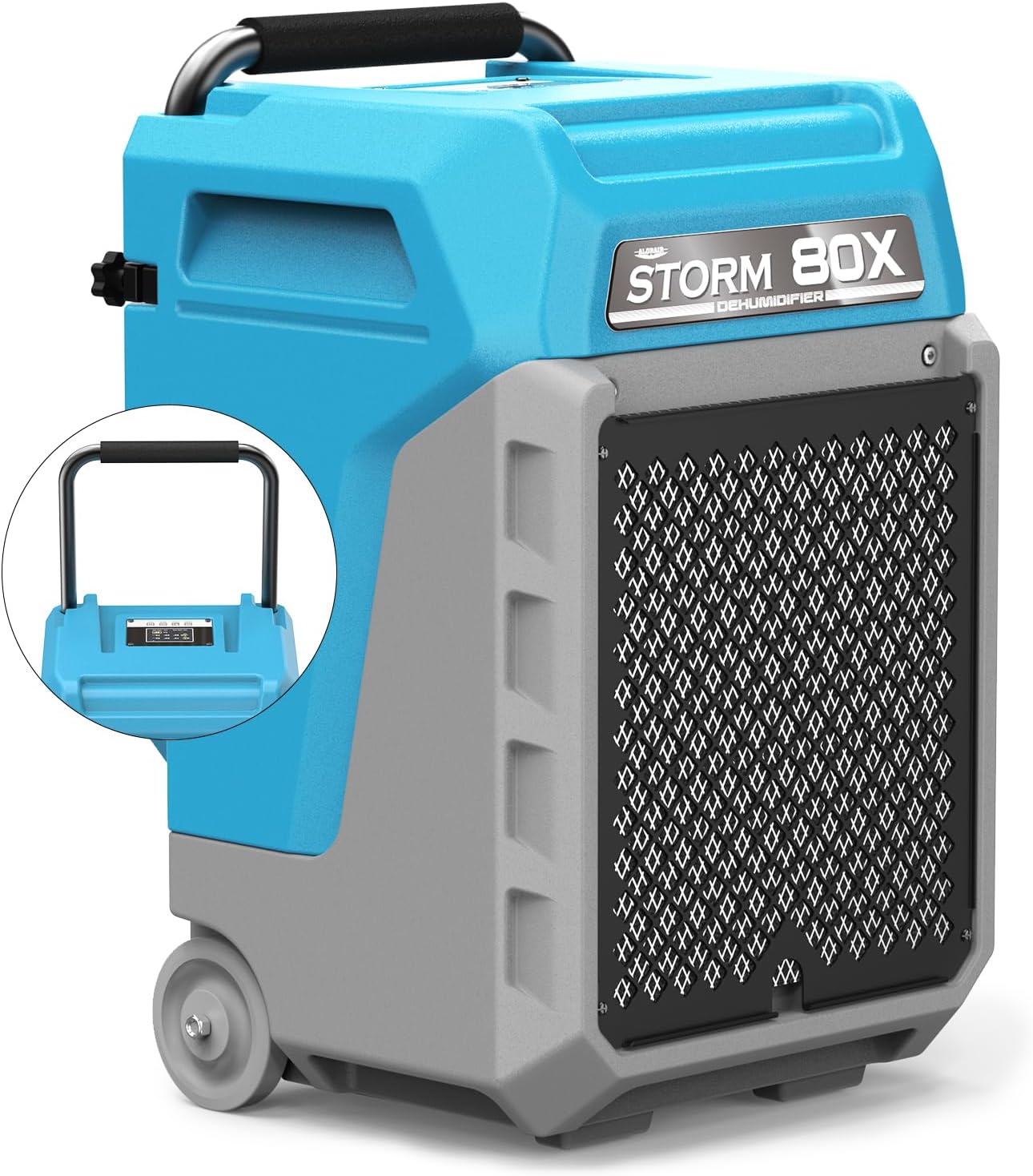
- Removes up to 170 pints daily under saturation conditions
- Covers basement and restoration spaces up to 2,100 square feet
- Built-in condensate pump supports automatic continuous water drainage
- Large wheels and retractable handle simplify movement between work areas
- Automatic defrost and restart functions support low-supervision operation

This has the drying capacity we actually want in a difficult basement
The ALORAIR Storm 80X earns our number one position for Best Commercial Dehumidifier For Basement because it is built for considerably tougher moisture conditions than a normal residential unit. It removes up to 170 pints of moisture per day under saturation conditions, with an AHAM-rated capacity of 80 pints per day at 80°F and 60% relative humidity.
That distinction between saturation and AHAM ratings matters. The 170-pint figure represents very hot and humid test conditions, while the 80 PPD AHAM figure gives a more useful reference for comparing performance under standardized conditions.
ALORAIR rates the Storm 80X for spaces up to 2,100 square feet. That puts it into useful territory for large basements, renovation areas, garages, water-damage restoration work, carpet drying, storage areas, and other spaces where moisture loads can exceed what a small portable home dehumidifier handles comfortably.
The airflow is another important number. The unit moves roughly 200 CFM, helping it process humid basement air continuously rather than only drying the small pocket of air immediately surrounding the machine.
Air movement matters in a large basement because moisture is rarely distributed evenly. One corner may be close to a foundation wall, another may contain stored materials, and another may have recently experienced a leak.
A common mistake is buying a dehumidifier based only on floor area. Actual moisture load matters too, including groundwater intrusion, damp concrete, air leakage, temperature, recent flooding, and how open the basement layout is.
A 1,500-square-foot dry finished basement does not create the same workload as a 1,500-square-foot basement after a plumbing failure. The Storm 80X makes particular sense when there is a genuine high-moisture problem rather than occasional mild humidity.
The built-in pump is the feature that makes continuous basement drying practical
The Storm 80X includes an integrated condensate pump rather than relying on a small water bucket. The pump automatically removes collected condensate, which is a major advantage when the machine needs to operate for long periods.
ALORAIR pairs the pump with a drain hose approximately 19.6 feet long. The system is designed to pump water vertically up to roughly 19.6 feet as well, giving considerably more installation flexibility than gravity drainage alone.
This becomes useful in a basement with no convenient floor drain beside the machine. The hose can potentially route toward an appropriate drain point rather than forcing somebody to walk downstairs repeatedly to empty a reservoir.
Imagine drying a basement after a water leak over a weekend. A bucket-based dehumidifier can stop once the tank fills, which means several hours of potential drying time disappear if nobody is there to empty it.
Automatic drainage supports genuinely continuous operation. Once the drain arrangement is correct, the machine can focus on controlling humidity rather than waiting for human attention.
The drainage setup still needs to be done properly. Avoid crushing or sharply bending the hose, and make sure the discharge location can safely accept the amount of condensate being pumped.
Check the hose periodically too. A pump does not help much if the line has been accidentally moved, blocked, or disconnected during renovation work.
The Storm 80X also includes automatic humidity control. Set the desired humidity level and the machine can cycle according to conditions rather than simply running continuously regardless of need.
For a basement used for long-term storage, automatic humidity control reduces unnecessary operation once the target level has been reached. It also helps prevent the space from drifting back toward persistently high relative humidity without someone constantly checking a hygrometer.
A practical basement target is often around 50 percent relative humidity, although the appropriate setting depends on conditions and the building. The important part is controlling persistent excessive moisture rather than chasing the lowest possible number.
Setting a dehumidifier extremely low does not automatically make the basement better. It can increase operating time and energy consumption without providing a useful additional benefit.
The automatic defrost system is particularly relevant in cooler basements. When the evaporator becomes cold enough for frost to develop, the machine can enter a defrost cycle rather than allowing ice to continue building on the coil.
Auto defrost helps maintain airflow and efficiency. During defrost, moisture extraction may temporarily decrease while the system clears the coil, then normal dehumidification resumes.
This is important because a frozen evaporator cannot exchange heat and remove moisture efficiently. Repeated heavy icing can turn a powerful dehumidifier into a machine that moves air without doing much useful drying.
The Storm 80X also includes memory restart and automatic recovery after a power interruption. That is useful in basements where the machine may be left operating for extended periods.
If power briefly fails overnight, you do not necessarily want to discover the next morning that the dehumidifier remained off for eight hours. Automatic restart reduces the supervision required during restoration jobs and longer drying cycles.
Why the Storm 80X deserves our number one ranking
Portability is unusually important for a commercial basement dehumidifier. The Storm 80X weighs around 63.9 pounds, so ALORAIR equips it with two substantial wheels and a retractable handle.
That makes it much easier to move across a basement or restoration site than carrying a box-shaped industrial unit by hand. The wheels matter once the machine weighs over 60 pounds, especially when equipment needs to move between rooms.
The housing is rotomolded polyethylene rather than a thin decorative residential shell. This construction is designed to tolerate bumps and demanding job-site conditions while protecting the components inside.
That makes sense for restoration work. Equipment may be loaded into vehicles, moved across unfinished concrete, rolled around tools, and repositioned several times during a drying project.
The Storm 80X measures roughly 15.2 inches deep, 14.4 inches wide, and 24.8 inches high. The relatively narrow footprint helps it fit into utility areas and unfinished basement spaces without consuming an enormous section of floor.
Compact dimensions help when drying around stored items, shelving, renovation equipment, furnaces, and other basement infrastructure. You still need to leave adequate clearance around the air intake and exhaust.
Do not push a commercial dehumidifier tightly against a wall because there happens to be an empty corner there. Restricting airflow reduces how effectively the machine can process humid air.
Placement should encourage circulation through the problem area. In a large open basement, a reasonably central location can work well, while more divided spaces may benefit from additional air movers to distribute dry air.
Air movers can be particularly useful after water damage. The dehumidifier removes moisture from the air while fans increase evaporation from damp building materials, allowing that moisture to become available for extraction.
Drying materials and drying air are connected. Simply lowering room humidity does not mean soaked carpet padding, timber, drywall, or concrete has already reached an acceptable moisture level.
For serious restoration work, use an appropriate moisture meter on affected materials. A room can feel dry while moisture remains trapped inside construction materials.
The Storm 80X includes a MERV-1 filter intended to catch larger airborne debris before it reaches internal components. This is particularly useful on construction and restoration sites where dust levels can be much higher than in a finished living room.
The filter needs maintenance. A clogged filter reduces airflow, and reduced airflow directly affects drying performance.
Check the filter during demanding drying jobs, especially around sanding dust, drywall debris, renovation work, or dirty unfinished basements. Do not wait until airflow feels obviously weak.
Power consumption is around 607 watts, with operation at 115 volts and roughly 5.3 amps according to current specifications. That means the Storm 80X can operate from common North American electrical service while delivering commercial-grade moisture removal.
Still, avoid overloading an existing circuit with several high-draw restoration devices. A basement drying setup may include the dehumidifier, air movers, pumps, lights, and power tools simultaneously.
Check what else is connected to the circuit. Commercial drying equipment needs sensible electrical planning, particularly during renovation or emergency restoration work.
The unit's rated COP is around 2.4 L/kWh. Efficiency matters because commercial dehumidifiers may run for many hours or several consecutive days during a difficult drying project.
The objective is not merely extracting a lot of water. It is extracting that water efficiently enough that continuous operation remains practical.
ALORAIR also includes a display for monitoring operating information. The Storm 80X can show GPP information, which is particularly useful in professional restoration work where technicians want more than a simple relative-humidity percentage.
GPP refers to grains of moisture per pound of dry air. GPP helps restoration professionals track actual moisture content in the air and compare drying conditions more meaningfully across temperature changes.
A homeowner does not necessarily need to work from GPP calculations. Relative humidity and material moisture measurements will usually be more intuitive for ordinary basement management.
For restoration professionals, though, having more detailed moisture information available directly at the equipment can be useful when tracking drying progress.
The Storm 80X also uses plug-and-play controls. You connect the unit, power it on, select the desired humidity, and let the automatic controls manage normal cycling.
This matters because powerful equipment does not need to be complicated. Commercial capacity with simple controls is a good combination when the machine may be used by contractors, property managers, or homeowners dealing with an unexpected water problem.
The unit is particularly strong for basement flooding recovery. After standing water has been safely removed, a high-capacity LGR dehumidifier can become part of the structural drying process.
Do not expect the dehumidifier itself to remove pools of standing water. Pumps, wet vacuums, or professional extraction equipment should deal with bulk water first.
Once that water is removed, the dehumidifier handles moisture evaporating from the remaining damp materials and air. Starting dehumidification after extraction improves the drying process rather than making the machine fight against water that should have been physically removed first.
Keep basement doors and windows managed during operation too. Running a dehumidifier beside an open window on a humid summer day can continuously introduce new moisture from outside.
In most situations, close the basement to uncontrolled humid outdoor air while drying. This allows the machine to work progressively on the moisture already inside the space.
Watch the relative humidity over time instead of expecting an immediate transformation. A wet basement can contain substantial moisture inside concrete, timber, carpet, furniture, and drywall.
Initial humidity reduction is only part of drying. Moisture continues migrating out of damp materials after the surrounding air becomes drier.
This is one reason commercial capacity matters. The Storm 80X can continue removing that released moisture instead of quickly becoming overwhelmed by the ongoing load.
The 170 PPD headline capacity also needs to be interpreted correctly. That maximum is measured under saturation conditions around 90°F and 90 percent RH.
Under AHAM conditions of 80°F and 60 percent RH, the rating is 80 PPD. The AHAM figure is the more conservative comparison number for typical dehumidifier evaluation.
This is not a weakness. Manufacturers commonly publish different extraction figures based on testing conditions, and knowing the difference helps avoid unrealistic expectations.
A cooler basement at moderate humidity will produce less condensate per day than a hot saturated restoration environment. The machine can still be doing its job correctly.
The built-in pump remains one of the biggest reasons we rank this model first. Gravity drainage can be limiting in basements because the available drain may sit above or far away from the ideal dehumidifier location.
Pumped drainage gives much more placement freedom. You can position the machine where airflow and moisture conditions make sense rather than wherever gravity happens to allow.
The wheels add another layer of flexibility. If one section of the basement needs more attention, repositioning a 63.9-pound machine becomes realistic.
The retractable handle also reduces the storage footprint when it is not being moved. These details matter on professional equipment that gets transported regularly.
The rotomolded housing is similarly practical. A residential dehumidifier may look cleaner in a finished room, but a commercial restoration unit needs to survive harder handling.
The Storm 80X is built for demanding environments, including construction sites, garages, water-damage restoration, carpet drying, and large basement applications.
Noise is one tradeoff to understand. Commercial airflow and compressor capacity are not designed primarily around bedroom-level quiet operation.
If your basement is directly underneath a quiet living area, expect more operational presence than a small residential unit. During serious moisture removal, we consider that an acceptable compromise.
Size and weight are also greater than a typical household dehumidifier. You are buying restoration-oriented capacity, pump hardware, stronger construction, and larger airflow components.
The purchase price will generally reflect that too. This is overkill for a mildly humid small basement where a basic residential dehumidifier already maintains the desired relative humidity without running continuously.
But this ranking is specifically for the Best Commercial Dehumidifier For Basement. In that context, excess capability is more useful than recommending a small appliance that struggles when actual water damage occurs.
Commercial users also benefit from the unit's six-year limited warranty listed by ALORAIR for the current Storm 80X. Warranty terms should always be checked at the time of purchase because coverage can vary by component and sales channel.
That longer support period is reassuring on equipment intended for demanding workloads. A commercial dehumidifier is not something most buyers expect to replace every season.
Maintenance will still determine long-term performance. Keep the filter clean, inspect drainage, maintain airflow clearance, and follow the manufacturer's storage and cleaning instructions.
If the machine has been used during dirty water-damage restoration, clean it appropriately before storing or moving it into another environment. Restoration equipment can collect dust and contamination during job-site use.
Do not ignore persistent basement moisture sources either. A dehumidifier controls airborne moisture, but it does not repair foundation cracks, failed waterproofing, plumbing leaks, roof drainage problems, or groundwater intrusion.
Fix active water entry whenever possible. Dehumidification works best after the moisture source is addressed, rather than becoming a permanent substitute for necessary building repairs.
For routine basement humidity, set a sensible target and let the automatic humidistat handle normal operation. For water-damage restoration, monitor conditions more actively and track material moisture until the drying target has actually been reached.
That distinction matters. Maintaining a basement and restoring a wet structure are two different workloads even if the same machine can handle both.
We believe the Storm 80X deserves rank number one because the important specifications line up unusually well for basement use. It combines serious extraction capacity, strong airflow, pumped drainage, mobility, automatic defrost, humidity control, restart memory, durable construction, and a relatively compact commercial footprint.
The built-in pump is especially important downstairs, while the wheels and retractable handle solve the problem of moving a commercial unit that weighs more than 60 pounds.
There are more powerful industrial dehumidifiers available, but greater capacity also brings additional size, power consumption, cost, and handling requirements. The Storm 80X sits in a useful middle range for basements and restoration work up to around 2,100 square feet.
We therefore give the ALORAIR Storm 80X our number one rank out of seven. Its 170 PPD saturation capacity, 80 PPD AHAM rating, roughly 200 CFM airflow, 2,100-square-foot coverage, built-in condensate pump, 19.6-foot drain hose and lift capability, automatic humidity control, automatic defrost, memory restart, MERV-1 filter, rotomolded housing, wheels, retractable handle, and commercial restoration focus make it a very complete basement drying machine.
For someone searching for the Best Commercial Dehumidifier For Basement, the Storm 80X deserves first place because it handles both ongoing high basement humidity and much tougher water-damage drying situations without giving up practical features such as automatic drainage and portability. It is larger, louder, and more expensive than a basic residential dehumidifier, but when the job involves serious moisture rather than occasional dampness, those commercial capabilities are exactly why we rank it first.

- Removes up to 125 pints of moisture daily at saturation
- Built-in pump provides up to 19.6 feet vertical drainage
- Covers basement and crawl spaces up to 1,300 square feet
- Automatic defrost and memory restart support unattended continuous operation
- Pump and gravity drainage provide flexible permanent installation options
The XP125 gets the basement basics right, especially the drainage
The CADPXS Remois XP125 earns our number two position for Best Commercial Dehumidifier For Basement because it combines serious moisture removal with a compact commercial design. It can remove up to 125 pints of moisture per day under saturation conditions, while the more standardized ratings are 60 pints per day at AHAM conditions and 37 pints per day under DOE conditions.
Those different numbers are worth understanding. The 125-pint figure is measured under very humid conditions, while the AHAM figure of 60 PPD at 80°F and 60% relative humidity is more useful when comparing what commercial dehumidifiers can do under less extreme conditions.
CADPXS rates the XP125 for areas up to 1,300 square feet. That makes it a sensible size for basements, crawl spaces, storage rooms, garages, utility spaces, and restoration jobs where a small residential dehumidifier may spend most of the day running.
The unit itself measures roughly 18.7 by 12.5 by 13.4 inches and weighs around 49.1 pounds. That compact commercial form is genuinely useful in a basement where furnaces, shelving, pipes, stored boxes, and other equipment already compete for floor space.
Do not judge a basement dehumidifier only by square footage, though. A 1,000-square-foot finished basement sitting around 60% humidity creates a very different workload from the same basement after a plumbing leak.
Concrete walls, damp floors, groundwater seepage, poor drainage outside the building, air leakage, and wet building materials all increase the moisture load. Commercial capacity becomes more valuable when the problem is persistent rather than occasional.
The built-in pump solves one of the most annoying basement problems
The XP125 includes two drainage methods, which is one of its strongest features. You can use conventional gravity drainage or the integrated automatic condensate pump when the water needs to travel somewhere gravity cannot easily reach.
The pump supports up to approximately 19.6 feet of vertical lift and comes with a 19.6-foot pump drain hose. That gives you much more freedom when deciding where the dehumidifier should actually sit.
This matters because the best location for moisture removal is not always directly beside a floor drain. Maybe the dampest area is across the basement, or the only suitable discharge point is higher than the dehumidifier itself.
With a gravity-only machine, drainage can dictate placement. Pumped drainage lets airflow and moisture conditions influence placement instead, which is a much better way to approach a difficult basement.
Imagine leaving the machine running overnight after several days of heavy rain. A bucket-style dehumidifier may fill during the night and shut down until somebody notices it the following morning.
The XP125 can continue moving condensate through its drain system. That is a significant advantage when you need humidity control to continue without someone walking downstairs every few hours.
Gravity drainage is still useful when a suitable floor drain is available below the outlet. It is simpler mechanically and may be the preferred permanent arrangement in a basement where the machine will remain in one location.
Having both drainage methods gives you options. Use the pump where vertical lift is required, or gravity when the installation naturally allows it.
The hose still needs to be routed properly. Avoid sharp bends, crushing the line behind storage boxes, or placing the discharge end somewhere that can send water back toward the foundation.
Check the drainage periodically as part of normal maintenance. Automatic drainage reduces supervision, but it should not mean completely forgetting that the hose exists.
The XP125 also has automatic defrost. This becomes important because basements and crawl spaces can operate at temperatures where frost begins developing on the evaporator coil.
Automatic defrost helps protect normal airflow by allowing the machine to deal with ice accumulation before it becomes a larger performance problem. Once the defrost process finishes, ordinary moisture removal can continue.
A heavily iced coil cannot remove moisture efficiently. If a dehumidifier repeatedly freezes without an effective defrost system, actual drying performance can drop dramatically.
Memory restart is another useful basement feature. After a power interruption, the machine can resume its previous operation instead of remaining inactive until somebody manually turns it back on.
That matters during storms, which are also exactly when basement moisture problems can become worse. Automatic restart reduces the need for constant checking when the unit is installed somewhere you do not visit every hour.
The XP125 also includes GPP functionality for more detailed moisture monitoring. GPP refers to grains of moisture per pound of dry air and can be particularly useful in restoration work.
Relative humidity alone changes with temperature, so restoration professionals sometimes want a more direct measure of moisture content in the air. For an ordinary homeowner, RH remains easier to understand, but the additional information gives the XP125 more commercial relevance.
Why the Remois XP125 earns our number two ranking
The 1,300-square-foot coverage makes this a strong middle-sized commercial machine. It is powerful enough for demanding basement moisture control without becoming unnecessarily large for a typical residential foundation.
The compact dimensions are particularly useful in crawl spaces. A low-profile machine is easier to position when ceiling height, ductwork, plumbing, and access openings are limited.
CADPXS also includes adjustable leveling feet. That may sound minor, but dehumidifiers work best when they sit correctly rather than rocking on an uneven basement or crawl-space surface.
Ergonomic handles help when the machine needs to be repositioned. At roughly 49 pounds, it is still substantial equipment, but it is manageable compared with much larger restoration machines.
The XP125 also supports optional hanging hardware. That can be useful in crawl spaces where keeping equipment off the ground improves access or protects it from occasional surface moisture.
Installation flexibility is a major strength here. Floor placement, optional hanging, gravity drainage, and pumped drainage let the same machine adapt to several different basement configurations.
An optional remote controller is supported as well. This is particularly useful if the dehumidifier is installed in a crawl space or another location that is annoying to access regularly.
Instead of crawling into a tight space just to check settings, remote control can make routine monitoring much more practical. For a normal open basement, that accessory may be less important.
The XP125 uses a washable MERV-1 filter to catch larger particles before they reach the internal components. In unfinished basements and restoration environments, that filter can collect considerably more debris than it would in a finished living room.
Filter maintenance directly affects dehumidifier performance. When the filter becomes clogged, airflow drops, and reduced airflow means less humid air reaches the evaporator.
Check it more frequently during renovation work. Drywall dust, sawdust, concrete dust, pet hair, and general basement debris can accumulate surprisingly quickly.
A common mistake is assuming that because the compressor is running, the machine must be performing normally. Restricted airflow can leave the unit operating while actual moisture extraction becomes less effective.
The XP125 is also designed around maintaining a useful basement humidity range rather than making the air as dry as physically possible. A target around 45% to 55% relative humidity is practical for many basement situations.
Lower humidity is not automatically better. Setting the humidistat excessively low can increase compressor runtime and electricity consumption without creating a meaningful benefit.
Start around 50% RH and monitor the basement. If there is still a musty smell or condensation, investigate both the humidity setting and the underlying moisture source.
Do not use a commercial dehumidifier as a permanent substitute for repairing water entry. Foundation cracks, leaking plumbing, poor exterior grading, failed gutters, and groundwater intrusion should be addressed where possible.
The dehumidifier manages moisture already entering the air. It does not repair the building.
Fixing the moisture source reduces the workload and allows the XP125 to maintain conditions instead of continuously fighting a new supply of water.
For water damage, remove standing water first. A dehumidifier is not the correct tool for extracting several centimetres of water from the basement floor.
Use appropriate pumping or extraction equipment for bulk water, then begin structural drying. Once the obvious water is removed, the dehumidifier can handle moisture evaporating from damp concrete, framing, carpets, and other materials.
Air movers can help during this stage too. They increase evaporation from wet surfaces while the XP125 removes that released moisture from the surrounding air.
Air movement and dehumidification work together during restoration. One encourages moisture to leave materials while the other removes it from the environment.
Do not rely only on how the basement feels. Concrete and timber can remain damp internally after the air itself becomes noticeably drier.
For serious restoration, use an appropriate moisture meter to track affected building materials. The job is finished when the materials reach an appropriate moisture level, not simply when the musty smell disappears.
The 125-pint saturation rating also deserves another mention because it is easy to misread commercial dehumidifier specifications. Saturation testing is performed under much wetter conditions than a normal conditioned basement.
The 60 PPD AHAM rating is more conservative and gives a more realistic standardized comparison point. At cooler temperatures and lower humidity, daily water collection will naturally be lower again.
That does not mean the machine has stopped working correctly. The amount of water available for extraction changes dramatically with temperature and relative humidity.
This is one reason simply comparing headline pint numbers can be misleading. Look at test conditions, airflow, drainage, coverage, operating temperature, and installation requirements together.
The XP125's compact dimensions also make ducting and positioning easier than with some large wheeled restoration machines. You can install it in a utility area without blocking a major section of the room.
Leave enough clearance around the intake and exhaust. Commercial airflow needs an unobstructed path through the machine.
Do not surround the dehumidifier with cardboard boxes just because it happens to fit between them. Restricting either side of the airflow path reduces performance.
Basement doors and windows should generally remain closed when outdoor air is humid. Otherwise the dehumidifier may spend much of its capacity removing moisture continuously entering from outside.
This is especially important during humid summer weather. Opening basement windows can sometimes increase moisture rather than reduce it.
Control the air entering the basement while the dehumidifier is trying to establish a stable humidity level.
The five-year limited warranty is another positive feature of the current Amazon listing. Commercial equipment can accumulate far more runtime than a small residential dehumidifier, so warranty coverage has real value.
Check the exact warranty terms and registration requirements after purchase. Coverage periods can differ between components, and keeping purchase documentation is sensible for commercial equipment.
Why does the XP125 rank second rather than first? The biggest reason is that our first-place ALORAIR Storm 80X offers more maximum extraction capacity and a more restoration-oriented portable package for particularly demanding basement jobs.
The ALORAIR reaches 170 PPD under saturation conditions compared with the CADPXS rating of 125 PPD. That additional capacity gives our winner more headroom when dealing with large moisture loads or active restoration projects.
The Storm 80X also uses large wheels and a retractable transport handle, which make frequent movement around restoration sites easier. The XP125 is compact and has carrying handles, but it is more naturally suited to semi-permanent basement or crawl-space installation.
That difference does not make the CADPXS less useful for normal basement humidity management. In fact, its compact rectangular design may be preferable when the machine will stay installed in one location for months.
The built-in pump also keeps it very competitive. For many homeowners, pumped drainage is more valuable than another few dozen pints of theoretical saturation capacity.
Continuous drainage is what makes unattended use practical. A commercial basement dehumidifier that constantly needs its tank emptied misses one of the main advantages of installing commercial equipment.
The XP125 does not rely on a collection bucket for normal operation. Route the drain correctly, set the humidity level, maintain the filter, and the system can operate with relatively little intervention.
That is exactly what we want for long-term basement humidity control. The machine should become part of the building environment rather than another appliance that needs attention twice per day.
For crawl spaces, the optional remote controller and hanging kit increase that usefulness further. These are spaces where crawling inside every time you want to check a setting gets old very quickly.
The XP125 is designed with permanent installation in mind, and that is one of the clearest reasons it earns such a high position in our list.
It also weighs less than some large restoration-oriented machines. At around 49.1 pounds, moving it occasionally is realistic without turning the process into a two-person equipment job.
Still, use proper lifting technique. Commercial dehumidifiers contain compressors and substantial internal hardware, so compact does not mean lightweight.
Store the unit clean and dry if it will not be used for an extended period. Drain remaining water, allow the machine to dry, clean the filter, and store the hoses properly.
Good storage prevents avoidable maintenance problems when the dehumidifier is needed again several months later.
For permanent basement installation, check the filter and drain system on a regular schedule instead. A machine that operates quietly in the background is easy to forget.
Look at the actual humidity reading periodically too. If the unit suddenly runs much longer than usual, that can indicate a dirty filter, blocked drain, seasonal humidity change, or a new source of moisture in the basement.
A sudden increase in runtime can be useful information. Do not automatically assume the dehumidifier itself has become less efficient.
Humidity changes can reveal building problems, particularly after heavy rainfall or plumbing changes. Treat the dehumidifier as part of moisture management rather than the only moisture-management tool.
We give the CADPXS Remois XP125 our number two rank out of seven because its 125 PPD saturation capacity, 60 PPD AHAM rating, 37 PPD DOE rating, 1,300-square-foot coverage, built-in condensate pump, 19.6-foot vertical pump capability, gravity drainage option, automatic defrost, memory restart, GPP functionality, washable MERV-1 filter, compact 49.1-pound design, adjustable feet, optional remote controller, and five-year limited warranty create an unusually complete basement dehumidification package.
For someone searching for the Best Commercial Dehumidifier For Basement, the Remois XP125 is a strong second-place choice because it combines commercial moisture removal with the drainage and installation flexibility needed for long-term basement or crawl-space use. It finishes behind our first-place ALORAIR mainly because the Storm 80X offers greater maximum extraction capacity and easier wheeled mobility, but the XP125 remains an excellent option when compact installation, automatic pumped drainage, reliable humidity control, and low-supervision operation matter most.

- Removes up to 70 pints of moisture daily under saturation conditions
- Built-in condensate pump supports drainage up to 19.6 feet vertically
- Covers basement and commercial spaces up to 1,000 square feet
- Automatic defrost and memory restart support low-supervision continuous operation
- Strong 180 CFM airflow helps circulate damp basement air efficiently
This is smaller than our top two, but the basement setup is very practical
The ALORAIR Sentinel Pro 35X earns our number three position for Best Commercial Dehumidifier For Basement because it combines commercial-grade moisture control with a relatively compact footprint. It removes up to 70 pints of moisture per day under saturation conditions and is rated around 35 pints per day under AHAM conditions.
That difference between 70 PPD and 35 PPD is important. Maximum extraction numbers are measured in much wetter conditions, while the AHAM figure gives a more realistic standardized reference when comparing dehumidifiers for normal basement use.
ALORAIR rates the Sentinel Pro 35X for spaces up to 1,000 square feet. That makes it a good fit for medium-sized basements, storage rooms, garages, utility spaces, workshops, and commercial areas where persistent humidity is more than a small residential appliance should be handling.
The unit moves roughly 180 CFM of air. Strong airflow matters in a damp basement because the machine needs humid room air to actually pass across its evaporator rather than repeatedly processing the same small pocket around the cabinet.
This becomes especially noticeable in an open basement. Humidity near a concrete foundation wall may be quite different from the reading beside a furnace or staircase, so circulating a decent volume of air helps conditions become more consistent.
Do not select a commercial dehumidifier based on floor area alone. Water intrusion, concrete moisture, outdoor humidity, basement temperature, ventilation, recent leaks, and the amount of wet material present can dramatically change the actual drying load.
A dry 900-square-foot finished basement at 55 percent relative humidity is one job. The same basement after a washing-machine hose fails is something completely different.
The Sentinel Pro 35X is best for persistent moisture control and moderate commercial drying rather than the most severe flood restoration. That distinction is one reason it sits below the two more powerful machines in our ranking.
The built-in pump is what makes it particularly useful downstairs
The Sentinel Pro 35X includes an integrated condensate pump and a drain hose measuring approximately 19.6 feet. The pump can move collected water upward by roughly the same 19.6-foot distance, which gives you considerably more freedom when deciding where the machine should sit.
Pumped drainage is extremely useful in basements because the best dehumidifier location may not be directly beside a convenient floor drain. The discharge point might be across the room or above the machine.
With gravity drainage only, the hose needs a continuous downward route. That can force you to put the dehumidifier somewhere that is convenient for drainage but poor for airflow.
The pump changes that. Position the unit where the humidity problem and airflow justify it, then route condensate toward an appropriate drain.
Think about a basement storage room where the dampest wall is 15 feet from the nearest drain. A gravity-only unit may need to sit at the opposite end of the room, while the Sentinel Pro 35X can use its pump to move condensate farther.
Continuous drainage also removes bucket maintenance. A dehumidifier that shuts down every time a reservoir fills is not particularly useful if nobody checks the basement for twelve hours.
This is especially relevant during wet summer weather. A commercial unit can collect surprising amounts of condensate when the basement starts out humid.
The drainage hose still needs to be installed carefully. Avoid tight bends, crushed sections, and discharge locations where water could eventually return toward the foundation.
Check the hose every so often as well. Automatic drainage is designed to reduce supervision, not eliminate basic inspection completely.
The Sentinel Pro 35X also provides automatic humidity control. Set the target relative humidity and the machine can regulate operation around that setting rather than simply running continuously.
A target around 45 to 55 percent RH is sensible for many basements, although the correct setting depends on the building and conditions. Starting around 50 percent gives you a practical baseline.
There is normally little reason to force a basement toward extremely low humidity. A very aggressive setting can increase compressor runtime and electricity consumption without solving anything that 50 percent RH would not already address.
The automatic defrost function is useful in cooler spaces. As the evaporator gets cold, frost can begin accumulating on the coil under certain temperature and humidity conditions.
Automatic defrost protects normal moisture removal by allowing the machine to clear frost before ice restricts airflow across the evaporator. Normal dehumidification then resumes.
This matters in basements because temperatures can be substantially lower than the living areas upstairs. A dehumidifier that performs well only in warm conditions can struggle once the basement gets cooler.
The unit also includes memory restart functionality. If electricity briefly goes out, the dehumidifier can resume operation rather than requiring someone to walk downstairs and manually restore every setting.
That is more useful than it sounds. Power interruptions often happen during severe weather, which can also be exactly when basement moisture becomes a bigger problem.
Automatic recovery reduces unnecessary supervision when the machine is expected to maintain basement humidity for weeks or months.
Why the Sentinel Pro 35X earns third place rather than first
The Sentinel Pro 35X has a high-efficiency design with a COP rating around 2.47 L/kWh. Efficiency matters because a basement dehumidifier may run for many hours each day while initially bringing humidity under control.
A commercial machine should not simply remove moisture quickly. It also needs to remove water efficiently enough that long-term operation remains reasonable.
The approximately 180 CFM airflow is strong for a unit in this capacity range. That gives it enough circulation for medium basement spaces without requiring the much larger blower systems found in heavy restoration equipment.
Physical size is another advantage. The cabinet measures roughly 12.9 inches deep, 14.14 inches wide, and 24.55 inches high.
That narrow footprint is convenient around basement shelving, mechanical equipment, storage boxes, and utility areas. Compact commercial equipment is easier to position correctly than a huge wheeled restoration machine when the unit will remain installed for months.
Do not squeeze it tightly between stored items, though. Both the intake and exhaust require enough open space for proper airflow.
A common mistake is finding an empty corner, pushing the dehumidifier against two walls, and assuming that because the machine fits there, the placement must be good. It is not if airflow becomes restricted.
For an open basement, place it where air can circulate reasonably freely. If the basement contains several closed rooms, consider additional air circulation or another strategy for moving humid air toward the dehumidifier.
Air movers can improve drying after water damage. They increase evaporation from damp carpet, framing, or concrete while the dehumidifier removes the released moisture from the air.
This matters because a low room humidity reading does not automatically mean every building material is dry. Concrete, wood, drywall, and insulation can retain moisture long after the air starts feeling comfortable.
For serious water-damage restoration, use an appropriate moisture meter. Track affected materials rather than deciding the job is finished solely because the basement no longer smells damp.
The Sentinel Pro 35X also uses a MERV-1 filter to catch larger particles before they reach the internal components. This is useful in unfinished basements where dust, pet hair, and renovation debris are common.
A dirty filter directly reduces airflow, and that can reduce moisture extraction. Inspect it regularly instead of waiting until the dehumidifier seems weaker.
This matters even more during construction. Drywall sanding or cutting wood in the same basement can load a filter much faster than normal household use.
Filter maintenance is one of those boring details that directly affects performance. A clean commercial dehumidifier operating at proper airflow will generally do more useful drying than a larger neglected machine with a blocked intake.
The six-year limited warranty is another positive point. For equipment expected to accumulate substantial runtime, longer warranty coverage gives some added reassurance.
Warranty terms can vary by component, so keep the purchase information and follow any product registration requirements. Commercial equipment deserves proper maintenance records if it will be used regularly.
The Sentinel Pro 35X is also portable enough for movement between basement areas. It is not the tiny appliance someone casually carries around with one hand, but its vertical compact design makes relocation manageable.
This can be useful during renovation. Start the machine close to the dampest work area, then reposition it as conditions improve.
For permanent basement humidity control, movement matters less. In that situation, the narrow footprint and pumped drainage become more valuable than wheels.
The pump gives this model installation flexibility that many compact dehumidifiers lack. That is one of the strongest reasons it ranks third instead of farther down the list.
The Sentinel Pro 35X is also appropriate for garages, warehouses, storage areas, workshops, bathrooms, and similar moisture-prone spaces. But basement use is where its combination of pump drainage and compact dimensions makes particularly good sense.
Basements often have humidity problems caused by more than indoor activities. Soil moisture, groundwater, foundation walls, exterior drainage, and temperature differences all contribute.
A dehumidifier controls the moisture that reaches the air. It does not repair the source of water entry.
Fix active water problems before relying on dehumidification. Repair plumbing leaks, improve exterior drainage, investigate foundation cracks, and deal with standing water first.
If there is standing water after flooding, remove the bulk water using suitable extraction equipment. Asking a dehumidifier to deal with litres of water sitting openly on the floor is inefficient.
The better sequence is extraction first, then evaporation and dehumidification. Once standing water is removed, the Sentinel Pro 35X can begin dealing with moisture leaving damp surfaces and materials.
Keep basement windows closed during humid outdoor conditions as well. Opening windows on a muggy summer day can continuously introduce new moisture while the dehumidifier is trying to reduce indoor humidity.
Control incoming humid air during operation so the machine is not constantly processing a fresh outdoor moisture load.
The 70 PPD headline figure also needs realistic interpretation. That capacity represents saturation conditions rather than the amount of water every owner should expect to see collected each day.
At approximately 80°F and 60 percent relative humidity, the AHAM capacity is around 35 pints daily. In an even cooler or drier basement, actual extraction may be lower.
That does not indicate a malfunction. There is simply less moisture available in the air for the machine to condense.
Compare dehumidifiers using matching test conditions. Looking at one company's saturation rating beside another company's AHAM rating can create a very misleading comparison.
The Sentinel Pro 35X also operates with approximately 180 CFM airflow, which helps explain why it remains useful even with the lower standardized pint figure. Extraction capacity and airflow need to work together.
Where it loses ground to our first-place ALORAIR Storm 80X is raw drying capacity. The Storm 80X can handle substantially larger moisture loads and covers a much larger area.
The Storm 80X is also designed more directly around demanding restoration work. Its larger wheels and transport handle make frequent movement across job sites easier.
Our second-place CADPXS also offers more capacity headroom for larger damp spaces. That leaves the Sentinel Pro 35X in a sensible third position.
This model is less about maximum extraction and more about fitting commercial dehumidification into a manageable basement installation. That can actually be the better choice when the basement is around 1,000 square feet and does not need oversized restoration equipment.
Buying too much dehumidifier has downsides too. Larger machines cost more, take more space, can create more noise, and may consume more power.
A properly sized unit running under automatic humidity control is often a better permanent solution than buying the largest restoration machine available.
The Sentinel Pro 35X hits a useful middle point. It is clearly more serious than a lightweight household dehumidifier but still compact enough for ordinary basement ownership.
The vertical housing also makes the control panel easier to reach than some very low crawl-space models. You do not need to crouch close to the floor every time you want to check a setting.
For a crawl space, a lower horizontal machine may fit better. For an open basement, the taller cabinet is not much of a disadvantage.
Noise should still be considered. A 180 CFM commercial dehumidifier will be more noticeable than a tiny bedroom appliance.
If the basement sits directly beneath a bedroom or recording room, placement can affect how much compressor and fan noise reaches occupied areas. Commercial performance usually means more audible operation.
During genuine moisture problems, we consider that a fair trade. Drying the structure correctly matters more than making the machine nearly silent.
For long-term operation, check humidity with a separate hygrometer occasionally. Comparing an independent reading with the dehumidifier's sensor helps you understand how evenly the basement is drying.
Place the independent hygrometer away from the direct exhaust stream. Air leaving a dehumidifier can be warmer and drier than the average room conditions.
A reading directly beside the outlet may therefore look excellent while a distant basement corner remains humid. Measure the room rather than only the machine.
The built-in pump should also be tested after installation. Confirm that water reaches the intended drain without leaking at connections.
If the machine will remain unattended for long stretches, inspect the drainage system periodically. A simple hose problem can undermine an otherwise excellent automatic setup.
We rank the Sentinel Pro 35X third because the two machines above it offer higher capacity for more difficult basement conditions. Its 1,000-square-foot coverage also limits how appropriate it is for very large foundations.
But those limitations are mostly about scale. The actual feature combination is extremely strong for a medium-sized basement.
You get commercial airflow, a built-in pump, long drain reach, automatic defrost, humidity control, restart memory, filtration, efficient operation, compact dimensions, and long warranty coverage in one package.
We give the ALORAIR Sentinel Pro 35X our number three rank out of seven because its 70 PPD saturation capacity, approximately 35 PPD AHAM capacity, 1,000-square-foot coverage, 180 CFM airflow, 2.47 L/kWh COP, integrated condensate pump, 19.6-foot drainage capability, automatic defrost, adjustable humidity control, memory restart, MERV-1 filtration, and six-year limited warranty create a very complete medium-capacity commercial basement dehumidifier.
For someone searching for the Best Commercial Dehumidifier For Basement, the Sentinel Pro 35X is a strong third-place choice when the space is around 1,000 square feet and reliable automatic drainage matters more than having the highest extraction capacity available. It ranks below our first two because they provide more drying headroom for severe moisture loads, but the compact size, strong airflow, built-in pump, automatic controls, and practical long-term installation make the Sentinel Pro 35X an excellent option for serious basement humidity control.

- Removes up to 70 pints daily under saturation conditions
- Covers basement and crawl spaces up to 1,000 square feet
- Continuous gravity drainage eliminates frequent manual water emptying
- Automatic defrost supports reliable operation in cooler basement conditions
- Compact 37.8 pound housing makes positioning and relocation easier
This is the simpler ALORAIR option, and that actually suits permanent basement use
The ALORAIR Sentinel HS35 earns our number four position for Best Commercial Dehumidifier For Basement because it strips the setup back to the things many basement owners actually need. You get 70 pints per day at saturation, 35 pints per day under AHAM conditions, 115 CFM airflow, and coverage rated for spaces up to 1,000 square feet.
Those two moisture removal numbers need to be understood correctly. The 70 PPD figure is measured in very humid saturation conditions, while the 35 PPD AHAM rating reflects testing at 80°F and 60 percent relative humidity.
For a normal basement, the AHAM number is usually the more useful comparison figure. A cooler basement running around 50 or 55 percent RH will naturally produce less collected water than a hot, saturated restoration environment.
The HS35 is also relatively compact at about 15.35 by 11.2 by 11.4 inches. That small commercial footprint is useful when the basement already contains shelving, storage bins, HVAC equipment, plumbing, or a water heater.
It weighs about 37.8 pounds, which is substantial but still manageable. There is an integrated carrying handle, so moving it from one side of the basement to another is realistic without needing the large wheels found on heavier restoration units.
This is where the HS35 feels different from our first three choices. It is less about emergency water damage restoration and more about dependable ongoing humidity control in a basement that tends to stay damp.
The gravity drain is simple, but you need to plan the location properly
The Sentinel HS35 uses continuous gravity drainage and includes a 6.5 foot drain hose. There is no condensate pump built into this model, so the hose needs a suitable downward path toward a floor drain or other approved drainage point.
That is the biggest practical difference between this model and more expensive commercial basement dehumidifiers. A pump lets you move water upward, while gravity drainage depends entirely on elevation.
In the right basement, that is not a problem at all. If there is a floor drain nearby, gravity drainage is mechanically simple and removes the need to empty a water tank manually.
Imagine a utility basement where the dehumidifier sits a few feet from an existing drain. Connect the hose, maintain a downward slope, and the condensate can drain continuously without a pump running in the background.
The mistake is placing the unit first and thinking about drainage afterward. If the hose has to rise over a pipe or climb toward the drain, water can collect in the line and prevent proper drainage.
Keep the hose free from sharp bends and avoid crushing it behind storage boxes. A commercial dehumidifier can be working perfectly while a badly routed drain line creates an entirely separate problem.
The manual humidity control is refreshingly straightforward. The rotary control allows the target humidity to be adjusted between roughly 30 and 70 percent RH.
For most basements, starting around 50 percent relative humidity is a sensible approach. Then watch the room over several days rather than immediately selecting the driest possible setting.
If condensation remains on pipes or windows, or there is still a persistent damp smell, check the humidity reading and look for active water intrusion. A dehumidifier should not be expected to compensate indefinitely for a leaking foundation or plumbing problem.
The HS35 shuts down when the selected humidity level has been reached and resumes when conditions require more drying. This prevents the compressor from running continuously when the room is already within the desired range.
Automatic restart is also included. If the basement loses power briefly, the unit can resume normal operation afterward rather than remaining off until someone notices.
That matters because storms and heavy rainfall can cause both power interruptions and increased basement moisture at the same time. A machine intended for low-supervision use should recover without needing constant attention.
Why it ranks fourth even though the design is very practical
Automatic defrost is one of the most important features for basement use. The HS35 can operate down to about 33°F, and when frost develops internally, the unit can pause compressor operation while keeping the fan active until the ice clears.
Automatic defrost protects moisture removal performance because a frozen evaporator cannot process humid air properly. Once the defrost cycle finishes, the dehumidifier returns to normal operation.
This is useful in unfinished basements and crawl spaces where temperatures can drop well below the main living areas. A machine designed only for warm rooms may spend too much time fighting frost.
Airflow is rated at 115 CFM. That is enough for the 1,000 square foot class the HS35 is designed around, but it is much lower than the larger commercial machines ranked above it.
The first place Storm 80X has considerably more extraction capacity and airflow for major water damage. Our second place CADPXS model also provides more drying headroom and pumped drainage.
The third place ALORAIR Sentinel Pro 35X is closer in capacity, but its vertical commercial design and built in pump give it more installation flexibility. The HS35 loses points mainly because gravity drainage limits placement.
That limitation becomes obvious in a basement where the only suitable drain is higher than the machine. You cannot simply route the hose upward and expect gravity to solve it.
For that situation, one of the pump-equipped models above it is the better choice. But if a floor drain already exists at the correct level, paying extra for a pump may not provide much real benefit.
The MERV 1 filter is another practical part of the HS35. It helps keep larger dust and debris from accumulating on the internal heat exchange components.
Filter maintenance is important for airflow. A dirty filter can reduce how much humid air moves through the machine, which directly affects moisture removal.
This matters particularly in unfinished basements. Sawdust, concrete dust, pet hair, insulation particles, and ordinary storage debris can build up much faster than they would in a finished bedroom.
Check the filter more frequently during renovation work. If the airflow suddenly seems weaker, a clogged filter is one of the first things worth inspecting.
The HS35 operates at around 50 dBA according to the current specifications. That is fairly restrained for commercial-style basement equipment, although it will still be audible in a quiet room.
If the basement sits directly beneath a bedroom, placement matters. Try positioning the unit away from lightweight walls or floor structures that easily transmit vibration.
The unit uses 115 volt, 60 Hz power and draws about 2.9 amps. That makes it easy to integrate into a normal basement electrical setup without requiring specialized high-voltage service.
Still, use a properly grounded outlet and follow the manufacturer's electrical instructions. Avoid placing electrical equipment where standing water can reach it.
If the basement has flooded, remove standing water first. A dehumidifier is designed to remove moisture from air and drying materials, not operate while sitting in pooled water.
After bulk water is extracted, air movers can be useful alongside the HS35. The fans encourage moisture to evaporate from wet concrete, carpet, or framing, while the dehumidifier removes that moisture from the surrounding air.
Air drying and dehumidification work together during water damage recovery. A lower humidity reading does not automatically mean timber, drywall, or concrete has fully dried internally.
For serious restoration work, use a moisture meter on affected building materials. That gives a much better indication of whether the drying job is actually complete.
The adjustable humidity range also means the HS35 works well as a permanent basement maintenance unit after an initial drying problem has been corrected. Set the desired level and allow the humidistat to cycle the machine as conditions change.
Do not chase extremely low humidity. Running constantly at a 30 percent setting can create unnecessary energy use when a basement around 45 to 55 percent RH is already under good control.
Reasonable humidity control is the real goal, not creating the driest room possible. The ideal setting is the one that controls dampness and condensation without making the machine run continuously for no reason.
ALORAIR also gives the HS35 a six year limited warranty, with the current warranty information stating full coverage during the first two years. That is reassuring for a machine intended to spend long periods operating in a basement.
The ETL certification adds another practical point for buyers looking at permanent installation. This is equipment designed around normal residential and commercial electrical use rather than an improvised moisture-control appliance.
So why rank four? The answer is mostly capability and drainage flexibility.
The HS35 simply cannot match the moisture removal headroom of our first and second choices. It also lacks the pumped drainage that makes our top three models easier to position in difficult basements.
For a 1,000 square foot basement with a floor drain, though, those disadvantages shrink considerably. The HS35 gives you 35 PPD AHAM performance, continuous gravity drainage, automatic defrost, automatic restart, adjustable humidity control, MERV 1 filtration, modest 50 dBA operation, and a compact housing that is easy to fit around existing basement equipment.
We give the ALORAIR Sentinel HS35 our number four rank out of seven because it focuses on reliable long-term basement humidity control rather than maximum restoration capacity. It is less powerful and less flexible than the pump-equipped machines above it, but its simple gravity drain, compact size, straightforward controls, low-temperature operation, and six year limited warranty make it a very strong option when the basement already has an appropriately positioned drain.
For someone searching for the Best Commercial Dehumidifier For Basement, the Sentinel HS35 is a positive fourth place choice for medium-sized spaces where persistent humidity is the main problem. It does not have the heavy-duty pump system or extraction capacity of our top selections, but for an installation where simple continuous drainage works, this is an efficient and practical commercial-style basement dehumidifier.

- Removes up to 189 pints of moisture daily in extreme humidity
- Built-in condensate pump provides up to 16 feet vertical drainage
- Covers large basement and commercial spaces up to 7,500 square feet
- Eight-inch wheels and integrated handle simplify heavy equipment movement
- Automatic defrost and two fan speeds support varied basement conditions
There is a lot of drying capacity here, maybe more than many basements actually need
The COSTWAY ES10637US-BK earns our number five position for Best Commercial Dehumidifier For Basement because this is a genuinely large industrial machine. It can remove up to 189 pints of moisture per day at 95°F and 90% relative humidity, with a more realistic rating of 68 pints per day at 80°F and 60% RH.
That difference is important when comparing commercial dehumidifiers. The 189-pint figure represents very wet test conditions, while the 68-pint figure gives a better idea of what the machine can extract in the sort of warm, humid environment a basement might actually experience.
COSTWAY rates the machine for spaces up to 7,500 square feet. That is far larger than many residential basements, so there is considerable capacity available for warehouses, garages, workshops, job sites, storage rooms, and restoration work as well.
The airflow is rated around 264 CFM. Moving enough humid air through the machine matters because moisture removal depends on getting damp room air across the refrigeration coil rather than simply drying the few feet surrounding the cabinet.
This is especially useful in an open basement where concrete walls, storage areas, utility equipment, and different ventilation conditions can create uneven humidity. A stronger blower helps mix that air while moisture is removed.
There is a catch. Bigger is not automatically better for every basement.
A finished 1,000-square-foot basement sitting at 58% humidity does not need the same machine as a warehouse or a basement after a major plumbing leak. Buying far more capacity than necessary means accepting a larger cabinet, more weight, higher power consumption, and more operating noise.
The ES10637US-BK makes the most sense for serious moisture loads. Think persistent dampness, large foundations, restoration work, commercial basements, or spaces where smaller residential units repeatedly struggle to reach the target humidity.
The built-in pump is probably the feature basement owners will appreciate most
The ES10637US-BK includes an integrated condensate pump for continuous drainage. It can move collected water vertically by up to 16 feet, which is much more useful in a basement than relying entirely on gravity.
That means the dehumidifier does not have to sit directly beside a low floor drain. Pumped drainage gives you far more placement freedom, especially when the moisture problem is on the opposite side of the basement from the available drain.
COSTWAY includes a 3.3-foot drain hose. The pump system is designed to handle a considerably longer drainage path and vertical lift, although you should always follow the supplied installation instructions when extending or routing drainage.
Picture a basement where the machine is working beside a damp foundation wall but the available drain is across the room. A gravity-only setup might force you to relocate the dehumidifier somewhere less useful.
With the pump, the machine can stay where airflow and moisture conditions make sense. Water can then be moved toward the appropriate discharge point.
Continuous drainage also prevents tank-related shutdowns. There is little value in running a high-capacity commercial dehumidifier overnight if it stops after a collection bucket becomes full.
The drainage hose still needs attention. Check that it is securely attached, not kinked, and not positioned where somebody can crush it with stored boxes or renovation materials.
A pump solves elevation problems, but it does not solve a blocked hose. Inspect the drainage arrangement periodically even when the system appears to be operating automatically.
The machine offers an adjustable humidity range from 30% to 80% RH. For normal basement moisture control, starting around 50% RH is usually much more sensible than immediately choosing the lowest possible setting.
A lower setting does not automatically mean better drying. If the basement is already stable around 45% to 50%, forcing the machine toward 30% can increase compressor runtime without solving an additional moisture problem.
The unit includes two fan speeds as well. This lets you choose airflow based on conditions instead of operating at one fixed speed all the time.
Higher airflow can be useful during initial drying or after a leak when moisture is widespread. A lower setting may make more sense once conditions stabilize and the dehumidifier is maintaining the space.
Automatic defrost is another important basement feature. The ES10637US-BK is rated for operating temperatures from approximately 41°F to 95°F, and cooler basement air can eventually produce frost on the evaporator.
Automatic defrost prevents heavy coil icing from restricting airflow and reducing moisture extraction. The machine temporarily manages the frost and then returns to normal dehumidification.
If a dehumidifier does not deal with icing correctly, the fan can keep running while actual water removal falls sharply. That is exactly the kind of problem you do not want from equipment being left unattended downstairs.
Its size and industrial nature are why we stopped at rank five
The ES10637US-BK weighs approximately 68 pounds and measures about 21.5 inches long, 16.5 inches wide, and 34 inches high. This is substantial equipment, not something you casually pick up and carry between rooms.
COSTWAY solves much of that problem with large eight-inch anti-slip wheels and an integrated handle. The large wheels make a 68-pound machine manageable, especially across unfinished basement floors and commercial work areas.
That mobility can be useful after water damage. Start the unit near the worst affected area, then reposition it as sections of the basement dry.
The supporting feet help keep the machine stable after it reaches the desired location. That is worth having on equipment containing a compressor and moving hundreds of cubic feet of air every minute.
The metal and copper construction also feels much more industrial than a normal plastic home dehumidifier. It is designed for basements, warehouses, factories, garages, and similar environments where equipment can experience harder treatment.
The tradeoff is that this machine needs real floor space. A compact crawl-space dehumidifier can disappear under ductwork or beside a utility wall, while this COSTWAY stands roughly 34 inches high.
That makes it less suitable for extremely cramped installations. Measure the intended location before buying, including enough clearance for intake and exhaust airflow.
Do not squeeze it against a wall simply because the cabinet technically fits. Commercial airflow needs room to enter and leave the unit.
The manufacturer recommends maintaining clear space around the machine. A blocked inlet can reduce airflow, which then reduces dehumidification performance even while the compressor continues running.
The removable washable mesh filter helps protect the internal components from larger dust and debris. Filter cleaning matters in unfinished basements where concrete dust, pet hair, insulation, sawdust, and renovation debris may be common.
Check it more frequently during construction or restoration. A filter that looks fine during normal household use can clog surprisingly quickly when drywall sanding is happening nearby.
The machine consumes around 650 watts and operates from 110V, 60Hz power. That is reasonable for the amount of moisture removal available, but it is still worth considering electrical load when several restoration devices are operating simultaneously.
A wet basement may have this dehumidifier running beside several air movers, a water pump, lighting, and power tools. Make sure the electrical circuit is appropriate for the combined load.
Commercial drying equipment should be treated like commercial equipment. Use a properly grounded outlet and avoid extension arrangements that are not rated for the appliance.
The humidity display on the control panel makes it easier to see current conditions. You can also see the selected fan speed and adjust the target humidity directly from the machine.
That simplicity is useful when several people may operate the equipment. A contractor or property manager should not need to navigate a complicated menu simply to change the humidity target.
There is also an automatic defrost function rather than requiring manual intervention whenever operating conditions become colder. Again, useful when the machine is expected to run for long stretches.
The 7,500-square-foot coverage figure deserves some caution. Coverage ratings should never replace actual moisture assessment.
A dry warehouse and a flooded basement of the same size require completely different drying capacity. Ceiling height, air leakage, temperature, wet materials, standing water, and external moisture sources all influence what the dehumidifier must handle.
For serious water damage, remove standing water first. A commercial dehumidifier is not a substitute for pumping or extracting pooled water from the basement floor.
Once bulk water is gone, air movers can help release moisture trapped in materials. The COSTWAY then removes that evaporated moisture from the air.
Air movers and dehumidifiers perform different jobs. Fans encourage evaporation while the dehumidifier lowers the moisture content of the surrounding air.
This process can continue for days when concrete, timber, insulation, drywall, or carpet has become wet. Do not decide that the job is finished simply because the room feels less humid.
A moisture meter is useful during serious restoration work. Building materials can retain moisture internally long after the room air begins feeling comfortable.
The 189 PPD specification also needs context. At 86°F and 80% RH, COSTWAY rates extraction around 127 pints daily.
At 80°F and 60% RH, capacity drops to approximately 68 pints. Water extraction changes dramatically with temperature and humidity, so seeing less than 189 pints in your basement does not mean the machine is underperforming.
In fact, collection should normally decrease as the basement becomes drier. That is exactly what you want to see.
The built-in pump remains the strongest argument for this unit. Basement drains are frequently inconvenient, and a 16-foot vertical pumping capability removes one of the biggest installation restrictions.
For someone managing an unfinished commercial basement, that can be more useful than having a prettier cabinet or smartphone app. Set the machine near the actual moisture problem and send the condensate where it needs to go.
The pump makes unattended operation much more realistic. That is essential when commercial equipment may be working overnight or across an entire weekend.
Humidity control should still be monitored independently occasionally. Place a separate hygrometer in another part of the basement to see whether conditions are consistent across the whole space.
Do not put that sensor directly beside the dehumidifier exhaust. Air leaving the machine is warmer and drier, so the reading will not represent average room conditions.
For larger basements with separate rooms, keep interior doors open when practical or use additional air circulation. The dehumidifier cannot remove moisture efficiently from air that never reaches it.
Good air circulation improves whole-basement humidity control. This is where the 264 CFM airflow becomes particularly useful.
The machine is also suitable for garages and workshops where doors open periodically and humidity loads change quickly. Warehouses and job sites are another logical use case because the high saturation capacity provides much more headroom than a household appliance.
So why only rank five if the raw numbers are so strong? Because capacity is only one part of choosing the Best Commercial Dehumidifier For Basement.
Our higher-ranked models provide more refined basement-focused designs, smaller installation footprints, stronger long-term support propositions, or a better balance between extraction capacity and permanent residential installation. The COSTWAY is physically larger and feels more like movable industrial equipment.
Its 68-pound weight is a meaningful compromise, even with those large wheels. Going down stairs, crossing thresholds, and transporting the machine between properties requires more effort than moving a compact crawl-space unit.
The product also requires some assembly out of the box, which is another small difference from more self-contained basement dehumidifiers. This is not a huge problem, but it reinforces the industrial nature of the unit.
The 3.3-foot included hose is fairly short compared with the size of the spaces the machine is designed to serve. The pump is capable of much greater drainage distance and lift, but the supplied hose may not suit every basement without planning.
That is worth checking before installation day. Have the correct drainage arrangement ready rather than discovering that the intended drain is fifteen feet away after the machine is already downstairs.
Placement planning matters with a machine this large. Think about power, drainage, airflow, access, and future maintenance before choosing the final position.
The 41°F minimum operating temperature is another practical limitation. It handles ordinary cool basements, but extremely cold unconditioned spaces can fall outside the rated operating range.
If a basement regularly reaches near-freezing temperatures, solve the temperature issue or choose equipment specifically designed for those conditions. Refrigerant dehumidifiers naturally lose effectiveness as temperature falls.
The washable filter should be cleaned on a routine schedule. The drain system should be inspected, wheels checked, and air intake kept clear.
Commercial capacity does not eliminate maintenance. A clean machine will maintain better airflow and usually deliver more consistent long-term drying performance.
There is another important point for homeowners. A dehumidifier should not become the permanent answer to an active building leak.
Repair failed plumbing, foundation cracks, gutter problems, exterior grading, and groundwater intrusion where possible. Otherwise the machine may spend years continuously removing moisture that could have been prevented from entering in the first place.
Fix the source and then control the remaining humidity. That produces a much more effective basement moisture strategy.
For long-term maintenance after repairs, adjust the humidistat to a sensible level and monitor how frequently the compressor runs. If runtime suddenly increases after months of stable operation, investigate why.
A dirty filter may be responsible. So could a drainage problem, seasonal weather change, plumbing leak, or new source of water entering the foundation.
The dehumidifier can therefore become an informal warning system. If the basement was stable and suddenly requires constant drying, something in the environment probably changed.
The ES10637US-BK has excellent raw drying performance, and that is why it still earns a respectable fifth place rather than falling near the bottom of our list.
We give the COSTWAY ES10637US-BK our number five rank out of seven because its 189 PPD saturation capacity, 127 PPD performance at 86°F and 80% RH, 68 PPD performance at 80°F and 60% RH, 7,500-square-foot coverage rating, 264 CFM airflow, built-in pump, 16-foot vertical drainage capability, two fan speeds, automatic defrost, washable filter, eight-inch wheels, 650W power rating, and 30% to 80% adjustable humidistat create a very capable commercial drying machine.
For someone searching for the Best Commercial Dehumidifier For Basement, this COSTWAY is a positive fifth-place choice if the basement is large, genuinely wet, or used as part of a commercial or restoration environment. It ranks below our first four because the machine is bulky, heavy, and somewhat more industrial than many permanent basement installations require, but when high moisture removal, pumped drainage, strong airflow, and easy wheeled movement matter more than compact size, the ES10637US-BK has a lot to offer.

- Removes up to 158 pints of moisture daily in saturation conditions
- Covers basements and commercial spaces up to 4,500 square feet
- Continuous drain hose eliminates the need for manual tank emptying
- Automatic defrost and restart support extended low-supervision basement operation
- Remote monitoring and dual controls simplify hard-to-reach installations
The 158-pint capacity is strong, but this one makes more sense as a fixed basement machine
The SAHAUHY 158 PPD commercial dehumidifier earns our number six position for Best Commercial Dehumidifier For Basement because the basic drying hardware is actually quite capable. It is rated to remove up to 158 pints of moisture daily at 95°F and 90% relative humidity, with coverage advertised for spaces up to 4,500 square feet.
That 158-pint number needs context. It represents very humid saturation-style conditions, so an ordinary basement at a moderate temperature and 50% to 60% relative humidity should not be expected to produce 158 pints of condensate every day.
The large coverage rating gives the unit room to work in basements, crawl spaces, warehouses, storage areas, workshops, construction areas, and other commercial spaces. For a residential basement with persistent moisture, there is considerably more drying capability here than you get from a small portable household dehumidifier.
The adjustable humidistat can be set across a broad 10% to 90% relative humidity range. For normal basement humidity control, though, there is rarely a reason to chase the lowest possible setting.
Starting around 50% RH is much more practical. Watch the basement for condensation, damp smells, and moisture around foundation surfaces, then adjust only when there is a real reason.
A dehumidifier running constantly at an unnecessarily low target consumes more electricity and adds compressor runtime without automatically making the basement healthier. The objective is controlled moisture, not simply the lowest number the control panel allows.
The automatic drainage and remote controls are the useful parts downstairs
This SAHAUHY uses continuous drainage rather than depending on a collection tank that needs to be emptied repeatedly. That is important for commercial basement use because continuous drainage allows extended unattended operation.
Imagine leaving a damp basement overnight after several days of heavy rain. A small bucket-style machine can stop once the reservoir fills, and the basement may then spend hours without active dehumidification.
With a correctly installed drain hose, condensate can leave the unit continuously. The important word there is correctly, because this particular design relies on the drainage arrangement being appropriate for the installation.
Route the hose without sharp bends or crushed sections. If gravity is involved, maintain the required downward path and make sure the discharge point can safely accept the condensate.
Drainage should be checked before unattended use. A powerful dehumidifier with a badly routed hose is still a badly installed dehumidifier.
The remote monitoring feature is particularly interesting for crawl spaces and awkward basement installations. SAHAUHY also uses dual control panels, allowing operation directly at the unit or through the supported remote monitoring arrangement.
That can solve a surprisingly annoying problem. If the machine is positioned behind storage, underneath ducting, or inside a crawl space, you do not necessarily want to physically reach the control panel every time you check operating conditions.
The automatic humidistat handles much of the routine work anyway. Set the target moisture level and allow the machine to regulate its operation as basement conditions change.
Automatic restart is another useful basement feature. If power goes out temporarily, the unit is designed to resume operation rather than remaining inactive until somebody notices.
This matters during storms. Heavy weather can increase groundwater and foundation moisture while also causing brief power interruptions, so automatic recovery is useful rather than decorative.
Automatic defrost is included as well. When frost begins developing on the evaporator, the dehumidifier can manage that condition instead of allowing ice buildup to progressively reduce airflow and moisture extraction.
Cool basement air makes this particularly relevant. Refrigerant dehumidifiers need proper coil temperature management because a heavily iced evaporator cannot remove moisture effectively.
Defrost helps preserve useful airflow when operating conditions become cooler. Once the frost has been cleared, normal dehumidification can continue.
The reusable filter is another practical feature. It protects internal components from larger dust and debris while humid air passes through the machine.
This becomes important in unfinished basements. Concrete dust, pet hair, sawdust, insulation particles, and renovation debris can accumulate much faster than they would in a clean finished living room.
Inspect the filter periodically and clean it when necessary. Restricted airflow can make a functioning compressor look less effective simply because not enough humid air is reaching the coil.
Why good capacity still leaves this SAHAUHY in sixth place
The outer housing uses metal construction with two metal carrying handles. That gives the machine a more industrial character than the thin decorative shells used on many household dehumidifiers.
The compact commercial housing suits permanent installation in a basement or crawl space where the machine may remain in one location for months. There is no internal collection tank taking up additional cabinet volume.
The downside is mobility. Compared with large restoration units equipped with substantial wheels and telescoping handles, a compact carry-handle design is less convenient when the dehumidifier needs to move repeatedly around a job site.
This matters less in a permanent basement. Install it correctly once and the handles may only be needed for occasional maintenance.
For water-damage restoration, though, mobility becomes more important. Contractors may need to reposition drying equipment several times as different sections of a structure reach their moisture targets.
That is one reason it ranks below our top choices. The first-place ALORAIR Storm 80X combines high extraction capability with a built-in pump and a transport system designed more directly around restoration work.
Our second-place CADPXS also provides a built-in condensate pump, which gives it more freedom when the drain is above or far from the ideal machine location. Pumped drainage is a significant advantage in difficult basements.
The SAHAUHY relies more heavily on the installation itself being suitable for continuous drainage. If you already have an appropriately positioned floor drain, that may not matter much.
If the only discharge point requires water to travel upward, a pump-equipped machine is much easier to work with. Drainage flexibility matters in basement installations because the wettest location and the available drain are often nowhere near each other.
The 4,500-square-foot rating is also something to interpret carefully. Square footage alone does not tell you how difficult the drying job will be.
A mildly humid 2,000-square-foot basement can be easier to manage than a 900-square-foot basement containing wet concrete, soaked framing, and saturated carpet after a plumbing failure. Moisture load matters more than floor area by itself.
For water damage, remove standing water first. A commercial dehumidifier is designed to process moisture in air and drying materials, not replace a pump or wet vacuum for bulk water extraction.
Extraction should happen before structural drying. Once standing water is gone, air movers can increase evaporation from damp surfaces while the dehumidifier removes that moisture from the air.
This is where a high-capacity commercial machine becomes useful. As moisture leaves concrete, timber, carpet, and drywall, the dehumidifier keeps the surrounding air dry enough for the process to continue.
Do not decide that everything is dry because the room humidity dropped quickly. Building materials can retain moisture internally long after the air itself becomes comfortable.
For serious restoration work, use an appropriate moisture meter. Check the actual materials rather than relying only on the dehumidifier display.
Room humidity and material moisture are different measurements. Both matter when dealing with a basement after water damage.
Basement windows should generally remain closed when outdoor air is warm and humid. Opening them can continuously introduce additional water vapour while the dehumidifier is trying to lower indoor humidity.
That is a common mistake during summer. The outdoor air may feel fresh, but once it enters a cooler basement its relative humidity can rise considerably.
Keep doors between basement areas open when practical so humid air can reach the machine. If the basement is divided into several closed rooms, additional air circulation may be necessary.
Good circulation improves whole-basement drying. A powerful dehumidifier cannot effectively treat air trapped behind closed doors if very little of that air reaches the intake.
The automatic timer can also be useful, although we prefer humidity-controlled operation for routine basement maintenance. Humidity does not follow a simple clock, particularly during changing weather.
Use the humidistat as the primary control and let the machine respond to actual conditions. Timers make more sense when you have a specific operational reason for limiting runtime.
The broad 10% to 90% humidity adjustment range is technically flexible, but again, sensible settings matter. Most basement owners will operate in a much narrower part of that range.
Around 45% to 55% RH is a practical zone for many basements. Exact requirements depend on temperature, materials, storage conditions, and the building itself.
Check an independent hygrometer elsewhere in the basement occasionally. Do not place it directly beside the dehumidifier exhaust because the discharged air is warmer and drier than average room air.
A separate reading across the room tells you more about whether the entire basement is actually reaching the desired humidity. Large spaces can have surprisingly different readings from one corner to another.
The metal cabinet is a positive for durability. Equipment used around renovation work, storage boxes, tools, and unfinished concrete is likely to receive more bumps than an appliance sitting quietly in a bedroom.
Still, avoid placing the unit where water can drip directly onto electrical components. Commercial construction does not make electrical equipment waterproof.
Use a properly grounded electrical connection and follow the manufacturer's installation requirements. Do not operate the machine while it is sitting in standing water.
Another practical strength is the five-year warranty stated by SAHAUHY, along with lifetime technical support and a 30-day return policy on the manufacturer's current listing. Keep the purchase record and check the exact warranty conditions applying to your sales channel.
Warranty support matters on commercial dehumidification equipment because compressors and fans can accumulate a large number of operating hours. A machine maintaining a basement all summer may run far more than a typical household appliance.
Regular maintenance still matters even with warranty coverage. Keep the filter clean, inspect drainage, leave adequate airflow clearance, and monitor for unusual changes in sound or performance.
If water collection suddenly falls while basement humidity remains high, start with simple checks. Look at the filter, intake, exhaust, drainage hose, room temperature, and humidistat setting.
Do not assume the compressor has failed immediately. Reduced airflow or colder environmental conditions can significantly change how much condensate appears at the drain.
The 158 PPD rating itself changes with conditions. At lower humidity and temperature, there is simply less water available for the refrigeration system to condense.
Less collected water can mean the basement is drying. That is why daily condensate volume should always be interpreted alongside the actual relative humidity.
There is also the question of the moisture source. A commercial dehumidifier can manage humid air, but it cannot permanently solve a foundation leak.
Inspect gutters, exterior grading, plumbing, sump systems, foundation cracks, and other potential sources if the basement remains persistently wet. Fixing water entry reduces the workload on the dehumidifier and protects the structure more effectively.
A machine running constantly can sometimes be telling you something useful. If the basement used to remain stable and suddenly the dehumidifier cannot reach its target, investigate what changed.
Dehumidifier runtime can reveal a new moisture problem. Heavy rain, a plumbing leak, blocked drainage, or increased outdoor humidity may be responsible.
SAHAUHY also positions this model for warehouses, factories, storage areas, shops, offices, and construction sites. That broader commercial focus explains the metal housing and continuous drainage design.
For basement ownership, though, the key question is whether you need 158 PPD saturation capacity or something smaller. Oversizing is not always harmful, but it can mean paying for capacity that rarely gets used.
Our higher-ranked models generally provide a more refined balance between capacity, drainage flexibility, mobility, and established basement-oriented features. That is ultimately what keeps the SAHAUHY in sixth place.
The specification sheet is still genuinely competitive. A 158-pint saturation rating, 4,500-square-foot coverage claim, continuous drainage, automatic humidistat, automatic defrost, power-loss restart, reusable filtration, remote monitoring, dual controls, and metal housing make this much more than a basic home dehumidifier.
The biggest weakness is that the product does not appear to provide a clearly published distinctive model designation, and the drainage system is less flexible than the built-in pump designs ranked above it. Those are not deal-breakers, but they matter when comparing commercial equipment closely.
We give the SAHAUHY 158 PPD commercial dehumidifier our number six rank out of seven because it offers substantial moisture removal, coverage up to 4,500 square feet, continuous automatic drainage, adjustable humidity control from 10% to 90%, automatic defrost, memory restart, remote monitoring, dual control panels, reusable filtration, metal construction, carrying handles, and a five-year warranty.
For someone searching for the Best Commercial Dehumidifier For Basement, this SAHAUHY remains a positive sixth-place option when you want strong drying capacity in a compact machine that can stay installed near a suitable drain. It ranks below our first five because the stronger choices provide better pump drainage, mobility, refinement, or more clearly documented performance packages, but for a basement with straightforward continuous drainage and a serious humidity load, the SAHAUHY still has plenty of useful commercial capability.

- Removes up to 70 pints daily under saturation conditions
- Handles basement and crawl spaces up to 1,000 square feet
- Continuous gravity drainage avoids frequent manual water tank emptying
- Automatic defrost supports operation in colder basement environments
- Compact 37.8 pound design includes convenient carrying handle
This is a straightforward commercial unit for smaller basement moisture problems
The ALORAIR Sentinel HS35 earns our number seven position for Best Commercial Dehumidifier For Basement because it is a compact, straightforward machine that covers the fundamentals well, but it does not have the extraction capacity or drainage flexibility of the commercial units ranked above it. It removes up to 70 pints per day under saturation conditions and 35 pints per day at AHAM conditions.
ALORAIR rates the HS35 for spaces up to 1,000 square feet. That makes it more appropriate for small to medium basements, crawl spaces, garages, storage areas, and utility rooms than very large commercial foundations.
The difference between 70 PPD and 35 PPD matters. The larger number comes from very humid saturation conditions, while the 35 PPD AHAM rating at 80°F and 60% relative humidity is a more useful reference for normal comparison.
The AHAM figure gives better real-world context because most basements will not remain at extreme saturation conditions. As the room becomes cooler or drier, the amount of condensate collected each day will naturally decrease.
This is not necessarily a sign that the dehumidifier is losing performance. It often means there is simply less moisture available in the air to remove.
The HS35 moves around 115 CFM of air through its compact cabinet. For a 1,000-square-foot application, that gives it enough circulation to continuously process damp basement air without requiring the larger blowers used by restoration machines.
The gravity drain is simple and reliable, but placement matters a lot
The Sentinel HS35 uses continuous gravity drainage and includes a 6.5-foot drain hose. There is no collection bucket that needs to be emptied every few hours, which is exactly what we want from a long-term basement humidity control system.
The limitation is that there is no built-in condensate pump. Water needs to travel downward through the hose toward an appropriate drain.
If your basement already has a floor drain near the intended installation point, this can work extremely well. Gravity drainage is mechanically simple and does not require another pump component to move the collected water.
If the available drain is higher than the dehumidifier, things become more complicated. You cannot route a gravity hose upward and expect water to keep moving correctly.
This drainage limitation affects installation flexibility. Pump-equipped machines can be positioned based primarily on airflow and moisture conditions, while the HS35 needs a suitable relationship between the unit and drain.
Plan that before buying. Measure the distance to the drain and look at the actual elevation rather than assuming a hose can simply be run anywhere.
The included 6.5-foot hose should maintain a downward path without loops or sections where water can pool. Avoid crushing the hose behind storage bins or shelving.
A clogged or badly positioned drain line can undermine an otherwise functioning dehumidifier. Check it periodically, especially after moving objects around the basement.
The HS35 uses manually controlled knobs rather than a complicated touchscreen. The simple humidity control is easy to understand, which is useful when the machine will be used by homeowners, property managers, or several people in a commercial space.
The humidistat lets you select the desired moisture level and allows the dehumidifier to cycle accordingly. For many basements, starting around 50% relative humidity is sensible.
Do not immediately turn the control toward the driest possible setting. Lower humidity is not automatically better if the basement is already stable and free from condensation around 45% to 55% RH.
An unnecessarily low setting can increase compressor runtime and energy use. The objective is maintaining controlled conditions rather than forcing the basement toward extremely dry air.
Automatic defrost is particularly useful downstairs. Basement temperatures can be considerably lower than the rooms above them, and cold evaporator coils can develop frost under the right conditions.
The HS35 monitors this and can enter a defrost cycle when necessary. Clearing frost helps restore proper airflow across the coil before normal moisture extraction continues.
A frozen evaporator is a real performance problem. The compressor and fan may appear active while actual dehumidification falls because air cannot move correctly across an iced coil.
The HS35 is designed for low-temperature operation down to around 33°F. That gives it useful flexibility in cooler basements and crawl spaces where a typical living-room appliance may struggle.
Low-temperature capability matters in unfinished basements, particularly through cooler seasons when the space is not heated to normal indoor temperatures.
Automatic restart is another useful feature. After a temporary power interruption, the machine can return to operation rather than waiting indefinitely for somebody to discover that it has stopped.
This matters during storms because electrical interruptions and basement moisture can occur together. Heavy rainfall may increase groundwater or foundation dampness at exactly the time a brief outage occurs.
Why the Sentinel HS35 finishes seventh in our commercial basement ranking
The biggest reason is capacity. At 35 PPD under AHAM conditions, the HS35 is considerably less powerful than several of the commercial dehumidifiers ranked above it.
There is less drying headroom for major water damage. If a basement contains saturated building materials after flooding or a substantial plumbing failure, one of the larger restoration-focused models will process moisture more aggressively.
Our first-place ALORAIR Storm 80X, for example, offers substantially greater extraction capacity along with a built-in pump and wheeled portable design. That combination is better suited to serious restoration work.
The second-place CADPXS model also gives you a pump and more drying capacity. Pumped drainage becomes a major practical advantage when the basement drain is inconveniently positioned.
The HS35 is better viewed as a permanent humidity-control machine. Install it near an appropriate gravity drain, set the humidistat, maintain the filter, and allow it to manage a damp basement over the long term.
That narrower purpose is not necessarily a weakness. Plenty of homeowners do not need a 150-pint restoration machine sitting downstairs all year.
If your problem is a 700-square-foot basement that creeps above 60% RH every summer, a compact commercial unit can make more sense than oversized industrial equipment.
The HS35 measures approximately 15.35 by 11.2 by 11.4 inches and weighs about 37.8 pounds. Its small horizontal chassis can fit into utility areas where a tall wheeled machine would be awkward.
The integrated carrying handle makes occasional movement easier. At under 40 pounds, it is still substantial equipment, but it is much easier to reposition than some 60 to 70 pound commercial units.
The compact size works well for permanent installation. It can sit near a foundation wall, beneath shelving with sufficient clearance, or in a utility area without dominating the basement.
Airflow clearance still matters. Do not pack boxes directly against the intake or exhaust just because the cabinet itself fits into a narrow opening.
The dehumidifier needs access to humid room air. Restricting airflow reduces how much moisture can reach the evaporator and can make the machine appear less effective than it really is.
The MERV-1 filter helps protect the internal components from larger particles. That is useful in unfinished basements where dust, hair, insulation debris, and renovation material may be present.
A clean filter helps maintain rated airflow. Check it more often during construction or renovation because drywall and concrete dust can accumulate quickly.
Do not wait until the machine becomes obviously weak. Filter maintenance is simple and directly related to performance.
The unit draws about 331 watts according to current specifications. That is modest compared with larger commercial restoration equipment and makes more sense for long-term basement humidity maintenance.
Still, energy use depends heavily on runtime. A dehumidifier that runs continuously because the moisture source has never been addressed can consume far more electricity than one cycling normally around its target humidity.
This is why building maintenance matters. A dehumidifier should not replace fixing water intrusion.
Check foundation cracks, plumbing leaks, sump systems, exterior grading, gutters, and downspouts if the basement remains persistently wet. Reducing the amount of water entering the structure reduces the load on the dehumidifier.
During summer, be careful with basement windows too. Warm outdoor air can contain a substantial amount of moisture.
When that air enters a cooler basement, its relative humidity can rise. Opening windows on a muggy day can therefore make basement humidity worse rather than better.
Keep uncontrolled humid outdoor air outside while the dehumidifier is working to establish stable conditions.
If the basement has experienced flooding, remove standing water first. The HS35 is not a substitute for a water pump or extraction vacuum.
Once bulk water is gone, dehumidification becomes useful. Moisture remaining in concrete, framing, carpet, and other materials begins evaporating into the surrounding air.
Air movers can speed that process by increasing evaporation from damp surfaces. The dehumidifier then removes the released moisture from the air.
Air movement and dehumidification perform different jobs, and both can be important during structural drying.
For significant water damage, use a moisture meter rather than relying entirely on room relative humidity. A basement can reach 50% RH while timber or drywall remains wetter than it should be internally.
This is another reason we rank the HS35 lower for restoration work. The machine is capable, but its smaller extraction capacity means severe drying jobs may take longer or require additional equipment.
Noise is relatively controlled at around 50 dBA according to current product specifications. That is useful when the basement sits beneath occupied rooms.
It will still be audible. A compressor dehumidifier is not silent equipment, particularly when the fan and refrigeration system are running together.
Placement can help. Avoid positioning the unit directly beneath a bedroom if another suitable drainage location is available.
Keep it on a stable surface as well. Vibration against loose flooring or shelving can create more perceived noise than the dehumidifier itself.
The HS35 is cETL certified, which is another positive for equipment intended for long-term electrical use. It operates from standard 115V household power.
Use a properly grounded outlet and follow the manufacturer's installation instructions. Never place the machine where standing water can reach its electrical components.
Commercial labeling does not mean waterproof construction. Electrical safety still applies in a wet basement.
The six-year limited warranty is one of the strongest reasons to remain positive about this model despite its seventh-place ranking. ALORAIR positions the HS35 as equipment intended for extended ownership rather than a disposable seasonal appliance.
Keep the purchase documentation and check any registration requirements. Warranty coverage can vary across different components and periods.
The relatively simple design may also appeal to buyers who do not want app connectivity or complicated menus. A manual control knob, automatic humidistat, gravity drain, filter, and compressor cover the basic job.
Simple equipment can be easier to maintain. There are fewer user-facing features to configure before the dehumidifier begins doing useful work.
For a permanent installation, use a separate hygrometer somewhere away from the machine. This helps confirm whether humidity is actually controlled across the entire basement.
Do not place the hygrometer directly in the exhaust stream. Air leaving the dehumidifier will be warmer and drier than average room air.
If the far side of the basement remains humid, improve air circulation. Keep interior doors open where practical or use a fan to help move air between separated areas.
The dehumidifier can only process air that reaches it. This becomes increasingly important in divided basements with several closed rooms.
Watch how frequently the HS35 runs once the basement reaches the target humidity. Continuous operation after several weeks may indicate that the machine is undersized or that new moisture is continuously entering the space.
Investigate rather than simply lowering the humidistat further. The problem may be a leak, seasonal groundwater, blocked exterior drainage, or humid outdoor air entering through the building envelope.
The number seven ranking comes down to comparison. The HS35 has the smallest performance envelope among several of the commercial models in this list and lacks the built-in pump that makes our top choices much easier to install.
Its strengths are simplicity and compactness, not maximum drying power. That makes it more appealing for maintenance than emergency restoration.
For the right basement, those strengths are useful. A 1,000-square-foot coverage rating, 35 PPD AHAM extraction, continuous drainage, automatic defrost, memory restart, filtration, modest power draw, and a compact cabinet cover the requirements of many persistent humidity problems.
We give the ALORAIR Sentinel HS35 our number seven rank out of seven because its 70 PPD saturation capacity, 35 PPD AHAM capacity, coverage up to 1,000 square feet, 115 CFM airflow, continuous gravity drainage, included 6.5-foot hose, automatic defrost, low-temperature operation, memory restart, MERV-1 filtration, compact 37.8-pound body, cETL certification, and six-year limited warranty make it a capable small commercial basement dehumidifier.
For someone searching for the Best Commercial Dehumidifier For Basement, the Sentinel HS35 is a positive seventh-place choice when the basement is relatively modest in size and already has a conveniently positioned floor drain. It ranks below the larger machines because it lacks pumped drainage and higher restoration capacity, but for straightforward long-term humidity control, its compact size, simple operation, low-temperature performance, and continuous gravity drain still make it a sensible commercial-grade option.